
How Central Asia's Special Economic Zones Are Rewiring Global Supply Chains
As geopolitical tensions disrupt traditional maritime routes, Kazakhstan and Uzbekistan are leveraging Special Economic Zones to transform the 'Middle Corridor' into a resilient, high-speed artery connecting Asia and Europe.
By Factlen Editorial Team
- Central Asian Governments
- View the corridor and SEZs as a generational opportunity to transition from raw material exporters to value-added industrial hubs.
- Global Importers
- See the route as a vital, resilient alternative to congested maritime chokepoints and sanctioned overland routes.
- Logistics Analysts
- Argue that severe infrastructure bottlenecks and bureaucratic friction cap the corridor's true potential.
What's not represented
- · Environmental Groups
- · Local Communities near SEZs
Why this matters
For businesses and consumers, the Middle Corridor offers a faster, sanctions-free alternative to congested maritime routes and Russian overland transit. For Central Asia, it represents a generational chance to transform from a landlocked resource exporter into a vital, value-added hub for global manufacturing.
Key points
- The Middle Corridor is a 4,000-kilometer multimodal trade route linking China to Europe via Central Asia and the Caspian Sea.
- Geopolitical tensions and maritime chokepoint disruptions have driven a 63% surge in cargo volume along the route.
- Kazakhstan and Uzbekistan are using Special Economic Zones (SEZs) to build value-added manufacturing hubs along the corridor.
- The route offers a faster alternative to sea freight, cutting transit times from 45 days to roughly two to three weeks.
- Severe infrastructure bottlenecks and bureaucratic friction remain significant hurdles to the corridor's long-term scalability.
Global supply chains are undergoing a profound rewiring. With traditional maritime chokepoints in the Red Sea facing persistent security threats and the traditional Northern Corridor overland route complicated by sanctions on Russia, international logistics operators are actively seeking resilient alternatives.[2][5]
Enter the Middle Corridor, formally known as the Trans-Caspian International Transport Route (TITR). Stretching roughly 4,000 kilometers, this multimodal network links western China to Eastern Europe by threading through Central Asia, crossing the Caspian Sea, and traversing the South Caucasus before reaching the European Union.[6]
What began as a niche alternative has rapidly gained strategic weight. Cargo volumes moving across the Caspian Sea segment surged by more than 63 percent in a single year, reflecting a massive shift in how goods are routed between the world's manufacturing centers and European consumer markets.[6]
But the Middle Corridor is no longer just about moving boxes from point A to point B. For the nations situated along its path—particularly Kazakhstan and Uzbekistan—the route represents a generational opportunity to fundamentally transform their domestic economies and integrate into global value chains.[3][5]

Historically, Central Asian economies have relied heavily on the export of raw materials, particularly hydrocarbons and minerals. Now, governments are deploying a specific policy instrument to capture more of the supply chain's value: the Special Economic Zone (SEZ).[1][3]
An SEZ is a geographically delineated area where governments offer regulatory flexibility, generous tax exemptions, and streamlined customs procedures to attract foreign direct investment. By placing these zones directly along the Middle Corridor, Central Asian states are creating industrial hubs that do more than just transit goods.[1][4]
In Kazakhstan, the implementation of SEZs has become the foundation of the country's regional development strategy. The government has poured an estimated $19 billion into 16 different zones, aiming to transition the economy toward value-added production and technology-based growth.[4]
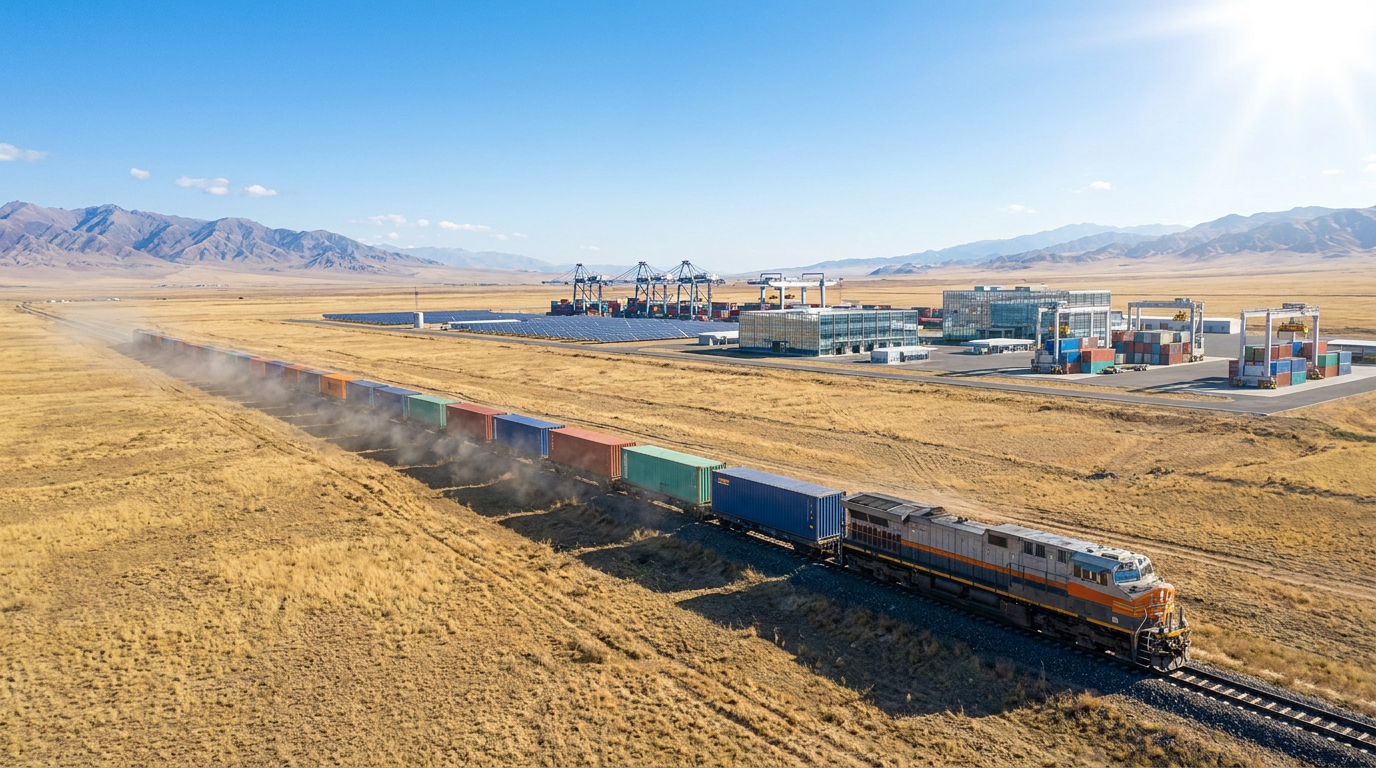
The Khorgos dry port, situated on the border between China and Kazakhstan, exemplifies this shift. Once a remote outpost, it has evolved into one of Eurasia's most critical logistics hubs, where Chinese goods are transferred to Kazakh rail networks and processed in adjacent industrial parks.[3]

The Khorgos dry port, situated on the border between China and Kazakhstan, exemplifies this shift.
Similarly, Uzbekistan is leveraging improved connectivity to expand its non-resource exports. By integrating with the corridor, Tashkent is positioning itself as an outward-looking economy, attracting joint ventures in textiles, agriculture processing, and renewable energy that can immediately access European and Asian markets.[1][3]
The appeal of the Middle Corridor for international shippers is primarily resilience and speed. While a sea voyage from China to Europe can take up to 45 days, overland transit via the Middle Corridor can deliver goods in roughly two to three weeks.[5]
This speed and reliability have attracted the attention of major global players. The European Union has designated the corridor as a flagship project under its Global Gateway strategy, viewing it as a critical artery for de-risking supply chains and securing access to Central Asia's critical minerals.[6]
Asian economies are equally invested. China and other East Asian manufacturing powerhouses view the corridor as a vital tool for supply chain diversification, ensuring that their exports can reach European markets even if maritime routes are compromised.[3]

However, the corridor's rapid expansion has exposed significant growing pains. Moving cargo across multiple sovereign borders and transitioning between rail and maritime transport at the Caspian Sea introduces complex logistical friction that can delay shipments.[3][6]
Infrastructure bottlenecks remain a severe constraint. While Kazakhstan has invested heavily in expanding its Aktau and Kuryk ports, the corridor's overall capacity is currently dwarfed by the traditional Northern route through Russia, handling only a fraction of the latter's historical volume.[3][6]
Furthermore, the route's efficiency is hampered by bureaucratic hurdles. Industry experts emphasize that physical infrastructure alone cannot guarantee success; the corridor requires deep institutional coordination, unified customs protocols, and digital integration to reduce the time lost at border crossings.[2][5]
The South Caucasus segment presents its own challenges. In Georgia, existing port capacity at Poti and Batumi is nearing exhaustion, and plans for a new deep-sea port at Anaklia have faced funding cuts and political delays, threatening to create a severe bottleneck at the edge of the Black Sea.[6]

Despite these obstacles, the momentum behind the Middle Corridor appears robust. The World Bank estimates that with continued infrastructure development and policy harmonization, freight transit times could fall by up to 50 percent, potentially tripling trade volumes by 2030.[2]
How we got here
2013
China announces the Belt and Road Initiative, sparking renewed interest in Eurasian overland routes.
2022
Sanctions on Russia following the invasion of Ukraine force logistics operators to seek alternatives to the Northern Corridor.
2024
Cargo volumes across the Caspian Sea segment of the Middle Corridor surge by 63%.
2026
Central Asian states accelerate the integration of Special Economic Zones to capture value-added manufacturing along the route.
Viewpoints in depth
Central Asian Governments
View the corridor as a generational opportunity to diversify their economies.
For nations like Kazakhstan and Uzbekistan, the Middle Corridor is not merely a transit route but an industrial catalyst. By pairing the corridor with Special Economic Zones, they aim to shed their historical reliance on raw material exports and build value-added manufacturing hubs that integrate directly into global supply chains.
European & Asian Importers
See the route as a vital, resilient alternative to congested maritime chokepoints.
Global logistics operators and major importing nations view the corridor as an essential de-risking tool. With the Red Sea facing persistent security threats and the Northern Corridor complicated by sanctions on Russia, the Middle Corridor offers a faster, sanctions-free overland alternative that ensures supply chain continuity.
Logistics Analysts
Argue that severe infrastructure bottlenecks cap the corridor's true potential.
Despite the rapid growth in cargo volumes, logistics experts caution that the corridor remains highly fragmented. Moving goods across multiple sovereign borders and transitioning between rail and maritime transport at the Caspian Sea introduces significant friction. Analysts point to limited port capacity in Georgia and the need for unified customs protocols as critical hurdles.
What we don't know
- Whether Georgia will secure the funding and political will to complete the critical Anaklia deep-sea port.
- How quickly the participating nations can harmonize their customs protocols to eliminate border delays.
- Whether the corridor can scale its capacity enough to truly rival traditional maritime shipping volumes.
Key terms
- Middle Corridor
- A trade route connecting Asia and Europe that bypasses Russia by crossing Central Asia and the Caspian Sea.
- Special Economic Zone (SEZ)
- A designated area within a country subject to unique economic regulations, such as tax exemptions, designed to attract foreign direct investment.
- Multimodal Transport
- The transportation of goods under a single contract but performed with at least two different means of transport, such as rail and maritime.
- Dry Port
- An inland intermodal terminal directly connected by road or rail to a seaport, operating as a center for the transshipment of sea cargo to inland destinations.
Frequently asked
What is the Middle Corridor?
The Middle Corridor, or Trans-Caspian International Transport Route, is a multimodal logistics network linking China to Europe via Central Asia, the Caspian Sea, and the Caucasus.
Why are Special Economic Zones (SEZs) important to this route?
SEZs offer tax incentives and streamlined customs to attract foreign investment, allowing Central Asian countries to manufacture and process goods along the corridor rather than just transit them.
How much faster is the Middle Corridor than sea freight?
Overland transit via the Middle Corridor can deliver goods between China and Europe in roughly two to three weeks, compared to up to 45 days for traditional maritime shipping.
What are the main challenges facing the route?
The corridor struggles with infrastructure bottlenecks, limited port capacity on the Caspian and Black Seas, and the bureaucratic friction of crossing multiple sovereign borders.
Sources
Source coverage
7 outlets
3 viewpoints surfaced







[1]ForbesLogistics Analysts
A Chinese Legacy: Special Economic Zones With Eurasian Characteristics
Read on Forbes →[2]The Astana TimesCentral Asian Governments
The Middle Corridor and the Future of U.K.-Central Asia Trade
Read on The Astana Times →[3]News.azGlobal Importers
Middle Corridor provides alternative trade connectivity and supply chain diversification
Read on News.az →[4]QazinformCentral Asian Governments
Kazakhstan's response to global uncertainty: SEZs and sustainable industrial growth
Read on Qazinform →[5]World Economic ForumGlobal Importers
Why the Middle Corridor is becoming a strategic artery for global trade
Read on World Economic Forum →[6]Carnegie Endowment for International PeaceLogistics Analysts
The Middle Corridor: A Window of Opportunity for Central Asia
Read on Carnegie Endowment for International Peace →[7]Factlen Editorial Team
Synthesis by Factlen editorial team
Read on Factlen Editorial Team →


Every angle. Every day.
Get business stories with full source coverage and perspective breakdowns delivered to your inbox.