
How AI and Bioacoustics Are Decoding the Wilderness
From detecting illegal logging in real-time to uncovering the phonetic alphabet of sperm whales, artificial intelligence is transforming how we listen to and protect the natural world.
By Factlen Editorial Team
- Conservation Technologists
- Advocates for using scalable AI and edge computing to proactively protect ecosystems.
- Marine Biologists & Linguists
- Researchers focused on decoding the structural complexity of animal communication.
- Skeptical Neuroecologists
- Scientists cautioning against anthropomorphizing the outputs of AI pattern recognition.
What's not represented
- · Indigenous communities whose lands are monitored by these devices
- · Policymakers tasked with integrating acoustic data into legal frameworks
Why this matters
By shifting conservation from reactive observation to proactive intervention, these technologies offer a scalable blueprint for halting biodiversity loss and fundamentally reshaping humanity's relationship with nature.
Key points
- Artificial intelligence and continuous acoustic monitoring are replacing traditional, reactive conservation methods.
- Solar-powered sensors in rainforest canopies can detect chainsaws and alert rangers in real-time, currently protecting over 736,000 hectares globally.
- Beyond threat detection, AI models have cataloged 160 million audio files and identified over 4,200 distinct species.
- Machine learning applied to sperm whale clicks has revealed a complex 'phonetic alphabet' with structures resembling human vowels.
For decades, the primary challenge of wildlife conservation has been one of scale and silence. The world's most critical ecosystems—from the dense Amazonian canopy to the pelagic depths of the Caribbean—are simply too vast to patrol on foot or by boat.[7]
Traditional monitoring has heavily relied on satellite imagery, which often only reveals deforestation or habitat destruction after the damage is already done. By the time a satellite captures a newly cleared patch of forest, the loggers have moved on, and the ecosystem is permanently altered.[3]
But a profound shift is underway, driven by the convergence of artificial intelligence and bioacoustics. By deploying continuous acoustic sensors and training machine learning models to interpret the cacophony of the wild, conservationists are turning the forest itself into a real-time alarm system.[3][7]
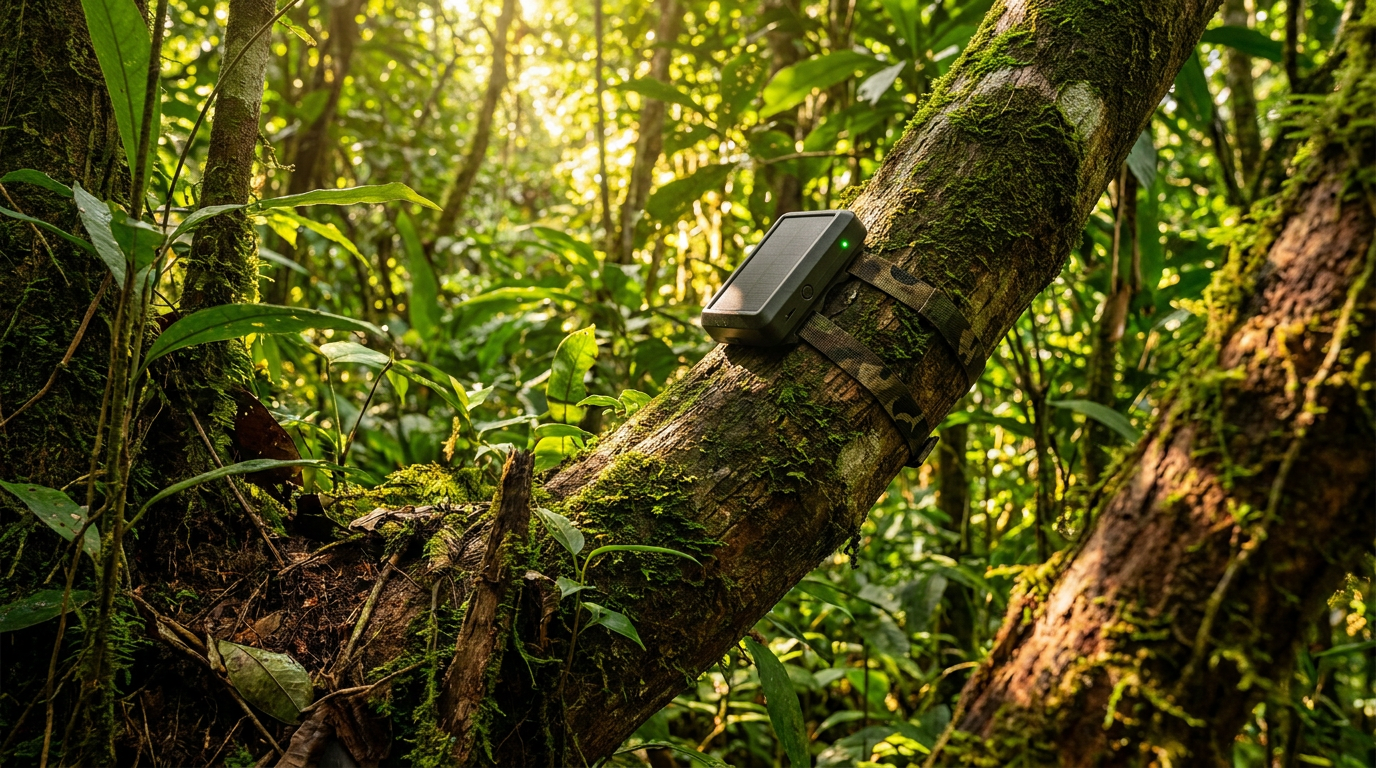
At the forefront of this movement is Rainforest Connection (RFCx), an organization that has pioneered the use of "Guardian" devices. Originally crafted from upcycled smartphones, these solar-powered acoustic monitors are strapped high in the forest canopy, where they listen to the environment 24 hours a day.[6]

The engineering required to keep these devices alive in one of the planet's harshest environments is formidable. The Guardians utilize custom power circuitry and specialized solar panels designed to harvest the fleeting, narrow bands of sunlight that manage to pierce the dense rainforest canopy.[6]
Once active, the devices capture every sound within a radius of up to three square kilometers. But raw audio is useless without analysis. This is where edge computing and artificial intelligence take over.[6]
The Guardians run sophisticated machine learning algorithms, such as Convolutional Neural Networks, directly on the device. These models are trained to isolate specific acoustic signatures—the mechanical whine of a chainsaw, the rumble of a logging truck, or the crack of a poacher's gunshot—from the overwhelming background noise of the jungle.[4][6]
When a threat is detected, the system immediately transmits an alert via cellular networks or satellite to local rangers. This real-time intelligence allows authorities to intercept illegal activities as they happen, rather than documenting the aftermath.[4]
When a threat is detected, the system immediately transmits an alert via cellular networks or satellite to local rangers.
The scale of this acoustic net is staggering. Today, nearly 600 Guardian devices are deployed across 37 countries, actively monitoring over 736,000 hectares of vulnerable wilderness.[4]

But the technology is doing far more than policing illegal logging; it is mapping the very fabric of biodiversity. The RFCx system has cataloged over 160 million audio files, creating a vast digital library of the natural world.[4]
From this immense dataset, AI models have successfully identified over 4,200 distinct species, including hundreds that are near-threatened or critically endangered. By tracking the presence and movement of these animals through their vocalizations, scientists can measure ecosystem health with unprecedented precision.[4][7]
While some researchers are using AI to listen for threats, others are using it to decode the fundamental nature of animal communication. Project CETI (Cetacean Translation Initiative) has assembled a multidisciplinary team of marine biologists, cryptographers, and linguists to study the complex clicks of sperm whales.[5]
Sperm whales possess the largest brains on Earth and live in tightly knit, matrilineal family units. They communicate across vast ocean distances using rapid sequences of clicks, a system that researchers previously likened to a simple Morse code.[1][2]

By applying Generative Adversarial Networks (GANs)—the same machine learning architecture used to model human language acquisition—researchers have uncovered a hidden architecture in the whales' vocalizations.[2]
The AI revealed that sperm whales vary the rhythm, tempo, and duration of their clicks to create a sophisticated "phonetic alphabet." Furthermore, researchers at UC Berkeley discovered that the acoustic properties of these calls feature spectral peaks remarkably similar to human vowels.[1][2]
In human language, these subtle variations carry distinct semantic meanings. The discovery that sperm whales utilize a structurally similar system is a watershed moment, suggesting a level of linguistic complexity previously thought to be uniquely human.[2][5]
However, the leap from recognizing syntax to understanding semantics remains fraught with uncertainty. Skeptics caution against the human tendency to anthropomorphize animal behavior.[7]

Neuroecologists point out the philosophical barrier of the "Umwelt"—the unique sensory world of an organism. Because sperm whales navigate the pitch-black ocean entirely through echolocation, their conceptual reality is fundamentally alien to human experience. Even if an AI can map the grammar of their clicks, translating concepts that have no human equivalent may prove impossible.[1][7]
How we got here
2013
Rainforest Connection is founded, launching early proofs-of-concept using upcycled smartphones.
2021
Project CETI officially launches its multidisciplinary effort to decode sperm whale communication.
2024
Researchers publish findings detailing the first 'Sperm Whale Phonetic Alphabet'.
2025
Acoustic monitoring networks surpass 730,000 hectares of protected forest globally.
2026
AI models successfully identify human-like 'vowels' in the spectral properties of whale clicks.
Viewpoints in depth
Conservation Technologists
Advocates for using scalable AI and edge computing to proactively protect ecosystems.
This camp argues that traditional conservation methods—foot patrols and satellite imagery—are fundamentally inadequate for the scale of modern environmental threats. By deploying always-on acoustic sensors, they believe we can shift from documenting deforestation to actively preventing it. They emphasize the cost-effectiveness of edge computing and the dual-use nature of the data, which simultaneously deters poachers and provides unprecedented biodiversity metrics.
Marine Biologists & Linguists
Researchers focused on decoding the structural complexity of animal communication.
Drawing on breakthroughs in machine learning, this group posits that animal communication is far more sophisticated than historically acknowledged. By applying models like Generative Adversarial Networks to sperm whale clicks, they have identified phonetic alphabets and vowel-like structures. They argue that proving high-level linguistic complexity in animals could fundamentally alter human empathy and accelerate global conservation legislation.
Skeptical Neuroecologists
Scientists cautioning against anthropomorphizing the outputs of AI pattern recognition.
While acknowledging the brilliance of AI in mapping acoustic syntax, this camp warns that structure does not automatically equal semantic meaning. They emphasize the concept of the 'Umwelt'—the reality that a sperm whale's sensory experience of the world is entirely alien to a human's. They argue that human-trained AI models may simply be projecting human linguistic frameworks onto animal behaviors that serve entirely different ecological functions.
What we don't know
- Whether the structural complexity of sperm whale clicks translates to semantic, conversational meaning.
- How to bridge the 'Umwelt' gap—understanding concepts expressed by animals whose primary sensory experience is entirely different from humans.
- The long-term funding and maintenance viability of maintaining thousands of edge-computing sensors in highly corrosive rainforest environments.
Key terms
- Bioacoustics
- The scientific study of sounds produced by or affecting living organisms, increasingly used to monitor ecosystem health.
- Generative Adversarial Networks (GANs)
- A class of machine learning frameworks used to identify patterns in animal communication, similar to how children learn language.
- Edge Computing
- Processing data locally on a remote device rather than sending it to a central cloud, allowing for real-time alerts in areas with poor connectivity.
- Umwelt
- The unique, self-centered sensory world as it is experienced by a particular organism, which may be fundamentally incomprehensible to humans.
Frequently asked
How do the forest sensors get power?
They use specialized solar panels designed to capture the thin, short-lived bands of sunlight that penetrate the dense rainforest canopy.
Can AI actually translate what whales are saying?
Not yet. AI has identified the structural 'alphabet' and 'vowels' of sperm whale clicks, but scientists do not yet know the semantic meaning behind these vocalizations.
What happens when the AI detects a chainsaw?
The system sends a real-time alert via cellular or satellite networks to local rangers, enabling them to intercept illegal logging before extensive damage occurs.
Sources
Source coverage
7 outlets
3 viewpoints surfaced







[1]WHYYSkeptical Neuroecologists
Can AI help us talk to animals?
Read on WHYY →[2]UC BerkeleyMarine Biologists & Linguists
The acoustic properties of whale calls resemble vowels, new study finds
Read on UC Berkeley →[3]Global GoodConservation Technologists
Turning Recycled Smartphones into Forest Protectors
Read on Global Good →[4]Social Enterprise World ForumConservation Technologists
AI for Social Good: Rainforest Connection
Read on Social Enterprise World Forum →[5]Project CETIMarine Biologists & Linguists
Decoding the language of sperm whales
Read on Project CETI →[6]World BankConservation Technologists
Rainforest Connection (RFCx) Guardian System
Read on World Bank →[7]Factlen Editorial Team
Synthesis by Factlen editorial team
Read on Factlen Editorial Team →

Every angle. Every day.
Get environment stories with full source coverage and perspective breakdowns delivered to your inbox.