
How AI Agents Work: The Shift From Chatbots to Autonomous Systems
Large language models are no longer just talking—they are planning, using tools, and executing complex workflows. Here is how agentic AI is transforming software from a passive tool into an active teammate.
By Factlen Editorial Team
- AI Researchers & Developers
- Focus on expanding the reasoning capabilities, memory structures, and tool-calling efficiency of autonomous models.
- Enterprise Operations Leaders
- Value agentic AI for its ability to automate unstructured, knowledge-heavy workflows that traditional RPA cannot handle.
- Governance & Security Teams
- Emphasize the need for strict guardrails, observability, and human-in-the-loop approvals to mitigate the risks of probabilistic systems.
What's not represented
- · Entry-level knowledge workers whose daily tasks are being automated by agentic workflows.
- · Consumer advocates concerned about the privacy implications of agents accessing personal data across multiple platforms.
Why this matters
Understanding agentic AI is crucial because it marks the transition from software that requires constant human prompting to software that can independently manage your schedule, write your code, and execute your business operations.
Key points
- Agentic AI transforms language models from passive chatbots into autonomous systems that can plan and execute multi-step tasks.
- AI agents use 'tool calling' to interact with external systems, allowing them to search the web, query databases, and run code.
- Unlike traditional automation, agentic systems can observe errors and autonomously adapt their plans to overcome obstacles.
- Enterprise adoption is accelerating, with organizations using multi-agent systems to automate complex workflows like customer support and financial reconciliation.
- While highly adaptable, AI agents require robust guardrails and observability to mitigate the risks of autonomous decision-making.
For the past few years, our relationship with artificial intelligence has been strictly conversational. We typed a prompt, and the machine generated a response. It was a reactive dynamic—brilliant at summarizing documents or drafting emails, but ultimately passive. The AI waited for instructions and stopped working the moment it finished its sentence. In 2026, that paradigm has fundamentally shifted. We are moving from generative AI to agentic AI, a transition that turns the chatbot into an autonomous operator capable of planning, reasoning, and executing multi-step tasks.[3][6][7]
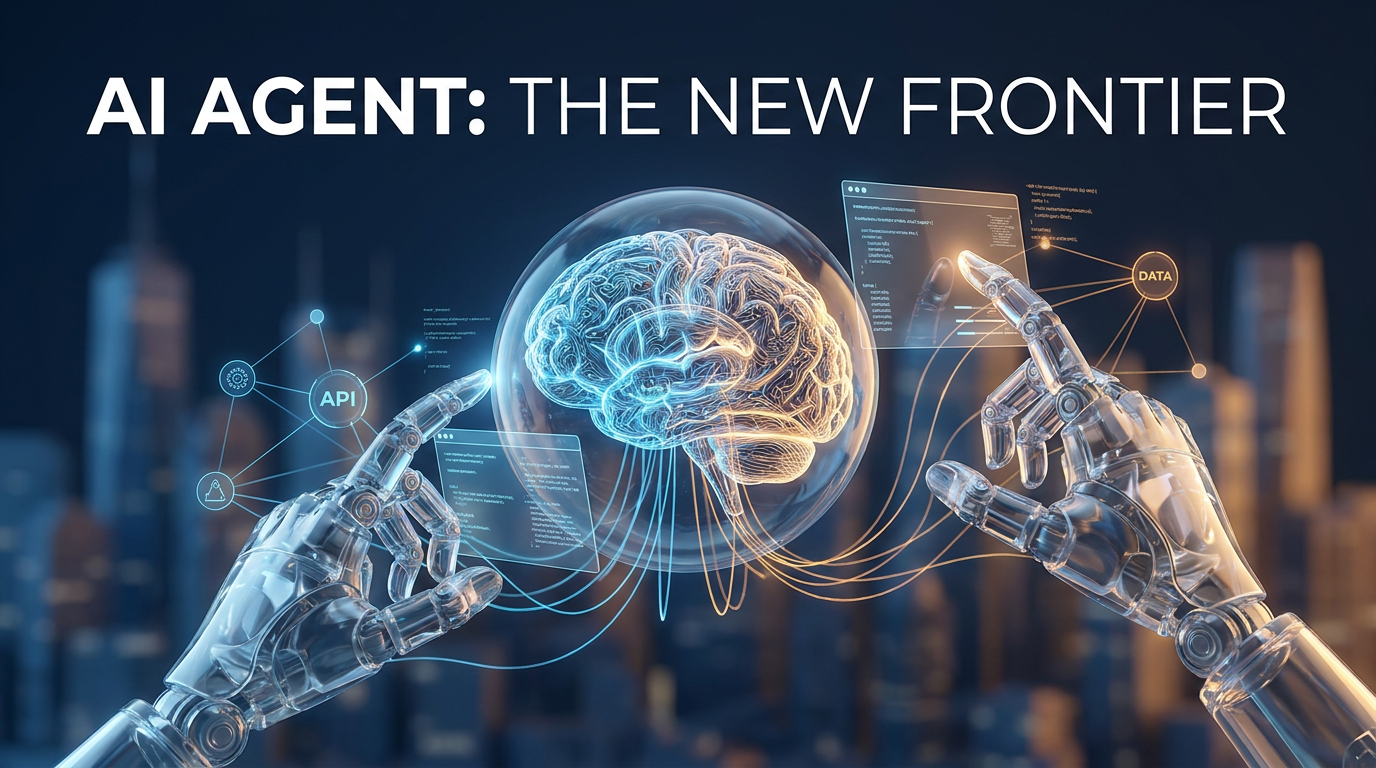
To understand the leap, it helps to look at the limitations of a standard Large Language Model (LLM). An LLM is essentially a brain in a jar. It possesses vast knowledge and reasoning capabilities, but it has no hands to interact with the outside world, no persistent memory of who you are, and zero autonomy. If you ask it to book a flight, it can write a script for how you might do it yourself, but it cannot actually purchase the ticket. AI agents change this by wrapping that "brain" in a framework that allows it to take action.[1][4][7]
An AI agent is a system where a language model acts as a reasoning engine to decide what to do next, equipped with the tools to actually do it. Instead of a single-shot prompt, agentic systems operate on a continuous loop: they perceive their environment, plan a sequence of actions, execute those actions using external tools, observe the results, and adapt if something goes wrong. This is the defining characteristic of agency—the ability to pursue a high-level goal with minimal human supervision.[2][3][5]

The mechanism begins with perception and goal-setting. When a user gives an agent a complex objective—such as "reconcile these invoices and flag any discrepancies"—the agent does not immediately start generating text. Instead, the LLM acts as a planner. It breaks the high-level goal down into a logical sequence of smaller subtasks. It determines what information it needs, which systems it must access, and in what order the steps must be completed.[1][2][6]
The true game-changer for agentic AI was the development of "tool calling." Tools are the digital hands of the agent. Through APIs, an agent can search the live web, query a secure corporate database, run Python code, send emails, or navigate a web browser. The LLM itself does not execute the code; rather, it recognizes that it needs a specific piece of data and writes the command to fetch it. This allows the agent to reach beyond its static training data and interact with dynamic, real-world systems.[1][4][7]
Once an action is taken, the agent enters the observation and reflection phase. This is where agentic systems diverge sharply from traditional software. If a traditional automated script encounters a broken link or a changed database schema, it crashes. If an AI agent encounters an error, it reads the error message, understands why the action failed, and formulates a new plan. It might retry the API call, search for an alternative data source, or, as a last resort, ask the human user for clarification.[3][5][6]
Once an action is taken, the agent enters the observation and reflection phase.
Memory is another critical component of the agentic stack. By default, LLMs have the memory of a goldfish—every interaction starts fresh. Agentic frameworks solve this by implementing both short-term memory (keeping track of the current task's state and conversation history) and long-term memory (using vector databases to recall user preferences, past interactions, and custom enterprise data). This allows the agent to maintain context over days or weeks of ongoing work.[4][7]

In enterprise environments, these systems are rarely deployed as a single, omnipotent agent. Instead, organizations are building multi-agent systems. In this architecture, an "orchestrator" agent receives the user's request and delegates subtasks to specialized worker agents. For example, a software development workflow might feature a researcher agent that reads documentation, a coder agent that writes the script, and a verifier agent that tests the code for bugs before passing it back to the orchestrator.[1][2][5]
The impact of this technology is already reshaping operations across industries. In customer support, agentic AI does not just draft a polite apology; it checks the user's order status, identifies a shipping delay, contacts the logistics provider's API for an update, and issues a partial refund—all autonomously. In finance, agents are automating complex reconciliation processes, pulling data from disparate ERP systems and highlighting anomalies that would take a human hours to find.[3][6][7]
This shift is driving massive adoption. By late 2025, industry surveys indicated that 60% to 70% of large organizations had moved generative AI out of the pilot phase and into production workflows. The primary driver for this adoption is speed to value. Teams report that agentic systems can compress implementation timelines by 30% to 50% for knowledge-heavy workflows, simply because developers no longer have to hard-code rules for every possible edge case.[4][7]

However, the rise of AI agents has sparked a board-level debate regarding when to use probabilistic AI versus deterministic traditional automation, like Robotic Process Automation (RPA). Traditional automation is rigid but highly predictable and fast. Given the same inputs, it produces the exact same outputs every time. Agentic AI is adaptable and can handle unstructured data, but it introduces variability. It is also slower; while a single LLM call might take two seconds, a five-step agentic reasoning loop can take 10 seconds or more.[4][7]
Governance and security present the steepest hurdles for agentic deployment. Because agents can take autonomous action, the risk profile is fundamentally different from a chatbot. If an agent hallucinates while drafting an email, it is embarrassing; if it hallucinates while executing a database deletion, it is catastrophic. Consequently, modern agent deployments rely heavily on strict guardrails, "human-in-the-loop" approval gates for high-stakes actions, and robust observability layers that trace exactly why an agent made a specific decision.[4][5][7]
Looking ahead, the market for AI agents is projected to grow at a staggering 45% compound annual growth rate over the next five years. We are moving from an era of "prompt engineering"—trying to coax the right answer out of a model—to "context engineering" and "agent harnesses," where developers focus on building the right environments, tools, and boundaries for autonomous systems to thrive.[4][5][7]
Ultimately, agentic AI represents a fundamental redefinition of software. We are no longer building tools that humans use to do work; we are building digital teammates that do the work alongside us. As these systems become more reliable and deeply integrated into our daily workflows, the friction of digital execution will continue to drop, freeing human workers to focus on strategy, creativity, and the tasks that machines still cannot touch.[3][5][7]
How we got here
2022–2023
Generative AI and chatbots enter the mainstream, relying on single-shot prompts and static training data.
Late 2023
Major AI labs introduce 'tool calling' and function calling, allowing language models to interact with external APIs.
2024–2025
Early agentic frameworks emerge, enabling developers to build systems that can plan and execute multi-step tasks.
Late 2025
Enterprise adoption accelerates, with 60–70% of large organizations moving generative AI into production workflows.
2026
Multi-agent systems become standard in enterprise software, shifting the focus from prompt engineering to autonomous workflow orchestration.
Viewpoints in depth
AI Researchers & Developers
Focus on expanding the reasoning capabilities, memory structures, and tool-calling efficiency of autonomous models.
For the engineering community, the transition to agentic AI is fundamentally about solving the 'brain in a jar' problem. Researchers are focused on expanding context windows and refining vector databases so agents can maintain long-term memory across complex, multi-day tasks. They view the current era as a shift from 'prompt engineering'—coaxing the right text out of a model—to 'context engineering' and building robust 'agent harnesses.' The ultimate goal is to create highly efficient multi-agent systems where specialized models can seamlessly delegate tasks to one another without losing context or hallucinating.
Enterprise Operations Leaders
Value agentic AI for its ability to automate unstructured, knowledge-heavy workflows that traditional RPA cannot handle.
Operations executives view agentic AI as the next major lever for productivity. While traditional Robotic Process Automation (RPA) was excellent for rigid, repetitive tasks, it failed when confronted with unstructured data or edge cases. Business leaders are deploying agents to handle the 'messy' middle of enterprise workflows—such as interpreting a frustrated customer's email, checking inventory across three different systems, and autonomously issuing a refund. For this camp, the primary metric is time-to-value; they report that agentic systems can be deployed 30% to 50% faster than traditional automation because developers do not have to hard-code every possible scenario.
Governance & Security Teams
Emphasize the need for strict guardrails, observability, and human-in-the-loop approvals to mitigate the risks of probabilistic systems.
Security and compliance professionals approach agentic AI with significant caution. Because these systems are probabilistic—meaning they might solve the same problem differently on two different days—they introduce a new layer of operational risk. If an agent has the autonomy to write to a database or send external emails, a hallucination could lead to data corruption or reputational damage. This camp advocates for treating the LLM as just one component of a larger, heavily restricted system. They demand robust observability tools that log exactly why an agent made a decision, strict API permissions, and mandatory 'human-in-the-loop' checkpoints before any high-stakes action is executed.
What we don't know
- How quickly regulatory bodies will establish liability frameworks for actions taken autonomously by AI agents.
- The long-term impact of agentic automation on entry-level knowledge-worker jobs.
- Whether the high compute costs associated with multi-step agentic loops will decrease enough for ubiquitous consumer adoption.
Key terms
- Agentic AI
- Artificial intelligence systems capable of autonomous decision-making, planning, and executing multi-step tasks to achieve a specific goal.
- Tool Calling
- The ability of an AI model to write and execute commands that interact with external software, APIs, or databases.
- Multi-Agent System
- An architecture where multiple specialized AI agents collaborate, often coordinated by an 'orchestrator' agent, to complete complex workflows.
- Human-in-the-Loop (HITL)
- A safety protocol where an AI agent must pause and request human approval before executing a high-stakes or irreversible action.
- Robotic Process Automation (RPA)
- Traditional, rule-based software used to automate highly structured, repetitive digital tasks without the use of AI reasoning.
Frequently asked
What is the difference between generative AI and agentic AI?
Generative AI creates content (like text or images) based on a prompt and then stops. Agentic AI uses generative AI as a reasoning engine to plan steps, use external tools, and autonomously complete a multi-step goal.
How do AI agents interact with the real world?
Agents use 'tool calling.' The AI model writes commands to access APIs, which allows it to search the web, query databases, send emails, or execute code on behalf of the user.
Are AI agents replacing traditional automation like RPA?
Not entirely. Traditional automation is faster and 100% predictable, making it ideal for rigid, repetitive tasks. AI agents are better suited for complex, unstructured workflows that require adaptability and decision-making.
What happens if an AI agent makes a mistake?
Unlike traditional scripts that crash when they encounter an error, agentic systems are designed to observe the failure, read the error message, and autonomously formulate a new plan or retry the action.
Sources
Source coverage
7 outlets
3 viewpoints surfaced







[1]IBMAI Researchers & Developers
What are AI agents?
Read on IBM →[2]Amazon Web ServicesGovernance & Security Teams
What is an AI agent?
Read on Amazon Web Services →[3]ZoomEnterprise Operations Leaders
What is agentic AI? A guide to autonomous AI systems
Read on Zoom →[4]Towards AIAI Researchers & Developers
AI Agents vs LLMs: Architecture, Use Cases, and Opportunities
Read on Towards AI →[5]Boston Consulting GroupEnterprise Operations Leaders
What Are AI Agents?
Read on Boston Consulting Group →[6]ZendeskEnterprise Operations Leaders
Agentic AI: What it is and how it works
Read on Zendesk →[7]Factlen Editorial TeamGovernance & Security Teams
Synthesis by Factlen editorial team
Read on Factlen Editorial Team →


Every angle. Every day.
Get meta stories with full source coverage and perspective breakdowns delivered to your inbox.