
Global Data Center Power Consumption Reaches 2% of World Electricity and 6% of US Grid
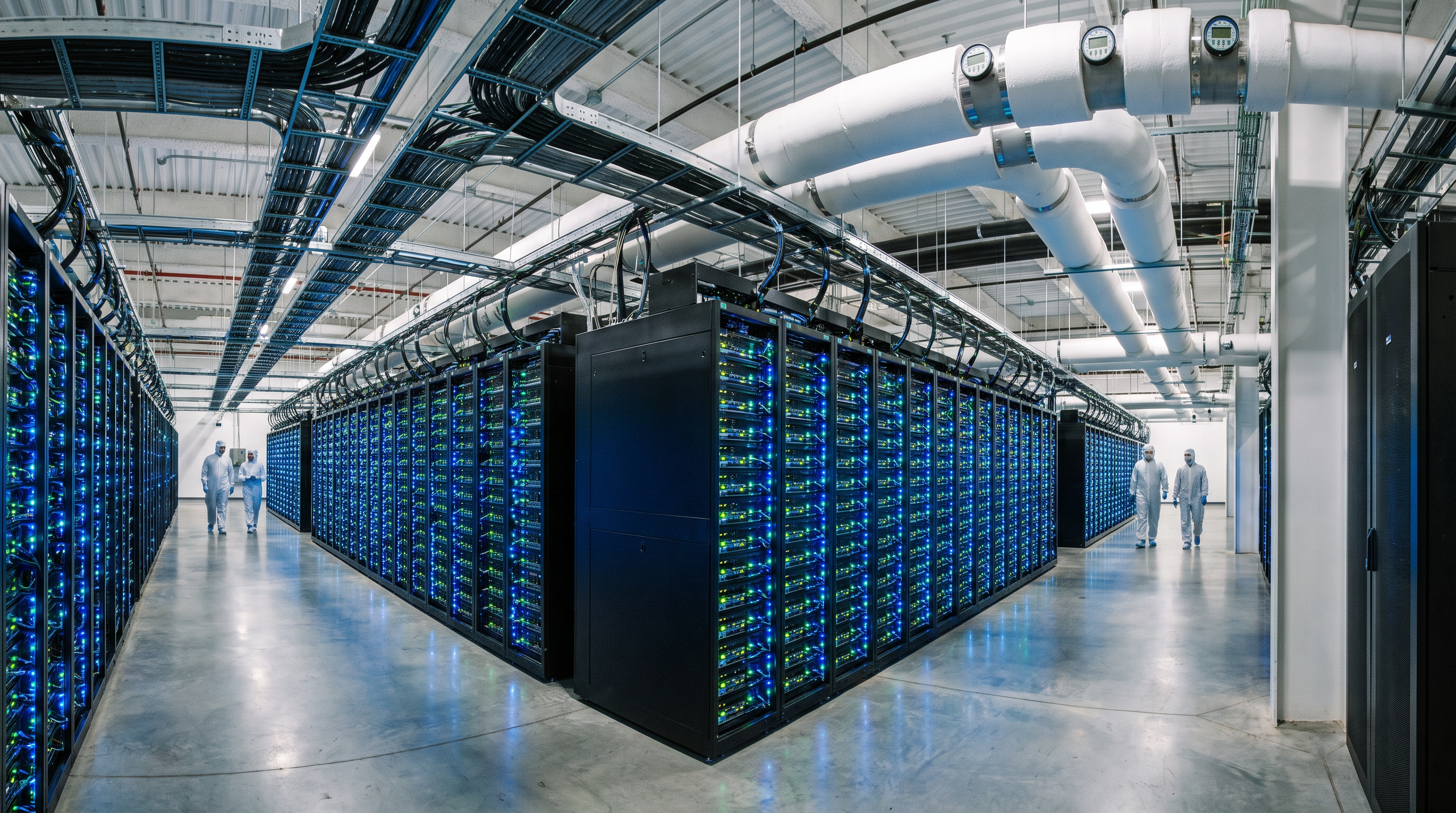
A comprehensive analysis reveals that data centers now draw 67.7 gigawatts globally, driven by AI expansion and cloud computing. The concentration of these facilities is placing unprecedented strain on local grids, with the US, Germany, and Singapore far exceeding the global average.

How this story has developed
This report is part of a developing story — read the earlier chapters below.
- Global Data Center Power Consumption Reaches 2% of World Electricity and 6% of US Grid (this article)
- Is the AI Boom a Hidden Tax on Your Utility Bill and the Climate?
- Brookfield and NextEra Plan $100 Billion AI Campus at Former DOE Site With Dedicated Power
- Grid Operators
- Focused on maintaining grid reliability and managing the slow pace of transmission infrastructure.
- Tech Industry & Hyperscalers
- Focused on scaling AI capabilities while funding renewable energy development.
- Community & Environmental Advocates
- Concerned about local resource strain, rising utility rates, and fossil fuel reliance.
The competing cases
Grid Operators & Utilities
Focused on reliability, capacity planning, and preventing local brownouts.
For the organizations managing regional power grids, the data center boom represents both a massive revenue opportunity and a severe reliability threat. Utilities argue that the sheer speed of data center construction—often completed in 18 months—vastly outpaces the 5-to-10-year timelines required to permit and build new high-voltage transmission lines. They advocate for stricter interconnection queues and demand that hyperscalers co-invest in local grid upgrades to prevent residential customers from subsidizing the infrastructure required for AI.
Hyperscale Tech Companies
Emphasizing efficiency gains, economic value, and renewable energy investments.
The operators of the world's largest data centers point out that while their absolute power consumption is rising, their efficiency is unprecedented. They argue that centralizing computing in hyperscale facilities is vastly more energy-efficient than millions of companies running on-premises servers. Furthermore, tech giants emphasize their role as the primary financial backers of new renewable energy projects, arguing that their massive power purchase agreements (PPAs) are single-handedly funding the deployment of next-generation solar, wind, and geothermal capacity.
Local Communities & Planners
Concerned with resource extraction, rising utility rates, and zoning impacts.
In high-density data center markets like Northern Virginia and Dublin, local planners view the 5% grid threshold as a breaking point. Citizen groups argue that data centers provide relatively few permanent jobs compared to their massive footprint and resource demands. Their primary concern is that the immense power and water requirements of these facilities will crowd out other industrial development, strain local aquifers for cooling, and ultimately lead to higher baseline electricity rates for residential consumers.
What’s at stake
As artificial intelligence and cloud computing become central to the global economy, their physical infrastructure is fundamentally altering energy markets. Understanding exactly where and how this power is consumed is critical for grid operators, policymakers, and communities planning for future energy resilience.
Exactly 67.7 gigawatts. That is the new continuous power draw of the world's data centers as of mid-2026, representing a 36% jump over just two years. According to a comprehensive May 2026 report by the International Data Center Authority (IDCA), the physical infrastructure of the internet has crossed a major threshold, now consuming 2% of all global electricity.[1]
To understand this surge, one must look at the mechanism of modern computing. A traditional cloud server hosting websites or databases draws a relatively steady, predictable amount of power. However, the specialized graphics processing units (GPUs) required for artificial intelligence operate differently. They run at maximum capacity for weeks during model training, generating immense heat that requires equally power-hungry liquid or forced-air cooling systems to prevent silicon meltdown.
This shift in hardware architecture is the primary driver of the new data. The International Energy Agency (IEA) and the IDCA both note that while global electricity demand is growing at roughly 3% annually, data center power demand soared by 17% in 2025 alone. The result is a decoupling of computing growth from historical efficiency trends, which had previously kept data center power flat for nearly a decade despite massive traffic increases.
The burden is highly concentrated rather than evenly distributed. While the global average sits at 2%, the evidence shows that data centers cluster in specific regions due to fiber-optic density, tax incentives, and historical infrastructure. The United States, which hosts 43% of the world's data center capacity, now dedicates 6% of its entire national electricity supply to these facilities.[1]
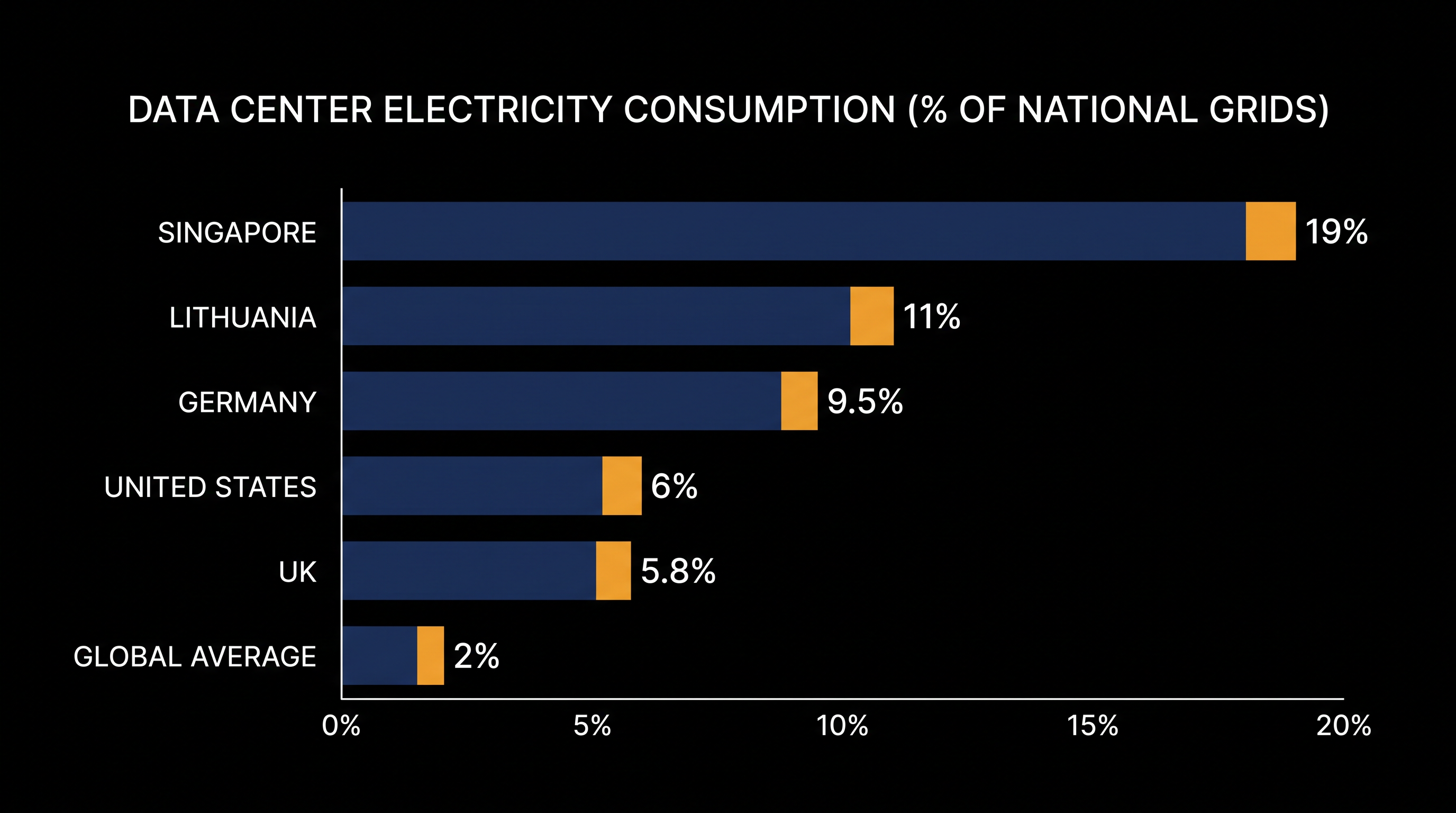
The concentration is even more extreme in smaller, tech-forward economies. In Germany, data centers account for 9.5% of national electricity use. In Lithuania, the figure is 11%, and in Singapore, a massive 19% of the national grid is devoted to computing infrastructure.[1]
Grid stress reliably triggers predictable community pushback. The IDCA data reveals a clear sociological threshold: when data center consumption surpasses 5% of a national or regional grid, community and political resistance reliably intensifies. Residents and local industries begin to compete with hyperscalers for finite power capacity, raising concerns about electricity rate hikes and grid stability during peak summer months.
This friction is already visible in infrastructure queues. In the United Kingdom, where data centers consume 5.8% of the grid, the backlog of facilities waiting for high-voltage grid connections grew by 460% in the first half of 2025. Developers are now routinely quoted wait times of several years before they can draw power.[1]
Developers are now routinely quoted wait times of several years before they can draw power.
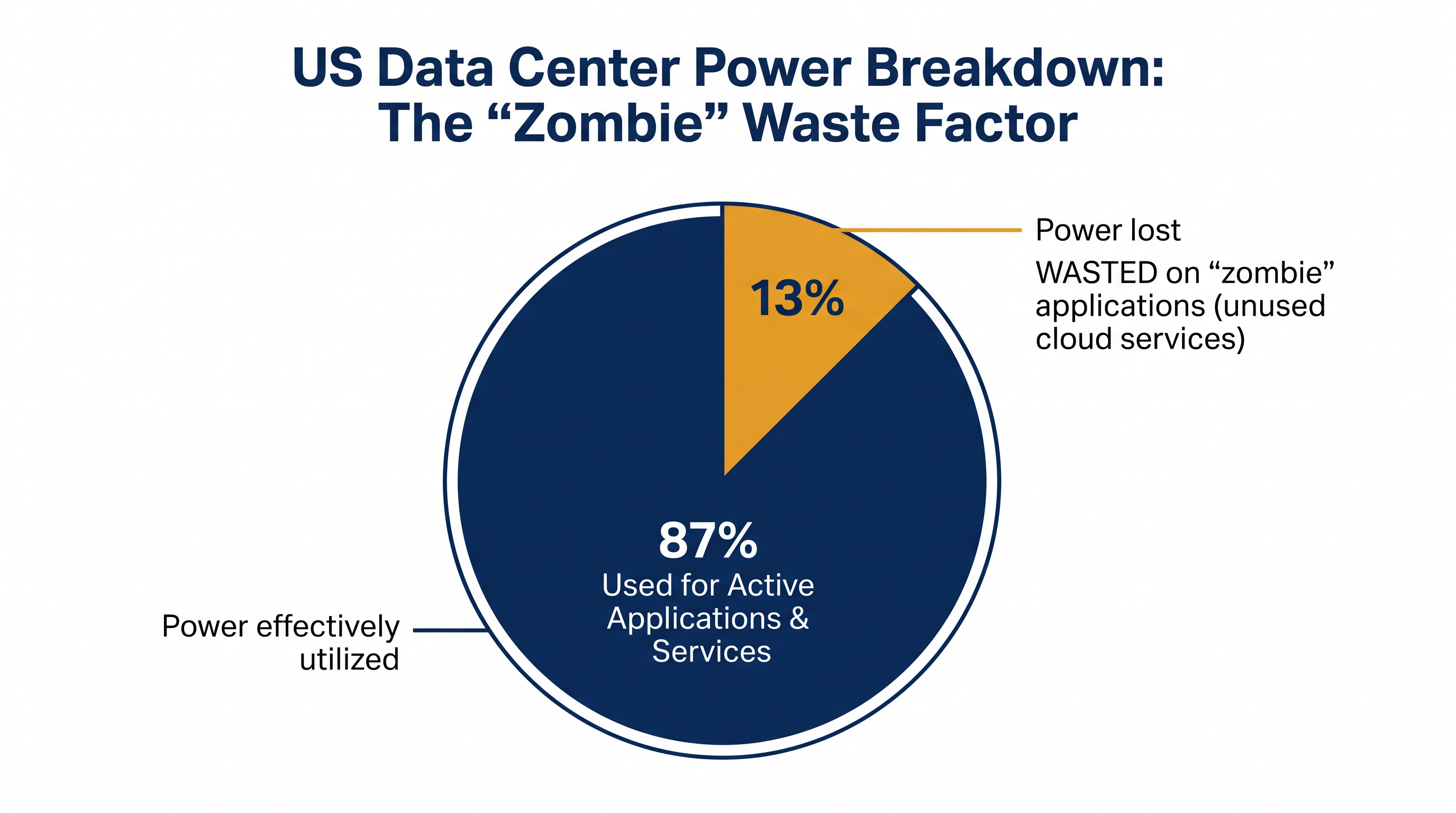
Despite the sophisticated engineering of modern server farms, the data reveals surprising waste at the software level. The IDCA report estimates that 13% of all data center power consumption in the United States is drawn by "zombie" services—cloud applications and containers that are running but entirely unused.
This software bloat accounts for more than 3 gigawatts of continuous power demand in the US alone, roughly equivalent to the output of three large nuclear reactors. Because cloud providers bill customers for uptime rather than utilization, there is currently little financial incentive for end-users to audit and shut down idle instances, baking structural inefficiency into the grid.
While these figures represent the most accurate consensus to date, researchers caution that exact accounting remains elusive. The MIT Energy Initiative notes that hyperscale operators—the tech giants building the largest facilities—often treat their exact power usage and efficiency metrics as proprietary trade secrets.
Consequently, analytical bodies like the IEA, EPRI, and IDCA must extrapolate total consumption from secondary indicators. They calculate grid impact by tracking server shipment volumes, facility square footage, and utility interconnection agreements rather than direct meter readings from the tech companies themselves.[2]
Looking ahead to 2030, the consensus fragments into a wide cone of uncertainty. The Electric Power Research Institute (EPRI) projects that US data centers could consume anywhere from 9% to 17% of national electricity by the end of the decade. The Lawrence Berkeley National Laboratory similarly forecasts a range between 6.7% and 12%.[2]
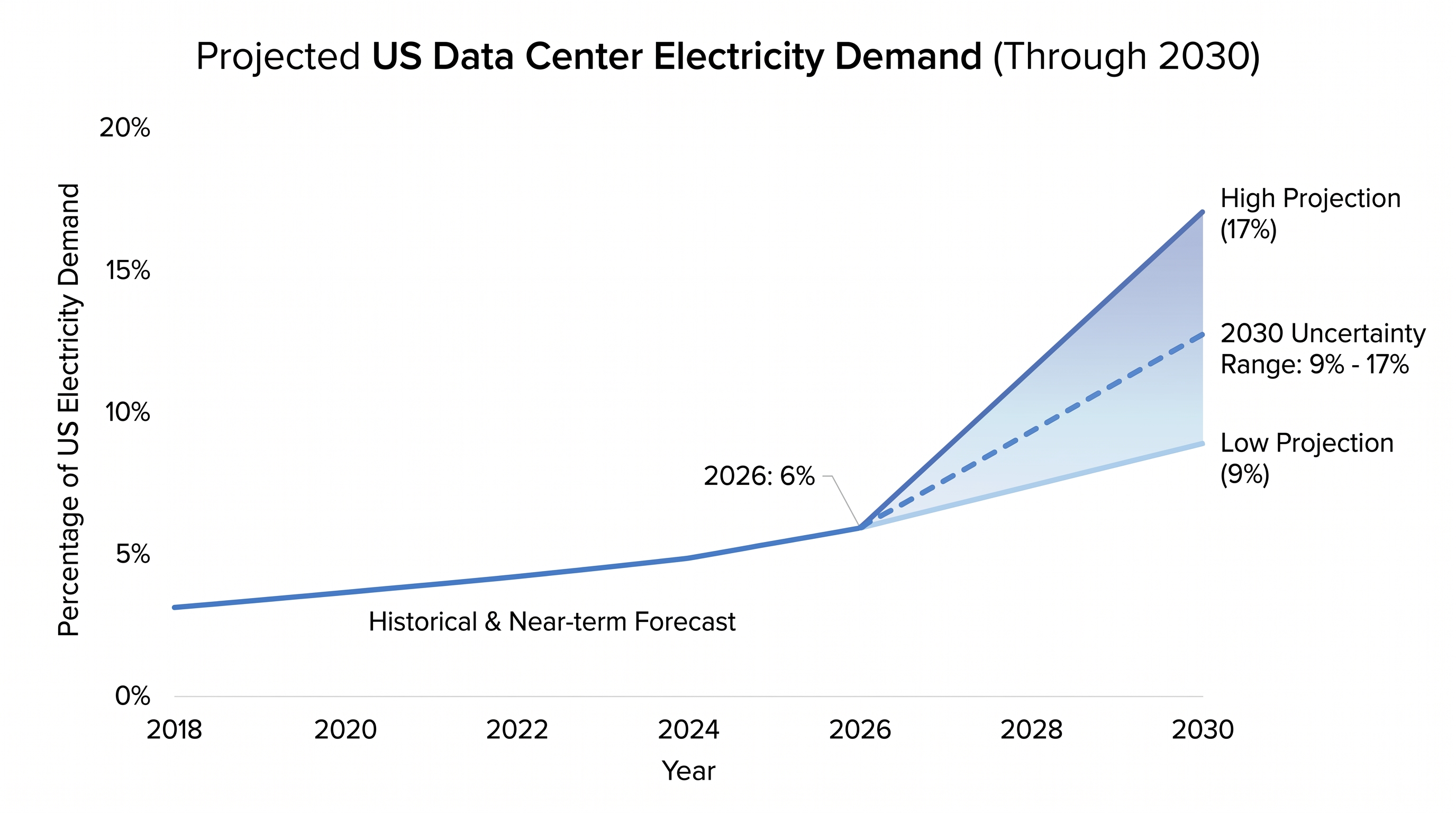
This variance depends almost entirely on whether the current boom in AI infrastructure represents a one-time capital expenditure cycle or a permanent new baseline for computing. If AI inference—the act of querying a trained model—becomes integrated into every digital transaction, the higher bounds of these estimates become highly probable.[2]
To mitigate this trajectory, research consortiums are pivoting toward structural solutions. The MIT Energy Initiative is currently modeling behind-the-meter power generation, where data centers operate their own advanced geothermal or small modular nuclear reactors (SMRs) rather than drawing from public grids.
Until those next-generation power sources commercialize, the data is unambiguous: the era of "invisible" cloud computing is over. Data centers have transitioned from a marginal, highly efficient background load into one of the primary drivers of global energy infrastructure expansion.
Key takeaways
- Global data center power consumption has reached 67.7 gigawatts, accounting for 2% of the world's electricity.
- The US grid is disproportionately impacted, with data centers now consuming 6% of the nation's total power.
- AI workloads, which require continuous, high-intensity power for GPUs, are the primary driver of the recent 36% growth.
- An estimated 13% of US data center power is wasted on "zombie" applications that run continuously without being used.
- Community and political resistance reliably intensifies when data centers exceed 5% of a local grid's capacity.
Unsettled ground
- The exact power consumption of individual hyperscalers, as tech companies rarely disclose un-abstracted facility-level energy data.
- Whether the current surge in AI power demand is a temporary infrastructure build-out phase or a permanent exponential curve.
- How much next-generation cooling technologies and specialized silicon will offset the rising power requirements of future AI models.
- 67.7 GW
- Global data center power footprint
- 6%
- US national grid consumption by data centers
- 19%
- Singapore national grid consumption by data centers
- 13%
- US data center power wasted on unused 'zombie' apps
- 9-17%
- Projected US grid share by 2030 (EPRI)
Background
2012–2018
Global computing power increases by 550%, but data center energy use rises only 6% due to massive efficiency gains.
2023
The generative AI boom begins, shifting data center workloads toward power-intensive GPU clusters.
2025
Global data center electricity demand surges by 17% in a single year, decoupling from historical efficiency trends.
May 2026
The IDCA reports that global data center consumption has reached 2% of world electricity, and 6% in the US.
2030 (Projected)
EPRI and IEA forecast that US data center power demand could reach between 9% and 17% of the national grid.
Terms in play
- Hyperscaler
- Large-scale cloud service providers, such as Amazon Web Services, Google Cloud, and Microsoft Azure, that operate massive global networks of data centers.
- AI Inference
- The process of a trained artificial intelligence model generating an answer or prediction in real-time, which requires significantly more power than a standard web search.
- Zombie Services
- Cloud applications, servers, or software containers that are powered on and consuming electricity but are no longer actively used or monitored by their owners.
- Behind-the-Meter Generation
- Power plants—such as solar arrays, geothermal taps, or small nuclear reactors—built directly on-site to power a facility without drawing from the public grid.
Sources
Source coverage
2 outlets
3 viewpoints surfaced


[1]ComputingCommunity & Environmental Advocates
UK and US datacentres consuming 6% of national electricity, report
Read on Computing →[2]EPRIGrid Operators
Powering Data Centers: U.S. Energy System and Emissions Impacts of Growing Loads
Read on EPRI →
Comments
Every angle. Every day.
Get data analysis stories with full source coverage and perspective breakdowns delivered to your inbox.