
Employer RTO Mandates Trigger 'Great Reversal': Fully In-Office Roles Skyrocket to 87% of Job Postings in Q2 2026
The era of remote-by-default hiring is officially over as fully in-office roles surged to 87% of all new job postings in the second quarter of 2026. However, a widening 'flexibility gap' reveals that nearly half of the workforce is actively seeking new roles to retain remote options.
By Irina Belova


- Corporate Leadership
- Argues that physical presence is essential for collaboration, mentorship, and company culture, and intends to reward in-office attendance.
- Workforce Advocates
- Maintains that flexibility is a non-negotiable priority for modern professionals and that strict mandates will drive away top talent.
- Market Analysts
- Observes the data objectively, noting that while hiring has shifted back to the office, the existing workforce remains largely hybrid.
Why it matters
For job seekers and employees, the balance of power has shifted back to the physical office, meaning career advancement and new opportunities will increasingly require a daily commute. However, companies enforcing strict mandates risk losing top talent to competitors who still offer flexibility.
The era of remote-by-default hiring is officially over. In a sharp reversal from pandemic-era norms, the job market has decisively pivoted back to the physical desk, fundamentally altering the landscape for anyone seeking a new role this year. For the job seeker, this means the daily routine is shifting back to morning commutes, packed lunches, and the familiar hum of the open-plan office. The physical workspace is once again becoming the center of gravity for career advancement, networking, and new opportunities, forcing a rapid adjustment for professionals who had grown accustomed to the flexibility of working from home.
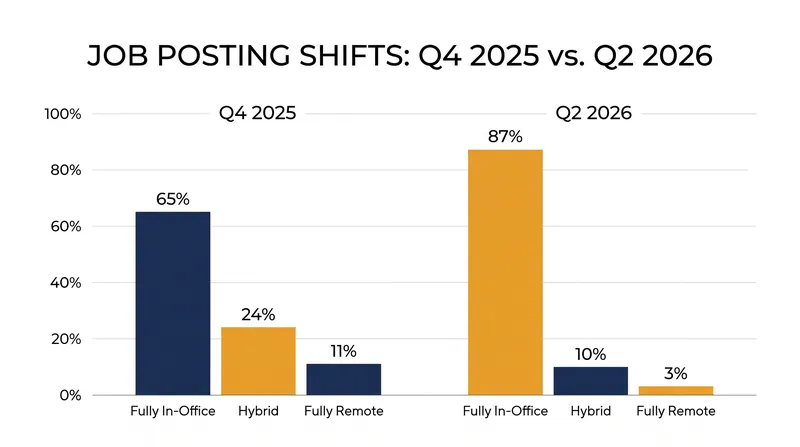
According to a proprietary analysis of professional job postings by Robert Half, fully in-office roles surged to 87% of all new postings in the second quarter of 2026. This represents a dramatic and sudden jump from just 65% in the fourth quarter of 2025. Over that same two-quarter window, hybrid roles dropped to roughly 10%, and fully remote postings plummeted to a mere 3%. The shift marks the largest single-year contraction in remote job availability since companies began widely offering work-from-home options in 2020, signaling that employers are finally making good on years of threatened return-to-office mandates.[1]
The return-to-office mandates driving this trend are real, accelerating, and increasingly strictly enforced. Thirty-six percent of employers report they have actively increased the number of days employees are required to work on-site over the past year. The momentum is highly visible in the physical real estate market as well. Office utilization metrics reached post-pandemic highs in late 2025, with Class A+ buildings absorbing demand much faster than commodity spaces. Companies are investing heavily in premium, amenity-rich environments in a calculated attempt to make the office a more appealing destination rather than just a mandatory obligation.[1]
At the executive level, the sentiment driving this shift is overwhelmingly clear and unified. The latest KPMG CEO Outlook survey highlights that 83% of global CEOs anticipate a return to full-time office attendance by 2026, a significant increase from 64% in 2023. Furthermore, 87% of CEOs say they are likely to reward employees who make the effort to come into the office with more favorable assignments, raises, and promotions. For ambitious professionals, visibility and physical presence are once again explicit requirements for climbing the corporate ladder, effectively ending the debate over whether remote workers face a proximity bias.[2]
At the executive level, the sentiment driving this shift is overwhelmingly clear and unified.
However, this aggressive push for in-person attendance has created a widening "flexibility gap" between employer demands and worker preferences. While companies are posting office-only roles, a massive segment of the workforce is actively resisting the change and preparing to vote with their feet. Nearly half of all professionals—46%—say they plan to look for a new job in the second half of 2026, with 39% of those job seekers citing a desire for more remote flexibility as their primary motivation for leaving their current employer.

This disconnect reveals a central tension in 2026 workforce planning: the hiring market is rapidly re-centering around the office, even as the existing workforce stubbornly keeps working in a hybrid pattern. Over half of remote-capable employees globally still work in a hybrid arrangement, largely because they were hired or grandfathered into earlier, more lenient policies. The job-posting trend toward on-site roles is a clear hiring-market signal, but enforcing those same strict mandates on existing staff carries significant retention risks that many human resources departments are currently struggling to navigate.
Some agile businesses are already capitalizing on this friction to upgrade their own talent pools. Small businesses and remote-first companies are using the flexibility gap to poach highly skilled professionals that their office-bound competitors simply cannot reach or retain. By offering remote roles by design, these organizations sidestep the return-to-office battles entirely and gain exclusive access to nearly half of the talent market that is currently considered a flight-risk, turning flexibility into a powerful competitive advantage in recruitment.
Other organizations are exploring alternative structural models to maintain team cohesion without forcing a daily commute. The return-to-office wave has quietly strengthened the business case for dedicated nearshore teams, allowing companies to build time-zone-aligned groups that work together in one physical location abroad. This strategy provides the collaborative benefits of an office environment without mandating that their domestic employees return to a grueling commute they might ultimately quit over, offering a compromise between executive desires and worker realities.
Ultimately, the organizations that stay competitive through this transition will need to manage remote and hybrid work with more precise data and tighter integration, rather than relying on blanket attendance mandates. While the physical office is clearly not obsolete, its role is fundamentally evolving. The strongest companies are not simply eliminating flexibility to fill empty desks, but are instead intentionally designing office environments that genuinely support the complex collaboration, organic mentorship, and spontaneous innovation that remote work alone continues to struggle to replicate.[2]
What to know
- Fully in-office job postings rose from 65% in Q4 2025 to 87% in Q2 2026.
- Fully remote job postings have plummeted to just 3%.
- 83% of global CEOs anticipate a return to full-time office attendance by 2026.
- 46% of professionals plan to look for a new job in the second half of 2026.
- Flexibility remains a top motivation for workers seeking new employment.
Where opinion splits
Corporate Leadership
Executives believe the office is critical for innovation and career advancement.
For many CEOs, the debate over remote work is effectively over. Leaders argue that face-to-face interaction is irreplaceable when it comes to onboarding new talent, fostering organic mentorship, and building a cohesive company culture. By explicitly tying promotions and favorable assignments to office attendance, executives are signaling that physical presence is a core component of performance and dedication.
Workforce Advocates
Employees view flexibility as a fundamental right and are willing to quit over it.
From the worker's perspective, the sudden reversal of remote policies feels like a breach of trust. Many professionals have built their lives around the flexibility gained over the past few years, eliminating grueling commutes and improving their work-life balance. Advocates argue that productivity has not suffered under hybrid models, and that companies enforcing rigid mandates will ultimately lose their best performers to more adaptable competitors.
Market Analysts
The data reveals a complex transition period where hiring and reality don't perfectly align.
Analysts point out a fascinating contradiction in the current market: while new job postings are overwhelmingly office-first, the actual day-to-day reality for most remote-capable workers remains hybrid. This suggests that employers are using new hires to slowly pull the center of gravity back to the office, avoiding the immediate mass resignations that might occur if they forced their entire existing workforce back five days a week.
Sources
Source coverage
2 outlets
3 viewpoints surfaced


[1]Robert HalfMarket Analysts
Remote work stats and trends
Read on Robert Half →[2]ColliersCorporate Leadership
CEOs Are Reinforcing the Value of In-Person Work
Read on Colliers →
Comments



Every angle. Every day.
Get lifestyle stories with full source coverage and perspective breakdowns delivered to your inbox.