
AI Is Eliminating the Busywork of Middle Management—And That's Good News for Your Career
A landmark Gartner projection that AI will eliminate 50% of middle management roles by 2027 is prompting a massive shift in how we work. Instead of replacing managers, the technology is automating administrative tasks, freeing professionals to focus on human-centric leadership, coaching, and strategic insight.
By Irina Belova

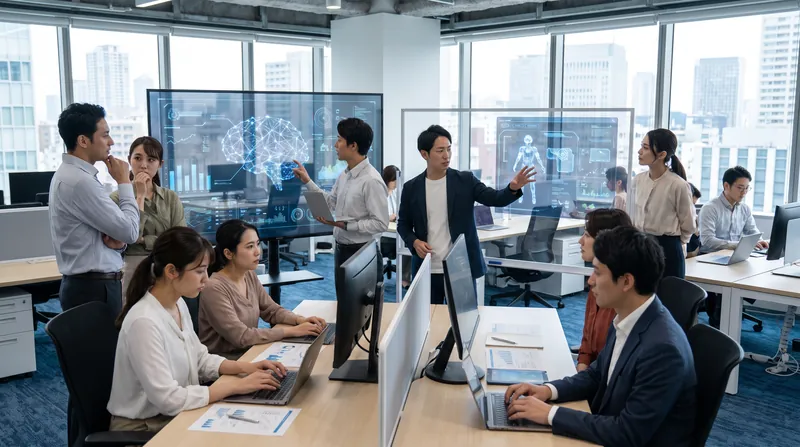
You know the feeling of spending three hours on a Tuesday afternoon just chasing down status updates and formatting a slide deck for a Wednesday morning sync. That administrative friction—the sheer weight of coordinating other people's work—has defined middle management for decades. But the era of the manager as a human relay station is ending. A landmark projection from Gartner indicates that by 2027, 20 percent of organizations will use artificial intelligence to flatten their structures, eliminating more than half of current middle management positions.[1]
While that headline number might initially land like a weight in your stomach, the reality unfolding inside modern offices is far more optimistic. The roles disappearing are the ones defined entirely by busywork. The technology is not coming for managers; it is coming for managing.
Think about the administrative friction that has historically defined the middle layer of a company—the hours spent chasing down status updates, formatting slide decks, and nagging teams to update their trackers. By automating these endless loops of scheduling, reporting, and performance monitoring, AI is clearing the bureaucratic underbrush that burns professionals out.[3]
The shift is already visible in how daily workflows are changing across major corporations. AI agents are now genuinely capable of synthesizing project data, tracking milestones, and flagging operational bottlenecks before they derail a quarter. This allows companies to operate leaner structures, a trend disruption strategists call a 'quiet compression.' Instead of announcing massive layoffs, organizations are simply not backfilling administrative management roles when people leave, allowing intelligent tools to absorb the routine workload and maintain productivity without the overhead.[4]
In this compressed environment, teams of twelve are gradually becoming teams of seven, but the dynamic is entirely different. For the managers who remain, the job is becoming significantly more interesting, carrying more influence and commanding higher compensation. Because they are no longer bogged down in the minutiae of daily tracking, these leaders can manage larger spans of control—overseeing fifteen people instead of seven—while actually working fewer hours on administrative tasks. They are directing AI agents the way they used to direct junior analysts.[4]
The focus is shifting from acting as an information gatekeeper to serving as an insight architect. Instead of merely passing instructions down and reports up, professionals are using their freed-up hours to translate AI-generated data into contextual business narratives.
They are looking for the subtle organizational patterns that algorithms inevitably miss because they lack an understanding of office dynamics. This transition places a massive premium on the human elements of leadership—the parts of the job a spreadsheet can never touch, and the very skills that originally drew many leaders to management.[2]
This human-centric approach means having the time to notice when a top performer has gone quiet in a meeting. It means sensing that two departments are about to collide over a shared resource and navigating that conflict before it happens. It means knowing exactly which team member needs a push and which one needs a breather. These are the nuanced, high-empathy judgments that build trust and psychological safety within a team, and they are entirely immune to automation.[3]
Human resources departments are actively leaning into this evolution. Rather than simply cutting costs, forward-thinking HR leaders are redefining management models to center on innovation, strategy, and coaching. They are preparing employees to take on high-value, creative roles, recognizing that a flattened organization still desperately needs people who can hold context, translate between the front line and the C-suite, and mentor junior talent. Without these human bridges, companies risk a culture gone cold and an exodus of their best young employees.[3][5]
We can already see this adaptable mindset taking root among independent professionals and forward-thinking corporate leaders. Freelancers and early-adopting managers are treating AI not as a top-down corporate mandate, but as a personal lever for growth. They are experimenting with workflows, using the tools to learn faster, and building agile teams that blend human expertise with automated efficiency. They view the technology as a collaborative partner rather than a replacement, actively seeking out new ways to integrate generative models into their daily routines to amplify their own strategic value.[6]
Ultimately, the managers who thrive in this new landscape will be the ones who master the human-AI collaboration interface. The new skill is not doing the routine task; it is designing the workflow, delegating to the agent, and exercising judgment over the output. By handing the busywork over to the machines, tomorrow's leaders are reclaiming their time to do the actual work of leading. They are transforming the modern workplace into an environment that is not only vastly more efficient, but surprisingly, much more human.[2][3]
Viewpoints in depth
Organizational Strategists
Viewing the shift as a necessary evolution from bureaucratic hierarchies to agile, insight-driven structures.
For disruption strategists and organizational designers, the elimination of traditional middle management is not a loss of talent, but a correction of bloated corporate structures. They argue that the historical role of the middle manager—acting as a human relay station between the C-suite and the front line—was an artifact of the pre-AI era. By deploying intelligent agents to handle scheduling, reporting, and performance tracking, companies can operate with leaner, faster teams. In this view, the managers who remain will manage larger spans of control, directing AI workflows while focusing their human energy on high-level strategic judgment.
Human Resources Leaders
Focusing on the cultural risks of flattening organizations and the urgent need to redefine leadership models.
HR professionals acknowledge the efficiency gains but warn against cutting the middle layer without a deliberate plan for company culture. Middle managers have historically been the glue that holds teams together, mentoring junior staff and translating abstract corporate goals into daily motivation. HR leaders advocate for a proactive redeployment of talent, transitioning managers away from operational oversight and into roles explicitly centered on coaching and innovation. They stress that if companies simply eliminate roles without upskilling their remaining leaders, they risk a collapse in employee engagement and a loss of critical institutional knowledge.
Frontline Managers
Experiencing the transition as a relief from administrative burnout, coupled with the pressure to rapidly upskill.
For the professionals actually doing the job, the AI transition is a double-edged sword that leans positive. Many are eager to shed the administrative friction that consumes their workweeks—the endless status meetings, dashboard updates, and coordination emails. They view the automation of 'managing' as a gift that allows them to return to the core of their expertise. However, this camp also recognizes the urgent need to become AI-fluent. Their survival in the flattened organization depends on their ability to design workflows, delegate to digital agents, and prove their value through complex stakeholder management and emotional intelligence.
Key points
- Gartner projects that 20 percent of organizations will use AI to flatten their structures by 2027, eliminating over half of traditional middle management roles.
- Rather than replacing human leaders, the technology is automating the administrative friction of scheduling, reporting, and performance tracking.
- Managers who adapt are shifting from 'information gatekeepers' to 'insight architects,' using their freed-up time to translate data into strategic action.
- Human resources departments are actively redefining leadership models to prioritize empathy, conflict resolution, and team mentoring.
How we got here
Late 2024
Gartner releases its top strategic predictions, forecasting that AI will eliminate over 50% of middle management roles in a fifth of organizations by 2026-2027.
Early 2025
Major tech and finance firms begin 'quiet compression,' shrinking team sizes and relying on AI tools to handle administrative oversight.
Mid 2025
Industry leaders publicly warn of structural shifts in white-collar employment, sparking debates over AI's impact on career pipelines.
2026
The narrative shifts from job loss to role evolution, with HR departments actively upskilling managers to focus on human-centric leadership and AI workflow design.
- Human-Centric Leadership Proponents
- Argue that AI eliminates the busywork of managing, allowing professionals to focus on empathy, coaching, and team dynamics.
- Efficiency Advocates
- Focus on the structural flattening of organizations and the economic benefits of replacing administrative layers with AI.
- Workforce Adaptability Experts
- Emphasize the need for HR and independent professionals to proactively upskill and redefine roles for the new AI era.
Perspectives this story doesn't cover
- Entry-Level Employees
- Labor Union Representatives
Sources
Source coverage
6 outlets
3 viewpoints surfaced






- [1]GartnerEfficiency Advocates
Gartner Top Strategic Predictions for 2025 and Beyond
Read on Gartner → - [2]ForbesHuman-Centric Leadership Proponents
The AI Middle Management Shift: From Gatekeepers To Insight Architects
Read on Forbes → - [3]Inc.Human-Centric Leadership Proponents
Gartner Says AI Will Replace 50% of Middle Managers. Here's Why It's Actually Good News.
Read on Inc. → - [4]Shawn KanungoEfficiency Advocates
Why 50% of Middle Managers Could Be Replaced by AI by 2027 (And What To Do If You're One)
Read on Shawn Kanungo → - [5]SHRMWorkforce Adaptability Experts
Implications for HR and Leadership
Read on SHRM → - [6]UpworkWorkforce Adaptability Experts
AI is shifting managers' responsibilities
Read on Upwork →
More in Lifestyle
See all →Circadian Rhythm
Clockwise Shift Rotation Exploits the 24.2-Hour Circadian Drift: Why Delaying Work Hours Preserves Sleep and Alertness
4 sources

Wage Compliance
The 1.5x Overtime Rule: How the Fair Labor Standards Act Calculates Time-and-a-Half
9 sources

H-1B Visas
White House Issues Executive Order Scrutinizing H-1B Employers With Layoffs, Extends $100,000 Visa Fee
4 sources
Task Prioritization
The 80/20 Ratio: How the Pareto Principle Identifies the 20% of Tasks That Generate 80% of Work Output
7 sources

Comments
Every angle. Every day.
Get Lifestyle stories with full source coverage and perspective breakdowns, free every day.