
AI-Powered Tools Deliver 35% Better Outcomes in Physical Therapy, Revolutionizing Mobility Care
New clinical data shows that integrating artificial intelligence into physical therapy practices improves patient recovery outcomes by 35% while reducing overall treatment time. The technology uses computer vision and real-time motion analysis to personalize rehabilitation and ensure patients perform exercises correctly at home.


- Rehabilitation Technologists
- Advocates for using computer vision and machine learning to enforce perfect exercise compliance.
- Clinical Practitioners
- Therapists focused on using AI to reduce administrative burnout and increase hands-on patient time.
- Healthcare Strategists
- Administrators and analysts focused on predictive care, cost efficiency, and scalable access.
Why it matters
For the millions of people who rely on physical therapy each year, AI integration means faster recovery times, fewer clinic visits, and lower out-of-pocket costs. By providing real-time feedback during home exercises, the technology solves the industry's biggest bottleneck: patients performing movements incorrectly or abandoning their routines entirely.
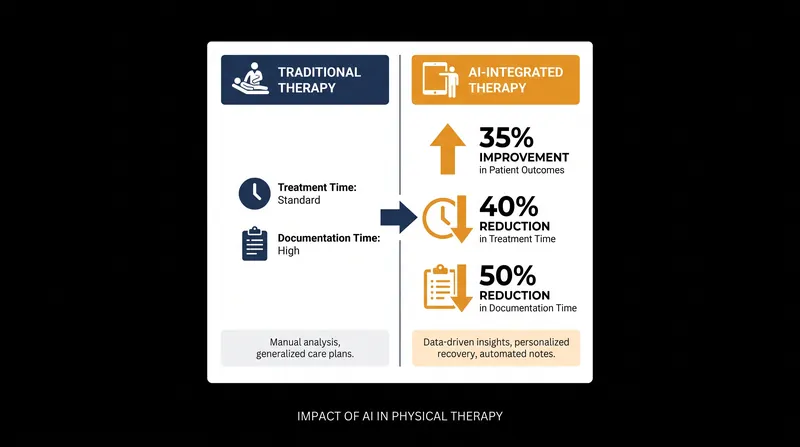
Artificial intelligence is fundamentally reshaping how patients recover from injuries and surgeries, with new clinical data revealing that AI-integrated physical therapy practices are achieving a 35% improvement in patient outcomes. Alongside this significant boost in recovery quality, these intelligent systems are driving a 40% reduction in overall treatment time, allowing patients to regain their mobility much faster than traditional methods typically allow. For the millions of people who rely on physical therapy each year to overcome chronic pain or post-surgical limitations, this technology represents a paradigm shift from subjective observation to data-driven precision.[1][3]
The breakthrough relies on a sophisticated combination of computer vision, wearable sensors, and machine learning algorithms that can analyze a patient's movement patterns with up to 95% accuracy. Instead of relying solely on periodic in-clinic assessments where a therapist visually estimates joint angles and range of motion, clinicians can now deploy AI-powered motion tracking that continuously monitors patients with mathematical precision. These systems map the human body in three-dimensional space, capturing kinematic data that reveals exactly how joints and muscles are interacting during complex movements.[1][3]
Historically, the physical therapy industry has struggled immensely with home exercise compliance, which remains the single biggest bottleneck to successful rehabilitation. Without direct supervision, patients often perform their exercises with poor form, fail to see meaningful progress, and ultimately abandon their rehabilitation routines entirely out of frustration. When patients perform movements incorrectly, they not only delay their recovery but actively risk exacerbating their original injury by reinforcing negative compensatory movement patterns.[1]
AI systems bridge this critical gap by acting as a continuous, on-demand digital therapist in the patient's living room. Using standard smartphone cameras or specialized wearable sensors, the software provides real-time biomechanical feedback, correcting a patient's posture instantly if they compensate with the wrong muscle group. This closed-loop feedback system ensures that every repetition performed at home is as safe and effective as one performed under a clinician's direct, watchful eye, transforming the home environment into a true extension of the clinic.[1][3]
AI systems bridge this critical gap by acting as a continuous, on-demand digital therapist in the patient's living room.
Beyond standard orthopedic recovery and routine sports injuries, artificial intelligence is proving to be highly transformative for complex neurological cases that require intensive, specialized care. AI-powered robotic exoskeletons and immersive virtual reality environments are enabling the high-repetition, precise training necessary to drive neuroplastic change in stroke survivors and patients with spinal cord injuries. These intelligent robotic systems can detect subtle compensatory movements that might easily escape the naked eye, automatically adjusting the level of physical resistance and support they provide in real time.[3]
For the clinicians delivering this care, the technology is alleviating a severe administrative burden that has fueled widespread burnout across the healthcare industry. Physical therapists typically spend a massive portion of their working day on mandatory documentation, including initial evaluations, daily progress notes, and complex insurance authorizations. Ambient AI scribes and automated tracking tools are now reducing this documentation time by up to 50%, freeing providers from the computer screen and allowing them to manage higher patient volumes without compromising the quality of their care.[3]

By automating the unseen clerical work and objective data gathering, AI is actually restoring the deeply human element of physical therapy. Instead of spending a quarter of an evaluation staring at a tablet to record range-of-motion measurements, therapists can maintain continuous eye contact, focus on manual tactile treatment, and build the empathetic therapeutic alliance that algorithms simply cannot replicate. Practitioners report that this shift allows them to focus on the psychological and emotional aspects of recovery, which are just as critical as the physical mechanics.
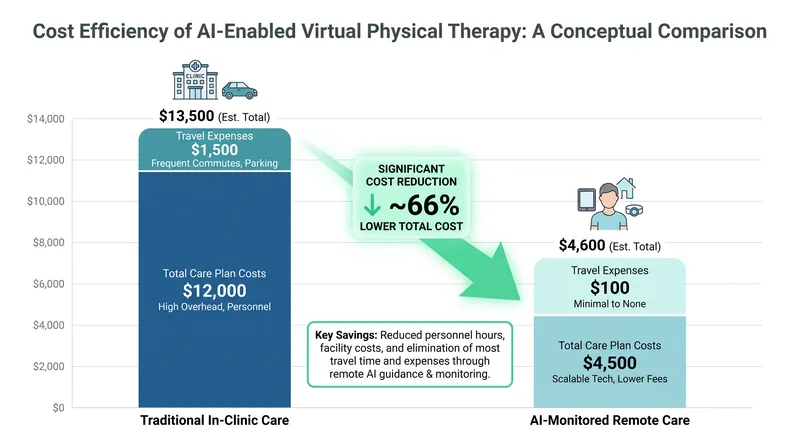
The financial and accessibility implications for patients are equally significant, particularly as healthcare costs continue to rise. By enabling highly effective remote monitoring and reducing the number of in-person sessions required to achieve full mobility, AI-enabled virtual physical therapy is significantly lowering out-of-pocket costs and travel expenses. This scalable digital model allows rural and underserved populations to receive high-quality, specialized care without facing geographical or transportation barriers, effectively democratizing access to top-tier rehabilitation expertise.[2][3]
As the technology matures, the industry is rapidly moving toward predictive rehabilitation. Advanced AI models are now being trained to analyze large datasets of biomechanics, daily activity levels, and medical history to identify potential injuries before they ever occur. By detecting subtle gait abnormalities or fall risks early, clinicians can design personalized prevention strategies, shifting the focus from post-injury treatment to proactive mobility preservation. This evolution promises to transform physical therapy from a reactive medical service into a foundational pillar of long-term preventative health.[2]
What to know
- AI-integrated physical therapy practices are reporting a 35% improvement in patient recovery outcomes.
- Computer vision and wearable sensors provide real-time form correction for home exercise programs.
- Automated documentation and ambient scribes are reducing therapist administrative time by up to 50%.
- AI-enabled remote monitoring is significantly lowering out-of-pocket costs and travel expenses for patients.
- The technology is shifting the industry toward predictive care, identifying injury risks before they occur.
Where opinion splits
Rehabilitation Technologists
Advocates for using computer vision and machine learning to enforce perfect exercise compliance.
This camp views the traditional home exercise program as a broken model, pointing to data showing that a significant portion of patients fail to complete their routines correctly. By deploying AI as a 'digital therapist' that monitors form through a smartphone camera, technologists argue that the industry can finally close the feedback loop. They emphasize that the 35% improvement in outcomes is directly tied to this real-time biomechanical correction, which prevents patients from developing compensatory movement patterns.
Clinical Practitioners
Therapists focused on using AI to reduce administrative burnout and increase hands-on patient time.
For frontline physical therapists, the primary value of AI lies in its ability to automate the clerical burden that has plagued the profession. Practitioners highlight that ambient scribes and automated range-of-motion tracking can cut documentation time in half. Rather than replacing the clinician, they argue that AI clears the administrative path, allowing therapists to maintain eye contact, provide manual tactile feedback, and build the empathetic therapeutic alliance that algorithms cannot replicate.
Healthcare Strategists
Administrators and analysts focused on predictive care, cost efficiency, and scalable access.
Strategists look beyond individual recovery to the macroeconomic impact of AI in physical therapy. They emphasize that remote monitoring and virtual care can save patients significant amounts of money per care plan while extending high-quality rehabilitation to rural and underserved populations. Furthermore, this camp is pushing the industry toward predictive rehabilitation—using AI to analyze gait and biomechanics to forecast fall risks and prevent injuries before they require costly surgical interventions.
Sources
Source coverage
3 outlets
3 viewpoints surfaced



[1]Shadhin LabRehabilitation Technologists
AI-Powered Physical Therapy: A New Era in Patient Care
Read on Shadhin Lab →[2]Husson UniversityHealthcare Strategists
Why Technology Is Redefining Physical Therapy in the 2020s
Read on Husson University →[3]SpryptRehabilitation Technologists
Benefits of AI-Powered Rehabilitation Tools
Read on Sprypt →
Comments
Every angle. Every day.
Get fitness stories with full source coverage and perspective breakdowns delivered to your inbox.