
Controlled Forest Fires Reduce Long-Term Smoke Pollution, Two-Decade Study Finds
A comprehensive analysis of California wildfires reveals that while prescribed burns initially release smoke, they cut the risk of severe fires by 92% and reduce cumulative toxic air pollution by 10% over a decade.
By Factlen Editorial Team
- Forest Ecologists
- Advocate for returning low-severity fire to the landscape to reduce fuel loads and prevent catastrophic infernos.
- Public Health Researchers
- Focus on the net reduction of PM2.5 exposure over time, viewing prescribed burns as a preventative health measure.
- Air Quality Regulators
- Tasked with protecting daily air quality, they must weigh the immediate impacts of intentional smoke against long-term models.
What's not represented
- · Indigenous Land Managers
- · Residents of Wildland-Urban Interface (WUI) Communities
Why this matters
Wildfire smoke has become a dominant public health threat across the American West, exposing millions to toxic PM2.5 pollution. This research proves that intentionally setting controlled fires—despite the short-term smoke they produce—is the most mathematically effective way to prevent the massive, deadly smoke plumes of catastrophic infernos.
Key points
- A Stanford study analyzed 20 years of satellite data to measure the air quality impacts of prescribed burns.
- Low-severity fires reduce the immediate risk of subsequent severe wildfires by 92%.
- Treating 500,000 acres annually would cut cumulative smoke pollution by 10% over a decade.
- The long-term air quality benefits outweigh the short-term smoke costs by a factor of 5 to 1.
For more than a century, the standard response to a forest fire in the American West was to extinguish it as quickly as possible. This policy of total suppression successfully put out flames, but it inadvertently created a ticking time bomb of accumulated dead wood, dense underbrush, and overcrowded trees.
Today, that fuel load is driving a crisis of catastrophic, high-severity wildfires. Beyond the immediate destruction of ecosystems and property, these infernos have triggered a secondary public health emergency: massive plumes of toxic smoke that blanket entire regions and expose millions to hazardous air pollution.
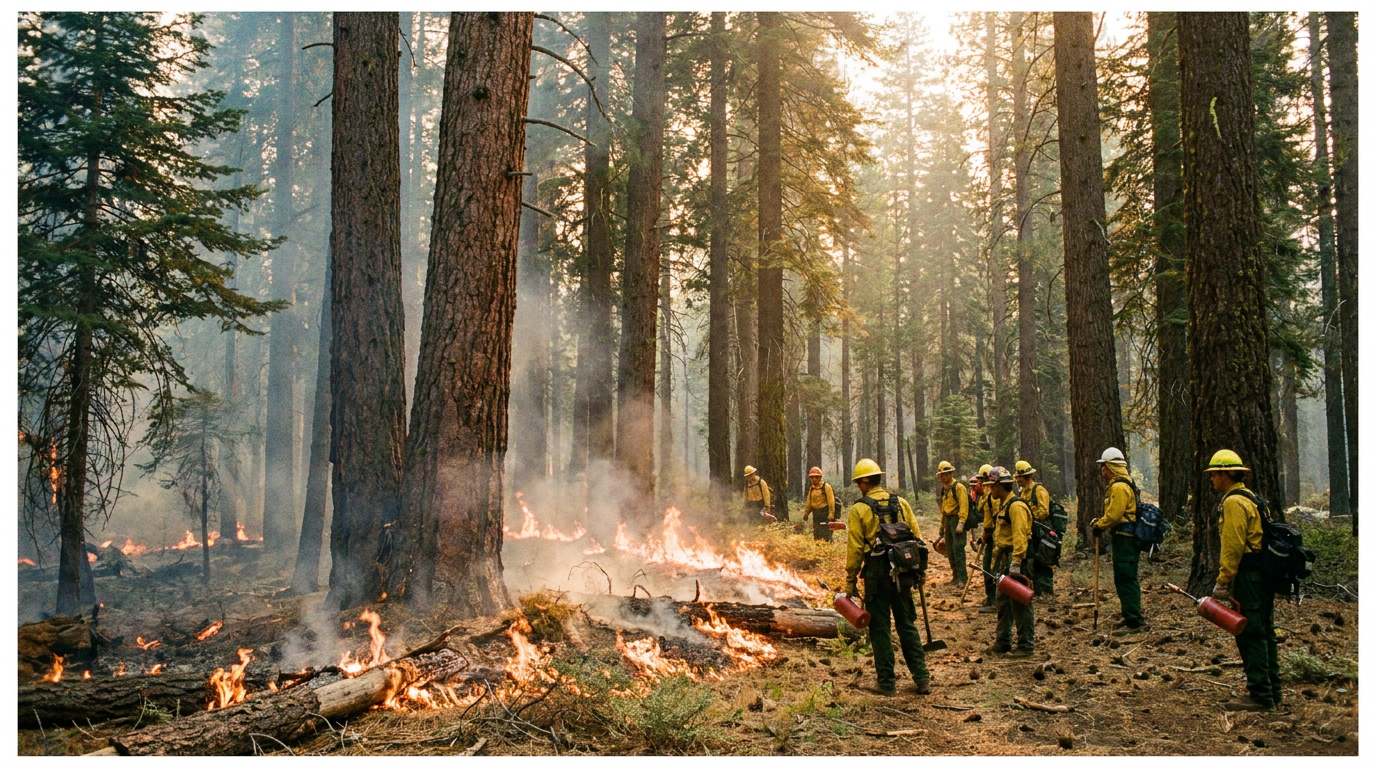
Forest ecologists have long advocated for a return to "prescribed burning"—the intentional, controlled application of low-severity fire to clear out accumulated fuel. But this proposed solution faces a major public relations and regulatory hurdle: prescribed burns generate their own smoke, intentionally polluting the air in the short term.
Now, a landmark study published in the journal Science provides the most comprehensive evidence to date that the long-term benefits of prescribed burns far outweigh their short-term costs. The research, led by scientists at Stanford University, quantifies exactly how much smoke can be prevented by fighting fire with fire.[4][5]

The central claim of the study is striking: treating 500,000 acres of California conifer forests with prescribed burns every year would reduce cumulative harmful smoke pollution by approximately 10% over a decade.[1][5]
During the most severe wildfire seasons—such as the historic blazes of 2020 and 2021—that reduction in smoke exposure could reach as high as 25%, potentially saving numerous lives and preventing thousands of asthma attacks and hospitalizations.[2]
To build this evidence base, the researchers did not rely on small-scale field tests. Instead, they analyzed two decades of satellite data covering nearly 99% of all wildfire events reported in California between 2000 and 2021.[5]
Because prescribed burning is currently practiced on too small a scale to study its macroscopic impacts directly, the team used natural low-severity wildfires as a proxy. They paired the burn data with fire-specific estimates of PM2.5—the microscopic particulate matter that penetrates deep into the lungs—from 2006 to 2020.[2][5]
Because prescribed burning is currently practiced on too small a scale to study its macroscopic impacts directly, the team used natural low-severity wildfires as a proxy.
The data revealed a profound protective effect. When an area experiences a low-severity fire, the risk of a subsequent high-severity fire in that exact location immediately drops by 92%.[3][5]

Crucially, this protective buffer extends well beyond the burn scar. The researchers found that the risk of severe fire is significantly reduced for up to 5 kilometers (about 3 miles) away from the directly treated area, and this benefit persists for up to a decade.[5]
The mechanism is straightforward: low-severity fires consume the "ladder fuels" on the forest floor without killing the mature canopy. When a subsequent wildfire hits that treated area, it drops from the canopy to the ground, losing intensity and producing a fraction of the smoke.[6]
However, the study is transparent about the trade-offs and the timeline of these benefits. The models confirm that launching a massive prescribed burn campaign will initially increase overall smoke exposure in the region.[3]

The data shows an inflection point: it takes about four years of sustained prescribed burning before the cumulative reduction in wildfire smoke overtakes the intentional smoke produced by the controlled burns.[2][3]
"This study highlights that yes, prescribed fire is good, but sometimes the benefits take a while," noted Marshall Burke, a professor at the Stanford Doerr School of Sustainability and senior author of the study. "As a species, we're not that good at delayed gratification, but our numbers say in the end, it's worth it."[3]
Over a full decade, the air quality benefits of preventing catastrophic wildfires outweigh the initial cost of smoke from prescribed burns by a staggering factor of 5 to 1.[5]

There are uncertainties in the modeling. Independent air quality experts point out that aggressive prescribed burning is a gamble on future weather. If a region undergoes extensive prescribed burning but experiences a decade of naturally low wildfire activity, the intentional smoke could represent a net detriment to public health for that specific period.[3]
Furthermore, executing 500,000 acres of prescribed burns annually is a monumental logistical challenge. It is roughly four times the area currently treated across all California wildlands, requiring massive workforce expansion and a shift in how air quality regulators permit intentional smoke on clear days.[2][5]
Despite these hurdles, the evidence pack presented by the Stanford team shifts the debate from a theoretical ecological concept to a quantified public health strategy. The data strongly suggests that accepting a controlled amount of smoke today is the most effective medical intervention available to prevent the toxic skies of tomorrow.[1][4]
How we got here
Pre-1900s
Indigenous communities routinely used low-severity fire to manage landscapes and reduce fuel.
20th Century
Federal and state policies mandated the suppression of all wildfires, leading to massive fuel accumulation.
2020-2021
California experienced its worst wildfire smoke years on record, exposing millions to hazardous PM2.5 levels.
June 2026
Stanford researchers published a two-decade analysis quantifying the long-term air quality benefits of prescribed burns.
Viewpoints in depth
Public Health and Epidemiology
Focuses on the long-term mortality reduction from lower PM2.5 exposure.
From a public health perspective, the study reframes prescribed burning from an ecological tool to a medical intervention. Epidemiologists emphasize that PM2.5 from wildfire smoke is exceptionally toxic, driving spikes in asthma, cardiovascular events, and premature mortality. While prescribed burns intentionally introduce some PM2.5 into the air, public health models show that this controlled exposure prevents the massive, uncontrolled toxic plumes of catastrophic fires. The 5-to-1 benefit ratio provides the empirical backing needed to justify the short-term respiratory impacts as a necessary trade-off for long-term population health.
Forest Ecology and Management
Emphasizes the restoration of natural fire regimes and the 92% reduction in severe fire risk.
Forest ecologists view the findings as validation of what indigenous land managers have known for centuries: conifer forests evolved with fire and require it to remain healthy. By suppressing all fires for the past century, management policies created artificially dense forests loaded with 'ladder fuels' that carry flames into the canopy. Ecologists point to the study's finding that low-severity fires reduce future severe fire risk by 92% as proof that fighting fire with fire is the only scalable way to defuse the fuel bomb currently sitting in Western forests.
Air Quality Regulation
Highlights the regulatory and political difficulty of intentionally polluting the air today for a theoretical benefit tomorrow.
For local air quality boards, the study highlights a profound regulatory paradox. Their mandate is to keep daily air pollution below federal safety thresholds. Approving a prescribed burn means intentionally degrading local air quality, which triggers immediate public complaints and health warnings. Regulators point out the uncertainty inherent in the models: if a region endures the smoke of a prescribed burn but a severe wildfire never strikes that area, the public suffered the pollution for no realized benefit. This 'delayed gratification' makes expanding prescribed burns a politically fraught endeavor.
What we don't know
- How local air quality boards will adapt their strict daily pollution thresholds to allow for the intentional, short-term smoke required by a massive prescribed burn campaign.
- Whether the 5-to-1 benefit ratio holds true in non-conifer ecosystems, such as chaparral or oak woodlands, which have different fire dynamics.
Key terms
- Prescribed burn
- The intentional, controlled application of fire to a landscape to reduce hazardous fuel loads and restore ecological health.
- PM2.5
- Fine particulate matter 2.5 micrometers or smaller in diameter, which can penetrate deep into the lungs and enter the bloodstream.
- Low-severity fire
- A fire that burns close to the ground, consuming underbrush and dead wood without killing the mature tree canopy.
- Conifer forest
- Forests dominated by cone-bearing, needle-leaved trees like pines and firs, which are highly adapted to frequent, low-intensity fires.
Frequently asked
Don't prescribed burns create harmful smoke?
Yes, prescribed burns do release PM2.5 pollution. However, the study found that the smoke they produce is far less than the catastrophic emissions from a high-severity wildfire.
How long does it take to see the air quality benefits?
The models indicate that while smoke pollution initially rises, a net reduction in cumulative smoke exposure is achieved by year four of a sustained burning campaign.
How much land needs to be burned to make a difference?
The researchers modeled treating 500,000 acres of California conifer forests annually, which is roughly four times the area currently treated across all state wildlands.
Does a prescribed burn protect nearby unburned areas?
Yes. The study found that low-severity fires reduce the risk of future severe fires not only in the directly burned area but up to 5 kilometers (3 miles) away.
Sources
Source coverage
6 outlets
3 viewpoints surfaced






[1]NaturePublic Health Researchers
Fiery data hint that controlled forest fires benefit human health
Read on Nature →[2]KQEDAir Quality Regulators
Can Controlled Burns Reduce California's Air Pollution?
Read on KQED →[3]SFGATEAir Quality Regulators
Prescribed burns could reduce air pollution over time, study finds
Read on SFGATE →[4]ScienceForest Ecologists
Low-severity fire reduces future severe fire risk and smoke exposure
Read on Science →[5]Stanford NewsForest Ecologists
Stanford study finds prescribed burns reduce wildfire smoke pollution
Read on Stanford News →[6]Science Media CentrePublic Health Researchers
Expert reactions to study assessing benefits of prescribed forest fires for air pollution
Read on Science Media Centre →

Every angle. Every day.
Get science stories with full source coverage and perspective breakdowns delivered to your inbox.