
Archaeologists Uncover 5,000-Year-Old Wooden 'Prototype' of Stonehenge
A newly analyzed timber structure found three miles from Stonehenge reveals that ancient Britons were aligning monuments to the summer solstice 500 years before the famous stone circle was built.
By Factlen Editorial Team
- Archaeoastronomers
- Focus on the precise mathematical and astronomical alignment of the structure.
- Field Archaeologists
- Focus on the physical evidence, the excavation process, and the material culture left behind.
- Prehistoric Historians
- Focus on how the site fits into the broader cultural evolution of Neolithic Britain.
What's not represented
- · Modern Pagan and Druid communities who view these ancient sites as active places of worship
- · Local Wiltshire residents impacted by the ongoing archaeological excavations and military housing developments
Why this matters
This discovery fundamentally rewrites the history of one of the world's most famous monuments, proving that the astronomical knowledge and cultural traditions behind Stonehenge existed centuries earlier than previously thought. It offers a rare, tangible glimpse into how early human communities organized their societies, tracked time, and found meaning in the cosmos.
Key points
- Archaeologists have identified a 5,000-year-old timber structure in Bulford, just three miles from Stonehenge.
- The monument consisted of two large wooden posts aligned perfectly with the summer solstice sunrise and winter solstice sunset.
- The wooden structure predates the astronomical alignment of Stonehenge's massive sarsen stones by approximately 500 years.
- Artifacts found at the site, including pottery and animal bones, suggest it was a major gathering place for seasonal communal feasting.
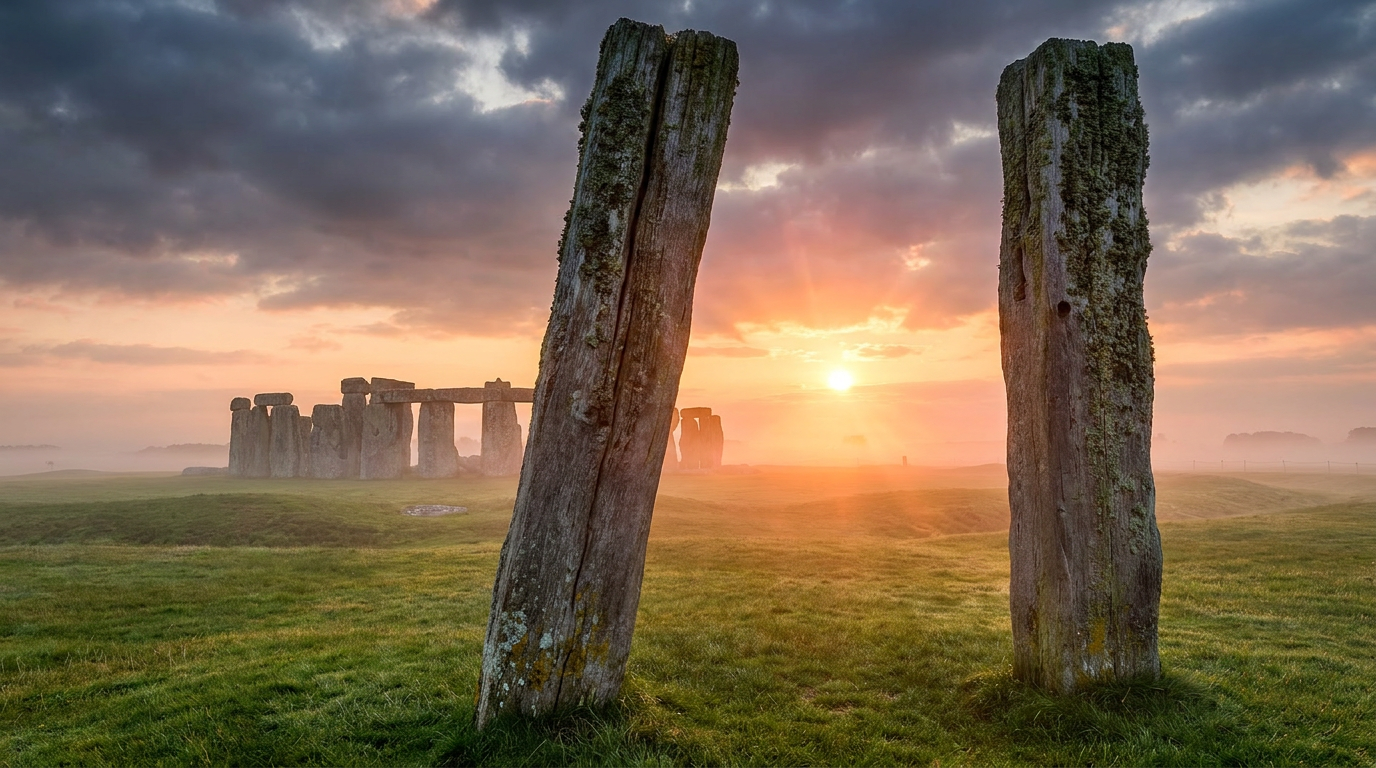
Just three miles from the iconic sarsen stones of Stonehenge, archaeologists have unearthed the remains of a 5,000-year-old timber structure that fundamentally rewrites the timeline of solar worship in prehistoric Britain. The discovery, located in the village of Bulford in Wiltshire, consists of two massive post holes that once held towering wooden pillars. According to researchers, these posts were perfectly aligned with the summer and winter solstices, predating the astronomical alignment of Stonehenge's famous stone circle by approximately 500 years. The find offers unprecedented insight into the early Neolithic communities that inhabited the Salisbury Plain, suggesting that the region was a center for celestial observation long before the first megaliths were dragged into place.[1][2][3]
The site was initially identified during ground clearance work for the British Ministry of Defence's Army Basing Programme, which was preparing to accommodate troops returning from Germany. Wessex Archaeology, the team leading the excavation, recognized the potential significance of the anomalous pits in the chalky soil. However, it took years of meticulous excavation and subsequent digital landscape modeling to fully grasp what the Bulford site represented. Excavation leader Phil Harding described the unearthing of the solstice-aligned pits as "certainly the highlight of my career," emphasizing that the seemingly simple post holes reveal profound details about how ancient communities revered the heavens.[4][5]
While the wooden posts themselves rotted away millennia ago, the surviving post holes provided archaeologists with exact dimensions and placements. The two pillars stood roughly 120 meters apart and are estimated to have reached between two and four meters in height. The sheer scale of the timber required for such a monument indicates a highly organized community capable of felling, transporting, and erecting massive trees using only stone and bone tools. The chalk packing around the base of the vanished posts confirms they were intended to stand permanently, serving as fixed points in the rolling Wiltshire landscape.[3][4]
The most striking claim surrounding the Bulford structure is its precise astronomical orientation. When researchers mapped the site, they discovered that a line drawn between the two posts points directly toward the sunrise on the summer solstice and the sunset on the winter solstice. This mirrors the exact solar alignment that would later make Stonehenge world-famous. Dr. Matt Leivers, a senior research manager on the project, noted that the Bulford site is fundamental to British archaeology because it represents the earliest known example of solstice-aligned construction in the region.[1][4][5]

To verify this alignment, the archaeological team collaborated with Dr. Fabio Silva, an archaeoastronomer from Bournemouth University and the Skyscape Academy. Because the Earth's axial tilt slowly wobbles over millennia—a phenomenon known as precession—the exact position of the sunrise 5,000 years ago differs slightly from where it rises today. Dr. Silva utilized advanced skyscape modeling software to reconstruct the ancient horizon and night sky as it would have appeared around 3000 BCE.[4][7]
The results of the skyscape analysis were staggering. When accounting for the estimated width of the wooden posts and the prehistoric celestial mechanics, the alignment was accurate to within just one degree. "If you take into account the width of the posts... then the alignment is exactly, exactly right," Dr. Silva confirmed. This level of precision strongly suggests that the placement was not accidental, but rather the result of generations of careful observation of the sun's movements along the horizon.[4][7]
The discovery acts as a crucial piece of evidence in the ongoing debate about the origins of Stonehenge. For decades, archaeologists have debated whether the stone circle was an isolated stroke of genius or the culmination of a long-standing local tradition. The Bulford timber structure firmly supports the evolutionary model of the landscape. It demonstrates that the conceptual framework for Stonehenge—a monument designed to frame the solstices—was already deeply ingrained in the local culture half a millennium before the massive sarsen stones were erected.[1][2][6]
The discovery acts as a crucial piece of evidence in the ongoing debate about the origins of Stonehenge.
Beyond the post holes, the excavation yielded a wealth of artifacts that paint a vivid picture of the site's function. Archaeologists recovered significant quantities of Grooved Ware pottery, animal bones, and a rare disc-shaped flint knife. The concentration of these artifacts, particularly the animal remains, strongly indicates that the site was used for large-scale communal feasting. These gatherings likely coincided with the solstices, bringing together dispersed farming communities to celebrate the changing of the seasons, trade goods, and forge social alliances.[5]

The presence of a wooden monument so close to the later stone circle also revitalizes theories regarding the symbolic use of materials in Neolithic Britain. Some prominent archaeologists have hypothesized that in prehistoric British culture, timber structures were associated with the realm of the living, while stone monuments were dedicated to the ancestors and the dead. Under this framework, the Bulford site may have been a vibrant, active ceremonial center for the living community, setting a cultural precedent that was later monumentalized in stone at Stonehenge.[6]
Despite the strength of the alignment evidence, transparent uncertainties remain regarding the exact nature of the Bulford structure. Because wood decays completely in the acidic topsoil and porous chalk, researchers cannot know if the posts were carved, painted, or decorated. The estimated height of two to four meters is a calculated guess based on the depth and width of the post holes, but the true visual impact of the monument is lost to time. Furthermore, it is impossible to know if the two posts were part of a larger, undiscovered timber complex that has been destroyed by subsequent millennia of agriculture.[3]
There is also ongoing debate about the primary utility of such monuments. While the ceremonial and religious significance is undeniable, some researchers argue that these early alignments served a highly practical purpose. For early agricultural societies, accurately tracking the solar year was a matter of survival. Knowing exactly when the days would begin to shorten or lengthen dictated the planting and harvesting of crops. The Bulford posts may have functioned as a monumental agricultural calendar, anchoring the community's economic survival to their religious practices.[1]

The timeline of the Bulford site places its construction squarely in the early Neolithic period, contemporary with the very first phase of Stonehenge. Around 3000 BCE, Stonehenge consisted merely of a circular earthwork enclosure and a ditch, with no large stones present. The fact that a highly accurate, solstice-aligned timber structure was operating just three miles away suggests that the Salisbury Plain was a bustling, interconnected ritual landscape, rather than a single isolated holy site.[4][6]
This interconnectedness challenges the traditional narrative of how prehistoric monuments were developed. It suggests a landscape where ideas, architectural styles, and astronomical knowledge were actively shared and refined over centuries. The transition from the wooden posts at Bulford to the megalithic stones at Stonehenge represents a technological and societal escalation, as later generations sought to make their ancestors' ephemeral wooden alignments permanent.[3][6]
The successful identification of the Bulford site also highlights the evolving nature of archaeological science. A century ago, two isolated post holes might have been recorded and dismissed as remnants of a simple prehistoric hut. Today, the integration of digital skyscape modeling, precise radiocarbon dating of organic residue, and wide-area landscape analysis allows researchers to extract profound narratives from seemingly minor features. It is a testament to how modern technology is illuminating the deepest shadows of human history.[4][7]

Ultimately, the discovery of the Bulford timber structure humanizes the builders of Stonehenge. It reveals that the awe-inspiring stone circle was not built overnight by a sudden influx of advanced knowledge, but was rather the final expression of a local tradition that had been practiced and perfected for 500 years. By looking at the empty post holes aligned with the midsummer sun, we are granted a direct line of sight into the minds of a community that was just beginning to map its place in the cosmos.[1][2]
How we got here
c. 3000 BCE
The Bulford timber structure is erected, with two massive wooden posts aligned to the summer and winter solstices.
c. 3000 BCE
The earliest phase of Stonehenge begins with the construction of a circular earthwork enclosure and ditch.
c. 2500 BCE
The massive sarsen stones and smaller bluestones are transported and erected at Stonehenge, monumentalizing the solar alignment in stone.
2016
The Bulford post holes are initially uncovered during ground clearance for a Ministry of Defence housing project.
June 2026
Following extensive skyscape modeling and analysis, archaeologists publicly confirm the site as a 5,000-year-old solstice-aligned 'prototype' for Stonehenge.
Viewpoints in depth
Archaeoastronomers
Focus on the precise mathematical and astronomical alignment of the structure.
This camp emphasizes that the 1-degree accuracy of the solar alignment could not have occurred by chance. Using advanced skyscape modeling to account for 5,000 years of stellar drift, they argue that the Neolithic builders possessed a sophisticated, generational understanding of celestial mechanics. To these researchers, the site is primarily an astronomical instrument and a calendar, proving that early Britons were deeply invested in mapping the cosmos.
Field Archaeologists
Focus on the physical evidence, the excavation process, and the material culture left behind.
For field archaeologists, the significance lies in the tangible remains: the massive post holes dug into the chalk, the Grooved Ware pottery, and the animal bones. They argue that while the alignment is important, the site was fundamentally a physical gathering place. The sheer effort required to fell and erect two-to-four-meter timbers indicates a highly organized labor force and a community centered around seasonal feasting and social cohesion.
Prehistoric Historians
Focus on how the site fits into the broader cultural evolution of Neolithic Britain.
This perspective views the Bulford structure as a crucial missing link in the evolution of British monuments. They argue that the site proves Stonehenge was not an isolated phenomenon, but the culmination of a long-standing local tradition of solar worship. By comparing the wooden posts to later stone circles, they explore the theory that timber represented the realm of the living, while stone was reserved for the ancestors, framing the Salisbury Plain as a vast, interconnected ritual landscape.
What we don't know
- Whether the wooden posts were carved, painted, or decorated, as the wood has completely decayed.
- The exact height of the timbers, though they are estimated to have stood between two and four meters tall.
- If the two posts were part of a larger, undiscovered timber complex that has been destroyed by millennia of agriculture.
- The specific religious rituals or ceremonies that were performed at the site during the solstice gatherings.
Key terms
- Archaeoastronomy
- The study of how people in the past understood the phenomena in the sky, how they used these phenomena, and what role the sky played in their cultures.
- Summer Solstice
- The day of the year with the longest period of daylight, occurring when the sun reaches its highest and northernmost position in the sky.
- Post hole
- A hole dug into the ground to hold a timber post, which often leaves a distinct dark stain and packed earth long after the wood has decayed.
- Precession
- The slow, gradual shift in the orientation of Earth's axis of rotation, which slightly changes the apparent position of stars and sunrises over thousands of years.
- Grooved Ware
- A style of pottery characteristic of the British and Irish Neolithic period, often associated with early henge monuments and communal feasting.
Frequently asked
Where exactly was the new structure found?
The timber structure was discovered in the village of Bulford in Wiltshire, England, approximately three miles (five kilometers) from Stonehenge.
How do archaeologists know wooden posts were there if they rotted away?
While the wood decayed millennia ago, it left distinct, large post holes packed with chalk in the soil, allowing researchers to determine the exact size and placement of the original timbers.
Did the same people build both the wooden structure and Stonehenge?
It is highly likely that the descendants of the community that built the Bulford timber structure went on to construct the later, more famous stone phases of Stonehenge.
Why was the structure aligned with the summer solstice?
For early agricultural societies, tracking the longest and shortest days of the year was crucial for farming calendars and likely held deep religious and communal significance.
Sources
Source coverage
7 outlets
3 viewpoints surfaced







[1]New ScientistArchaeoastronomers
Ancient monument marked summer solstice centuries before Stonehenge
Read on New Scientist →[2]BBCField Archaeologists
Simpler, older version of Stonehenge found three miles from famous site
Read on BBC →[3]The DebriefPrehistoric Historians
Archaeologists Discover Stonehenge 'Prototype' Constructed 500 Years Before Britain's Most Famous Megalithic Site
Read on The Debrief →[4]DexertoPrehistoric Historians
Ancient wooden structure mirrors Stonehenge's solar alignment
Read on Dexerto →[5]Salisbury RadioField Archaeologists
Archaeologists have uncovered evidence of a remarkable prehistoric structure near Stonehenge
Read on Salisbury Radio →[6]Stonehenge Stone CirclePrehistoric Historians
Theories and Explanations of Stonehenge
Read on Stonehenge Stone Circle →[7]Bournemouth UniversityArchaeoastronomers
Skyscape Academy: Archaeoastronomy Research
Read on Bournemouth University →


Every angle. Every day.
Get science stories with full source coverage and perspective breakdowns delivered to your inbox.