
Bidirectional EV Charging Is Finally Here: How V2G and V2H Work in 2026
After years of pilot programs, bidirectional charging has arrived, allowing electric vehicles to power homes during outages and stabilize the grid. The rollout of the ISO 15118-20 standard and new bidirectional chargers are turning EVs into massive, mobile energy storage assets.
By Factlen Editorial Team
- Grid & Policy Planners
- View electric vehicles as a massive, cheap distributed battery network essential for preventing blackouts.
- Automakers & Hardware Providers
- Initially cautious about battery warranties, manufacturers are now adopting V2G as a major selling point.
- Consumer & Energy Advocates
- Excited about home backup and energy savings, but concerned about the high upfront cost of bidirectional hardware.
What's not represented
- · Renters without dedicated driveways
- · Used EV buyers
Why this matters
An average electric vehicle holds roughly ten times the energy of a standard home backup battery. Unlocking that capacity means households can survive multi-day blackouts without gas generators, while grid operators can tap millions of parked cars to prevent blackouts during peak demand.
Key points
- Bidirectional charging allows EVs to send power back to a home (V2H) or the utility grid (V2G).
- A fully charged EV can power an average home for three to ten days during a blackout.
- The new ISO 15118-20 standard allows the dominant CCS charging connectors to support two-way power flow.
- Data shows that well-managed V2G programs do not accelerate battery degradation.
- Installing a bidirectional home charger currently costs between $5,000 and $15,000.
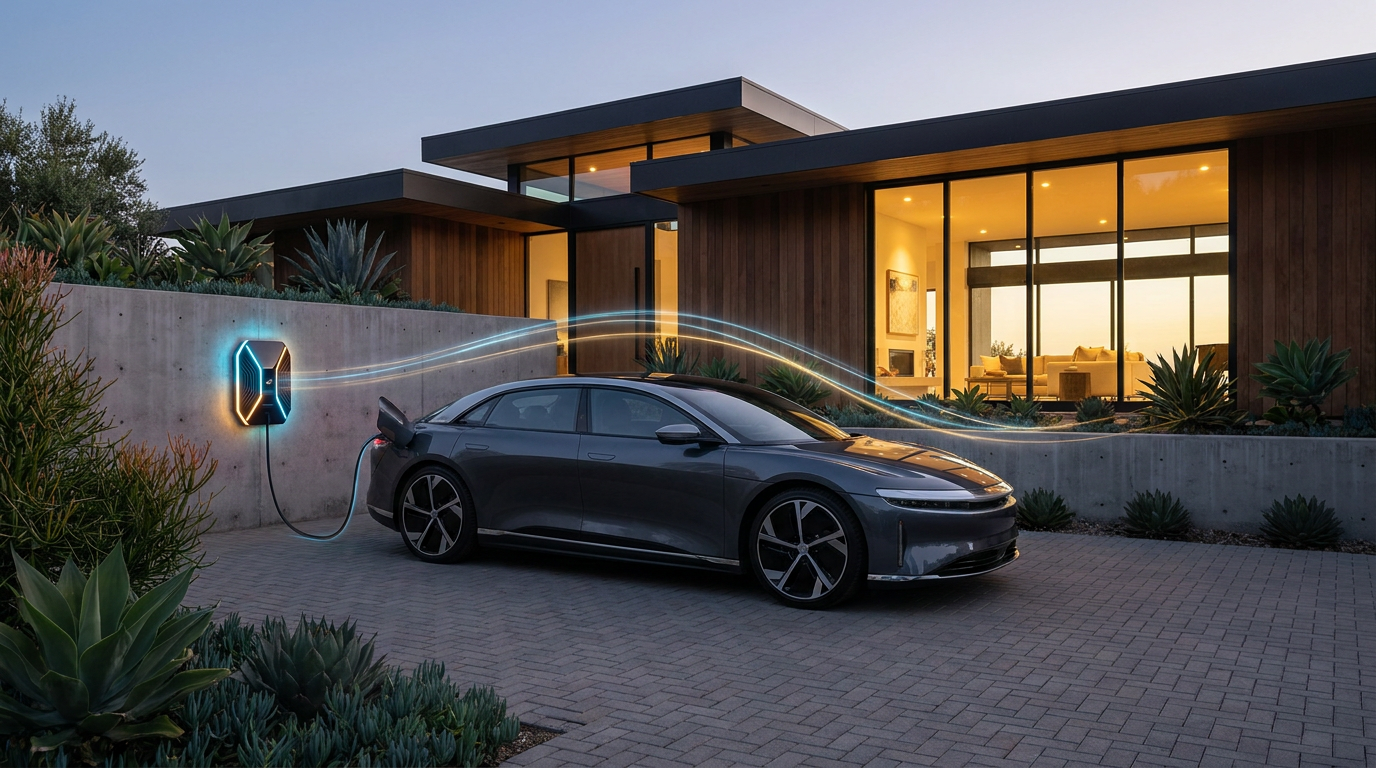
Every evening, a quiet transformation occurs across the American landscape. Millions of electric vehicles are steered into driveways, plugged into home chargers, and left dormant until morning. Inside these vehicles lies a massive, largely untapped reservoir of energy. To put the scale in perspective, a standard stationary home backup battery, like the widely used Tesla Powerwall, holds about 13.5 kilowatt-hours of electricity. Meanwhile, a Ford F-150 Lightning electric truck carries a 131-kilowatt-hour battery pack—nearly ten times the capacity of the dedicated home unit.[3][5]
For years, this immense energy storage was locked behind a one-way valve. Standard Level 2 home chargers are designed solely to push power from the electrical grid into the vehicle's battery, treating the car as a simple consumer of electricity. But in 2026, the widespread rollout of bidirectional charging is finally moving from isolated pilot programs into residential garages. This technology allows electricity to flow in both directions, fundamentally changing the relationship between the homeowner, the vehicle, and the utility company.[4][8]
The umbrella term is bidirectional charging, but the technology splits into three distinct capabilities that serve very different purposes. Vehicle-to-Load (V2L) is the simplest iteration, providing standard electrical outlets on the car to plug in camping gear, laptops, or power tools directly. Vehicle-to-Home (V2H) connects the vehicle to a house's main electrical panel, turning the car into a whole-home backup generator. Vehicle-to-Grid (V2G) goes a step further, allowing the vehicle to export its stored power all the way back to the utility company's network.[4][7]

The most immediate consumer appeal lies in Vehicle-to-Home backup capabilities. During a severe storm, grid failure, or rolling blackout, a fully charged electric vehicle can power an average household for three to ten days, depending heavily on the home's energy efficiency, heating type, and the vehicle's battery size. This effectively eliminates the need for noisy, gas-powered backup generators, providing silent, emissions-free resilience that kicks in the moment the grid goes down. For families in hurricane-prone or wildfire-affected regions, this transforms the car into a critical survival tool.[3]
Achieving this resilience requires specific, specialized hardware that goes far beyond a standard plug. A conventional charger cannot invert the car's direct current (DC) battery power back into the alternating current (AC) used by household appliances. Homeowners must install a bidirectional EVSE (Electric Vehicle Supply Equipment) unit, which contains an internal heavy-duty inverter. This must be paired with an automatic transfer switch that safely disconnects the house from the grid during an outage, ensuring that exported power doesn't backfeed onto utility lines and endanger repair workers.[3][4]
The cost of this specialized hardware remains a significant hurdle for early adopters looking to upgrade their homes. As of 2026, a full V2H installation ranges from $5,000 to $15,000, depending on the specific bidirectional charger model and the complexity of the home's existing electrical panel. However, energy advocates note that this upfront cost is often substantially cheaper than purchasing and installing multiple stationary home batteries to achieve the equivalent backup capacity, making it a highly cost-effective route for those who already own a compatible vehicle.[3][8]

While V2H protects the individual homeowner from localized outages, Vehicle-to-Grid (V2G) technology is designed to protect the broader electrical network from systemic collapse. Grid operators are currently facing unprecedented strain from historic heat waves, erratic weather patterns, and the surging electricity demands of artificial intelligence data centers. Balancing supply and demand has never been more difficult, and the grid desperately needs flexible storage to absorb excess solar power during the day and deploy it when the sun goes down.[2][7]
Instead of spending billions of dollars to build expensive new peaker power plants that only run a few hours a year, utilities are increasingly tapping into parked electric vehicles. Through Virtual Power Plant (VPP) programs, owners give the grid operator permission to draw a small, strictly capped amount of power from their cars during peak evening hours. In return, the utility provides the vehicle owner with financial credits, reduced charging tariffs, or direct cash payments, turning the car into a revenue-generating asset.[5][6]
The scale of this distributed battery network is staggering when aggregated across a nation. General Motors estimates that its 250,000 bidirectional-capable vehicles currently on American roads hold enough combined energy capacity to power 120,000 homes for an entire week. If even a fraction of the global EV fleet participates in V2G programs, it could fundamentally stabilize the grid, providing a massive buffer of dispatchable energy that can be deployed instantly without burning a single drop of fossil fuel.[2]
The scale of this distributed battery network is staggering when aggregated across a nation.
For years, automakers actively resisted V2G integration, fearing that the constant cycling of electricity would wear out expensive car batteries prematurely and trigger massive warranty claims. This hesitation kept bidirectional charging relegated to niche applications, academic studies, and a very limited selection of vehicle models. Manufacturers were understandably protective of their battery packs, which represent the single most expensive component of an electric vehicle, and strictly voided warranties if the car was used to backfeed the grid.[1][7]
However, recent data has largely dismantled this worry, paving the way for widespread adoption. The International Energy Agency found that well-managed vehicle-to-grid setups do not accelerate chemical battery aging. Because participating vehicles generally operate at lower average states of charge and discharge at slow, steady rates, the degradation is negligible. Some studies even suggest that smart V2G cycling—which prevents the battery from sitting at a 100 percent charge for days on end—could actually improve long-term battery longevity compared to standard charging habits.[1][2][7]
The technological breakthrough enabling this open ecosystem is a universal communication standard known as ISO 15118-20. Finalized in 2022 and widely implemented by automakers and charger manufacturers in 2026, this digital protocol acts as a common language. It allows the vehicle, the bidirectional charger, and the utility grid to securely authenticate each other, negotiate energy prices in real time, and safely manage the two-way power flow without any manual intervention from the driver.[4][6]

Before the widespread adoption of ISO 15118-20, bidirectional charging was mostly limited to the CHAdeMO connector, a standard used prominently by the Nissan Leaf but largely abandoned by the rest of the industry. Now, the dominant CCS (Combined Charging System) and NACS (North American Charging Standard) connectors can natively support two-way transfer. This breakthrough shatters the proprietary lock-in that previously stalled the industry, allowing a Ford truck to potentially use a Wallbox charger to feed a Pacific Gas and Electric grid.[4][8]
Policy mandates are also accelerating the shift from optional feature to standard equipment. Legislation in California aims to require all new electric vehicles sold in the state to be bidirectional-capable by 2030, forcing automakers to standardize the hardware. Meanwhile, European nations are funding massive infrastructure deployments, such as Vattenfall's 200-charger pilot project in Sweden, to prove the technology at scale and write the regulatory rulebooks for how consumers will be compensated for their energy.[4][6]

This transition turns the electric vehicle from a simple transportation appliance into a foundational piece of national infrastructure. As hardware costs inevitably fall and communication standards unify the market, the millions of batteries sitting idle in driveways are poised to become the ultimate buffer for the renewable energy transition. The car is no longer just a way to get to work; it is a mobile power plant that pays for itself while keeping the neighborhood's lights on.[8]
How we got here
2013
The Nissan Leaf introduces early bidirectional charging capabilities using the CHAdeMO connector standard.
2022
The ISO 15118-20 communication standard is finalized, paving the way for universal two-way charging.
2024
The Ford F-150 Lightning popularizes Vehicle-to-Home backup power in the United States.
2025
The UK government mandates V2G capability for all new commercial charger installations.
2026
Widespread rollout of CCS-compatible bidirectional chargers and utility V2G tariffs begins.
Viewpoints in depth
Grid & Policy Planners
View electric vehicles as a massive, cheap distributed battery network essential for preventing blackouts.
Utility operators argue that upgrading the grid to handle peak demand with traditional infrastructure is prohibitively expensive and slow. By tapping into the millions of EV batteries already parked in driveways, they can instantly deploy a Virtual Power Plant (VPP) to smooth out the 'duck curve' of solar energy. They emphasize that compensating drivers for this energy is far cheaper than building new peaker plants.
Automakers & Hardware Providers
Initially cautious about battery warranties, manufacturers are now adopting V2G as a major selling point.
For years, car companies strictly voided warranties if an EV was used to backfeed the grid, fearing accelerated chemical degradation. However, backed by recent data showing that smart, shallow cycling doesn't harm the battery, automakers have reversed course. They now view bidirectional capability as a premium feature that differentiates their vehicles and creates sticky ecosystems of branded home chargers and energy management software.
Consumer & Energy Advocates
Excited about home backup and energy savings, but concerned about the high upfront cost of bidirectional hardware.
Advocates celebrate V2H as a game-changer for household resilience, especially in regions prone to extreme weather and rolling blackouts. However, they caution that the $5,000 to $15,000 installation cost for bidirectional chargers and transfer switches risks turning energy independence into a luxury for the wealthy. They are lobbying for stronger tax credits and standardized, non-proprietary hardware to drive costs down.
What we don't know
- How quickly utility companies will roll out standardized compensation rates for consumers participating in V2G programs.
- Whether the high upfront cost of bidirectional home chargers will drop significantly as manufacturing scales up.
Key terms
- V2H (Vehicle-to-Home)
- A system where an electric vehicle discharges its battery to power a house, typically used for backup during a blackout.
- V2G (Vehicle-to-Grid)
- A system where an electric vehicle exports stored energy back to the utility grid, often earning the owner financial credits.
- V2L (Vehicle-to-Load)
- A feature allowing users to plug standard 120V appliances or tools directly into outlets built into the electric vehicle.
- ISO 15118-20
- The universal digital communication standard that allows electric vehicles, chargers, and the power grid to securely negotiate two-way energy transfer.
- Virtual Power Plant (VPP)
- A cloud-based network of distributed energy resources—like parked EVs and home batteries—that utilities can tap into collectively to stabilize the grid.
Frequently asked
Does bidirectional charging degrade my EV battery?
According to the International Energy Agency, well-managed V2G setups do not accelerate battery aging. Because the system uses shallow, slow discharges, the degradation is negligible.
Can any electric vehicle power a home?
No. The vehicle must specifically support bidirectional charging. As of 2026, models like the Ford F-150 Lightning, Kia EV9, and GM Ultium vehicles support it, but many older EVs do not.
Do I need a special charger for V2H?
Yes. A standard Level 2 charger only flows one way. You need a bidirectional EVSE with a built-in inverter and a transfer switch to safely power your home.
Sources
Source coverage
8 outlets
3 viewpoints surfaced








[1]International Energy AgencyGrid & Policy Planners
Vehicle-to-grid technology report
Read on International Energy Agency →[2]General MotorsAutomakers & Hardware Providers
Bidirectional EVs are here. Let's invest in them together
Read on General Motors →[3]American Solar Energy SocietyConsumer & Energy Advocates
V2H: Vehicle-to-Home Bi-Directional Charging
Read on American Solar Energy Society →[4]Emporia EnergyAutomakers & Hardware Providers
What is V2G? A Guide to Vehicle-to-Grid Technology
Read on Emporia Energy →[5]Clean Energy ReviewsConsumer & Energy Advocates
V2G Explained - Benefits of Vehicle-to-grid Technology
Read on Clean Energy Reviews →[6]VattenfallGrid & Policy Planners
Large-scale pilot in Sweden explores new role for electric vehicles
Read on Vattenfall →[7]WikipediaGrid & Policy Planners
Vehicle-to-grid
Read on Wikipedia →[8]Factlen Editorial TeamConsumer & Energy Advocates
Synthesis by Factlen editorial team
Read on Factlen Editorial Team →

More in technology
See all 5 stories →
Every angle. Every day.
Get technology stories with full source coverage and perspective breakdowns delivered to your inbox.