
Beyond Sustainability: How Community-Led 'Regenerative Tourism' is Rewriting the Travel Playbook
The travel industry is shifting from 'sustainable' models that merely minimize harm to 'regenerative' approaches that actively restore ecosystems and empower local communities.
By Factlen Editorial Team
- Community Tourism Advocates
- Argue that true regeneration requires local ownership and economic empowerment of indigenous and rural populations.
- Conservationists & Ecologists
- Focus on the ecological math, prioritizing tourism models that actively fund reforestation and biodiversity restoration.
- Travel Tech Innovators
- Highlight the role of data, IoT sensors, and smart dispersal apps in preventing overtourism and managing visitor flows.
What's not represented
- · Mass-Market Tour Operators
- · Aviation Industry Executives
Why this matters
As global travel volumes surpass pre-pandemic peaks, the shift from 'sustainable' to 'regenerative' tourism dictates where billions of dollars flow. For travelers, understanding this model is the difference between inadvertently contributing to overtourism and actively helping to restore the communities and ecosystems they visit.
Key points
- Regenerative tourism moves beyond 'sustainable' travel by actively seeking to leave destinations ecologically and socially better than before.
- Community-led initiatives are central to the model, ensuring that tourism revenue stays local and empowers indigenous guides and artisans.
- Ecological data shows that biodiversity is significantly higher in areas managed by local communities compared to state-managed lands.
- Smart dispersal technology, including IoT sensors and big data, is being used to redirect tourist flows and prevent urban overtourism.
For decades, the gold standard for conscientious travelers was "sustainable tourism"—a philosophy built on the premise of doing no harm. Visitors were urged to reuse their hotel towels, stick to marked trails, and minimize their carbon footprints. But as global travel volumes surge in 2026, a growing consensus among ecologists and local communities suggests that merely maintaining the status quo is no longer sufficient. The baseline of many popular destinations is already degraded. Enter regenerative tourism: a paradigm shift that asks travelers not just to leave no trace, but to actively leave a place better than they found it.[2][5]
This transition from passive sustainability to active regeneration is fundamentally rewiring the economics of the travel industry. At its core, regenerative tourism treats a destination as a living ecosystem where the environment, the local economy, and the cultural heritage are deeply intertwined. It rejects the extractive model of mass tourism, where international corporations siphon profits while locals bear the brunt of overcrowded streets and depleted resources. Instead, it places local communities and indigenous guides at the helm of the visitor experience.[4][6]
The data reflects a rapid change in consumer appetite. According to recent industry reports, more than 66 percent of travelers now actively seek out experiences that tangibly enhance the communities they visit. This is not merely a niche preference for eco-lodges; it represents a broad psychological shift. Travelers are increasingly viewing themselves not as passive consumers of a destination's beauty, but as temporary collaborators in its preservation and growth.[1]

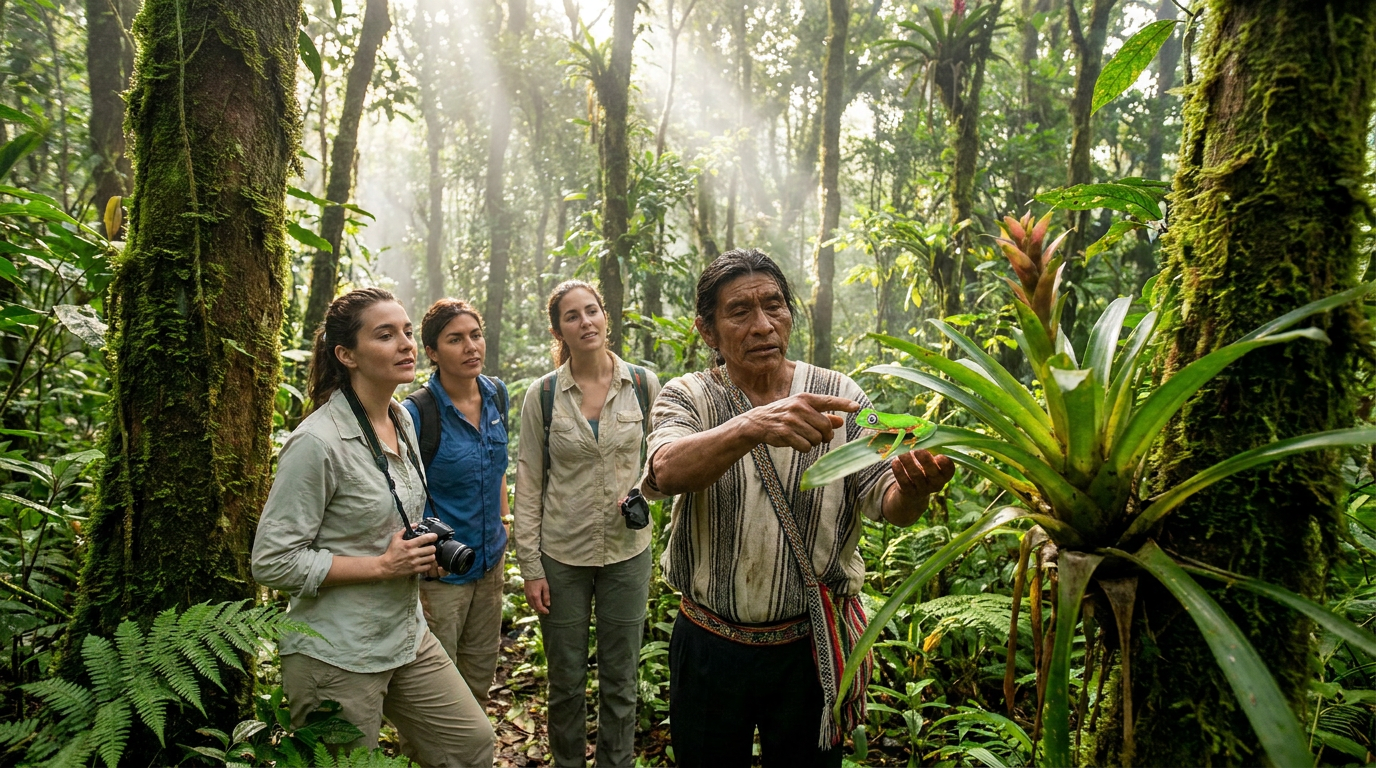
The mechanics of regenerative travel rely heavily on community-led initiatives. When local residents control the tourism narrative, the economic benefits are localized, and the cultural exchange becomes authentic rather than commodified. In Panama, for example, the PACTO program has empowered ten distinct villages to set their own tourism objectives. Rather than having a government ministry dictate attractions, these communities identify their own priorities—from maintaining ancient hiking trails to establishing artisan workshops that preserve traditional crafts.[1]
This localized control yields measurable results. Panama's ReD SOSTUR initiative, which focuses heavily on community-managed cultural exchanges, reported a 40 percent increase in visitation to participating rural areas. Crucially, the revenue generated by these visits flows directly to local artisans, farmers, and guides, creating a resilient micro-economy that does not depend on large-scale resort infrastructure.[1]
The ecological benefits of shifting power to local communities are equally striking. The United Nations Environment Programme (UNEP) has found that biodiversity is approximately 20 percent higher in areas managed by local and indigenous communities compared to state-managed lands. Indigenous groups currently manage roughly half of the world's land-based biodiversity, making their traditional knowledge indispensable to any genuine regenerative effort.[1]

Costa Rica has long been a pioneer in this space, leveraging tourism dollars to fund ambitious reforestation and coral reef restoration projects. Visitors to community-run agroforestry projects, such as those in the Selva Bonita region, do more than just observe nature; their presence and financial contributions directly support farming techniques that halt soil erosion and revive degraded landscapes. The tourism revenue essentially subsidizes the transition away from harmful monoculture farming.[1][2]
Costa Rica has long been a pioneer in this space, leveraging tourism dollars to fund ambitious reforestation and coral reef restoration projects.
Similar transformations are occurring in Europe. In Italy, the Lago di Gallo project successfully converted a stretch of damaged, over-exploited land into a thriving, biodiverse ecosystem. The restoration was not funded by a massive government grant, but by a steady stream of guided hikes led by local residents. The fees paid by tourists to experience the landscape are reinvested directly into ongoing reforestation efforts, creating a self-sustaining loop of environmental repair.[1]
But regenerative tourism is not limited to rural or wilderness settings; it is also being deployed to solve the crisis of urban overtourism. In ancient capitals and dense European cities, the sheer volume of visitors threatens to hollow out local neighborhoods. Here, regeneration takes the form of "smart dispersal"—using technology and community planning to redirect foot traffic away from breaking-point hotspots and toward lesser-known districts.[3][6]
Technology acts as the invisible infrastructure supporting this dispersal. Real-time applications and platforms now analyze big data to anticipate visitor demand and manage tourist flows. By sending push notifications or offering dynamic pricing incentives, these systems can guide travelers to alternative neighborhoods, easing the strain on sensitive historical sites while distributing tourist spending to small businesses that rarely see international visitors.[3]

Behind the scenes, environmental monitoring is becoming increasingly sophisticated. Internet of Things (IoT) sensors are being deployed in fragile ecosystems and crowded urban waterways to measure water quality, air pollution, and biodiversity metrics in real time. If a specific area begins to show signs of ecological stress, local authorities and tour operators can immediately cap visitor numbers or reroute tours, preventing long-term damage before it occurs.[3]
For the individual traveler, participating in regenerative tourism requires a shift in how trips are planned and executed. It begins with the simple act of slowing down. Opting for longer stays—two weeks rather than a frantic three-day weekend—reduces the environmental footprint associated with transit and allows for a deeper, more meaningful connection with the host community. Slow travel is the prerequisite for regenerative travel.[2]
The choice of accommodation and activities is equally critical. Regenerative travelers prioritize locally-owned guesthouses and community-run eco-lodges over international hotel chains. They dine at farm-to-table restaurants that source ingredients from regional growers, and they hire independent local guides rather than booking through massive, foreign-owned tour operators. Every dollar spent is viewed as an investment in the destination's resilience.[4][5]

Activities, too, are chosen for their net-positive impact. This might involve participating in a beach cleanup, joining a community-led wildlife monitoring patrol, or simply paying a premium for a cultural workshop that helps keep a traditional craft alive. The goal is to ensure that the act of visiting actively subsidizes the preservation of the things the visitor came to see.[2][4]
Ultimately, the rise of regenerative tourism acknowledges a hard truth: travel is an extractive industry by default. The carbon emitted, the water consumed, and the physical space occupied by tourists all exact a toll on a destination. By embedding restoration into the very fabric of the travel experience, the regenerative model offers a viable path forward—one where exploring the world simultaneously helps to heal it.[6]
How we got here
Pre-2020
The era of mass tourism and the rise of 'sustainable' travel, which focused primarily on reducing carbon footprints and minimizing harm.
2020-2022
The pandemic halts global travel, allowing ecosystems to temporarily recover and prompting a widespread rethinking of the tourism industry's impact.
2023-2024
The concept of 'regenerative tourism' gains mainstream traction, with destinations like Costa Rica and New Zealand embedding it into official policy.
2025-2026
Community-led models and 'smart dispersal' technologies mature, shifting power to local guides and indigenous groups to manage visitor flows.
Viewpoints in depth
Community Tourism Advocates
Argue that true regeneration is impossible without local ownership.
This camp emphasizes that international hotel chains and massive tour operators cannot lead the regenerative shift. They argue that true regeneration requires grassroots initiatives where local guides and indigenous groups dictate the terms of engagement. By keeping the economic benefits within the community, these models build local resilience and ensure that cultural exchanges remain authentic rather than commodified for mass consumption.
Conservationists & Ecologists
Focus on the ecological math, arguing that maintaining a degraded baseline is insufficient.
Ecologists point out that 'sustainable' travel is increasingly a failed concept because maintaining the status quo in already-degraded ecosystems is not enough. They prioritize tourism models that actively fund reforestation, coral reef restoration, and soil regeneration. In their view, the success of a destination should be measured by net-positive biodiversity gains, with tourism revenue acting as a direct subsidy for environmental repair.
Travel Tech Innovators
Highlight the role of data and smart dispersal in preventing overtourism.
This perspective argues that good intentions are insufficient without the technological infrastructure to manage visitor flows. They champion 'smart dispersal'—using real-time apps, big data, and IoT sensors to redirect foot traffic away from fragile ecosystems and overcrowded city centers. By dynamically managing where tourists go, they believe technology can distribute economic benefits more evenly while protecting sensitive historical and natural sites from irreversible wear and tear.
What we don't know
- How to effectively scale regenerative practices to accommodate the billions of mass-market tourists without diluting the community-led focus.
- Whether major international airlines and cruise operators can ever truly integrate into a regenerative model, given their inherent carbon footprints.
- The long-term economic resilience of micro-tourism projects if global travel patterns shift suddenly due to climate or economic shocks.
Key terms
- Regenerative Tourism
- An approach to travel that aims to leave a destination ecologically and socially better than it was before the visitor arrived.
- Smart Dispersal
- The use of technology and data to redirect tourist foot traffic away from overcrowded hotspots to lesser-visited areas.
- Agroforestry
- A land-use management system where trees or shrubs are grown around or among crops or pastureland, often supported by eco-tourism.
- Community-Based Tourism
- Travel experiences owned, managed, and led by local residents, ensuring economic benefits remain within the community.
Frequently asked
What is the difference between sustainable and regenerative tourism?
Sustainable tourism aims to minimize harm and maintain the status quo, while regenerative tourism actively improves and restores the destination's ecosystem and community.
How do local guides fit into regenerative travel?
Local guides ensure that tourism revenue stays within the community, provide authentic cultural context, and often lead activities that directly fund local conservation efforts.
Can regenerative tourism work in busy cities?
Yes, primarily through 'smart dispersal' technology that redirects tourists to lesser-known neighborhoods, supporting local businesses outside the main tourist corridors and reducing strain on hotspots.
Does regenerative travel cost more?
Not necessarily. While some eco-lodges charge a premium, choosing community-run guesthouses and local eateries often costs less than international resorts while keeping money in the local economy.
Sources
Source coverage
6 outlets
3 viewpoints surfaced






[1]CarbonClickCommunity Tourism Advocates
Regenerative tourism examples in small communities
Read on CarbonClick →[2]EcobnbConservationists & Ecologists
Regenerative tourism explained: what it is, how it works and why it represents the future of conscious travel
Read on Ecobnb →[3]Tourism Innovation SummitTravel Tech Innovators
How Technology Can Boost Regenerative Tourism
Read on Tourism Innovation Summit →[4]Centre for the Promotion of ImportsCommunity Tourism Advocates
Market opportunities and trends in regenerative tourism
Read on Centre for the Promotion of Imports →[5]Outwest LivingCommunity Tourism Advocates
What is Regenerative Tourism?
Read on Outwest Living →[6]Factlen Editorial TeamTravel Tech Innovators
Synthesis by Factlen editorial team
Read on Factlen Editorial Team →

More in travel
See all 37 stories →Regenerative Travel
How 'Regenerative' Travel is Replacing Sustainability as the New Standard in Luxury Tourism
8 sources

Flight Hacks
The Free Stopover Hack: How to Turn Layovers into Multi-Destination Trips
9 sources

Sustainable Travel
The Definitive Guide to Kyoto's 'Hands-Free Travel' and Sustainable Tourism Rules in 2026
7 sources
Astrotourism
The Global Rise of Astrotourism: How Dark Sky Sanctuaries are Redefining Remote Travel
6 sources

Every angle. Every day.
Get travel stories with full source coverage and perspective breakdowns delivered to your inbox.