
Why the 'Library of Things' is Reshaping the Community Sharing Economy
A growing global movement is replacing the need to buy rarely used items by allowing communities to borrow everything from power drills to camping gear. The model is saving millions of dollars while significantly reducing carbon emissions and neighborhood waste.
By Factlen Editorial Team
- Circular Economy Advocates
- Focus on the environmental necessity of reducing material extraction and landfill waste.
- Community & Equity Organizers
- Emphasize the social benefits of affordability, skill-building, and neighborhood cohesion.
- Municipal & Library Planners
- Focus on modernizing public services and integrating lending models into existing civic infrastructure.
What's not represented
- · Traditional tool and appliance manufacturers
- · Hardware store owners and local retailers
Why this matters
The average household spends thousands of dollars on tools and equipment that sit unused for 99% of their lifespan. The Library of Things model offers a proven blueprint for reducing household expenses, cutting environmental waste, and rebuilding local community ties.
Key points
- A Library of Things allows residents to borrow infrequently used items like tools and camping gear instead of buying them.
- There are over 2,000 formal lending libraries globally, ranging from grassroots groups to public library branches.
- The model saves communities millions of dollars while significantly reducing carbon emissions and manufacturing waste.
- Nearly half of US public libraries now lend non-traditional items like Wi-Fi hotspots to bridge the digital divide.
- Lending hubs often double as community centers, hosting repair cafes and skill-sharing workshops.
In the average garage or storage closet, hundreds of dollars worth of equipment sits quietly gathering dust. A power drill, for instance, is used for an estimated 13 minutes over its entire lifespan, yet millions are manufactured, shipped, and sold every year. This paradox of modern consumption has given rise to a rapidly expanding alternative: the Library of Things (LoT).[6][7]
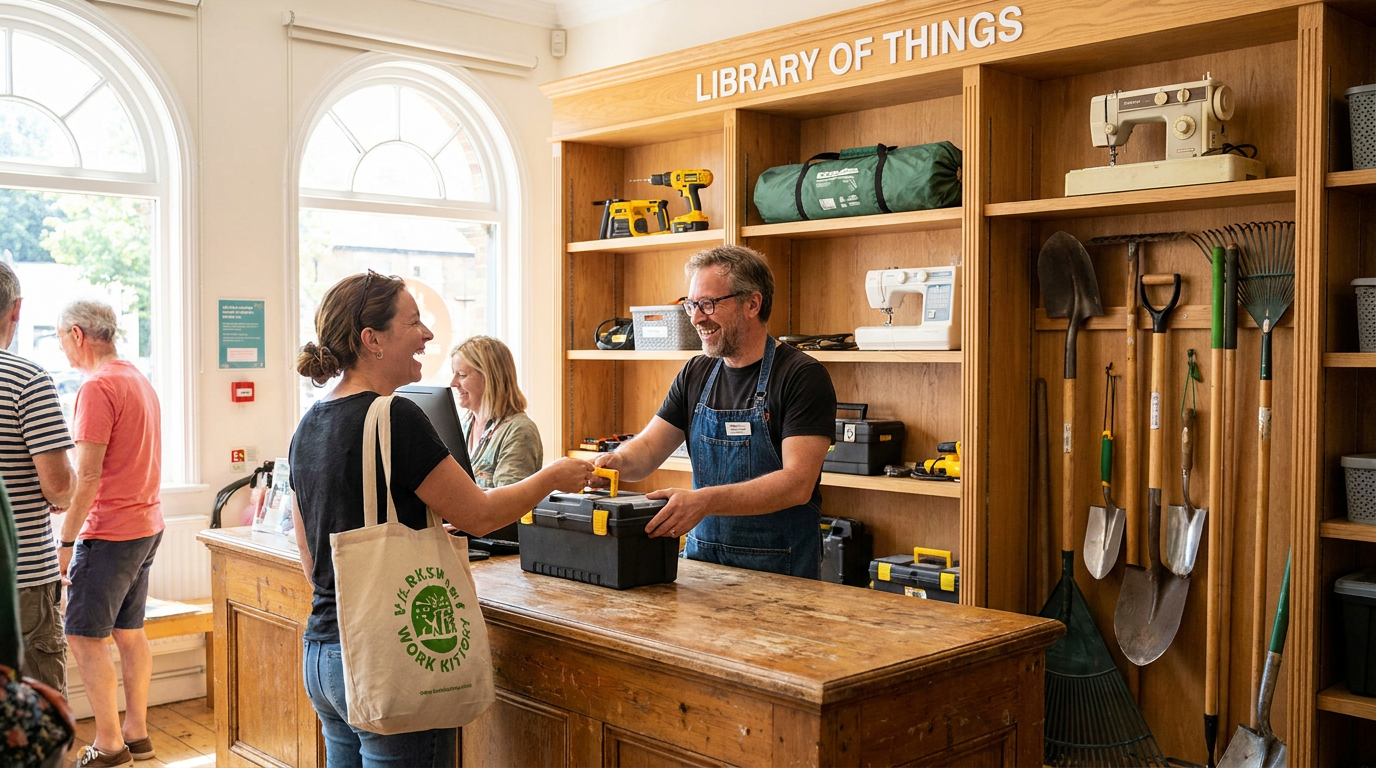
A Library of Things operates on a simple premise: instead of purchasing items that are only needed occasionally, community members borrow them. These lending hubs stock everything from camping gear and carpet cleaners to sewing machines, power tools, and even medical equipment. By shifting the focus from individual ownership to communal access, the model challenges the traditional retail economy while offering immediate practical benefits to residents.[3][6]
The concept is not entirely new—the Berkeley Public Library's Tool Lending Library has been operating since 1979—but the scale of the movement has surged in recent years. Today, there are roughly 2,000 formally established Libraries of Things worldwide, supported by cloud-based inventory platforms that manage hundreds of thousands of items and facilitate nearly a million loans annually.[1][3]
The economic mechanism behind these libraries is designed for accessibility. Most operate on a low-cost annual membership model or a small pay-per-item fee, with many offering sliding scales or "pay-what-you-can" options for low-income residents. The financial impact on communities is substantial. In the United Kingdom, the Library of Things network reports that its 39,000 members have collectively saved over £10 million by borrowing rather than buying.[2][5]

Beyond individual savings, the model acts as a powerful engine for the circular economy. Every borrowed item represents a product that did not need to be manufactured, packaged, and shipped. The environmental footprint of producing high-energy items like electronics and power tools is immense. By maximizing the lifespan of a single shared item, communities drastically reduce their material extraction and carbon emissions.[2][6]
The environmental data backs up the theory. The UK-based Library of Things estimates that its operations have saved 650 tonnes of CO2 equivalent emissions and diverted 211 tonnes of waste from landfills. When tools break, they are not simply thrown away; dedicated volunteers and staff repair them, keeping them in circulation and further extending their utility.[2][5]
The UK-based Library of Things estimates that its operations have saved 650 tonnes of CO2 equivalent emissions and diverted 211 tonnes of waste from landfills.
While the economic and environmental metrics are compelling, organizers argue that the social impact is equally transformative. Libraries of Things frequently serve as community hubs, hosting repair cafes, skill-sharing workshops, and DIY classes. These spaces bring together people from diverse socioeconomic backgrounds who might not otherwise interact.[1][3]
Surveys indicate that this shared infrastructure fosters a tangible sense of belonging. According to the Doughnut Economics Action Lab, 65% of Library of Things members report feeling more connected to and proud of their neighborhood. By providing access to tools that would otherwise be unaffordable, the libraries also empower residents to improve their homes, start gardens, and launch small businesses.[5][7]

The movement is also transforming traditional civic infrastructure. Public library systems across North America and Europe are increasingly integrating "Things" into their catalogs. The latest Public Library Technology Survey indicates that 47% of public libraries now lend Wi-Fi hotspots, a significant jump driven by the need to close the digital divide.[4]
This integration goes far beyond digital connectivity. Municipal libraries are lending out park passes, radon detectors, autism sensory kits, and blood pressure monitors. By analyzing neighborhood-level data—such as asthma rates or senior poverty—libraries can tailor their non-traditional collections to address specific public health and equity needs.[4][7]

Despite the rapid growth, the model faces structural uncertainties. Operating a Library of Things requires physical space, which is often at a premium in urban centers. Furthermore, the logistics of maintaining, repairing, and testing electrical equipment demand skilled labor. While many libraries rely heavily on dedicated volunteers, scaling the model requires sustainable funding and paid staff.[3][6]
To address these hurdles, some organizations are developing modular, self-serve kiosks that can be installed in existing community spaces like housing blocks or shopping centers. Others are partnering directly with local governments and housing associations to secure long-term funding, proving that the service generates more social value than it costs to operate.[1][5]
Ultimately, the Library of Things represents a profound shift in how communities view resources. In a culture that has long equated success with material accumulation, these lending hubs offer a different vision: one where abundance is shared, waste is minimized, and neighbors rely on one another to build more resilient cities.[3][6][7]
How we got here
1979
The Berkeley Public Library opens its Tool Lending Library, one of the earliest modern examples of the concept.
2014
The UK-based Library of Things begins testing its model, eventually expanding to dozens of neighborhoods.
2020
The COVID-19 pandemic accelerates the need for community resource sharing, with many libraries adopting contactless pickup.
2024
Public library surveys reveal that nearly half of US branches have expanded into lending digital tools like Wi-Fi hotspots.
2026
The global network of formal lending libraries surpasses 2,000 locations, saving millions of dollars and tonnes of emissions.
Viewpoints in depth
Circular Economy Advocates
Focus on the environmental necessity of reducing material extraction and landfill waste.
For environmental advocates, the Library of Things is a critical intervention against hyper-consumption. They argue that the current economic model—which demands endless manufacturing of items destined for infrequent use—is ecologically unsustainable. By maximizing the utility of a single product across dozens of households, communities can drastically cut greenhouse gas emissions and reduce the volume of electronic and plastic waste entering landfills. This camp views lending libraries not just as a convenience, but as a mandatory shift toward a sustainable, post-growth economy.
Community & Equity Organizers
Emphasize the social benefits of affordability, skill-building, and neighborhood cohesion.
Social organizers view lending libraries primarily as engines for equity and connection. High-quality tools, medical equipment, and recreational gear are often prohibitively expensive for low-income families. By removing the financial barrier to access, these libraries empower residents to maintain their homes, learn new skills, and participate in activities they otherwise couldn't afford. Furthermore, organizers highlight that the physical spaces themselves—often hosting workshops and repair cafes—combat urban isolation by forcing neighbors to interact, share knowledge, and build mutual trust.
Municipal & Library Planners
Focus on modernizing public services and integrating lending models into existing civic infrastructure.
For civic planners and library directors, the movement represents the natural evolution of public services. As the digital age changes how people consume books and media, traditional libraries are redefining their role as holistic community resource centers. Planners argue that utilizing existing library infrastructure to lend out Wi-Fi hotspots, air quality monitors, and tools is a highly efficient use of taxpayer dollars. They use demographic data to tailor these non-traditional collections, ensuring that public resources directly address local challenges like the digital divide or health disparities.
What we don't know
- How traditional retailers and manufacturers will adapt if the sharing economy significantly impacts the sales of household tools.
- Whether grassroots, volunteer-run libraries can secure the long-term municipal funding needed to scale their operations permanently.
- How liability and maintenance costs will evolve as libraries begin lending more complex or high-risk equipment.
Key terms
- Library of Things (LoT)
- A community-based service that lends out physical items—such as tools, electronics, and recreational gear—rather than books.
- Circular Economy
- An economic system aimed at eliminating waste and the continual use of resources by sharing, repairing, and recycling existing materials.
- Collaborative Consumption
- An economic model where consumers share access to products or services, rather than having individual ownership.
- Repair Cafe
- A community gathering where people bring broken household items to be fixed by volunteers, teaching repair skills and preventing waste.
Frequently asked
What kind of items can you borrow?
Collections vary by location but typically include power tools, gardening equipment, camping gear, sewing machines, kitchen appliances, and sometimes medical or digital equipment.
How much does it cost to use?
Most libraries operate on a low-cost annual membership or charge a small fee per item borrowed, with many offering free or discounted access for low-income residents.
What happens if an item breaks?
Libraries expect normal wear and tear. Many have dedicated volunteers or staff who repair broken items, keeping them in circulation for as long as possible.
Are public libraries doing this?
Yes, many traditional public libraries are expanding their catalogs to include non-traditional items, with 47% of US public libraries now lending Wi-Fi hotspots.
Sources
Source coverage
7 outlets
3 viewpoints surfaced







[1]ShareableCommunity & Equity Organizers
Library of Things: A Cornerstone of the Real Sharing Economy
Read on Shareable →[2]Library of Things UKCircular Economy Advocates
Our Impact: Borrowing is better for our planet
Read on Library of Things UK →[3]Upstream SolutionsCommunity & Equity Organizers
Join the REAL sharing economy with a Library of Things
Read on Upstream Solutions →[4]PolicyMapMunicipal & Library Planners
Data-Informed Collections: Libraries of Things and Community Health
Read on PolicyMap →[5]Doughnut Economics Action LabCircular Economy Advocates
Library of Things: Doughnut Design Case Study
Read on Doughnut Economics Action Lab →[6]MediumMunicipal & Library Planners
The Library of Things: Origins and Definition
Read on Medium →[7]Factlen Editorial Team
Synthesis by Factlen editorial team
Read on Factlen Editorial Team →


Every angle. Every day.
Get community stories with full source coverage and perspective breakdowns delivered to your inbox.