
The Science of the 2026 EV Road Trip: Preconditioning, NACS, and the 80% Rule
With over 242,000 public charging ports and the widespread adoption of the NACS plug, EV road trips have transformed from stressful to seamless. Success now relies on understanding battery thermal management and strategic route planning.
By Factlen Editorial Team
- Pragmatic Commuters
- Desire a seamless, "plug and play" experience that mimics the simplicity of gas stations, relying heavily on automated in-car systems.
- EV Enthusiasts & Early Adopters
- Value the technological aspects of EV ownership, actively utilizing third-party apps to optimize charging curves and minimize travel time.
- Infrastructure Planners
- Focus on bridging the gap between dense metropolitan networks and sparse rural corridors to ensure equitable access and grid stability.
What's not represented
- · Rural residents waiting for infrastructure expansion
- · Independent charging network operators competing with NACS
Why this matters
As electric vehicles become mainstream, the old rules of the gas station no longer apply. Understanding how to leverage thermal management and charging curves can shave hours off a long journey and preserve the long-term health of your vehicle's battery.
Key points
- The US public EV charging network has expanded to over 242,000 ports, easing range anxiety.
- The adoption of the NACS plug allows non-Tesla vehicles to access the vast Supercharger network.
- Battery preconditioning automatically warms or cools the battery to 68-86°F to maximize charging speeds.
- Charging an EV past 80% at a fast charger is inefficient due to the battery's charging curve.
- Advanced routing software calculates elevation, weather, and charger availability to optimize road trips.
The great American road trip has officially been electrified. For years, the prospect of taking an electric vehicle across state lines was accompanied by a lingering sense of "range anxiety"—a fear of being stranded miles from a plug. But by 2026, that anxiety is rapidly becoming a relic of the past. It has been replaced by a new era of strategic, tech-enabled travel, where the vehicle itself does the heavy lifting of route optimization.[8]
The sheer scale of the landscape has shifted. There are now over 4.5 million electric vehicles on United States roads, representing a massive 26.7% jump in registrations over a single year. To support this fleet, the infrastructure has finally begun to keep pace, with the national network swelling to more than 242,000 public charging ports.[2]
The biggest catalyst for this newfound freedom is the widespread adoption of the North American Charging Standard (NACS). In a rare moment of industry consensus, major automakers—including Ford, General Motors, Rivian, and Hyundai—coalesced around the plug design originally pioneered by Tesla.[3]
For the driver, this standardization is a game-changer. Whether using a manufacturer-provided adapter or driving a newer model with a built-in NACS port, non-Tesla owners can now seamlessly tap into the vast Supercharger network. This effectively unifies the charging map, turning a fragmented patchwork of stations into a cohesive, reliable grid.[3]

But hardware and plugs are only half the equation. The real secret to a seamless EV road trip in 2026 lies hidden beneath the floorboards, governed by sophisticated software and thermal engineering.[8]
Enter battery preconditioning. To understand why this matters, it helps to think of an EV battery like an athlete's muscles: it performs at its absolute best only when properly warmed up and kept within a specific climate window.[7]
The ideal operating temperature for a lithium-ion EV battery pack sits comfortably between 68°F and 86°F (20°C to 30°C). When the cells are within this goldilocks zone, they can rapidly absorb massive amounts of direct current without sustaining internal damage.[1]
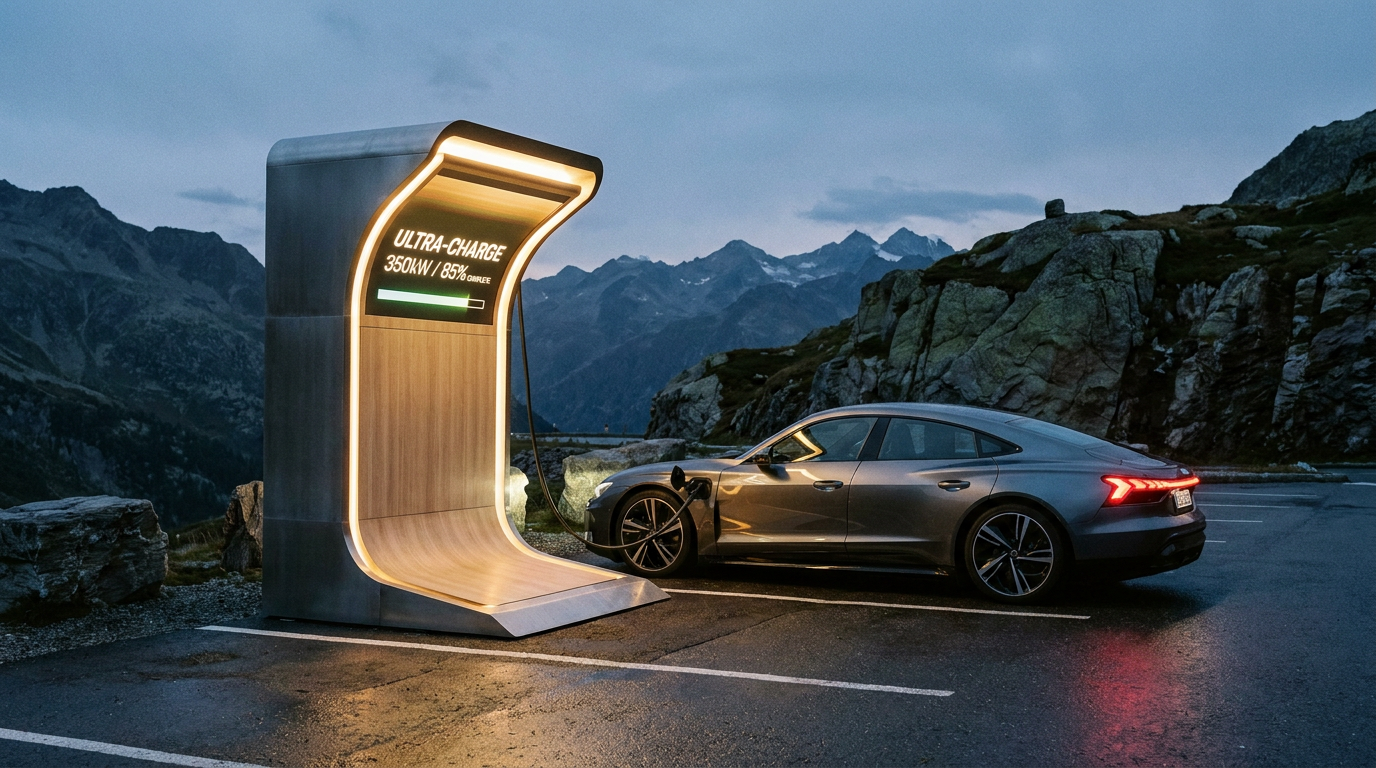
If a driver pulls up to a 350-kilowatt fast charger with a freezing cold battery, the vehicle's computer will deliberately throttle the charging speed. This safety mechanism prevents a damaging chemical reaction known as lithium plating, where metallic lithium deposits on the anode rather than absorbing properly into the cell.[1]
If a driver pulls up to a 350-kilowatt fast charger with a freezing cold battery, the vehicle's computer will deliberately throttle the charging speed.
Modern electric vehicles solve this through their Thermal Management System (TMS). When a driver uses an in-car navigation system—like Google Built-in—to route to a fast charger, the vehicle anticipates the stop. Up to an hour before arrival, the TMS automatically begins heating or cooling the battery pack, using predictive algorithms to ensure it hits the perfect temperature just as the car shifts into park.[1][6][7]

This invisible preparation is transformative. A preconditioned battery can shave 15 to 20 minutes off a charging session, turning what used to be a long, tedious wait into a quick coffee and restroom break.[7]
Once plugged in, drivers must navigate the next crucial concept: the charging curve. Unlike a traditional gas tank that fills at a constant, linear rate, an electric vehicle battery charges rapidly at lower percentages and slows down dramatically as it gets full.[4]
This brings us to the golden rule of EV road tripping: the "80% Rule." Pumping energy into a battery from 10% to 80% might take just 20 minutes at a high-speed station. However, forcing electrons into that final, crowded 20% of the pack can take just as long, if not longer.[4]

Veteran road trippers have learned to "charge in time, not to full." Rather than waiting an hour to reach 100%, it is almost always faster to unplug at 80%, drive a couple of hours, and make another brief 15-minute stop down the highway.[5]
To orchestrate this intricate dance of temperatures and charging curves, drivers rely on advanced routing software. Dedicated applications like A Better Route Planner (ABRP) and increasingly smart native vehicle interfaces do the complex math automatically.[3][4][6]
These routing engines are remarkably precise. They calculate the vehicle's specific power consumption, factoring in real-time variables like elevation climbs, ambient weather, headwinds, and live charger availability, plotting a sequence of stops that minimizes total travel time.[4]

Despite these massive technological leaps, the infrastructure reality of 2026 is still one of uneven maturation. While major interstate corridors and dense metropolitan areas boast redundant, highly reliable charging hubs, noticeable gaps persist in rural stretches.[5]
Some states are actively working to bridge this divide. Wyoming, for example, leads the nation in chargers per EV, utilizing federal funds to strategically place stations along remote highways to encourage adoption in wide-open spaces.[2]
Ultimately, the electric road trip has evolved from an exercise in range anxiety into a masterclass in efficiency. By understanding the science of preconditioning and the rhythm of the charging curve, drivers are finding that the journey itself has changed—encouraging them to stretch, explore, and savor the open road in near-total silence.[8]
How we got here
2023
Major automakers begin announcing a shift to the North American Charging Standard (NACS).
2024
EV registrations surge as battery ranges improve and prices begin to stabilize.
2025
NACS adapters roll out to non-Tesla owners, unlocking thousands of new fast-charging locations.
2026
US public charging infrastructure surpasses 242,000 ports, shifting the focus from availability to reliability.
Viewpoints in depth
EV Enthusiasts & Early Adopters
Value the technological aspects of EV ownership, actively utilizing third-party apps to optimize charging curves.
For early adopters, planning an EV road trip is part of the appeal rather than a chore. This group heavily utilizes third-party applications like A Better Route Planner (ABRP) and PlugShare to manually optimize their journeys. They understand the intricacies of their specific vehicle's charging curve and prefer to make multiple short stops—charging only from 10% to 60%—to minimize total travel time. To them, the EV road trip is a highly efficient, data-driven puzzle to be solved.
Pragmatic Commuters
Desire a seamless, "plug and play" experience that mimics the simplicity of gas stations.
As EVs reach mass adoption, a growing segment of drivers has no interest in learning about kilowatt-hours or lithium plating. They expect the vehicle to handle the complexity entirely behind the scenes. This camp relies exclusively on native, in-car navigation systems like Google Built-in to automatically route them to chargers and trigger battery preconditioning. Their primary demand is reliability: they want to plug in, tap a credit card, and walk away without needing to download multiple proprietary network apps.
Infrastructure Planners
Focus on bridging the gap between dense metropolitan networks and sparse rural corridors.
State and federal planners view the EV transition through the lens of grid capacity and equitable access. While private companies have rapidly built out charging hubs in profitable, high-traffic metro areas, planners are focused on utilizing federal funds to deploy chargers in rural and underserved regions. They emphasize that a truly national network cannot have "charging deserts," pointing to states like Wyoming that are prioritizing high charger-to-EV ratios to ensure long-distance travel remains viable everywhere.
What we don't know
- How quickly rural charging gaps will be closed as federal funding deployment continues.
- Whether the grid in high-traffic corridors can sustain peak holiday travel demand without localized queuing.
Key terms
- NACS (North American Charging Standard)
- The charging connector originally developed by Tesla, now adopted as the industry standard across most major EV brands in North America.
- DC Fast Charging (Level 3)
- High-power public charging stations capable of adding hundreds of miles of range in under 30 minutes.
- Thermal Management System (TMS)
- The internal system that actively heats or cools an EV's battery to maintain optimal operating temperatures.
- State of Charge (SoC)
- The current energy level of an electric vehicle's battery, expressed as a percentage.
- Lithium Plating
- A damaging condition that can occur if a cold lithium-ion battery is fast-charged, where metallic lithium deposits on the anode.
Frequently asked
Do I need to charge my EV to 100% at fast chargers?
No. Fast charging slows down significantly after 80% to protect the battery. It is usually much faster to unplug at 80% and make another short stop further down the road.
What is battery preconditioning?
It is the process where your EV automatically heats or cools its battery to the ideal temperature (around 68-86°F) before arriving at a charger, allowing it to accept power much faster.
Will my non-Tesla EV work at a Supercharger?
By 2026, most major automakers have adopted the North American Charging Standard (NACS). With the right adapter or a built-in NACS port, many non-Tesla EVs can now use the Supercharger network.
What happens if I drive an EV in the cold?
Cold weather reduces battery efficiency and range. However, using your car's navigation to route to a charger allows the thermal management system to warm the battery, mitigating slow charging speeds.
Sources
Source coverage
8 outlets
3 viewpoints surfaced








[1]Midtronics
How Battery Preconditioning Affects EV Performance and Testing
Read on Midtronics →[2]Aftermarket MattersInfrastructure Planners
2026 U.S. Electric Vehicle Charging Station Report
Read on Aftermarket Matters →[3]RadiusMapperEV Enthusiasts & Early Adopters
EV Trip Planner: How I Plan a Long EV Road Trip
Read on RadiusMapper →[4]Plug In AmericaEV Enthusiasts & Early Adopters
The Ultimate Guide to EV Road Trip Planning
Read on Plug In America →[5]GreenCarsInfrastructure Planners
What's Improving and What Still Needs Work in EV Charging
Read on GreenCars →[6]ChevroletPragmatic Commuters
Battery Preconditioning | Quick Start Guide
Read on Chevrolet →[7]BP PulsePragmatic Commuters
EV Preconditioning Explained
Read on BP Pulse →[8]Factlen Editorial Team
Synthesis by Factlen editorial team
Read on Factlen Editorial Team →
Every angle. Every day.
Get automotive stories with full source coverage and perspective breakdowns delivered to your inbox.