
Why Developers and Everyday Users Are Moving AI Offline in 2026
Advancements in consumer hardware and open-weight models have made running powerful AI locally on laptops a practical, privacy-first alternative to cloud subscriptions.
By Factlen Editorial Team
- Open-Source Advocates
- Argue that AI must be democratized, transparent, and free from corporate gatekeeping to ensure equitable access.
- Privacy & Security Professionals
- Value local AI primarily for data residency, compliance, and predictable cost structures rather than ideological freedom.
- Hardware Ecosystem Integrators
- Maintain that the future of AI is hybrid, blending on-device local processing for privacy with secure cloud compute for heavy lifting.
What's not represented
- · Cloud AI Infrastructure Providers
- · Regulatory Agencies
Why this matters
By moving AI from corporate data centers to your own laptop, you eliminate subscription fees, guarantee absolute data privacy, and gain the ability to work entirely offline. This shift democratizes artificial intelligence, turning it from a rented cloud service into a piece of personal infrastructure you control.
Key points
- Running AI models locally ensures absolute data privacy, as prompts and documents never leave the user's device.
- The elimination of cloud API fees and monthly subscriptions makes local AI highly cost-effective over time.
- Software tools like Ollama and LM Studio have simplified the installation process, making local AI accessible to non-developers.
- Mathematical compression techniques like quantization allow massive 12-billion parameter models to run smoothly on standard 16GB laptops.
- Open-weight models from Meta, Alibaba, and Google now rival the performance of flagship proprietary cloud models for daily tasks.
For the first few years of the generative artificial intelligence boom, interacting with a large language model meant tethering yourself to the cloud. Every prompt, question, and snippet of code was sent to massive data centers owned by a handful of tech giants, processed on racks of expensive servers, and beamed back to your screen. But in 2026, a quiet revolution has decentralized that power. Developers and everyday users are increasingly severing the cloud umbilical cord, choosing instead to run powerful AI models entirely locally on their own laptops and workstations.[8]
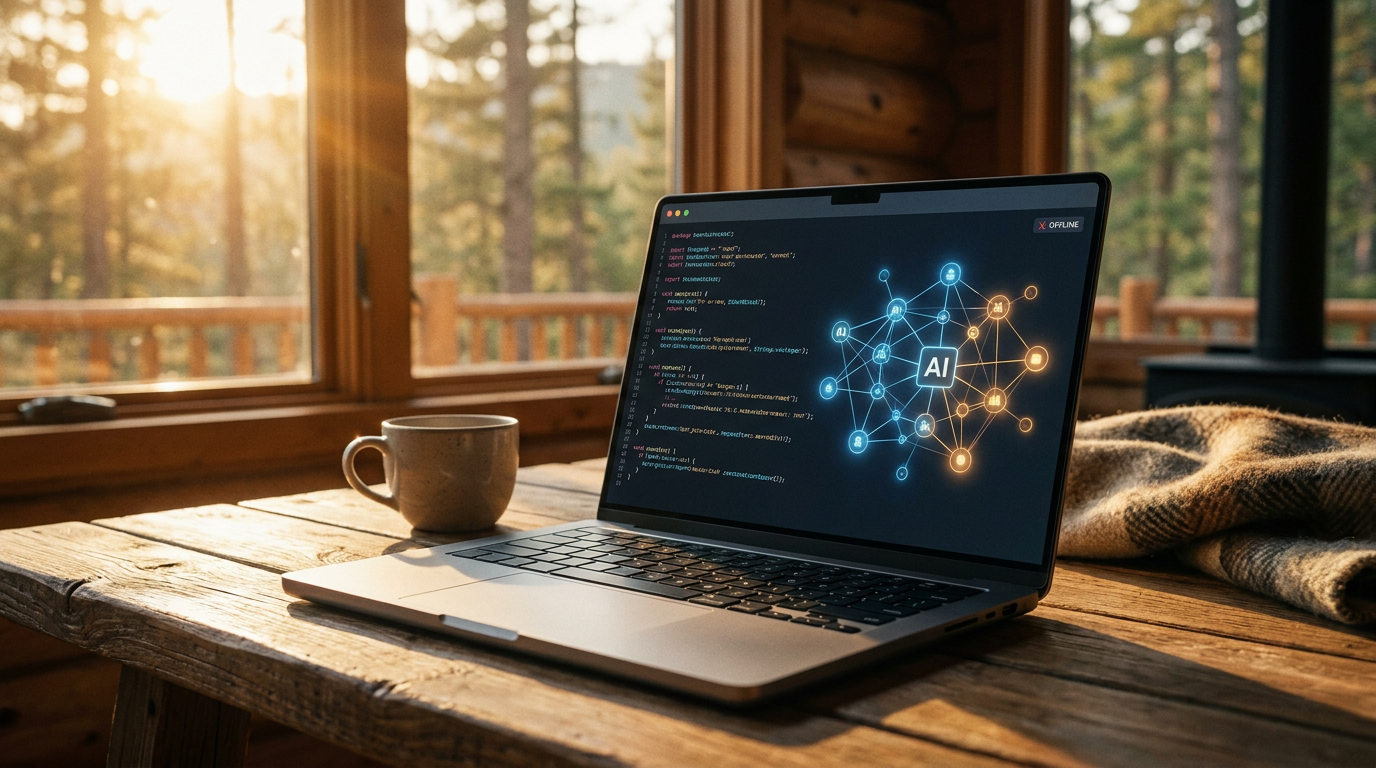
Running an AI locally means downloading the model's weights—the mathematical "brain" of the system—directly to your device's storage. When you type a prompt, the computation happens on your own silicon rather than a remote server. This shift transforms AI from a rented service into a piece of owned infrastructure, fundamentally altering the economics, privacy, and accessibility of the technology.[5]
The primary driver of this migration is absolute data privacy. When a user queries a cloud-based API, their proprietary code, sensitive financial documents, or personal health questions inevitably pass through external servers. By running models locally, the data never leaves the machine. For enterprise IT departments, healthcare providers, and privacy-conscious individuals, this air-gapped approach eliminates the risk of data leaks and compliance violations, ensuring that sensitive information cannot be used to train future commercial models.[3][4]
Economics play an equally compelling role. The standard consumer AI subscription costs roughly $20 per month, while developers pay per-token for API access—a cost that scales linearly with usage. Local inference requires an upfront investment in capable hardware, but once the machine is purchased, the marginal cost of generating a million words or analyzing thousands of documents drops to the price of the electricity required to run the processor. There are no rate limits, no subscription tiers, and no surprise billing spikes.[8]

This localized architecture also unlocks true offline capability. A local large language model functions perfectly in an airplane cabin, a remote research outpost, or a secure facility with no internet access. Because the inference happens on the device, users experience zero network latency; responses begin generating in milliseconds, unbothered by server outages or throttled bandwidth during peak hours.[5]
Until recently, running a highly capable AI model required a massive, power-hungry desktop computer equipped with multiple expensive graphics cards. That barrier has fallen dramatically thanks to advancements in consumer hardware. Apple's M-series and A-series chips, featuring unified memory architectures, allow the central processor and the graphics processor to share a single pool of high-speed RAM. This means a standard modern laptop can hold massive neural networks in memory that previously required specialized enterprise hardware.[7]
Hardware alone did not solve the puzzle; a software breakthrough known as quantization was equally vital. In their raw state, large language models require enormous amounts of memory to store their parameters in high-precision formats. Quantization mathematically compresses these weights—often down to 4-bit precision—shrinking the model's footprint by up to 75 percent. While this compression results in a microscopic drop in the model's nuance, it allows highly capable 12-billion parameter models to run smoothly on a standard 16GB laptop.[1][3]

Hardware alone did not solve the puzzle; a software breakthrough known as quantization was equally vital.
Accessing these compressed models has been democratized by a new generation of software tools. For developers and power users, an open-source application called Ollama has become the industry standard. Operating primarily through a command-line interface, Ollama runs as a lightweight background service, allowing users to download and execute models with a single line of text. It seamlessly exposes a local API, making it trivial for software engineers to plug offline AI into their own applications and coding environments.[3][4]
For users who prefer a more visual experience, desktop applications like LM Studio have transformed local AI into a plug-and-play ecosystem. LM Studio offers a clean graphical interface that resembles a standard chat application, complete with a built-in directory for discovering and downloading new models. Users can adjust parameters with sliders, chat with multiple models side-by-side, and manage their local AI library without ever opening a terminal window.[4][5]

The hardware and software would be useless without the models themselves, and 2026 has seen an explosion of highly capable open-weight releases. Tech giants and independent research labs alike have released powerful models under permissive licenses. Alibaba's Qwen 3 family, Meta's Llama 4, and Google's Gemma 4 have provided users with a diverse menu of specialized intelligences, ranging from lightweight coding assistants to massive reasoning engines.[1]
The performance gap between these open-weight models and proprietary cloud services has effectively vanished for everyday tasks. Recent benchmarks show that mid-sized local models now rival the reasoning and coding capabilities of the flagship cloud models from just a year ago. While they may not possess the encyclopedic breadth of a trillion-parameter cloud behemoth, they are more than capable of drafting emails, summarizing complex PDFs, and writing boilerplate code.[1]

The technology has matured to the point that major operating systems are baking local inference directly into their foundations. Apple Intelligence, powered by the company's Core AI framework, now leverages on-device processing to handle the vast majority of user requests. By routing tasks through the device's Neural Engine, the operating system can rewrite text, summarize notifications, and execute complex Siri commands locally, only reaching out to the cloud for the most demanding queries.[2][6]
Despite these advancements, local AI is not without its trade-offs. Running a large language model is a computationally intense process that pushes consumer hardware to its limits. Generating long responses locally will spin up laptop fans, generate noticeable heat, and drain battery life significantly faster than simply streaming text from a remote server. It transforms the computer from a thin client into a heavy-duty processing node.[8]
Furthermore, the cloud still reigns supreme for the absolute frontier of artificial intelligence. Multi-step reasoning tasks, massive codebase refactoring, and complex agentic workflows still require the sheer scale of data center compute. Local models excel at high-frequency, bounded tasks, but they cannot yet replace the heavy lifting required for cutting-edge enterprise applications.[1]

Ultimately, the rise of local AI represents a profound democratization of computing power. It ensures that the most transformative technology of the decade is not solely controlled by a few centralized gatekeepers, but is instead available as a private, offline utility on desks and in backpacks around the world. By putting the weights directly into the hands of the users, the AI ecosystem has become more resilient, more private, and vastly more accessible.[8]
How we got here
Feb 2023
Meta's original LLaMA model leaks online, sparking the open-source local AI movement.
Aug 2023
Ollama launches, dramatically simplifying local inference via a streamlined command-line interface.
Jan 2024
LM Studio brings a polished, beginner-friendly graphical interface to local model management.
Jun 2026
Apple Intelligence natively integrates local LLM processing into the core of macOS and iOS.
Viewpoints in depth
Open-Source Advocates
Argue that AI must be democratized, transparent, and free from corporate gatekeeping to ensure equitable access.
This camp views the shift to local AI as a necessary rebellion against the centralization of power by a few massive tech companies. They argue that if AI is to become a foundational utility like electricity or the internet, the underlying models must be open, inspectable, and freely available to run on personal hardware. By relying on open-weight models, developers can build uncensored, highly customized applications without fearing that a cloud provider will suddenly change their API pricing, deprecate a model, or alter its behavior overnight.
Privacy & Security Professionals
Value local AI primarily for data residency, compliance, and predictable cost structures rather than ideological freedom.
For enterprise IT leaders and security researchers, the appeal of local AI is entirely pragmatic. When dealing with sensitive patient records, proprietary source code, or classified financial documents, sending data to a third-party cloud API is often a non-starter due to strict compliance frameworks. Local inference provides a mathematical guarantee of data residency. Furthermore, this camp appreciates the predictable cost structure of local AI; once the hardware is procured, the organization is shielded from the unpredictable, usage-based billing spikes associated with cloud APIs.
Hardware Ecosystem Integrators
Maintain that the future of AI is hybrid, blending on-device local processing for privacy with secure cloud compute for heavy lifting.
Hardware giants like Apple argue that the optimal user experience requires a seamless blend of both local and cloud intelligence. They emphasize that while local processing is perfect for high-frequency, privacy-sensitive tasks like rewriting an email or sorting personal photos, the sheer computational requirements of frontier reasoning models still necessitate data center scale. Their vision is an operating system that intelligently routes simple tasks to the local Neural Engine while securely passing complex, multi-step queries to a private cloud infrastructure, giving users the best of both worlds without requiring them to manage the underlying complexity.
What we don't know
- How quickly local hardware capabilities will scale to accommodate the next generation of trillion-parameter reasoning models.
- Whether cloud providers will aggressively lower API pricing to disincentivize the migration to local inference.
- How the open-source community will address the security implications of malicious actors running uncensored models offline.
Key terms
- Local Inference
- Running an AI model directly on your device's hardware rather than sending data to a remote server.
- Quantization
- A mathematical compression technique that reduces the memory footprint of an AI model with minimal loss in quality.
- Open-Weight Model
- An AI model where the core mathematical parameters are publicly available for anyone to download and run.
- Unified Memory
- A hardware architecture where the CPU and GPU share the same pool of RAM, crucial for running large models on laptops.
- Parameters
- The billions of adjustable mathematical weights that make up the "brain" of an artificial intelligence model.
Frequently asked
Do I need a massive gaming PC to run local AI?
No. Thanks to quantization and unified memory, modern laptops like Apple MacBooks or mid-range Windows PCs can comfortably run capable models.
Is a local model as smart as ChatGPT?
For most daily tasks like drafting emails, summarizing text, and basic coding, mid-sized local models perform on par with flagship cloud models.
Does running AI locally drain my battery?
Yes. Generating text locally is a computationally intense process that will drain a laptop battery significantly faster than standard web browsing.
Can I use local AI without an internet connection?
Absolutely. Once the model files are downloaded to your device, the entire inference process happens completely offline.
Sources
Source coverage
8 outlets
3 viewpoints surfaced








[1]Hugging FaceOpen-Source Advocates
The Best Open Source LLM Models to Run Locally in 2026
Read on Hugging Face →[2]AppleHardware Ecosystem Integrators
Core AI Framework and Apple Intelligence
Read on Apple →[3]arXivPrivacy & Security Professionals
Forensic Analysis of Local LLMs: Ollama, LM Studio, and llama.cpp
Read on arXiv →[4]Dev.toOpen-Source Advocates
Ollama vs LM Studio: Choosing Your Local AI Gateway
Read on Dev.to →[5]MediumPrivacy & Security Professionals
LM Studio vs Ollama? Run AI models, locally and privately
Read on Medium →[6]PCMagHardware Ecosystem Integrators
Apple Intelligence is the big theme of WWDC 2026
Read on PCMag →[7]MacRumorsHardware Ecosystem Integrators
Apple to Highlight On-Device AI Capabilities at WWDC
Read on MacRumors →[8]Factlen Editorial TeamPrivacy & Security Professionals
Synthesis by Factlen editorial team
Read on Factlen Editorial Team →


Every angle. Every day.
Get ai stories with full source coverage and perspective breakdowns delivered to your inbox.