
Why Brazilian Jiu-Jitsu is Emerging as a Premier Longevity and Cognitive Fitness Tool for Older Adults
Older adults are increasingly turning to Brazilian Jiu-Jitsu, leveraging the martial art's unique combination of low-impact resistance, cardiovascular conditioning, and intense cognitive problem-solving to stave off physical and mental decline.
By Factlen Editorial Team
- Sports Medicine Researchers
- Focus on the biomechanical realities and orthopaedic risks of grappling.
- Cognitive & Longevity Scientists
- Emphasize the neuroprotective benefits of complex motor learning.
- BJJ Practitioners & Coaches
- Highlight the practical adaptability and community aspects of the sport.
- Factlen Editorial Synthesis
- Synthesizing the intersection of martial arts, aging, and cognitive health.
What's not represented
- · Physical therapists specializing in geriatric martial arts
- · Older adults who tried BJJ and quit due to injury
Why this matters
As the global population ages, finding sustainable, engaging forms of exercise that protect both the body and the brain is critical. Brazilian Jiu-Jitsu offers a blueprint for maintaining functional mobility, bone density, and neuroplasticity without the high-impact risks of other sports.
Key points
- Older adults are increasingly adopting Brazilian Jiu-Jitsu (BJJ) for its unique combination of cardiovascular conditioning, resistance training, and cognitive stimulation.
- Unlike striking martial arts, BJJ relies on leverage and technique, making it highly adaptable for aging bodies seeking to avoid high-impact collisions.
- The sport's intense strategic demands, often called 'physical chess,' trigger neuroplasticity and help delay age-related cognitive decline.
- Sports medicine data shows BJJ has an injury rate of 9.2 per 1,000 exposures, substantially lower than MMA, Taekwondo, or Judo.
- To practice safely, older adults must modify their training by prioritizing early tap-outs, selecting safe partners, and focusing on flow-based sparring.
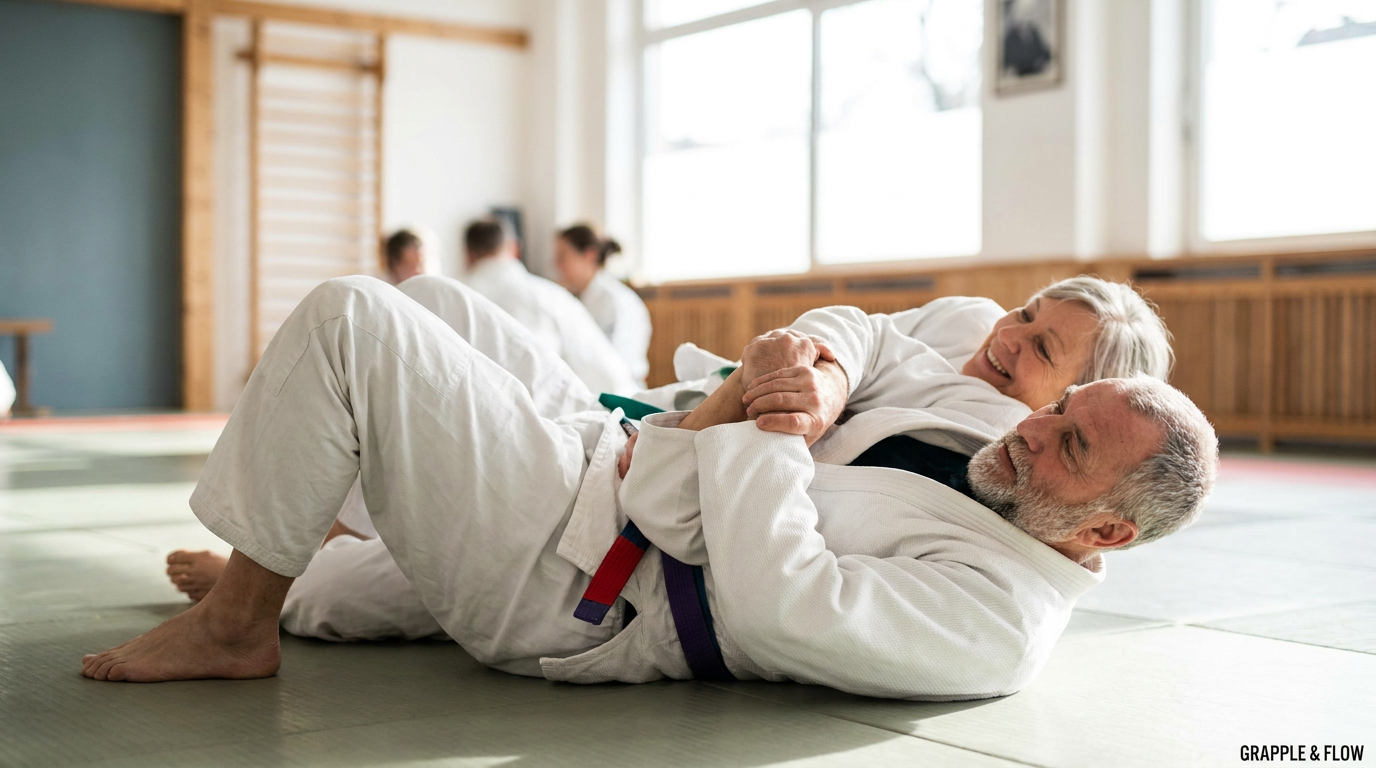
For decades, the standard medical advice for aging adults looking to maintain their fitness has centered on low-impact, repetitive exercises. Walking, swimming, and stationary cycling have long been the gold standards for preserving cardiovascular health without putting undue stress on aging joints. However, a growing cohort of adults in their fifties, sixties, and beyond are abandoning the elliptical machine for the grappling mat. Brazilian Jiu-Jitsu (BJJ), a combat sport centered on ground fighting and submission holds, is experiencing an unexpected demographic shift. Older adults are increasingly adopting the martial art not just for self-defense, but as a comprehensive tool for physical longevity and cognitive preservation.[1]
At first glance, the adoption of a combat sport by older demographics seems counterintuitive. BJJ involves joint locks, chokeholds, and intense physical sparring—elements typically associated with the resilience of youth. Yet, the underlying mechanics of the sport make it uniquely suited for the aging body. Unlike striking arts such as boxing or Muay Thai, which rely heavily on explosive speed and concussive force, BJJ is fundamentally based on leverage, weight distribution, and biomechanical efficiency. This emphasis on technique over brute strength allows older practitioners to safely engage in rigorous physical activity while minimizing the wear and tear associated with high-impact collisions.[1][4]
The physical benefits of this grappling art extend far beyond basic cardiovascular endurance. A study published by Springer examining the effects of a 12-week BJJ training program on elderly men found significant improvements in functional fitness, mobility, and muscular endurance. Because the sport requires practitioners to constantly maneuver their own body weight and that of their opponent, it naturally builds core stability and functional strength. This type of resistance training is critical for older adults, as it directly combats sarcopenia—the age-related loss of muscle mass—and improves bone density.[5][8]
Furthermore, the dynamic movements inherent to BJJ—such as hip escapes, bridging, and sweeping—require a full range of motion that promotes joint health and flexibility. Unlike the linear movements of running or cycling, grappling forces the body to move in multiple planes of motion. This complex physical engagement strengthens stabilizing muscles and dramatically improves balance. For aging populations, enhanced proprioception and balance are vital for fall prevention, which remains one of the leading causes of injury and loss of independence among seniors.[1][8]

Beyond the musculoskeletal benefits, the cardiovascular demands of BJJ are substantial. A typical training session involves periods of intense exertion interspersed with brief recovery phases, mirroring the physiological effects of high-intensity interval training (HIIT). Research from the University of Jyväskylä, which analyzed twin studies to isolate the effects of exercise on mortality, demonstrated that highly active individuals experience a 24 percent lower mortality rate compared to their sedentary counterparts. While genetics play a role, the intense cardiovascular engagement required to grapple effectively provides a robust defense against heart disease, hypertension, and metabolic decline.[6]
However, the most compelling argument for BJJ as a longevity tool may lie in its cognitive demands. The sport is frequently referred to by practitioners as "physical chess." Every sparring session—known as a "roll"—is a live, high-stakes puzzle. Practitioners must anticipate their opponent's movements, recognize physical patterns, and execute complex sequences of techniques under pressure. This constant requirement for strategic problem-solving forces the brain to remain highly active and engaged throughout the entire training session.[1][4]

However, the most compelling argument for BJJ as a longevity tool may lie in its cognitive demands.
This intense mental engagement triggers neuroplasticity, the brain's ability to form and reorganize synaptic connections. According to the Alzheimer's Association, continuously challenging the brain by learning new, complex skills is one of the most effective ways to delay the onset of cognitive decline. While activities like crossword puzzles offer some cognitive stimulation, BJJ combines mental problem-solving with simultaneous physical exertion. This dual-tasking environment requires the brain to process spatial awareness, tactile feedback, and strategic planning all at once, providing a uniquely potent stimulus for cognitive preservation.[1][7]
Despite these benefits, the primary concern for any older adult considering a martial art is the risk of injury. The perception of BJJ as a dangerous, injury-prone sport is common, but sports medicine data paints a different picture. A comprehensive study published in the Orthopaedic Journal of Sports Medicine analyzed injury rates across various combat sports and found that BJJ competitors have a substantially lower risk of injury compared to their peers.[2]
The data reveals that the injury rate in competitive BJJ is approximately 9.2 per 1,000 athlete-exposures. To put this into perspective, the injury rate for mixed martial arts (MMA) ranges from 236 to 286 per 1,000 exposures, while Taekwondo and Judo see rates up to 139.5 and 130.6, respectively. The absence of striking in BJJ eliminates the primary vectors for concussions and severe facial trauma. Furthermore, because BJJ takes place primarily on the ground, the risk of high-amplitude throwing injuries—which are common in Judo and wrestling—is significantly reduced.[2][4]

When injuries do occur in BJJ, they are overwhelmingly orthopaedic in nature. The Scoggin study noted that 78 percent of all competition injuries were orthopaedic, with the elbow and knee being the most vulnerable joints. Research published in SciELO corroborates this, noting that joint injuries, particularly from submission holds like the armbar or kimura, are the most common ailments among practitioners. While these injuries can be severe, they are generally localized to the joints and do not carry the same long-term neurological risks associated with the repeated head trauma seen in striking sports.[2][3]
To mitigate these orthopaedic risks, older practitioners must adopt a modified approach to training. Longevity on the mat requires prioritizing technique over ego. This means "tapping out"—conceding a submission—early and often, rather than fighting out of compromised positions that put joints at risk. Additionally, older adults benefit from carefully selecting training partners, focusing on controlled, flow-based sparring rather than highly competitive, explosive matches. By managing training intensity and prioritizing recovery, older athletes can sustainably practice the sport for decades.[1][4]

Beyond the physical and cognitive metrics, BJJ addresses a critical, often overlooked component of aging: social isolation. The culture of a BJJ academy is inherently communal. Practitioners must trust one another with their physical safety, fostering deep bonds and a strong sense of camaraderie. For older adults navigating life transitions such as retirement or an empty nest, the dojo provides a structured, supportive community. This social engagement is a vital pillar of mental health, reducing stress and providing a sense of purpose and belonging.[1][7]
While the current data strongly supports the benefits of BJJ for older adults, uncertainties remain. Because the massive surge in BJJ's popularity is a relatively recent phenomenon, long-term longitudinal studies tracking practitioners from middle age into their eighties are still sparse. Sports scientists are still working to understand the precise long-term effects of decades of joint manipulation on the aging skeletal system, and how the sport's specific biomechanical stresses interact with pre-existing conditions like osteoarthritis.[1][2][3]
Nevertheless, the synthesis of cardiovascular conditioning, functional resistance training, and intense cognitive stimulation makes Brazilian Jiu-Jitsu a uniquely comprehensive approach to aging. By challenging both the body and the mind in a supportive, community-driven environment, BJJ offers a compelling alternative to the solitary, low-impact routines traditionally prescribed to older adults. For those willing to step onto the mat, the sport provides not just a method of self-defense, but a profound framework for maintaining vitality, mobility, and mental sharpness well into the later stages of life.[1][4][8]
Viewpoints in depth
Sports Medicine Researchers
Focus on the biomechanical realities and orthopaedic risks of grappling.
Sports medicine professionals acknowledge that while BJJ lacks the concussive head trauma of boxing, it presents unique orthopaedic challenges. Researchers emphasize that the sport's reliance on joint manipulation—specifically targeting the elbows, shoulders, and knees—requires older practitioners to be hyper-vigilant. They advocate for strict tap-out protocols and specialized strength conditioning to protect aging ligaments from the hyperextension inherent to submission grappling.
Cognitive & Longevity Scientists
Emphasize the neuroprotective benefits of complex motor learning.
For longevity experts, the value of BJJ lies in its dual-tasking nature. By forcing the brain to solve complex spatial and strategic puzzles while simultaneously managing intense cardiovascular exertion, BJJ acts as a powerful stimulus for neuroplasticity. These scientists argue that mastering the 'physical chess' of grappling is far more effective at staving off cognitive decline than solitary, repetitive exercises like jogging or cycling.
BJJ Practitioners & Coaches
Highlight the practical adaptability and community aspects of the sport.
Instructors and long-time practitioners argue that BJJ is infinitely scalable to a person's age and physical condition. They point out that the sport's foundational philosophy—using leverage and timing to overcome size and strength—was specifically designed to empower physically weaker individuals. Coaches stress that the true longevity benefit comes from the dojo's strong social community, which keeps older adults engaged, accountable, and socially connected.
What we don't know
- Long-term longitudinal data tracking the joint health of BJJ practitioners who train continuously into their seventies and eighties is currently limited.
- It remains unclear exactly how the specific biomechanical stresses of BJJ interact with pre-existing age-related conditions like advanced osteoarthritis over a multi-decade timeline.
- The precise threshold of training intensity required to maximize cognitive benefits without triggering physical overtraining in older adults is still being studied.
Key terms
- Sarcopenia
- The natural, age-related loss of skeletal muscle mass and strength.
- Neuroplasticity
- The brain's ability to reorganize itself by forming new neural connections throughout life.
- Proprioception
- The body's ability to sense its movement, action, and location, which is crucial for balance.
- Athlete-exposures
- A metric used in sports medicine to calculate injury rates, representing one athlete participating in one match or practice.
- Flow rolling
- A form of light, continuous sparring in BJJ focused on movement and technique rather than winning or applying forceful submissions.
Frequently asked
Am I too old to start Brazilian Jiu-Jitsu?
While physical limitations vary by individual, BJJ is designed around leverage rather than strength, making it highly adaptable for older adults. Many practitioners begin in their 50s or 60s by focusing on controlled, flow-based training.
Do I have to compete in tournaments?
No. The vast majority of older BJJ practitioners train recreationally for fitness and cognitive benefits, entirely avoiding the higher injury risks associated with formal competition.
What are the most common injuries in BJJ?
When injuries occur, they are typically orthopaedic, most commonly affecting the elbows and knees due to joint locks. Concussions and head trauma are rare compared to striking sports.
How does BJJ help with brain health?
BJJ requires constant strategic problem-solving under physical pressure, often called 'physical chess.' This dual-tasking environment stimulates neuroplasticity, which helps delay age-related cognitive decline.
Sources
Source coverage
8 outlets
4 viewpoints surfaced








[1]Factlen Editorial TeamFactlen Editorial Synthesis
Synthesis by Factlen editorial team
Read on Factlen Editorial Team →[2]Orthopaedic Journal of Sports MedicineSports Medicine Researchers
Assessment of Injuries During Brazilian Jiu-Jitsu Competition
Read on Orthopaedic Journal of Sports Medicine →[3]SciELOSports Medicine Researchers
Injury prevalence in Brazilian jiu-jitsu athletes: comparison between different competitive levels
Read on SciELO →[4]BJJ Eastern EuropeBJJ Practitioners & Coaches
New Study: Jiu-Jitsu Competitors Have the Lowest Injury Rate Among Combat Athletes
Read on BJJ Eastern Europe →[5]SpringerBJJ Practitioners & Coaches
Effects of a 12-week Brazilian jiu-jitsu training program on functional fitness in elderly men
Read on Springer →[6]University of JyväskyläCognitive & Longevity Scientists
Twin studies on physical activity and mortality
Read on University of Jyväskylä →[7]Alzheimer's AssociationCognitive & Longevity Scientists
Staying Mentally Active to Reduce Cognitive Decline
Read on Alzheimer's Association →[8]National Institute on AgingCognitive & Longevity Scientists
Resistance-based activities and muscle retention in older adults
Read on National Institute on Aging →

Every angle. Every day.
Get fitness stories with full source coverage and perspective breakdowns delivered to your inbox.