
U.S. Homeowner Equity Hits Record $18 Trillion, Creating $11.7 Trillion in Tappable Wealth
American mortgage holders now possess an unprecedented $11.7 trillion in accessible home equity, averaging $212,000 per borrower. As homeowners look to tap this wealth without losing low primary mortgage rates, the choice of borrowing vehicle becomes critical.


- Market Analysts
- Focuses on the macroeconomic implications of the $18 trillion equity milestone and regional housing disparities.
- Consumer Finance Advisors
- Emphasizes the behavioral and mechanical differences between borrowing options to protect household wealth.
- Mortgage Lenders
- Tracks the shift in loan origination volume from primary mortgages to second-lien products.
The competing cases
The Home Equity Line of Credit (HELOC)
A revolving credit line that allows homeowners to borrow, repay, and borrow again during a set draw period.
For: Offers maximum flexibility, as borrowers only pay interest on the exact amount they draw, rather than a large lump sum. Against: Carries a variable interest rate tied to the prime rate, meaning monthly payments can increase unexpectedly if broader economic rates rise. Evidence: In mid-2026, strong borrowers are seeing HELOC pricing around Prime + 0% to Prime + 2%, with average monthly payments dropping to $311 per $50,000 borrowed as rates slightly eased. Fits well when: You are funding a phased renovation where contractor invoices arrive over several months, or you want a flexible emergency fund. Does not fit when: You need a single, fixed amount immediately and require the strict discipline of a fully amortized, predictable payment schedule.
The Fixed Home Equity Loan
A closed-end second mortgage that delivers a single lump sum upfront with a fixed interest rate and predictable repayment schedule.
For: Locks in a fixed interest rate for the life of the loan, guaranteeing that the monthly payment will never change regardless of macroeconomic volatility. Against: Borrowers pay interest on the entire lump sum from day one, even if the funds sit in a bank account waiting to be used. Evidence: 2026 market data shows fixed home equity loans pricing in the high-7% to high-8% range, depending on the borrower's combined loan-to-value ratio and credit profile. Fits well when: You are consolidating a specific amount of high-interest credit card debt or paying for a one-time, fixed-cost expense like a roof replacement. Does not fit when: Your project costs are uncertain or you plan to pay off the borrowed amount within 12 to 36 months, as the upfront closing costs may outweigh the benefits.
The Cash-Out Refinance
Replacing an existing primary mortgage with a new, larger loan and taking the difference in cash.
For: Provides access to large sums of capital while consolidating all housing debt into a single monthly payment, often with a lower interest rate than second-lien products. Against: Erases the borrower's existing primary mortgage rate, which is a massive financial penalty for the 80% of U.S. homeowners who currently hold rates below 6%. Evidence: ICE data reveals that 70% of cash-out borrowers in recent quarters accepted an average rate increase of 1.45 percentage points to extract an average of $94,000, raising their monthly payments by roughly $590. Fits well when: You already have a high primary mortgage rate, or the sheer volume of high-interest debt you are consolidating mathematically offsets the penalty of a higher mortgage rate. Does not fit when: You hold a sub-4% pandemic-era mortgage and only need a modest amount of capital for a minor project.
What’s at stake
For the average homeowner, this record equity represents a massive financial safety net and a cheap source of capital for renovations or debt consolidation. However, accessing it efficiently requires navigating high interest rates and choosing the right financial product to avoid unnecessary costs.
If you own a home in the United States, your household balance sheet likely just hit a personal all-time high on paper. Over the past few years, property values have surged, quietly transforming the American housing stock into a massive reservoir of stored wealth. But paper wealth does not pay for a kitchen remodel, cover college tuition, or eliminate high-interest credit card debt.
According to the August 2026 Mortgage Monitor report released by Intercontinental Exchange (ICE), U.S. mortgage holders now sit on a record $18 trillion in home equity. This milestone reflects a sustained period of home price appreciation, which accelerated to a 14-month high of 1.5% annual growth in July.[1][3]
The headline figure is staggering, but the more actionable metric is what the financial industry calls "tappable equity." Of that $18 trillion total, $11.7 trillion is considered accessible—meaning homeowners can borrow against it while still maintaining a conservative 20% equity cushion in their properties.[1][2]
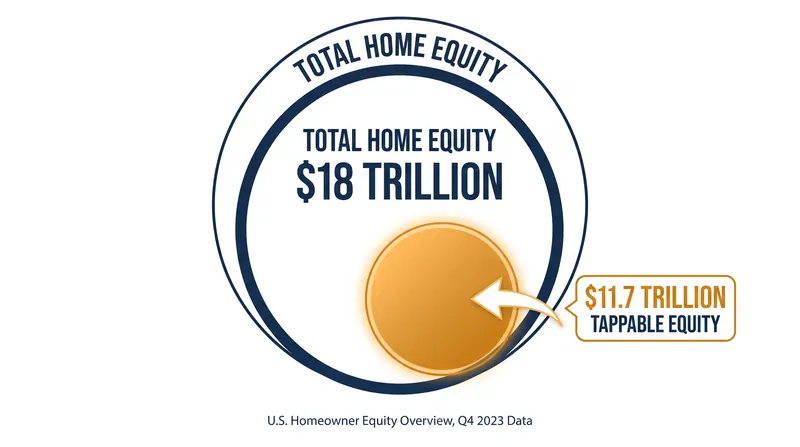
For the 47.5 million homeowners who hold this wealth, that averages out to roughly $212,000 in tappable equity per borrower. It is a historic financial safety net, but one that is currently trapped behind a complex wall of interest rate mathematics.[2][3]
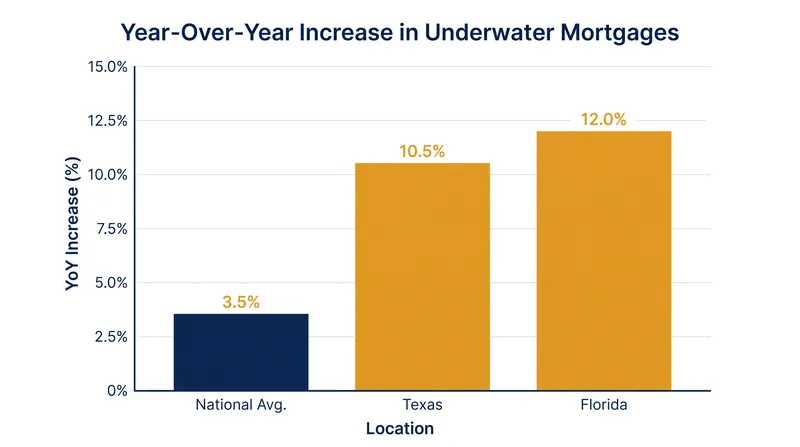
While the aggregate numbers paint a picture of unprecedented wealth, the gains are not evenly distributed across the housing market. Approximately 813,000 borrowers are currently underwater, owing more than their homes are worth. This represents a 44% year-over-year increase in negative equity.[1][2][3]
While the aggregate numbers paint a picture of unprecedented wealth, the gains are not evenly distributed across the housing market.
This distress is highly concentrated among a specific cohort: recent buyers who purchased between 2022 and 2025 using FHA or VA loans, particularly in cooling Sunbelt markets. In cities across Texas and Florida, where price declines from recent peaks have been most pronounced, the equity picture looks vastly different than the national average.[1][2][3]
For the vast majority who do have equity, the primary dilemma is how to access it without surrendering the ultra-low primary mortgage rates they locked in years ago. With roughly 80% of U.S. homeowners holding mortgage rates below 6%, the traditional cash-out refinance has become a mathematically painful proposition for many.[4]
As a result, lenders are seeing a significant shift in borrower behavior. Homeowners are increasingly leaving their cheap primary mortgages untouched and turning to second-lien products. First-quarter equity withdrawals through second liens rose significantly, marking the largest volume for that quarter in 17 years.[1][4][5]
This lock-in effect is also reshaping the broader real estate market. Because trading up to a new home requires taking on a new, higher-rate mortgage, millions of families are choosing to stay put. Instead of moving, they are tapping their $212,000 equity cushions to fund major renovations and adapt their current homes to their changing needs.[6]

Beyond renovations, this tappable wealth is serving as a critical release valve for household balance sheets. With American credit card debt surpassing $1.2 trillion, many homeowners are using secured home equity products to consolidate high-interest revolving debt, trading 20% credit card APRs for single-digit secured loan rates.[5][6]
However, tapping equity means putting the home on the line as collateral. As property insurance costs rise to all-time highs and the broader economy fluctuates, financial advisors warn that over-leveraging a property can quickly turn a comfortable financial cushion into a strict liability if household income drops.[4]
Ultimately, this $11.7 trillion milestone represents a massive reservoir of consumer resilience. To navigate this opportunity safely, homeowners must carefully weigh the mechanics of how they borrow against what they actually need the money for. The best financial vehicle depends entirely on the borrower's timeline, discipline, and the specific scope of their capital needs.[5][6]
Key takeaways
- U.S. mortgage holders now hold a record $18 trillion in home equity, driven by a 14-month high in annual home price growth.
- Approximately $11.7 trillion of that equity is 'tappable,' allowing homeowners to borrow while maintaining a 20% equity cushion.
- The average homeowner with a mortgage has roughly $212,000 in accessible wealth.
- To preserve low primary mortgage rates, borrowers are increasingly turning to HELOCs and fixed home equity loans over cash-out refinances.
Unsettled ground
- How long the current acceleration in home price growth will last if interest rates remain elevated through the end of 2026.
- Whether the rising concentration of underwater mortgages in Texas and Florida will spread to other cooling Sunbelt markets.
Sources
Source coverage
6 outlets
3 viewpoints surfaced






[1]ICE Mortgage TechnologyMarket Analysts
ICE Mortgage Monitor: Mortgage Holder Equity Climbs to Record $18 Trillion as Annual Home Price Growth Reaches 14-Month High
Read on ICE Mortgage Technology →[2]Real Estate TodayMarket Analysts
Home Equity Reaches a Record $18 Trillion
Read on Real Estate Today →[3]MBA NewslinkMarket Analysts
ICE: Mortgage Holder Equity Hits Record $18 Trillion
Read on MBA Newslink →[4]National Mortgage NewsMortgage Lenders
New data showed contrasting signals for the U.S. housing market
Read on National Mortgage News →[5]Honest CasaConsumer Finance Advisors
HELOC vs home equity loan: the practical difference
Read on Honest Casa →[6]Marshfield Medical Center Credit UnionConsumer Finance Advisors
HELOC vs. Home Equity Loan: The Basic Difference
Read on Marshfield Medical Center Credit Union →
Comments



Every angle. Every day.
Get real estate stories with full source coverage and perspective breakdowns delivered to your inbox.