
Federal Appeals Court Rules President Cannot Build White House Ballroom Without Congressional Approval
A federal appeals court has halted above-ground construction of a $400 million White House ballroom, ruling 2-1 that the president lacks the authority to unilaterally alter the executive mansion. The decision sets up a high-stakes Supreme Court showdown over the limits of executive power.

- The Appellate Majority
- Argues that the White House belongs to the American people and Congress, making the president a temporary tenant who requires legislative approval for major structural changes.
- The Trump Administration
- Contends that the president has inherent authority to secure and improve the Executive Residence, and that the privately funded project is a vital national security upgrade.
- Historic Preservationists
- Argues that the administration bypassed mandatory environmental and architectural reviews, unlawfully destroying historic property without congressional oversight.
Common questions
Is all construction at the White House stopping?
No. The court's order explicitly allows below-ground work, including the construction of a secure bunker and medical facilities, to continue.
Are taxpayers paying for the new ballroom?
The administration states the $400 million project is being funded entirely by private donations, though courts ruled this does not exempt the project from congressional oversight.
What happens after the 14-day stay expires?
Unless the Supreme Court issues an emergency order to block the appellate ruling, all above-ground construction on the ballroom must cease.
The short answer
- A federal appeals court ruled 2-1 that the Trump administration cannot build a White House ballroom without Congress's approval.
- The court declared the president a 'temporary tenant' who lacks unilateral authority over the historic property.
- The injunction halts above-ground construction but permits work on underground security facilities to continue.
- President Trump condemned the ruling and vowed to appeal immediately to the Supreme Court.
- The court paused its order for 14 days, creating a tight window for Supreme Court intervention.
A federal appeals court has ordered the Trump administration to halt above-ground construction of a $400 million White House ballroom, ruling that the president cannot unilaterally alter the executive mansion without congressional approval. The decision strikes at the core of executive power over federal property, setting up a high-stakes showdown at the Supreme Court.[1][2]
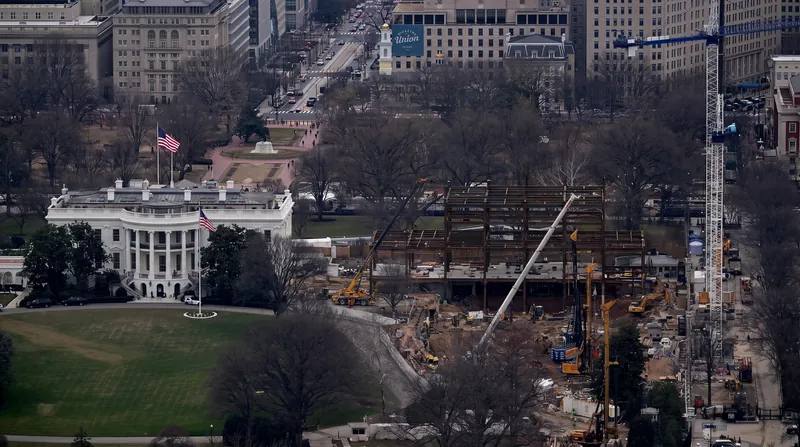
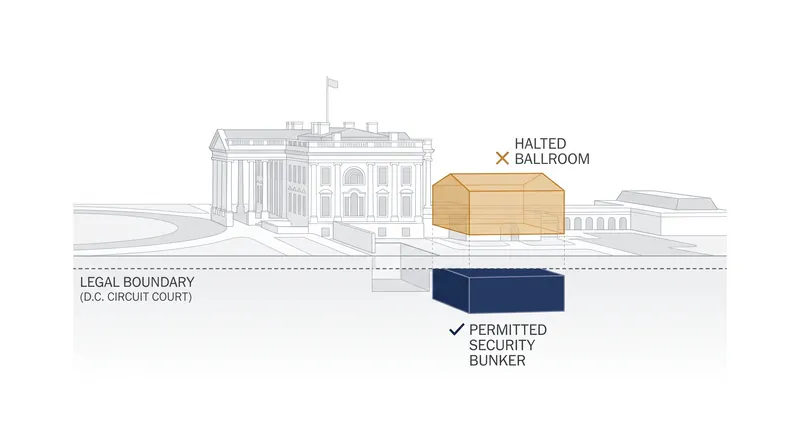
In a 2-1 decision issued Friday, the U.S. Court of Appeals for the District of Columbia Circuit upheld a lower court's preliminary injunction against the project. The ruling freezes vertical construction on the 90,000-square-foot facility, which has been rising on the site of the demolished East Wing since late last year.[1][3]
The majority opinion, authored by Judges Patricia Millett and Bradley Garcia, dismantled the administration's claim of unilateral authority. "Each President is a temporary tenant, not the owner, of the White House and its Executive Residence," the judges wrote, emphasizing that the property is maintained for the American people and future administrations.[1][2]
The court concluded that whether a massive ballroom should be constructed is a matter for Congress to decide, not an issue for "Executive self-help." The ruling noted an absence of any express or implied authorization granting the president the ability to fundamentally reshape the historic grounds.[1][3]
President Donald Trump responded swiftly on his Truth Social platform, rejecting the court's characterization. "We are not tenants... we are PRESIDENTS," he wrote, asserting an inherent right to fix, renovate, and secure the White House grounds without seeking permission from lawmakers. He vowed to appeal the "unjust decision" in its entirety.[2][3]
President Donald Trump responded swiftly on his Truth Social platform, rejecting the court's characterization.
The legal battle, initiated by the National Trust for Historic Preservation, hinges on the statutory limits of presidential power. When the administration demolished the East Wing in October 2025, it bypassed standard environmental and architectural reviews, arguing that the project's reliance on private donations exempted it from congressional oversight.[2][5]
The appellate majority rejected that premise. The judges ruled that private financing does not override the Constitution's Property Clause, which grants Congress control over federal land. They noted that historical upkeep provisions cited by the administration authorize routine maintenance, not the demolition and replacement of substantial portions of the White House.[3]
The administration has heavily leaned on national security to justify the project's rapid pace. Government lawyers argued that the ballroom's superstructure is inextricably linked to a new underground bunker, featuring blast-proof columns and a drone port on the roof, making any delay a severe security threat.[4][6]
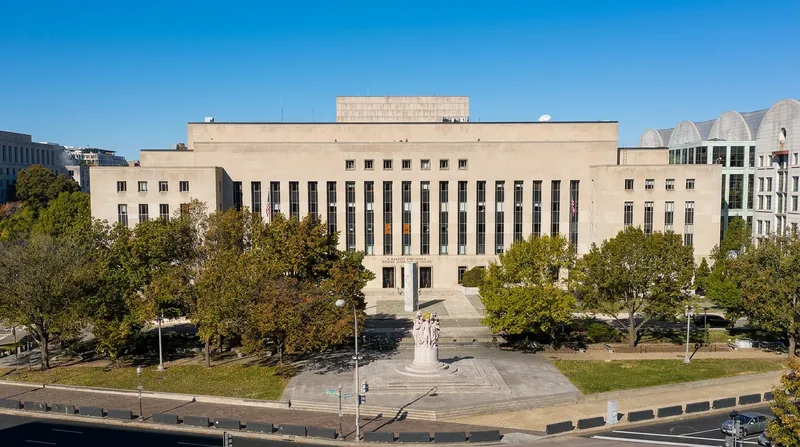
The court navigated this by bifurcating the project. The injunction explicitly permits all below-ground construction, including the bunker and military installations, to proceed unabated. It only halts the above-ground hospitality facility, rejecting the administration's claim that the two phases are inseparable.[1][3]
In her dissent, Judge Neomi Rao argued that the preservation group lacked the legal standing to sue the administration in the first place. She contended that the lower court's injunction was an overreach and that the president likely possesses the authority to make improvements to the Executive Residence.[3]
The practical implications of the ruling are immediate, though temporarily paused. The appeals court stayed its decision for 14 days, giving the White House a brief window to seek an emergency intervention from the Supreme Court before the cranes are forced to stop.[1][2]
If the Supreme Court declines to step in, the project will face a complex demobilization at its most sensitive phase. With structural steel already rising above grade, a prolonged freeze would leave the partially finished framework exposed to the elements while the underlying lawsuit slowly winds its way through the courts.[5]
Why it matters
This ruling defines the hard limits of presidential power over federal property, establishing that even privately funded projects at the White House require congressional approval. If upheld by the Supreme Court, it will force a massive, partially built construction project to freeze, fundamentally altering the administration's plans for the executive mansion.
Competing readings
The Constitutional Custodians
The view that the White House is public property subject to congressional control.
This perspective, anchored by the appellate majority and preservation groups, emphasizes that the president is merely a steward of the White House. Proponents argue that the Property Clause of the Constitution explicitly vests control of federal land in Congress. From this viewpoint, allowing a president to unilaterally demolish and rebuild parts of the executive mansion—even with private funds—sets a dangerous precedent that bypasses the democratic process and environmental review laws.
The Executive Authority Argument
The view that the president has inherent power to secure and modernize the residence.
The administration and its legal defenders argue that the president requires broad latitude to manage the White House, particularly when national security is at stake. This camp contends that the ballroom's superstructure is an integral shield for the underground bunker and drone port. They argue that because the project relies on private donations rather than congressional appropriations, it should be exempt from legislative micromanagement, framing the court's intervention as an overreach into executive branch operations.
The sequence
Oct 2025
The Trump administration demolishes the historic East Wing to clear space for the new ballroom.
Dec 2025
The National Trust for Historic Preservation files a lawsuit to block the privately funded project.
Mar 2026
U.S. District Judge Richard Leon issues a preliminary injunction halting above-ground construction.
Apr 2026
An appeals court grants a temporary administrative stay, allowing vertical work to proceed while it reviews the case.
Aug 2026
The D.C. Circuit Court formally upholds the injunction, giving the administration 14 days to appeal to the Supreme Court.
Jargon, explained
- Preliminary Injunction
- A temporary court order that stops a party from taking a specific action until a final decision is reached in a lawsuit.
- Property Clause
- A provision in the U.S. Constitution that grants Congress the exclusive power to manage and regulate federal property.
- Standing
- The legal requirement that a party must have suffered a concrete injury to bring a lawsuit before a federal court.
What’s still unclear
- Whether the Supreme Court will issue an emergency stay to let construction continue during the appeal.
- How the administration will safely secure the exposed steel superstructure if vertical work is forced to stop.
- Whether Congress will eventually step in to retroactively authorize the project.
Sources
Source coverage
6 outlets
3 viewpoints surfaced






[1]PBS NewsHourThe Appellate Majority
Appeals court rules Trump can't build White House ballroom without congressional approval
Read on PBS NewsHour →[2]The GuardianThe Appellate Majority
Appeals court halts construction of Trump's $400m White House ballroom
Read on The Guardian →[3]JURISTThe Appellate Majority
Appeals court blocks White House ballroom, says only Congress can authorize it
Read on JURIST →[4]KSL TVThe Trump Administration
Trump administration cites security risk, asks appeals court to pause White House ballroom halt
Read on KSL TV →[5]KWTXHistoric Preservationists
Construction on Trump's White House ballroom can continue for now, US appeals court says
Read on KWTX →[6]KFYR TVThe Trump Administration
Trump administration asks appeals court to pause order halting White House ballroom construction
Read on KFYR TV →
Comments

Every angle. Every day.
Get law justice stories with full source coverage and perspective breakdowns delivered to your inbox.