
California Launches $3,500 'MyFirstEV' Rebate Program to Replace Ended Federal Tax Credit
Following the expiration of the $7,500 federal EV tax credit, California has introduced a $3,500 point-of-sale rebate exclusively for first-time electric vehicle buyers. The $270 million program is funded equally by the state and participating automakers.

- State Policymakers
- Focus on maintaining climate goals and market momentum despite the loss of federal backing.
- Automotive Industry
- Focus on moving inventory and sharing the subsidy cost to stimulate consumer demand.
- Consumer Advocates
- Focus on upfront affordability and equity for first-time buyers entering the EV market.
Fast facts
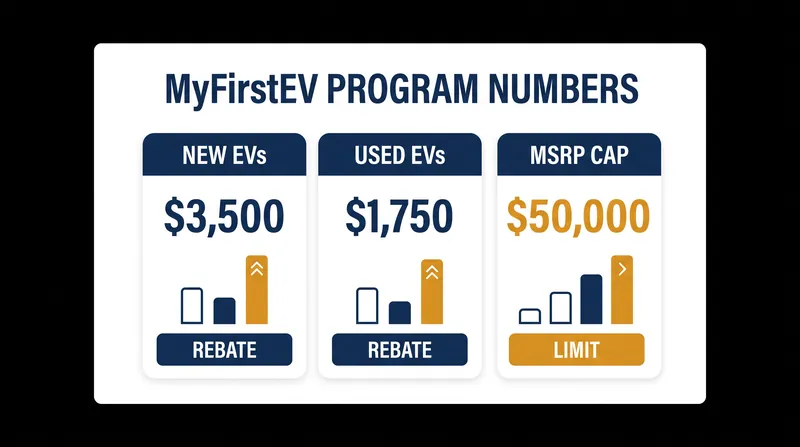
- California has launched the MyFirstEV program, offering a $3,500 instant rebate for new electric vehicles and $1,750 for used models.
- The initiative replaces the former $7,500 federal tax credit, shifting the financial benefit to a point-of-sale discount at the dealership.
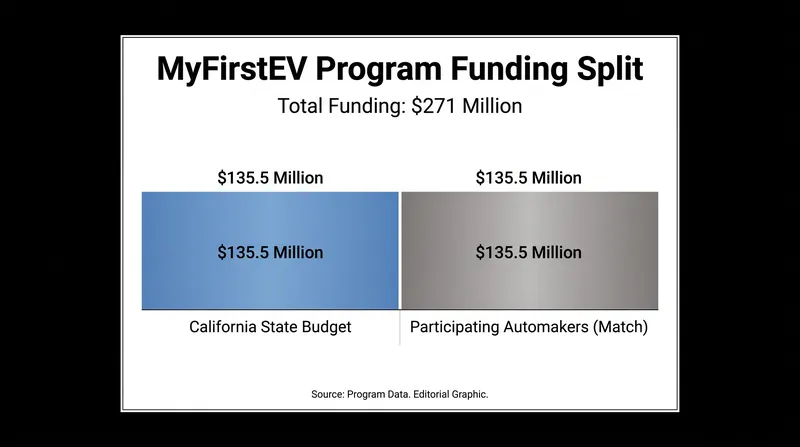
- Funding totals $270 million, split evenly between the state budget and dollar-for-dollar matches from 13 participating automakers.
- The program imposes a $50,000 price cap on new vehicles, though this limit is waived for automakers headquartered in California.
Why this matters
With federal EV incentives gone, California's new model shifts the financial benefit from a delayed tax return to an instant dealership discount. If successful, this point-of-sale approach could become a blueprint for other states trying to maintain EV adoption rates without federal backing.
The expiration of the $7,500 federal tax credit left a sudden vacuum in the electric vehicle market, stalling adoption rates just as states were relying on them to meet aggressive decarbonization targets. In California, where zero-emission vehicles constitute nearly a fifth of all new car sales, the loss of federal backing threatened to derail a carefully engineered transition away from fossil fuels. The policy shift forced state regulators to confront a structural vulnerability: their climate trajectory was heavily dependent on a federal subsidy that no longer existed.[2][4]
To bridge this gap, Governor Gavin Newsom launched the "MyFirstEV" program, a state-level intervention designed to replace the delayed federal tax credit with an immediate point-of-sale discount. The initiative offers $3,500 off the purchase or lease of a new electric vehicle and $1,750 off a used model. By shifting the financial mechanism from a tax return to the dealership floor, the state aims to maintain market momentum while operating within a tighter budget.[1][6]
Unlike the former federal model, which required buyers to claim the credit on their annual tax returns, the California rebate is applied directly at the point of sale. This structural shift is intended to lower the upfront financial barrier, a hurdle that often deters middle-income consumers from transitioning to electric powertrains. Buyers no longer need to float the premium cost of the vehicle for months while waiting for tax season.[2][7]
The $270 million program operates on a unique public-private partnership model that halves the burden on taxpayers. The state government allocated $135.5 million from its 2026-2027 budget, which is matched dollar-for-dollar by participating automakers. This cost-sharing arrangement ensures that the state does not bear the entire financial weight of subsidizing the automotive market, while compelling manufacturers to invest directly in their customer base.[3][4]
Thirteen major automakers have signed on to participate, including Ford, General Motors, Honda, Hyundai, Kia, Lucid, Mitsubishi, Nissan, Rivian, Subaru, Tesla, Toyota, and Volvo. The program rolled out its initial phase on August 7 with Hyundai, Lucid, and Tesla, allowing buyers to claim the discount immediately. Other manufacturers are scheduled to integrate the instant rebate into their dealership software systems throughout the fall.[1][4][6]
The program rolled out its initial phase on August 7 with Hyundai, Lucid, and Tesla, allowing buyers to claim the discount immediately.
In a strategic departure from broad-based subsidies, MyFirstEV is exclusively available to first-time electric vehicle buyers. Consumers must sign an attestation confirming they have never previously owned or leased a zero-emission vehicle. Policy analysts at research firms like Atlas Public Policy note that this targeted approach maximizes the return on investment, as survey data consistently indicates that drivers who transition to electric vehicles rarely revert to internal combustion engines.[4][7]
To ensure the funds support mainstream adoption rather than luxury purchases, the program imposes strict price ceilings. Qualifying new vehicles must have a manufacturer's suggested retail price of $50,000 or less, while used models are capped at $25,000 and must be sold through a certified pre-owned program. These limits are designed to stretch the $135.5 million state allocation across an estimated 73,000 vehicle transactions.[1][2][6]
However, the legislation includes a significant and controversial exemption for automakers headquartered in California. Buyers purchasing from California-based companies—such as Rivian and Lucid—can claim the $3,500 discount regardless of the vehicle's retail price. This carve-out is explicitly designed to support the state's domestic manufacturing base and reward companies that contribute to the local economy, even if their flagship models exceed the standard $50,000 cap.[2][5]
The inclusion of a $1,750 rebate for used electric vehicles represents a critical component of the state's equity strategy. By lowering the cost of entry for the secondary market, the program aims to make zero-emission technology accessible to a broader demographic. This used-vehicle discount stacks with existing low-income assistance initiatives, such as the Clean Cars 4 All program, which can provide thousands of dollars in additional support for qualifying households.[3][6]
The shift to a point-of-sale model also streamlines the administrative burden on consumers. Buyers do not need to navigate complex tax codes, calculate their annual tax liability, or fill out pre-approval applications. Instead, the discount is factored directly into the financing or lease agreement before the vehicle leaves the lot, reducing the monthly payment calculation in real time.[5][7]
California's intervention is not occurring in a vacuum. The state is currently defending its zero-emission vehicle sales mandates and heavy-duty diesel engine regulations against federal legal challenges. In this context, the MyFirstEV program serves as both an economic stimulus and a geopolitical statement, reinforcing the state's commitment to its climate trajectory regardless of federal policy shifts or fossil fuel market volatility.[3][4]
As the program scales up, its performance will be closely monitored by the 17 other states that have adopted portions of California's clean car regulations. If the combination of point-of-sale discounts, automaker matching funds, and first-time buyer targeting proves effective at sustaining adoption rates, the MyFirstEV framework could become a definitive blueprint for regional governments seeking to drive the energy transition independently.[5]
Viewpoints in depth
Point-of-Sale Instant Rebates (The California Model)
An immediate dealership discount funded jointly by the state and participating automakers, targeting first-time buyers.
FOR: Lowers the immediate upfront cost and monthly financing payments, removing the need for buyers to float a premium price for months. It stretches public funds by requiring a 50% automaker match ($135.5 million state / $135.5 million industry). AGAINST: Requires complex integration with dealership sales software and limits consumer choice to participating brands. The $50,000 price cap restricts options for larger families needing three-row SUVs. EVIDENCE: Research from Atlas Public Policy indicates that point-of-sale incentives are significantly more effective at driving adoption among middle-income buyers than delayed tax credits. FITS WELL WHEN: The primary barrier to entry is the initial down payment or monthly financing cost, and the goal is to convert new demographics to electric vehicles. DOES NOT FIT WHEN: Consumers prefer brands that refuse to match the state's financial contribution, or when buyers are seeking premium models above the price cap from non-California manufacturers.
Post-Purchase Tax Credits (The Former Federal Model)
A delayed financial benefit claimed on annual tax returns, funded entirely by the government.
FOR: Applies universally across all qualifying manufacturers without requiring corporate opt-ins. It provided a larger total financial benefit ($7,500 versus $3,500) and was administratively simpler for dealerships, as the burden of proof fell on the taxpayer and the IRS. AGAINST: Forces the consumer to finance the full purchase price upfront, delaying the financial benefit by up to 16 months depending on the purchase date. It disproportionately benefits higher-income households with sufficient tax liability to absorb the credit. EVIDENCE: Historical sales data shows that while the $7,500 credit drove significant volume, it often subsidized purchases by affluent buyers who would have acquired the vehicle regardless of the incentive. FITS WELL WHEN: The government has a massive federal budget to deploy, and the objective is sheer volume across all income brackets. DOES NOT FIT WHEN: The policy goal is to democratize access for working-class buyers who cannot afford to float a $7,500 premium for a year.
What we don’t know
- It remains unclear how quickly the $135.5 million state allocation will be depleted given the first-come, first-served structure.
- The long-term impact on non-participating automakers, who cannot offer the $3,500 discount to their customers, is not yet known.
Sources
Source coverage
7 outlets
3 viewpoints surfaced







[1]CBS NewsConsumer Advocates
Newsom announces rollout of California's $3,500 EV rebate for first-time buyers
Read on CBS News →[2]Los Angeles TimesConsumer Advocates
California is bringing back EV rebates. This is how to get one.
Read on Los Angeles Times →[3]KQEDState Policymakers
California Announces $3,500 Instant Rebate for New EV Purchases, Available Now
Read on KQED →[4]Canary MediaAutomotive Industry
California to offer a novel $3,500 rebate for first-time EV buyers
Read on Canary Media →[5]FOX 11 Los AngelesConsumer Advocates
California to launch $3,500 instant EV rebate to replace defund federal tax credit
Read on FOX 11 Los Angeles →[6]Office of Governor Gavin NewsomState Policymakers
Governor Newsom announces $3,500 instant rebates now available for Californians buying their first zero-emission vehicle
Read on Office of Governor Gavin Newsom →[7]Joint ChargingAutomotive Industry
What Is MyFirstEV?
Read on Joint Charging →
Comments

More in transportation
See all 5 stories →Regulatory Compliance
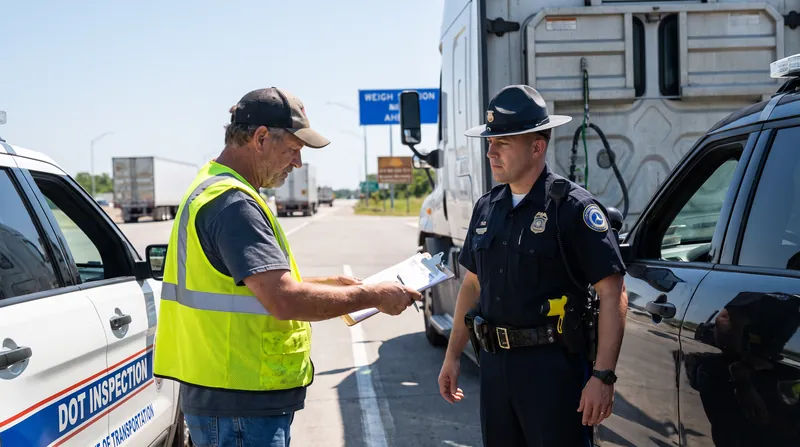
FMCSA Codifies Strict English Proficiency Rule for Commercial Truck Drivers, Citing Safety Loophole
5 sources
Freight Automation
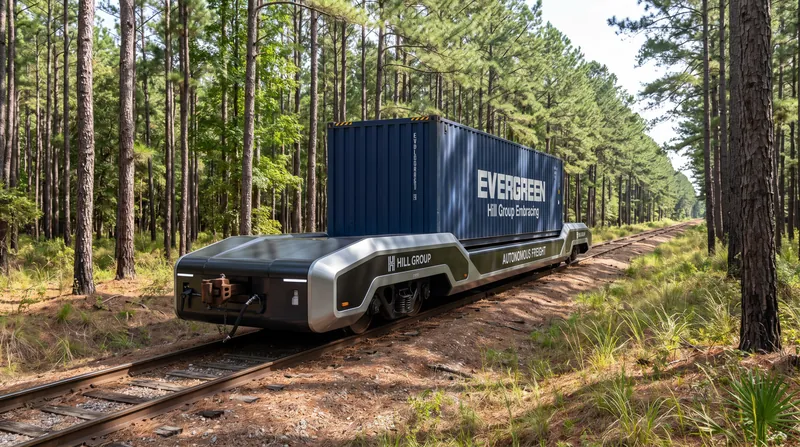
G&W and Parallel Systems Partner to Test Autonomous, Self-Propelled Container Cars for Freight Rail Future
6 sources
Space Regulation
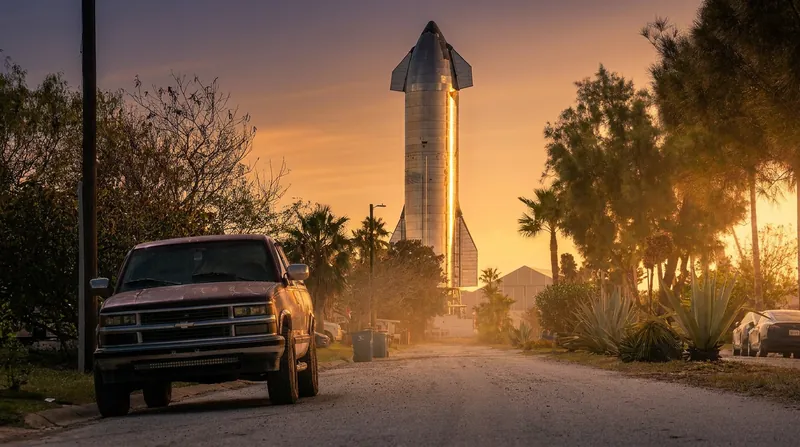
FAA Proposes Waiving NEPA and 12 Other Environmental Laws to Streamline Commercial Space Licensing
7 sources
Every angle. Every day.
Get transportation stories with full source coverage and perspective breakdowns delivered to your inbox.