
Supreme Court to Decide if Employees Can Sue for Sex Discrimination Under Title IX
The Supreme Court will resolve a circuit split on whether employees at federally funded educational institutions can bypass Title VII and sue for sex discrimination under Title IX. The ruling will determine if workers can access uncapped damages and longer filing deadlines for workplace claims.

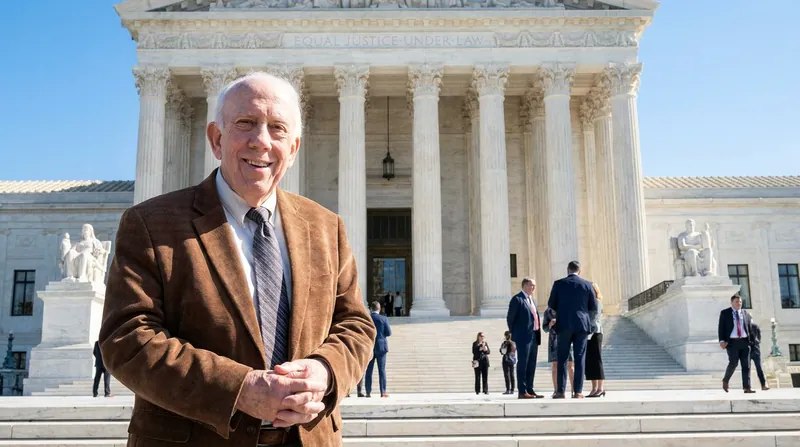
- Title VII Exclusivity Proponents
- Argues that Title VII is the exclusive and appropriate remedy for workplace disputes, complete with necessary administrative safeguards.
- Title IX Expansion Advocates
- Argues that Title IX's broad language should protect the employees who run federally funded programs, providing a critical alternative pathway for justice.
- Federal Enforcement Officials
- Argues that while Title IX protects students, it was not intended to circumvent Title VII's carefully negotiated employment framework.
How we got here
1972
Congress passes Title IX of the Education Amendments, prohibiting sex discrimination in federally funded education programs.
November 2024
The Eleventh Circuit rules that Title IX does not provide a private right of action for employment discrimination, deepening a circuit split.
May 2026
The Supreme Court grants certiorari in Crowther v. Board of Regents to resolve the geographic divide over employee rights.
Why it matters
If the Court allows Title IX employment claims, workers at federally funded schools and universities will gain a powerful alternative to Title VII, bypassing the EEOC process and accessing uncapped compensatory damages. A ruling against the employees would cement Title VII as the exclusive remedy, limiting employer liability and enforcing strict administrative deadlines.
The U.S. Supreme Court is preparing to resolve a decades-old legal divide that dictates how hundreds of thousands of educational employees can fight workplace sex discrimination. During its upcoming October 2026 term, the Court will hear arguments in Crowther v. Board of Regents of the University System of Georgia, a case that asks whether employees at federally funded schools and universities can sue their employers under Title IX. For years, the legal landscape has been fractured, with an employee's rights depending entirely on their geographic location. Now, the justices will decide whether Title VII of the Civil Rights Act of 1964 serves as the exclusive remedy for workplace discrimination, or if Title IX offers a parallel, and often more powerful, legal avenue.[1]
The stakes for both educational institutions and their workforces are substantial, rooted in the stark procedural differences between the two civil rights statutes. Title VII, the federal law expressly designed to prohibit employment discrimination, requires plaintiffs to first file a charge with the Equal Employment Opportunity Commission (EEOC) within 180 or 300 days of the alleged incident. Furthermore, Title VII caps compensatory and punitive damages based on the size of the employer, with a maximum limit of $300,000. Title IX, enacted under the Spending Clause to prohibit sex discrimination in federally funded education programs, carries no such administrative exhaustion requirements and features no statutory caps on compensatory damages.[2]
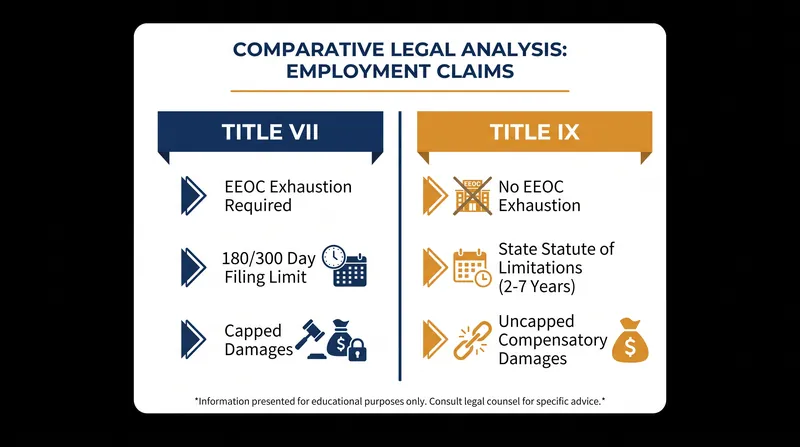
If the Supreme Court affirms that Title IX provides an implied private right of action for employees, workers could bypass the EEOC entirely and proceed directly to federal court. They would also benefit from significantly longer filing windows, as Title IX borrows the personal-injury statute of limitations from the forum state, which can range from two to seven years. Conversely, a ruling that forecloses Title IX employment claims would cement Title VII as the sole legal vehicle for these disputes, preserving the familiar procedural framework and damages limits that employers have long relied upon to manage litigation risk.
The Supreme Court's intervention stems from a consolidated appeal out of the Eleventh Circuit involving two former university employees. Thomas Crowther, a former art professor at Augusta University, sued after his contract was not renewed following student allegations of sexual harassment, which he contested. MaChelle Joseph, the former women's basketball coach at the Georgia Institute of Technology, sued after she was terminated following an internal investigation into her treatment of players. Joseph alleged her firing was actually retaliation for her persistent complaints regarding disparate funding and resources between the men's and women's basketball programs.[1]
The Supreme Court's intervention stems from a consolidated appeal out of the Eleventh Circuit involving two former university employees.
In November 2024, the Eleventh Circuit ruled against both employees, holding that Title IX does not contain an implied private right of action for employment discrimination. The court reasoned that while Title IX provides a remedy for students—who otherwise lack a statutory mechanism to enforce their rights—Congress intended for Title VII to govern the workplace. By dismissing the Title IX claims, the Eleventh Circuit aligned itself with the Fifth and Seventh Circuits, which had previously concluded that Title VII's comprehensive enforcement scheme precludes a parallel remedy under Title IX.
That ruling deepened what employee advocates describe as a lopsided circuit split. Eight other federal appellate courts—including the First, Second, Third, Fourth, Sixth, Eighth, Ninth, and Tenth Circuits—have interpreted Title IX more broadly, allowing employees to bring sex discrimination claims under the statute. This geographic disparity means that a university employee in New York or California currently possesses a distinct set of legal rights and potential remedies compared to a counterpart in Georgia or Texas, creating a fractured compliance environment for national educational networks.[1][3]
The federal government has also weighed in on the dispute, signaling a shift in its enforcement posture. In an amicus brief filed at the Supreme Court's invitation, the U.S. Solicitor General recommended that the justices grant certiorari to resolve the split. However, the government agreed with the Eleventh Circuit's underlying conclusion, arguing that Congress did not intend for Title IX to implicitly circumvent the express administrative requirements and damages limitations that lawmakers carefully negotiated when drafting Title VII.[2]
Regardless of how the Supreme Court rules on the private right of action, the federal government will retain its authority to enforce Title IX compliance at funded institutions through administrative channels, including the potential withdrawal of federal funds. However, the forthcoming decision, expected by the summer of 2027, will fundamentally reshape the litigation strategy for private plaintiffs. Educational employers are closely monitoring the docket, recognizing that a ruling in favor of the employees could significantly expand their exposure to uncapped liability and direct federal lawsuits.
What to know
- The Supreme Court will decide if educational employees can sue for sex discrimination under Title IX.
- A ruling for the employees would allow them to bypass the EEOC and access uncapped damages.
- The Eleventh Circuit previously ruled that Title VII is the exclusive remedy for workplace discrimination.
- The decision will resolve an 8-3 circuit split that currently subjects schools to different regional laws.
Where opinion splits
Educational Employers
Argues that Title VII is the exclusive and appropriate remedy for workplace disputes.
Institutions and their legal advocates maintain that Congress specifically designed Title VII to handle employment discrimination, complete with a specialized agency (the EEOC) to mediate disputes before they reach federal court. They argue that allowing employees to use Title IX creates an unintended loophole, permitting plaintiffs to bypass administrative exhaustion and seek uncapped damages, which subjects federally funded schools to unpredictable and excessive liability.
Employee Advocates
Argues that Title IX's broad language should protect the employees who run federally funded programs.
Civil rights attorneys and employee advocates emphasize that Title IX broadly prohibits sex discrimination against any 'person' in a federally funded education program. They argue that excluding employees from this protection ignores the reality that staff and faculty are integral to these programs. From this perspective, Title IX provides necessary leverage and a critical alternative pathway for justice, especially when Title VII's strict filing deadlines might otherwise bar a legitimate claim.
The Federal Government
Argues that while Title IX protects students, it was not intended to circumvent Title VII's employment framework.
In its brief to the Supreme Court, the U.S. Solicitor General took the position that Title IX does not provide an implied private right of action for employment discrimination. The government contends that because Congress enacted a comprehensive enforcement scheme specifically for the workplace under Title VII, it is highly unlikely lawmakers intended for Title IX to serve as a parallel track that bypasses those carefully negotiated procedural rules and damages caps.
Key terms
- Title IX
- A 1972 federal civil rights law that prohibits sex-based discrimination in any school or education program that receives funding from the federal government.
- Title VII
- A section of the Civil Rights Act of 1964 that prohibits employment discrimination based on race, color, religion, sex, and national origin.
- Circuit Split
- A situation where different federal appellate courts interpret a law differently, often prompting the Supreme Court to intervene and establish a unified national rule.
- Administrative Exhaustion
- A legal requirement that a plaintiff must first bring their complaint to a specific government agency, such as the EEOC, before they are allowed to file a lawsuit in court.
- Certiorari
- A formal order by which an appellate court, such as the Supreme Court, agrees to review a decision made by a lower court.
Unanswered questions
- How the Supreme Court will balance the broad language of Title IX against the specific employment framework of Title VII.
- Whether a ruling limiting Title IX claims might retroactively affect pending lawsuits in the eight circuits that currently permit them.
Reader questions
Can employees currently sue for sex discrimination under Title IX?
It depends on where the employee lives. Currently, eight federal circuits allow these claims, while three circuits (the 5th, 7th, and 11th) prohibit them, requiring employees to use Title VII instead.
Why would an employee prefer to sue under Title IX instead of Title VII?
Title IX does not require employees to first file a charge with the EEOC, it often provides a much longer window to file a lawsuit, and it does not cap compensatory damages based on the employer's size.
When will the Supreme Court issue a ruling on this case?
The Court is expected to hear oral arguments during its October 2026 term, with a final decision likely issued by the summer of 2027.
Sources
Source coverage
3 outlets
3 viewpoints surfaced



[1]Ogletree DeakinsTitle VII Exclusivity Proponents
Supreme Court to Review Whether Title IX Allows Employee Discrimination Claims
Read on Ogletree Deakins →[2]Ropes & GrayFederal Enforcement Officials
Supreme Court Grants Certiorari in Crowther v. Board of Regents
Read on Ropes & Gray →[3]Fisher PhillipsTitle VII Exclusivity Proponents
Can an Employee Sue a Federally Funded School for Sex Discrimination Under Title IX?
Read on Fisher Phillips →
Comments
Every angle. Every day.
Get careers work stories with full source coverage and perspective breakdowns delivered to your inbox.