
The V2H Explainer: How Your Next EV Could Power Your Entire House
Bidirectional charging has crossed into the mainstream in 2026, allowing electric vehicles to act as massive, whole-home backup batteries. Here is how the technology works, what it costs, and which cars support it.
By Factlen Editorial Team
- Automakers & Hardware Providers
- Viewing the EV as a mobile power plant that fundamentally changes home energy economics.
- Energy & Solar Integrators
- Focusing on daily energy arbitrage and the integration of EVs into smart home microgrids.
- Industry Analysts & Skeptics
- Highlighting the practical limitations, hardware costs, and battery degradation risks.
What's not represented
- · Utility line workers concerned about safety protocols during grid backfeeding.
- · Renters and multi-family housing residents who cannot install home integration hardware.
Why this matters
Your next electric vehicle could eliminate the need for a $15,000 home battery system. Understanding bidirectional charging allows homeowners to protect themselves from blackouts and slash their utility bills using the massive battery already parked in their driveway.
Key points
- A typical EV battery holds 5 to 10 times more energy than a standard dedicated home battery.
- Vehicle-to-Home (V2H) technology allows an EV to power an average house for three to seven days during a blackout.
- Installing V2H hardware costs between $3,500 and $8,000, significantly less than a comparable stationary battery system.
- Only about 15 EV models in the U.S. currently support true V2H integration, led by Ford, GM, and Tesla.
The biggest battery you own probably isn't mounted to your garage wall—it is parked in your driveway. A typical modern electric vehicle carries between 60 and 131 kilowatt-hours (kWh) of usable energy storage. For years, that electricity only flowed in one direction: from the grid into the car. But in 2026, the paradigm has shifted.[1]
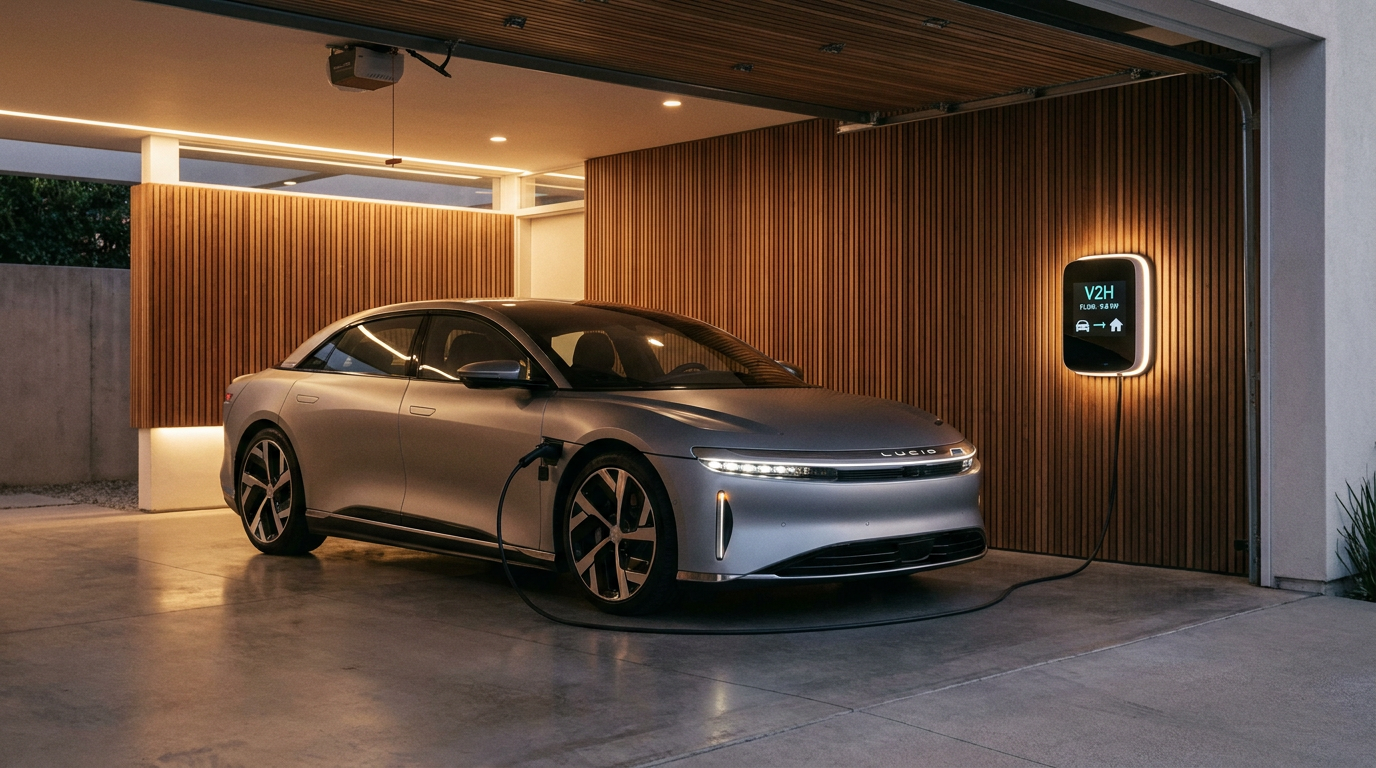
Bidirectional charging, long a buzzword in the automotive industry, has officially crossed from limited pilot programs into mainstream reality. Specifically, Vehicle-to-Home (V2H) technology allows an EV to discharge its massive battery directly into a home's electrical panel, effectively turning the car into a whole-house backup generator.[3][5]
The sheer scale of EV batteries makes dedicated home storage look minuscule by comparison. A standard Tesla Powerwall holds 13.5 kWh of energy. In contrast, a Ford F-150 Lightning Extended Range holds 131 kWh, and a Chevrolet Silverado EV boasts over 200 kWh.[1][2]
In practical terms, a fully charged V2H-capable truck can power an average American home—including the refrigerator, lights, internet, and moderate air conditioning—for three to seven days during a blackout. A single stationary home battery, by comparison, typically provides only 8 to 12 hours of backup.[1][2][4]

The financial math is driving a surge in consumer interest. Installing a dedicated home battery system can cost between $12,500 and $18,000 for a fraction of the capacity. Outfitting a home for V2H, which requires a specialized bidirectional charger and a transfer switch, currently costs between $3,500 and $8,000 fully installed.[1][3][4]
However, the industry is still plagued by confusing terminology. Automakers frequently market their cars as "bidirectional," but that umbrella term covers three distinct technologies: V2L, V2H, and V2G. Understanding the difference is critical for buyers navigating the 2026 market.[1][6]
V2L, or Vehicle-to-Load, is the most common and basic form. It simply provides standard 120-volt or 240-volt outlets on the vehicle itself, allowing owners to plug in a laptop, a power drill, or a camping fridge. It requires no home integration and cannot power your house's electrical panel.[1][2][3]
It simply provides standard 120-volt or 240-volt outlets on the vehicle itself, allowing owners to plug in a laptop, a power drill, or a camping fridge.
V2H, or Vehicle-to-Home, is the true whole-house backup solution. It routes the car's DC power through a bidirectional wall charger, which inverts it to AC power and feeds it into the home's breaker box. Crucially, it uses a microgrid interconnection device to safely isolate the house from the utility grid during an outage, protecting line workers from electrocution.[5]
Finally, V2G, or Vehicle-to-Grid, takes the concept a step further by exporting the EV's stored energy back to the utility company. While V2G offers the potential to earn hundreds of dollars a year in grid-balancing credits, it requires complex utility agreements and smart meters, keeping it largely restricted to regional pilot programs in 2026.[1][2][3]

Not every electric vehicle can serve as a home battery. As of mid-2026, only about 15 of the 54 EV models sold in the United States support true V2H integration. Ford and General Motors are the current market leaders, with GM making V2H standard across its Ultium platform, including the Silverado, Blazer, and Equinox EVs.[4][5]
Tesla, which historically resisted V2H to protect its lucrative Powerwall business, has been forced to pivot by competitive pressure. The company is now rolling out its "Powershare" bidirectional capability to the Cybertruck and newer Model Y vehicles via over-the-air updates.[4][6]
The hardware required to unlock this feature is also maturing. Homeowners cannot simply run a standard Level 2 charger in reverse. They must install a bidirectional DC charger, such as the Wallbox Quasar 2, the dcbel r16, or the Ford Charge Station Pro. These units act as the brain of the operation, managing the complex handshake between the car, the house, and the grid.[1][3][5]
Beyond emergency blackouts, V2H enables a concept known as "flexible self-consumption." Homeowners with rooftop solar panels can charge their EV with free solar energy during the day, and then discharge the car to power their home during the evening when utility rates peak. This daily arbitrage can yield thousands of dollars in savings over the life of the vehicle.[5]

Skeptics, however, point to the practical limitations. The most obvious drawback is that the car must be parked in the garage to power the house. If the grid goes down while the EV is at the office or running errands, the home remains in the dark unless it has a secondary stationary battery.[1][7]
There are also lingering concerns about battery degradation. Using an EV as a daily home battery introduces "micro-cycling," which could theoretically shorten the lifespan of the vehicle's most expensive component. In response, automakers are updating their warranties to explicitly cover V2H usage, though some cap the total megawatt-hours that can be discharged.[2][7]
Despite these hurdles, the transition is accelerating. With the federal Section 30C tax credit—which offers up to $1,000 for EV charger installations—set to expire in June 2026, many buyers are rushing to upgrade their home electrical panels. Within a few years, buying an EV without bidirectional capability may seem as archaic as buying a smartphone without a camera.[1][7]
How we got here
2022
Ford launches the F-150 Lightning with Intelligent Backup Power, pioneering mainstream V2H.
2024
General Motors announces V2H will become standard across its Ultium EV platform.
2025
Tesla begins rolling out Powershare bidirectional capabilities to the Cybertruck and Model Y.
June 2026
The federal Section 30C tax credit for bidirectional charger installations is scheduled to expire.
Viewpoints in depth
Automakers & Hardware Providers
Viewing the EV as a mobile power plant that fundamentally changes home energy economics.
For vehicle manufacturers and charging hardware companies, bidirectional charging is the ultimate value-add. By unlocking the massive battery already sitting in the driveway, they can offer consumers whole-house backup power at a fraction of the cost of a dedicated stationary battery. This camp argues that V2H capability justifies the premium price of modern EVs and will soon become a non-negotiable standard feature for buyers.
Energy & Solar Integrators
Focusing on daily energy arbitrage and the integration of EVs into smart home microgrids.
Solar installers and energy management firms view V2H as the missing link in residential energy independence. Rather than just using the EV for emergency blackouts, this camp advocates for 'flexible self-consumption'—charging the car with cheap midday solar power and discharging it to the home during expensive evening peak rates. They emphasize that the true value of bidirectional charging lies in daily utility savings, not just disaster prep.
Industry Analysts & Skeptics
Highlighting the practical limitations, hardware costs, and battery degradation risks.
While acknowledging the technological promise, analysts and consumer advocates urge caution. They point out that V2H hardware still costs thousands of dollars to install and requires complex permitting. Furthermore, skeptics highlight the obvious physical limitation: if the grid goes down while the homeowner is at work or running errands, the house remains without power. There are also lingering concerns about how daily 'micro-cycling' might impact the long-term health and warranty coverage of the vehicle's primary battery.
What we don't know
- How long-term 'micro-cycling' for daily home power will ultimately affect the lifespan of EV batteries.
- Whether utility companies will standardize interconnection rules, which currently vary wildly by local jurisdiction.
Key terms
- Bidirectional Charging
- Technology that allows electricity to flow both into an electric vehicle's battery and back out of it.
- V2H (Vehicle-to-Home)
- A system that allows an EV to discharge power directly into a home's electrical panel, acting as a whole-house backup battery.
- V2G (Vehicle-to-Grid)
- A system where an EV exports stored energy back to the utility grid, often in exchange for financial credits or payments.
- V2L (Vehicle-to-Load)
- A feature providing standard 120V or 240V AC outlets directly on the vehicle to power standalone devices or tools.
- Transfer Switch
- An electrical device that safely disconnects a home from the utility grid during an outage so the EV can power the house without backfeeding the grid.
Frequently asked
What happens if I drive away during a power outage?
Your home will lose power immediately unless you have a secondary backup system, such as a small stationary battery or a gas generator, to bridge the gap while the car is away.
Does using V2H void my EV battery warranty?
Most automakers that officially support V2H explicitly cover it under their standard battery warranties, though some may cap the total amount of energy you can discharge over the vehicle's lifespan.
Can I use V2H if I don't have solar panels?
Yes. You can charge your EV from the utility grid when electricity rates are low, and then use the car to power your home during expensive peak hours or during a blackout.
What is the difference between V2L and V2H?
V2L provides a standard electrical outlet on the car for plugging in individual devices. V2H integrates directly into your home's electrical panel to power the entire house.
Sources
Source coverage
7 outlets
3 viewpoints surfaced







[1]NuWatt EnergyEnergy & Solar Integrators
Vehicle-to-Home (V2H) EV Charging Explainer
Read on NuWatt Energy →[2]Energy Solutions IntelligenceIndustry Analysts & Skeptics
Bidirectional EV Charging 2026: Which Cars Can Power Your Home and the Grid?
Read on Energy Solutions Intelligence →[3]Surge PVAutomakers & Hardware Providers
Bidirectional Charger Buyer Guide 2026
Read on Surge PV →[4]Eos EnergyAutomakers & Hardware Providers
V2H EV models 2026: Power Your Home, Rain or Shine
Read on Eos Energy →[5]American Solar Energy SocietyEnergy & Solar Integrators
How Does Vehicle-to-Home Actually Work?
Read on American Solar Energy Society →[6]AMP RenewablesEnergy & Solar Integrators
Which EVs support V2H in the UK in 2026?
Read on AMP Renewables →[7]Factlen Editorial TeamIndustry Analysts & Skeptics
Synthesis by Factlen editorial team
Read on Factlen Editorial Team →


Every angle. Every day.
Get shopping stories with full source coverage and perspective breakdowns delivered to your inbox.