
The Science of Reading: Inside the Phonics-Based Curriculum Sweeping U.S. Schools
Driven by decades of cognitive research and a wave of new state laws, American classrooms are undergoing a massive shift away from 'balanced literacy' toward the 'science of reading.' Here is how the evidence-based approach works and why it is transforming early education.
By Factlen Editorial Team
- Literacy Researchers
- Argue that reading is not a natural process and requires explicit, systematic instruction for almost all children.
- State Policymakers
- Focus on systemic mandates, curriculum bans, and standardized test score improvements to drive the transition.
- Classroom Educators & Prep Programs
- Navigate the complex reality of unlearning past training while implementing new, highly structured curricula.
What's not represented
- · Parents of dyslexic students
- · Publishers of legacy balanced-literacy curricula
Why this matters
Reading proficiency is the foundation of all subsequent academic success. This nationwide shift ensures that millions of children, particularly those who struggle with decoding or dyslexia, receive the explicit instruction they need to become confident, capable readers.
Key points
- At least 42 states and Washington D.C. have passed laws or policies mandating evidence-based reading instruction since 2013.
- The 'science of reading' framework relies on five core pillars: phonemic awareness, phonics, fluency, vocabulary, and comprehension.
- States are increasingly banning the 'three-cueing' method, which encouraged students to guess words based on context or pictures.
- A 2026 report found that 50 percent of teacher preparation programs now align with evidence-based reading, double the rate from three years ago.
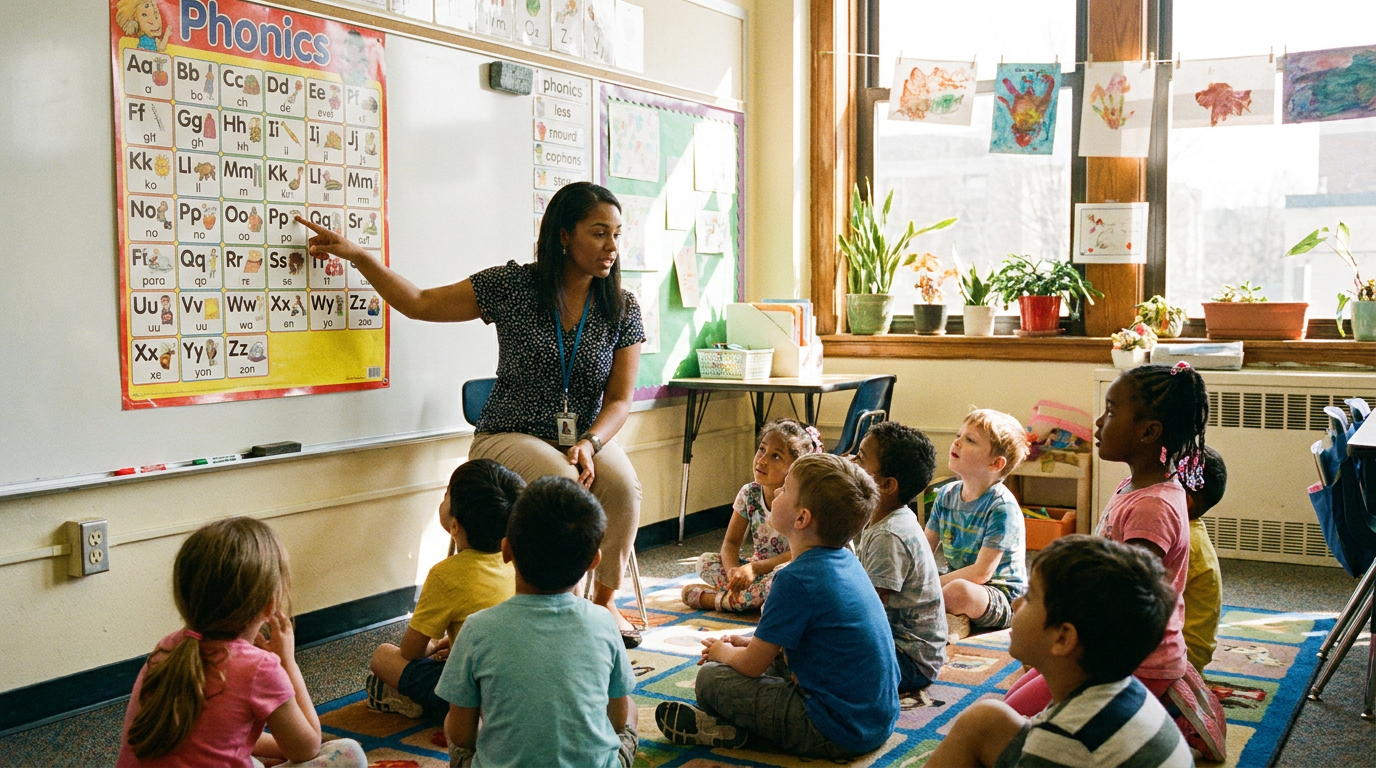
For decades, American educators have engaged in a quiet but profound debate over how children actually learn to read. Now, that debate is effectively over. Across the United States, a massive curriculum shift is underway, driven by a movement known as the "science of reading." As of 2026, 42 states and the District of Columbia have passed laws or implemented policies requiring schools to use evidence-based reading instruction. This legislative wave, which gained early momentum in Mississippi over a decade ago, has fundamentally rewritten the rules of early education. States are not just recommending new methods; they are mandating them, tying funding to approved curricula, and in some cases, explicitly banning older instructional models that cognitive scientists have long criticized.[3][6]
The urgency behind this shift stems from a sobering reality: a significant portion of American students have persistently struggled to achieve reading proficiency. Prior to this wave of reform, many school districts relied on an approach known as "balanced literacy." While well-intentioned, balanced literacy often minimized direct phonics instruction in favor of exposing children to rich literature, operating on the assumption that reading is a natural process akin to learning to speak. A hallmark of this era was the "three-cueing" method, which encouraged young readers to guess unknown words by looking at pictures, using context clues, or looking at the first letter, rather than sounding the word out from left to right.[2][5]
Cognitive scientists and literacy researchers have spent years demonstrating that the brain does not learn to read by guessing. Reading is an acquired skill that requires the brain to forge new neural pathways connecting visual symbols to spoken sounds. The science of reading is not a specific curriculum or a branded product, but rather a comprehensive body of interdisciplinary research spanning neuroscience, psychology, and linguistics. It posits that virtually all children require explicit, systematic instruction to crack the code of written language. When students are taught to guess words based on context, they are actually mimicking the habits of struggling readers, rather than developing the decoding skills necessary to tackle complex, unpictured texts in later grades.[3][5]
At the core of this evidence-based framework is a concept known as the "Simple View of Reading." This model dictates that reading comprehension is the product of two distinct but equally vital components: decoding and language comprehension. Decoding is the mechanical ability to translate printed letters into sounds and blend them into words. Language comprehension is the ability to understand the meaning of those spoken words, sentences, and broader concepts. If a student lacks either skill—if they can sound out a word but do not know what it means, or if they have a robust vocabulary but cannot decipher the letters on the page—true reading comprehension cannot occur.[3]

To build these two essential capacities, the science of reading relies on five foundational pillars of instruction. The first is phonemic awareness, which is the ability to identify and manipulate the individual sounds, or phonemes, in spoken language entirely in the dark, without looking at letters. The second is phonics, the explicit teaching of how those spoken sounds map onto specific letters and letter combinations. Unlike the sporadic phonics lessons of the past, systematic phonics instruction follows a highly structured sequence, moving from simple consonant-vowel pairings to complex spelling patterns, ensuring no foundational gaps are left to chance.[5][7]
The remaining three pillars bridge the gap between decoding and deep understanding. Fluency is the ability to read text accurately, at a conversational pace, and with appropriate expression, which frees up cognitive resources so the brain can focus on meaning rather than mechanics. Vocabulary development involves explicitly teaching the meaning of words and exploring how they relate to one another. Finally, comprehension strategies teach students how to actively engage with a text, make inferences, and connect new information to their existing background knowledge. Under the science of reading, these five pillars are not optional add-ons; they are the non-negotiable core of daily literacy instruction.[5]
The remaining three pillars bridge the gap between decoding and deep understanding.
The legislative push to enshrine these pillars into law has accelerated dramatically in recent years. States like New York and California have established strict deadlines for districts to overhaul their materials. New York's fiscal year 2025 budget, for instance, mandated that all school districts certify their curriculum and instructional strategies align with evidence-based reading instruction by September 2025, backed by a $10 million investment to retrain 20,000 teachers. Similarly, Oklahoma's Strong Readers Act, which takes effect for the 2025-2026 school year, explicitly bans the three-cueing method and requires literacy instruction to emphasize phonics and vocabulary development.[4][5]
These mandates are largely modeled after the "Mississippi miracle." Beginning in 2013, Mississippi passed a series of sweeping literacy laws that overhauled teacher training, deployed literacy coaches to struggling schools, and required strict adherence to the science of reading. By 2019, Mississippi had transformed from one of the lowest-performing states in the nation to a leader in reading growth on the National Assessment of Educational Progress (NAEP). Lawmakers across the country took notice, realizing that systemic changes to reading instruction could yield measurable, statewide improvements in student outcomes, even in historically under-resourced districts.[6]
However, passing a law is entirely different from changing daily classroom practice. A major bottleneck in the transition has been the way future educators are trained. For decades, many university teacher preparation programs championed balanced literacy and neglected to teach the cognitive science of reading. A June 2026 report from the National Council on Teacher Quality (NCTQ) highlighted significant progress on this front, revealing that slightly more than half of the nation's teacher preparation programs now use scientifically grounded methods to train aspiring educators. This represents a massive improvement from just three years prior, when only 25 percent of programs were fully aligned with the science of reading.[1][7]

Despite this progress, the NCTQ report also underscored the remaining challenges. Hundreds of teacher preparation programs still fail to adequately cover the five pillars of literacy, and many continue to teach disproven methods. Furthermore, the report found that even strong programs often dedicate insufficient time to training teachers on how to support English language learners and students with specific reading disabilities like dyslexia. When new teachers enter the classroom without a firm grasp of explicit phonics instruction, school districts are forced to spend immense time and resources retraining them on the job.[1][8]
Inside the classroom, the transition is proving to be a complex cultural shift. A nationally representative survey of early childhood educators conducted in the spring of 2026 by the RAND Corporation and the Thomas B. Fordham Institute found that while most teachers now favor phonics instruction, ingrained habits are hard to break. About a third of the surveyed educators reported that they still mix phonics with the discredited three-cueing approach. Literacy experts note that this blending of conflicting methods can confuse young readers, as it simultaneously tells them to sound a word out and to guess it based on a picture.[2]

The persistence of these mixed methods highlights the immense difficulty of unlearning years of professional training. Teachers who have spent their careers building extensive classroom libraries and designing balanced literacy centers are now being asked to adopt highly structured, systematic curricula. To bridge this gap, states are increasingly investing in intensive professional development and deploying specialized literacy coaches to model evidence-based practices in real time. Researchers emphasize that providing teachers with high-quality, aligned instructional materials is critical, as it removes the burden of having to piece together phonics lessons from scratch.[2][6]
As the 2026-2027 school year approaches, the science of reading movement has moved past the debate stage and into the grueling work of implementation. The focus has shifted from passing legislation to ensuring fidelity—making sure that the evidence-based curricula purchased by districts are actually being used correctly in the classroom. While the transition requires significant effort and investment, the ultimate goal is profoundly uplifting: a future where the vast majority of children, regardless of their background or zip code, are explicitly given the tools they need to unlock the written word and access the broader world of knowledge.[3]
How we got here
2013
Mississippi passes a series of sweeping literacy laws, initiating what becomes known as the 'Mississippi model'.
2019
Mississippi students show significant reading score improvements on the National Assessment of Educational Progress (NAEP).
2023
Only 25 percent of U.S. teacher preparation programs are found to adequately teach the five components of scientifically backed reading.
2025-2026
Major state mandates, including New York's certification deadline and Oklahoma's Strong Readers Act, take effect to enforce evidence-based instruction.
Viewpoints in depth
Literacy Researchers & Cognitive Scientists
This camp argues that reading is not a natural process and requires explicit, systematic instruction for almost all children.
Researchers emphasize decades of brain imaging and cognitive studies showing that the brain must build new neural pathways to connect visual symbols to spoken sounds. They strongly oppose the "three-cueing" method, arguing that teaching children to guess words based on context or pictures mimics the habits of struggling readers rather than building true decoding skills. For this camp, the science of reading is a non-negotiable biological reality.
State Policymakers
Lawmakers focus on systemic mandates, curriculum bans, and standardized test score improvements to drive the transition.
Frustrated by stagnant or declining reading proficiency rates, policymakers have moved beyond mere recommendations. By passing strict legislation, tying funding to approved materials, and mandating new licensure exams, they aim to force a top-down overhaul of how reading is taught. They frequently point to the "Mississippi miracle" as proof that aggressive legislative intervention and statewide coaching can yield rapid, measurable improvements in student outcomes.
Classroom Educators
Teachers are navigating the complex reality of unlearning past training while implementing new, highly structured curricula.
While increasingly supportive of phonics, many veteran teachers feel whiplash from the sudden shift away from the "balanced literacy" methods they were taught in university. They highlight the practical challenges of the transition, noting that without high-quality materials, embedded coaching, and time to adjust, blending old habits with new mandates can inadvertently confuse students. For educators, the focus is on securing the resources and professional development necessary to make the mandates work in practice.
What we don't know
- How quickly the remaining 50 percent of teacher preparation programs will update their syllabi to align with the science of reading.
- Whether the massive influx of state funding for professional development will be enough to fully break ingrained 'three-cueing' habits in veteran educators.
Key terms
- Science of Reading
- A vast body of scientifically based research about reading and issues related to reading and writing.
- Phonemic Awareness
- The ability to identify and manipulate individual sounds (phonemes) in spoken words, entirely through listening and speaking.
- Phonics
- A method of teaching reading that focuses on the relationship between letters (graphemes) and sounds (phonemes).
- Balanced Literacy
- An instructional approach that attempts to balance explicit language instruction with independent reading and language exploration, often minimizing systematic phonics.
- Three-Cueing
- An instructional method that prompts students to use meaning, sentence structure, and visual cues (like pictures) to guess unknown words.
Frequently asked
What is the science of reading?
It is a comprehensive body of interdisciplinary research spanning neuroscience, psychology, and linguistics that explains how the human brain learns to read and which instructional methods are most effective.
Why is the three-cueing method being banned?
Cognitive scientists argue that three-cueing encourages children to guess unknown words using pictures or context, which mimics the habits of struggling readers instead of teaching them how to actually decode the letters.
Does the science of reading only involve phonics?
No. While explicit phonics instruction is a critical component, the framework also requires robust instruction in phonemic awareness, fluency, vocabulary, and reading comprehension.
How are teacher preparation programs adapting to this shift?
Progress is happening, but gaps remain. As of 2026, about 50 percent of teacher preparation programs align with evidence-based reading instruction, up from 25 percent three years ago.
Sources
Source coverage
8 outlets
3 viewpoints surfaced








[1]ChalkbeatClassroom Educators & Prep Programs
Half of teacher preparation programs align with the science of reading, report finds
Read on Chalkbeat →[2]Education WeekClassroom Educators & Prep Programs
Teachers Still Voice Disagreement Over 'Science of Reading'
Read on Education Week →[3]Stanford Graduate School of EducationLiteracy Researchers
Stanford Professor Rebecca Silverman discusses a transformative movement backed by research
Read on Stanford Graduate School of Education →[4]New York State GovernmentState Policymakers
Improving Reading Proficiency for New York Children
Read on New York State Government →[5]Oklahoma Education JournalLiteracy Researchers
The Science of Reading: What Is It and How Does It Inform Literacy Instruction?
Read on Oklahoma Education Journal →[6]Baylor UniversityState Policymakers
The 'science of reading' movement is sweeping through state legislatures
Read on Baylor University →[7]K-12 DiveClassroom Educators & Prep Programs
Teacher prep programs struggle to teach science of reading
Read on K-12 Dive →[8]Idaho Education NewsClassroom Educators & Prep Programs
Idaho teacher prep programs earn top marks for reading instruction — but gaps remain
Read on Idaho Education News →

Every angle. Every day.
Get education stories with full source coverage and perspective breakdowns delivered to your inbox.