
How 'Phone-Free' Policies Are Reshaping K-12 Schools
As a wave of states mandate bell-to-bell cellphone bans, new national data reveals how lockable pouches are transforming classroom focus, student well-being, and school discipline.
By Factlen Editorial Team
- Educators & Administrators
- Teachers view phone bans as a necessary intervention to reclaim instructional time and improve classroom climate.
- Researchers & Policymakers
- Academics emphasize that while phone bans change behavior, they are not a standalone cure for learning loss.
- Parents & Students
- Families broadly support focused classrooms but express deep anxiety over emergency communication.
What's not represented
- · Ed-tech companies whose classroom applications rely on student devices.
- · Pediatricians studying the physiological effects of reduced daily screen time.
Why this matters
With over 37 states now restricting devices in classrooms, millions of families are navigating new daily routines. Understanding the actual data behind these bans helps parents and educators set realistic expectations for student behavior, academic outcomes, and mental health.
Key points
- At least 37 states have implemented policies restricting or banning student cellphones during the school day.
- Lockable pouches have driven an 80 percent decline in self-reported classroom phone use.
- Teacher satisfaction with school phone policies jumps from 26 percent to 75 percent after pouches are introduced.
- Academic test scores show little to no immediate improvement following the implementation of phone bans.
- Schools typically experience a temporary 16 percent spike in suspensions during the first year as students adjust.
- Student well-being dips initially but rebounds to positive levels by the second and third years of the policy.
The smartphone has been a ubiquitous fixture of the American classroom for well over a decade, fundamentally altering how teenagers socialize, communicate, and learn. But the 2025–2026 school year marks a definitive turning point in this digital relationship. Across the country, a massive wave of state legislation and district-level mandates is fundamentally altering the daily routine of millions of K-12 students. Frustrated by years of distracted learning and escalating mental health concerns, administrators are replacing lenient honor codes with strict, enforceable hardware solutions designed to sever the connection between students and their screens during instructional hours.[6][7][8]
States like New York, California, and Texas have enacted sweeping bell-to-bell restrictions that prohibit personal device use from the moment the morning bell rings until the final dismissal. By early 2026, at least 37 states and the District of Columbia have implemented policies requiring districts to restrict or outright ban student cellphones. This legislative momentum reflects a growing bipartisan consensus that the mere presence of a smartphone in a learning environment degrades cognitive focus, even when the device is tucked away in a pocket or backpack.[1][6][7][8]
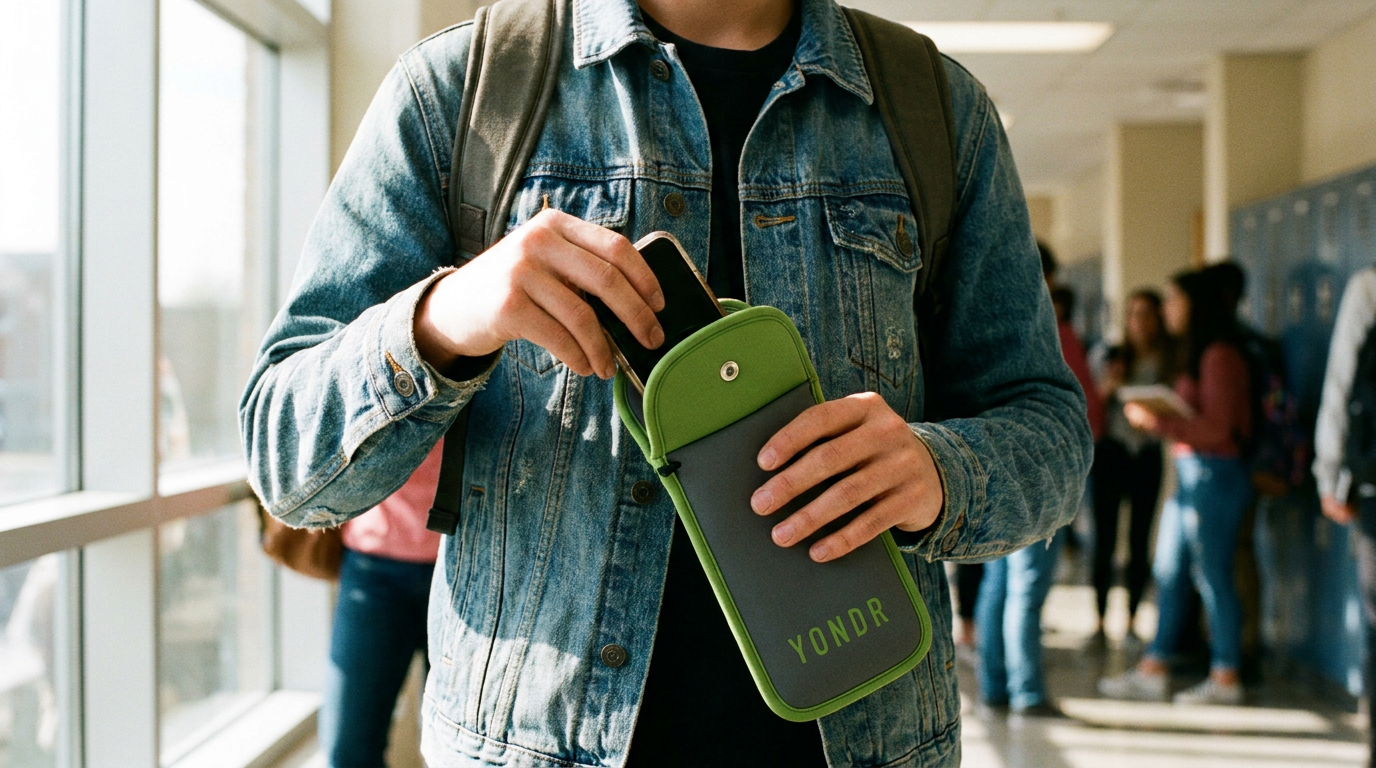
To enforce these new bell-to-bell rules, thousands of schools have realized that traditional confiscation methods are no longer viable. Teachers simply do not have the time or energy to police hundreds of devices. Instead, districts have turned to physical hardware to engineer a distraction-free environment. The most popular and widely adopted solution is the lockable phone pouch, pioneered by companies like Yondr, which physically prevents students from accessing their screens while allowing them to maintain possession of their expensive property.[1][4]
The mechanism behind these lockable pouches is straightforward but highly effective. As students enter the school building each morning, they are required to slide their smartphones, smartwatches, and wireless earbuds into a specialized neoprene sleeve. The top of the sleeve snaps shut with a proprietary magnetic lock. The students carry these locked pouches with them throughout the entire school day, but the devices remain completely inaccessible until they are tapped against a magnetic unlocking base station on their way out the door at dismissal.[1][4]

The primary goal of these aggressive new policies—getting students off their screens and focused on their immediate physical surroundings—appears to be working exactly as intended. A landmark May 2026 working paper published by the National Bureau of Economic Research (NBER) analyzed comprehensive data from over 40,000 schools across the United States. The researchers found a staggering 80 percent decline in students' self-reported personal cellphone use in classrooms following the district-wide adoption of lockable pouches.[2][3]
Researchers did not rely solely on student surveys to reach this conclusion; they corroborated the self-reported data by tracking anonymous GPS pings emitted by devices on school campuses. By the third year of a pouch mandate, total cellular activity dropped by 30 percent. The study’s authors note that this is a remarkably substantial decrease, especially given that the raw GPS data also captured the unrestricted phones of adult staff members and the background app refreshes of locked devices.[2][4]
For classroom educators, the removal of these constant digital distractions has been described as a profound professional relief. Teachers have long cited the endless policing of screen time, the disruption of notification chimes, and the mediation of interpersonal conflicts that originated on social media during class time as a major drain on their instructional energy. Removing the phone from the equation allows teachers to reclaim minutes of lost learning time every single period.[1][4]
For classroom educators, the removal of these constant digital distractions has been described as a profound professional relief.
This reclaimed time translates directly into improved morale. Following the implementation of lockable pouches, teacher satisfaction with their school's phone policies surged dramatically, jumping from a dismal 26 percent to a robust 75 percent. School leaders consistently report that without the constant, low-level battle over Snapchat streaks and text messages, the baseline climate of the school building improves, allowing staff to focus entirely on pedagogy rather than acting as device confiscators.[3][4]
However, the widespread assumption that simply removing phones will automatically supercharge academic performance has not been borne out by the latest data. The comprehensive NBER study, led by prominent educational researchers from the University of Michigan, Stanford University, and Duke University, found that the hardware bans had close to zero overall impact on standardized test scores in the three years immediately following their adoption.[1][2][3]

While the researchers did observe modest academic gains in high school mathematics, they also noted small, statistically significant negative effects in middle school achievement. The lead authors caution policymakers that while lockable pouches successfully eliminate a major classroom distraction, they are not a magical silver bullet for pandemic-era learning loss. Improved test scores still require high-quality instruction, rigorous curriculum, and engaged students; a quiet room is only the first step.[1][2][3]
The impact of these bans on student mental health and online bullying is similarly nuanced, challenging the popular narrative that a phone-free day instantly cures adolescent anxiety. The data reveals a highly complex adjustment period as students are forced to adapt to a disconnected school day, stripping away what has become their primary tool for social navigation and emotional regulation.[2][3]
In the first year of a strict phone ban, student-reported subjective well-being actually declines. Researchers attribute this initial dip to adjustment costs—the psychological friction, withdrawal, and anxiety students experience when suddenly separated from their digital networks. Yet, the data shows that by the second and third years of the policy, this negative trend reverses entirely, and student well-being rebounds to positive levels as the new, phone-free normal sets in.[1][3]
This turbulent adjustment period is also highly visible in school discipline and behavioral data. When districts first introduce lockable pouches, suspension rates and disciplinary infractions spike by an average of 16 percent. This temporary surge is driven largely by students actively testing the new boundaries, attempting to physically break the pouches, or outright refusing to comply with the new daily routine at the school entrance.[2][4]

Administrators and researchers alike advise that schools must be fully prepared to weather this initial wave of pushback without abandoning the policy. The NBER data clearly shows that this disciplinary surge is temporary; behavioral problems reliably return to typical baseline levels after the first year of enforcement, once the student body accepts that the hardware restrictions are permanent and unavoidable.[1][4]
Perhaps the most complex constituency in the phone-free school movement is the parents. While national polling from organizations like EdChoice shows that parents are generally much more supportive of hardware bans than their teenage children, that parental support is highly conditional and often fraught with deep-seated safety concerns regarding school violence.[5]
Nearly 40 percent of parents still believe their child should have some level of immediate access to a phone in the classroom, primarily driven by anxieties over school emergencies, active shooter scenarios, and the desire for direct, unfiltered communication. State laws attempt to thread this delicate needle by allowing students to keep the locked pouches on their physical person, and by mandating strict exemptions for students who require devices for medical monitoring or Individualized Education Programs.[5][6]
As the 2026 school year progresses, the national debate has largely shifted from whether phones should be restricted to how best to manage the logistical and cultural transition. The data clearly suggests that while lockable pouches will not single-handedly solve the nation's academic crisis, they successfully engineer a quieter, more focused learning environment—provided that school districts, teachers, and parents are willing to endure the inevitable growing pains of year one.[1][3][8]
How we got here
2024
Early-adopter states begin passing legislation encouraging districts to limit classroom distractions.
2025
States like Texas and New York pass sweeping bell-to-bell restrictions and allocate grant funding for storage solutions.
May 2026
The National Bureau of Economic Research publishes the first nationwide study on the efficacy of lockable phone pouches.
July 2026
California's Phone-Free Schools Act officially takes effect, requiring compliance from all public schools.
Viewpoints in depth
Educators & Administrators
Teachers view phone bans as a necessary intervention to reclaim instructional time and improve classroom climate.
For the adults managing classrooms, the removal of smartphones is primarily about eliminating friction. Teachers report that prior to bell-to-bell bans, a significant portion of their instructional energy was spent policing screen time, confiscating devices, and mediating interpersonal conflicts that originated on social media during class. By outsourcing the enforcement to a physical pouch, educators say they can return to their primary role of teaching, which is reflected in the massive jump in staff satisfaction following implementation.
Researchers & Data Analysts
Academics emphasize that while phone bans change behavior, they are not a standalone cure for learning loss.
Educational economists and researchers look at the long-term data and caution against treating phone bans as a panacea. The NBER study highlights that simply removing a distraction does not automatically instill knowledge; test scores remain largely flat after bans are introduced. Researchers stress that while the baseline environment improves, schools must pair these distraction-free environments with high-quality, evidence-based instruction to actually move the needle on academic achievement.
Parents & Guardians
Families broadly support focused classrooms but express deep anxiety over emergency communication.
Parental support for phone-free schools is strong but highly conditional. Polling indicates that while most parents want their children focused on learning rather than scrolling, a significant minority—nearly 40 percent—want their kids to retain some level of access to their devices. This hesitation is largely driven by fears of school emergencies and the desire for direct communication. Consequently, parents often advocate for policies that allow students to keep their locked pouches on their person, rather than storing them in central lockers.
What we don't know
- Whether the modest academic gains seen in high school math will eventually replicate across other subjects and grade levels.
- How the long-term mental health benefits of phone-free school days will affect broader adolescent anxiety trends.
- Whether parents will continue to support bell-to-bell bans if a major school emergency highlights communication barriers.
Key terms
- Bell-to-bell policy
- A rule prohibiting student phone use for the entire school day, including lunch and passing periods, rather than just during instructional time.
- Lockable phone pouch
- A physical sleeve, such as a Yondr pouch, that secures a student's device with a magnetic lock that can only be opened at designated stations.
- GPS ping data
- Location and activity signals emitted by smartphones, used by researchers to track whether devices are active on school campuses.
- Individualized Education Program (IEP)
- A legally binding document outlining special education services for a student, which can include medical or educational exemptions to phone bans.
Frequently asked
How do lockable phone pouches actually work?
Students place their phones inside a neoprene pouch that locks with a magnetic pin. They carry the pouch with them all day, but cannot access the phone until they tap it against an unlocking base station at dismissal.
Do phone bans improve student test scores?
Recent national data shows little to no immediate impact on overall standardized test scores, though researchers observed modest gains in high school mathematics.
What happens if a student needs their phone in an emergency?
Most state policies and district rules allow students to access phones if directed by a teacher, or during a verified emergency. Students also retain physical possession of the locked pouch.
Why do suspensions increase when bans are introduced?
Schools typically see a 16 percent spike in disciplinary actions during the first year as students test boundaries and resist the new rules, but these issues drop in subsequent years.
Sources
Source coverage
8 outlets
3 viewpoints surfaced








[1]Education WeekEducators & Administrators
Schools Banned Cellphones. Did It Work?
Read on Education Week →[2]K-12 DiveResearchers & Policymakers
NBER study: Cellphone bans improve well-being, but not test scores
Read on K-12 Dive →[3]University of Michigan NewsResearchers & Policymakers
Lockable phone pouches in schools improve student well-being over time
Read on University of Michigan News →[4]The Philadelphia InquirerEducators & Administrators
Study finds school cell phone bans limit use, but don't boost test scores
Read on The Philadelphia Inquirer →[5]EdChoiceParents & Students
What Do Parents and Teens Think About Cellphone Bans?
Read on EdChoice →[6]New York State GovernmentResearchers & Policymakers
Governor Hochul Announces Statewide Cellphone Policy for Schools
Read on New York State Government →[7]Texas Education AgencyResearchers & Policymakers
2025-2026 Phone Free Schools Grant Program
Read on Texas Education Agency →[8]CalMattersResearchers & Policymakers
California limits cell phones in K-12 schools
Read on CalMatters →
Every angle. Every day.
Get education stories with full source coverage and perspective breakdowns delivered to your inbox.