
The Science of 'Physical Chess': How Brazilian Jiu-Jitsu Rewires the Aging Brain
Neuroscientists are discovering that the complex, real-time problem-solving required in Brazilian Jiu-Jitsu triggers profound structural changes in the brain, offering unique benefits for mental health and cognitive longevity.
By Factlen Editorial Team
- Neuroscientists & Researchers
- Focus on the measurable structural changes in the brain, increased neuroplasticity, and the preservation of white matter through complex motor learning.
- Mental Health Professionals
- Emphasize the therapeutic value of 'forced mindfulness,' cortisol reduction, and the sport's ability to regulate the amygdala's fear response.
- Longevity Experts
- Highlight the importance of functional fitness, joint mobility, and cardiovascular health in preventing age-related physical and cognitive decline.
- BJJ Practitioners
- Value the practical application of the art, the strategic 'physical chess' element, and the deep social bonds formed through mutual trust on the mats.
What's not represented
- · Traditional fitness industry advocates
- · Individuals with physical disabilities preventing grappling
Why this matters
As rates of cognitive decline and chronic anxiety rise, finding sustainable interventions is critical. Research suggests that complex, socially engaged motor skills like martial arts may protect the brain more effectively than traditional repetitive exercise.
Key points
- Brazilian Jiu-Jitsu acts as 'physical chess,' requiring real-time problem solving that stimulates brain regions responsible for executive function.
- Learning complex grappling techniques triggers neuroplasticity, physically altering brain volume and improving cognitive efficiency.
- The intense focus required during sparring induces a 'flow state,' forcing mindfulness and drastically reducing rumination and anxiety.
- Regular practice lowers cortisol while boosting dopamine, serotonin, and oxytocin, improving overall mood and sleep quality.
- For older adults, learning complex motor skills like BJJ helps preserve white matter and defends against age-related cognitive decline.
For decades, the standard prescription for aging gracefully and managing stress has been remarkably straightforward: run on a treadmill, lift some weights, and perhaps download a meditation app. But a growing body of neuroscientific research is pointing toward a vastly different, far more intense intervention. Brazilian Jiu-Jitsu (BJJ), a grappling martial art focused on leverage and submission holds, is rapidly gaining recognition not just as a physical workout, but as a profound cognitive therapy.[1]
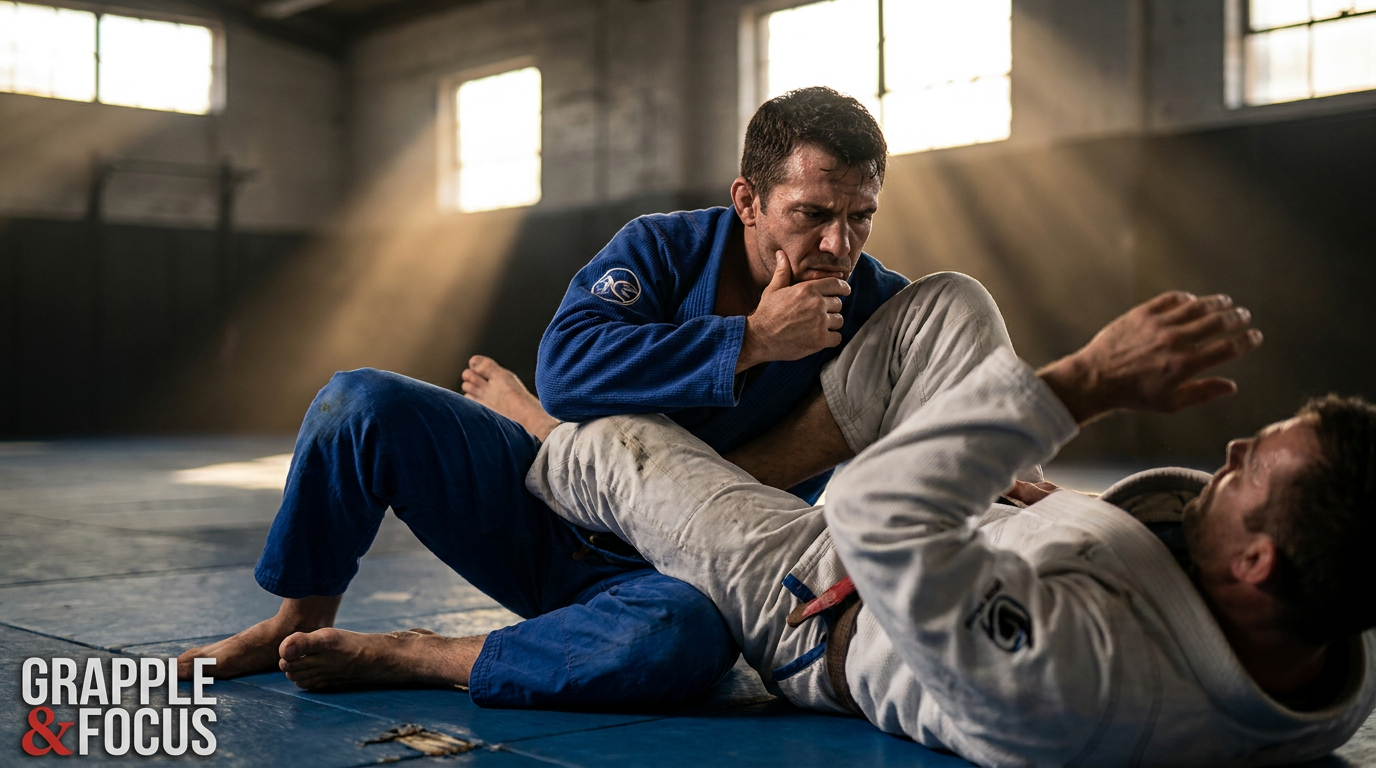
Practitioners have long referred to the sport as "physical chess." Unlike running or cycling, which rely on repetitive, predictable motor patterns, BJJ requires constant, real-time problem-solving under physical duress. Every sparring session—known as a "roll"—is a dynamic puzzle where practitioners must process their opponent's weight distribution, anticipate traps, and calculate leverage, all while managing their own breathing and fatigue.[1]
To understand why this matters, neuroscientists are moving their research out of sterile laboratories and onto the mats. Traditional studies on brain plasticity often relied on simple tasks, like asking subjects to tap their fingers in a specific sequence. Today, researchers are using advanced functional near-infrared spectroscopy (fNIRS) and MRI technology to map the brains of martial artists as they learn to navigate complex physical combat.[2]
The findings are striking. Research from the Yaniv Assaf Lab, which specializes in structural brain plasticity, reveals that learning BJJ fundamentally rewires the brain's Default Mode Network. Scans show that the brain regions responsible for logical planning, strategy, and executive function light up during grappling just as intensely as they do during a high-level chess match.[2]
This cognitive demand triggers neuroplasticity—the brain's ability to form and reorganize synaptic connections. The Assaf Lab found that as beginners progress, their brain volume physically shifts. Areas associated with spatial awareness and complex motor control actually grow in volume, while other regions become highly streamlined and efficient. The learning curve is exponential, meaning the most dramatic neurological changes occur during a practitioner's first few months on the mats.[2]
Beyond structural changes, the sport induces a potent neurochemical cocktail. The intense physical exertion releases endorphins and dopamine, while the close-contact, trust-based nature of the training stimulates oxytocin production. Simultaneously, the brain's primary inhibitory neurotransmitter, GABA, shows enhanced function, which contributes directly to emotional regulation and a reduction in baseline anxiety.[1]
These biological shifts translate into measurable psychological benefits. A 2023 clinical trial conducted by the University of Queensland tracked individuals participating in regular BJJ training. The results showed a 43 percent reduction in self-reported stress levels, with 68 percent of participants experiencing significantly improved sleep quality. Furthermore, their self-efficacy scores—a measure of confidence in their ability to handle life's challenges—increased by more than half.[3]

Psychologists attribute much of this stress reduction to a phenomenon known as "forced mindfulness." When a person is jogging, their mind is free to ruminate on an upcoming work deadline or a mounting inbox. But when a 200-pound training partner is actively trying to apply a chokehold, mental wandering becomes biologically impossible. The brain is forced entirely into the present moment.[1]
But when a 200-pound training partner is actively trying to apply a chokehold, mental wandering becomes biologically impossible.
This total immersion triggers what psychologist Mihaly Csikszentmihalyi famously defined as the "Flow State"—a period where self-consciousness vanishes and time seems to warp. Because BJJ perfectly balances high-stakes challenges with the continuous development of new skills, it induces this state more reliably than almost any other recreational hobby, serving as a vital mental reset for exhausted professionals.[1]
The practice also fundamentally alters how the brain processes fear and panic. Brain scans of experienced grapplers show a marked decrease in amygdala reactivity—the brain's emotional and fear center. To survive and progress in the sport, practitioners must learn to control their breathing and find comfort within extreme physical discomfort, a skill that directly translates to managing anxiety off the mats.[2]

This resilience is corroborated by broader population data. A 2024 study by the Australian Institute of Sport revealed that 92 percent of adults who trained in martial arts at least twice a week reported a reduction in symptoms of depression and anxiety. Notably, those specifically training in BJJ reported a 38 percent greater increase in overall confidence compared to individuals who only attended traditional gyms.[5]
The benefits extend far beyond stress relief, offering a compelling intervention for cognitive decline. Long-term twin studies conducted by the University of Jyväskylä in Finland have shown that highly active adults have a 24 percent lower mortality rate than their sedentary peers. However, researchers increasingly believe that sports requiring a combination of physical exertion and intense mental strategy provide the greatest longevity benefits.[4]
As humans age, perceptual and cognitive abilities naturally deteriorate. But research from the University of California, Riverside demonstrates that learning complex new skills can effectively reverse this trend. In their studies, older adults who engaged in demanding new learning tasks increased their cognitive abilities to levels similar to those of adults 30 years younger in just six weeks.[7]

Because Brazilian Jiu-Jitsu features a virtually infinite syllabus of techniques, sweeps, and submissions, the learning never stops. This continuous cognitive challenge helps preserve white matter connectivity and procedural memory—the type of memory responsible for motor skills, which is highly resistant to age-related decline if actively maintained.[1]
Physically, the sport adapts well to aging bodies. Because BJJ emphasizes leverage, timing, and technique over brute strength, older practitioners can train safely by modifying their game. Data published by the National Center for Biotechnology Information highlights that elderly men undergoing a 12-week BJJ program saw considerable enhancements in functional fitness, joint mobility, and the core stabilizing muscles necessary to prevent falls.[6]
Finally, there is the undeniable impact of the "social brain." Humans are fundamentally social creatures, and martial arts engage social neural networks in unique ways. The constant partner interaction requires practitioners to read intentions, communicate non-verbally, and build deep mutual trust, combating the epidemic of isolation that often accompanies aging.[1]
Researchers are still working to isolate exactly how much of this cognitive preservation is due to the specific mechanics of grappling versus the general benefits of learning any highly complex, socially engaged physical activity. It remains to be seen if other intricate movement practices, like advanced ballroom dance or rock climbing, trigger identical structural changes in the Default Mode Network.[1]

What is clear, however, is that the mats offer far more than a place to sweat. By demanding real-time problem-solving, emotional regulation, and continuous learning, Brazilian Jiu-Jitsu acts as a comprehensive cognitive gym. It builds a resilient, adaptable brain capable of navigating the complexities of modern life long after the training session ends.[1]
Viewpoints in depth
Neuroscientists & Researchers
Focus on the measurable structural changes in the brain and the preservation of white matter through complex motor learning.
For neuroscientists, martial arts provide a perfect real-world laboratory for studying brain plasticity. Researchers are moving away from simple, repetitive lab tasks to observe how the brain handles the chaotic, multi-variable environment of a grappling match. They note that the constant need to calculate spatial geometry and anticipate an opponent's movements forces the brain to build and reinforce new neural pathways. This continuous cognitive demand is viewed as a powerful mechanism for preserving executive function and delaying the onset of age-related cognitive decline.
Mental Health Professionals
Emphasize the therapeutic value of 'forced mindfulness' and the sport's ability to regulate the amygdala's fear response.
Psychologists and therapists increasingly view BJJ as a form of somatic therapy. Because the physical stakes of a sparring session demand absolute presence, it effectively shuts down the Default Mode Network, halting the cycle of anxious rumination. Furthermore, by repeatedly exposing practitioners to controlled physical adversity—such as being pinned or caught in a submission—the sport acts as a form of exposure therapy. Over time, this trains the nervous system to remain calm under pressure, lowering baseline cortisol levels and reducing the reactivity of the brain's fear centers.
Longevity Experts
Highlight the importance of functional fitness, joint mobility, and cardiovascular health in preventing age-related physical decline.
Experts in aging and longevity point to the holistic physical benefits of grappling. While traditional weightlifting isolates specific muscle groups, BJJ requires the entire body to work as a cohesive unit, heavily engaging the core and stabilizing muscles. This functional strength is critical for preventing falls in older age. Additionally, the sport's emphasis on flexibility, hip mobility, and cardiovascular endurance provides a comprehensive defense against the physical deterioration typically associated with aging.
BJJ Practitioners
Value the practical application of the art, the strategic 'physical chess' element, and the deep social bonds formed on the mats.
For those who train regularly, the scientific data merely validates what they already experience daily. Practitioners are drawn to the endless technical depth of the sport, which ensures that there is always a new puzzle to solve. Beyond the physical and mental workout, they emphasize the profound sense of community. The mutual trust required to safely practice submission holds fosters deep social bonds, creating a supportive environment that keeps individuals engaged in the practice for decades.
What we don't know
- Whether the neuroplastic benefits of BJJ are significantly greater than other highly complex motor skills, such as advanced gymnastics or ballroom dancing.
- Exactly how much of the reported mental health improvement is driven by the physical exercise versus the strong social community inherent in martial arts academies.
Key terms
- Neuroplasticity
- The brain's ability to reorganize itself by forming new neural connections throughout life, especially in response to learning new skills.
- Default Mode Network (DMN)
- A network of interacting brain regions that is active when a person is not focused on the outside world, often associated with mind-wandering and rumination.
- Flow State
- A psychological state of complete immersion and focus in an activity, where self-consciousness drops away and time seems to distort.
- Procedural Memory
- A type of long-term memory responsible for knowing how to do things, also known as motor skills, which is highly resistant to age-related decline.
- Amygdala
- The region of the brain primarily associated with emotional processes, particularly the processing of fear and the fight-or-flight response.
Frequently asked
Am I too old to start Brazilian Jiu-Jitsu?
No. Because BJJ relies on leverage and technique rather than explosive speed or brute strength, it is highly adaptable. Many practitioners begin in their 50s, 60s, and beyond, modifying their training to protect their joints.
How does BJJ reduce anxiety if it is a combat sport?
The intense focus required to grapple forces the brain into the present moment, acting as a form of active meditation. Over time, learning to stay calm in physically uncomfortable positions trains the brain's amygdala to be less reactive to everyday stressors.
Do I have to compete in tournaments to get these benefits?
Not at all. The vast majority of BJJ practitioners are hobbyists who train solely in their local academies. The cognitive and physical benefits come from the daily process of learning and sparring, not from formal competition.
Is the risk of injury high for older adults?
Like any physical sport, there is a risk of injury, but it can be heavily mitigated by choosing a safety-focused academy, tapping out early, and communicating physical limitations to training partners.
Sources
Source coverage
7 outlets
4 viewpoints surfaced






[1]Factlen Editorial TeamBJJ Practitioners
Synthesis by Factlen editorial team
Read on Factlen Editorial Team →[2]Yaniv Assaf LabNeuroscientists & Researchers
Structural brain plasticity and motor learning in martial arts
Read on Yaniv Assaf Lab →[3]University of QueenslandMental Health Professionals
Clinical trial on Brazilian Jiu-Jitsu and stress management
Read on University of Queensland →[4]University of JyväskyläLongevity Experts
Twin studies on physical activity, sports, and longevity
Read on University of Jyväskylä →[5]Australian Institute of SportMental Health Professionals
2024 study on martial arts and mental health
Read on Australian Institute of Sport →[6]National Center for Biotechnology InformationLongevity Experts
Effects of Brazilian Jiu-Jitsu training on functional fitness in elderly men
Read on National Center for Biotechnology Information →[7]University of California, RiversideNeuroscientists & Researchers
Cognitive benefits of learning complex new skills in older adults
Read on University of California, Riverside →


Every angle. Every day.
Get fitness stories with full source coverage and perspective breakdowns delivered to your inbox.