
How Solid-State Batteries Work: The Breakthrough Powering the Next Generation of EVs
After a decade of laboratory development, solid-state batteries are finally entering pilot production in 2026, promising to double EV range and cut charging times to 15 minutes.
By Factlen Editorial Team
- Solid-State Innovators
- Startups and specialized firms pushing aggressive timelines and highlighting breakthrough energy density metrics.
- Automotive Integrators
- Established car manufacturers focused on getting cells into real vehicles and testing mechanical durability.
- Manufacturing Realists
- Incumbent battery giants warning that scaling solid-state production to millions of vehicles remains a distant and costly challenge.
What's not represented
- · Raw material mining sector
- · Independent safety regulators
- · Lithium-ion recycling industry
Why this matters
Solid-state batteries promise to double EV range, eliminate fire risks, and cut charging times to under 15 minutes. As the technology moves from laboratories to road testing in 2026, it marks the most significant leap in energy storage since the invention of the lithium-ion cell.
For over a decade, solid-state batteries have been the automotive industry's holy grail—a technology perpetually promised to be just five years away. But as 2026 unfolds, the narrative is finally shifting from laboratory breakthroughs and theoretical whitepapers to real-world asphalt. After years of painstaking materials science research, the world's largest automakers and battery startups are crossing the chasm into pilot production. The transition marks what engineers consider the most significant leap in energy storage since the commercialization of the lithium-ion cell in the early 1990s, promising to fundamentally rewrite the constraints of electric mobility.[1]
The pace of integration has accelerated dramatically in recent months. This week, QuantumScape, a leading solid-state developer backed by years of research, announced a joint research agreement with Honda to advance its lithium-metal battery platform for automotive applications. The multi-year plan focuses on scaling manufacturing processes and integrating the cells into Honda's future lineup. This announcement comes just days after Stellantis and Factorial Energy began road-testing a Dodge Charger Daytona equipped with solid-state cells in North America. Mercedes-Benz has also quietly logged over 700 miles in a modified EQS sedan using similar advanced cells, signaling that the technology is finally robust enough to leave the controlled environment of the laboratory.[1][2]
Meanwhile, the technology's unmatched energy density is already enabling applications that were previously impossible with heavy liquid-based batteries. The technology is literally taking flight. In mid-June, a team of engineers successfully flew a motorized glider to an altitude of 24,000 feet using a custom solid-state pack. The battery delivered an astonishing 410 watt-hours per kilogram (Wh/kg)—a massive leap over the 250 Wh/kg limit of standard lithium-ion packs used in aviation. While a lightweight glider is a far cry from a commercial airliner, the successful test flight demonstrates how solid-state chemistry could eventually help decarbonize weight-sensitive industries like aerospace and robotics.[4]
To understand why the global transportation sector is pouring billions of dollars into this transition, one must look inside the architecture of the cell itself. Traditional lithium-ion batteries, which power everything from smartphones to current electric vehicles, rely on four main components: a cathode (the positive electrode), an anode (the negative electrode), a porous plastic separator, and a liquid electrolyte. This fundamental design has powered the modern portable electronics revolution, but it is rapidly approaching its theoretical chemical limits.[6]

When a conventional battery charges or discharges, lithium ions swim back and forth between the cathode and anode through this liquid medium. While the organic liquid electrolyte is highly conductive and excellent at facilitating this ionic transfer, it is also highly volatile and flammable. If the battery is punctured in a crash, or if it overheats due to a manufacturing defect, the liquid can ignite, creating the dangerous thermal runaway fires occasionally associated with electric vehicles. Managing this heat requires heavy, complex cooling systems that add dead weight to the vehicle.[6][7]
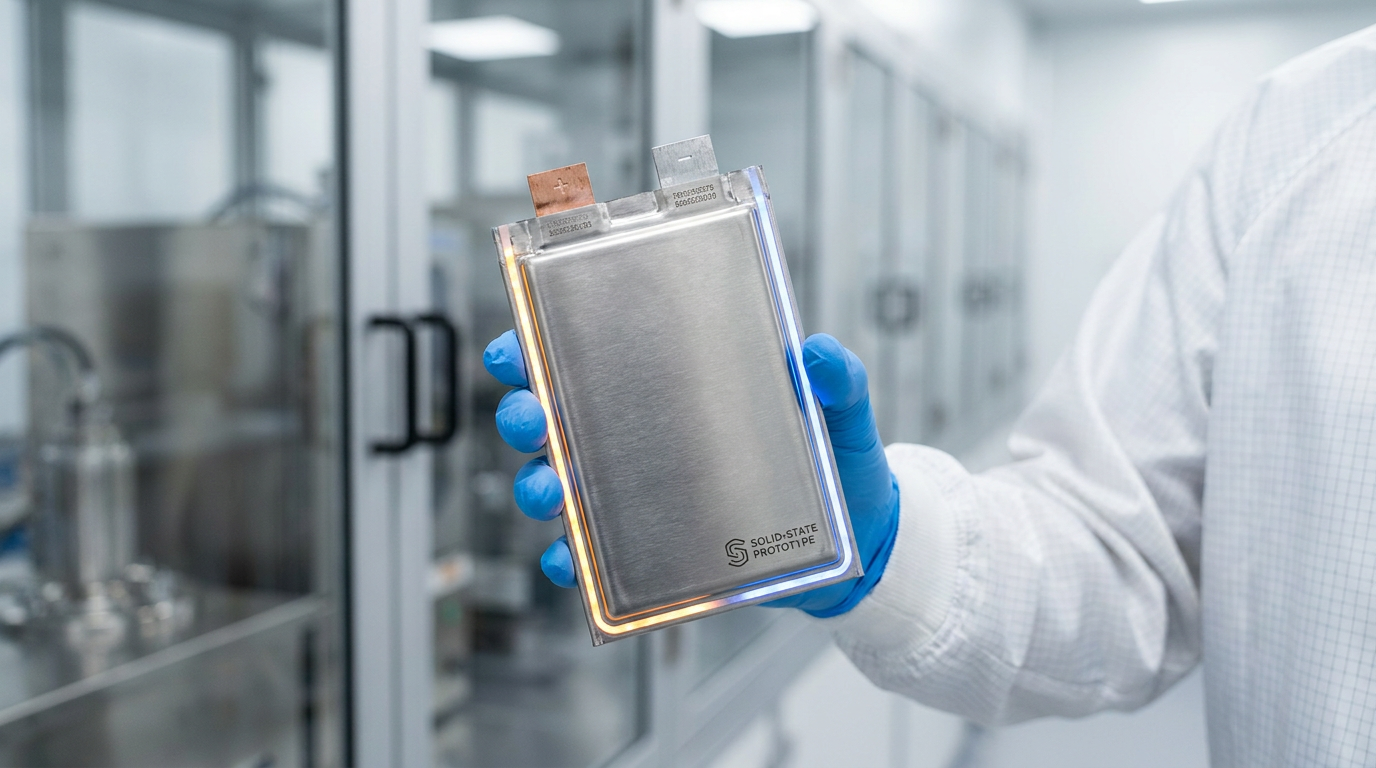
Solid-state batteries elegantly solve this problem by replacing the liquid with a solid material—often a specialized ceramic, polymer, glass, or sulfide-based compound. This solid layer acts as both the electrolyte and the physical separator, allowing lithium ions to pass through while keeping the positive and negative electrodes firmly apart. Because the solid material is inherently non-flammable and structurally stable at high temperatures, the risk of catastrophic battery fires is virtually eliminated, allowing automakers to strip out heavy protective casing and cooling infrastructure.[6][7]
Removing the flammable liquid immediately solves the safety equation, but the true breakthrough lies in the cascading effects on energy density. Because the solid electrolyte is structurally rigid, it acts as a physical barrier against the growth of 'dendrites.' Dendrites are microscopic, needle-like metallic whiskers that naturally form on the anode during fast charging. In a liquid battery, these sharp whiskers can easily pierce the thin plastic separator, causing a short circuit. The rigid solid electrolyte suppresses this growth, unlocking a massive shift in battery chemistry.[6][9]
By successfully suppressing dendrites, battery engineers can finally discard the bulky, heavy graphite anode used in traditional cells and replace it with a pure lithium-metal anode. This architectural shift is the key to the solid-state revolution. A lithium-metal anode dramatically increases the amount of energy that can be stored in the exact same physical footprint, effectively doubling the capacity of the battery without increasing its size or weight. It is the 'golden combination' that researchers have been chasing for decades.[7][9]
This architectural shift is the key to the solid-state revolution.
The performance numbers emerging from early 2026 pilot lines confirm these theoretical advantages. Factorial's FEST solid-state cells are currently achieving an energy density of 375 Wh/kg in real-world testing. Meanwhile, QuantumScape's QSE-5 battery, co-developed with Volkswagen's PowerCo, boasts a volumetric energy density of 844 watt-hours per liter. In practical automotive terms, this translates to electric vehicles capable of traveling 600 to 745 miles on a single charge, effectively eliminating range anxiety and surpassing the range of most internal combustion engine vehicles on the road today.[1][5]

Charging speeds are equally transformative, addressing the second major hurdle to EV adoption. Because solid electrolytes maintain their structural and chemical stability at higher temperatures, they can accept massive influxes of electrical current without degrading the cell. QuantumScape and Factorial have both demonstrated the ability to charge their solid-state cells from 10% to 80% capacity in under 15 to 18 minutes. Toyota's first-generation solid-state design targets a 10-minute fast charge. This brings the EV charging experience remarkably close to the time it takes to fill a traditional car with gasoline.[1][5][6]
Despite these staggering specifications, the road to mass market adoption remains steep and complex. The primary hurdle is no longer the fundamental chemistry, but the immense mechanical stress of manufacturing and operating these cells at a global scale. Transitioning a delicate, perfect cell from a pristine laboratory environment to a high-volume gigafactory that produces millions of units a day requires entirely new manufacturing techniques. Furthermore, the materials must be flawlessly integrated; even a microscopic imperfection in the solid electrolyte can compromise the entire battery's performance and lifespan.[3]
The operational stresses are equally daunting. As lithium ions move in and out of the electrodes during charging and discharging, the materials naturally swell and shrink. In a traditional battery, the liquid electrolyte easily flows and accommodates this constant volumetric expansion. In a solid-state battery, this repeated flexing can cause the rigid ceramic or glass electrolytes to crack or lose contact with the electrodes, leading to a sudden and irreversible collapse in performance. Solving this interfacial resistance has been the graveyard of many solid-state startups.[7][8]
Overcoming this durability issue has been the focus of intense, decade-long engineering efforts. Toyota, which holds over 1,000 patents in the space, has partnered closely with Idemitsu Kosan to develop a highly flexible, crack-resistant sulfide solid electrolyte. This material is designed to deform and maintain ionic contact even as the electrodes swell under stress. With this breakthrough, the Japanese automaker plans to begin small-scale pilot production in 2026, targeting a commercial rollout in premium electric vehicles by 2027 or 2028.[3][8]

Cost remains the final, and perhaps most stubborn, barrier to ubiquity. Today's mature lithium-iron-phosphate (LFP) batteries are being produced at roughly $60 per kilowatt-hour at the cell level, making them highly economical for mass-market vehicles. Early solid-state cells are estimated to cost significantly more—potentially adding thousands of dollars to the price of a vehicle. Because of this premium, solid-state technology will likely debut in luxury vehicles, high-performance sports cars, and premium electric motorcycles before economies of scale allow it to trickle down to everyday commuter cars.[8]
Given these manufacturing and economic realities, industry leaders remain divided on the exact timeline for a complete transition. While companies like BYD and Toyota are pushing aggressive 2027 mass-production targets, CATL—the world's largest battery manufacturer—has offered a notably more cautious assessment. Internally, CATL rates the technology's current readiness at a level 4 out of 9 on the Technology Readiness Level (TRL) scale, indicating that while the engineering is sound, large-scale industrialization is still years away. They view the current landscape as an engineering validation phase rather than the dawn of immediate mass production.[3]
CATL's chairman recently noted that while small-batch production is feasible today, the chances of solid-state batteries powering millions of vehicles by 2030 remain relatively small due to the complexities of standardizing the manufacturing process and optimizing production yields. Instead, many automakers are taking a transitional approach, developing 'semi-solid' batteries that use a hybrid of solid and liquid electrolytes to bridge the gap between current technology and the all-solid future. These semi-solid packs offer a moderate bump in energy density and safety while utilizing existing lithium-ion manufacturing equipment, serving as a vital stepping stone.[3]

Nevertheless, the momentum behind pure solid-state technology is undeniable. 2026 is widely being recognized across the industry as the definitive year of validation. Automakers have moved past bench-testing single coin cells in laboratories and are now integrating full, high-capacity battery packs into actual development vehicles navigating public roads in extreme weather conditions. As these pilot lines spin up and dedicated supply chains begin to form, the theoretical promises of the past decade are finally being measured against real-world asphalt, proving that the chemistry can survive the rigors of daily driving.[1][3]
The transition will not be an overnight flip, but rather a phased rollout that will redefine the capabilities of electric transportation over the next decade. As production scales and costs begin their inevitable downward curve, the internal combustion engine's final major advantage—the five-minute refueling stop—is rapidly evaporating. With vehicle ranges extending past 600 miles, fire risks virtually eliminated, and charging times dropping to 15 minutes, the solid-state era has officially begun. It is a triumph of modern materials science, promising a cleaner, safer, and vastly more efficient future for global mobility.[1][5]
How we got here
2020–2023
Solid-state startups achieve major laboratory breakthroughs in dendrite suppression and ionic conductivity.
Late 2025
Automakers begin receiving A-sample solid-state cells for initial testing and validation.
January 2026
Donut Lab launches the world's first production electric motorcycle powered by a solid-state battery.
June 2026
Factorial and Stellantis begin real-world road testing of solid-state battery packs in North America.
2027–2028
Major automakers, including Toyota, target the commercial launch of their first solid-state electric vehicles.
Viewpoints in depth
The Innovators' View
Solid-state startups believe the fundamental chemistry challenges have been solved, paving the way for rapid commercialization.
Companies dedicated entirely to solid-state technology argue that the hardest scientific hurdles—specifically dendrite suppression and ionic conductivity—are now behind them. By successfully demonstrating cells that can withstand hundreds of fast-charge cycles without degrading, these developers believe the focus has shifted entirely to engineering and scale. They point to successful pilot lines and partnerships with major OEMs as proof that the technology is ready to leave the lab, projecting that their early-mover advantage will disrupt the entire energy storage market.
The Automakers' View
Car manufacturers are heavily investing in the technology to unlock longer ranges, but are prioritizing durability and safety over immediate rollout.
For legacy automakers, solid-state batteries represent a chance to reset the EV competitive landscape. Their primary focus is on the mechanical durability of the cells—ensuring that the solid electrolytes do not crack under the constant swelling and shrinking of daily driving. Brands like Toyota and Honda are taking a methodical approach, co-developing flexible sulfide-based materials and targeting 2027 or 2028 for their first commercial vehicles. They view solid-state not just as a range extender, but as a fundamental safety upgrade that allows them to remove heavy cooling systems and rethink vehicle architecture.
The Manufacturers' View
Incumbent battery giants warn that scaling solid-state production to millions of vehicles remains a distant and costly challenge.
The world's largest battery producers, who currently dominate the lithium-ion market, offer the most cautious timelines. They emphasize that building a perfect cell in a lab is vastly different from achieving high-yield, gigawatt-hour production. These realists point out that current lithium-iron-phosphate (LFP) batteries are incredibly cheap and reliable, creating a high economic barrier for solid-state entry. Until solid-state manufacturing can achieve similar economies of scale and drive down the premium cost per kilowatt-hour, these giants believe the technology will remain confined to luxury niches while semi-solid and advanced liquid batteries continue to power the mass market.
What we don't know
- The exact consumer price premium for the first generation of solid-state EVs.
- How well the solid electrolytes will hold up to a decade of extreme winter weather and daily fast-charging.
- Whether the global supply chain can produce enough high-purity lithium metal to meet projected demand.
Key terms
- Electrolyte
- The medium inside a battery that allows ions to flow between the positive and negative electrodes during charging and discharging.
- Dendrites
- Microscopic, needle-like metallic whiskers that can grow inside a battery during fast charging, potentially causing short circuits.
- Energy Density
- The amount of energy a battery can store relative to its weight or volume, typically measured in watt-hours per kilogram (Wh/kg).
- Lithium-Metal Anode
- A highly efficient negative electrode made of pure lithium, enabled by solid-state technology, which drastically increases a battery's capacity.
- Thermal Runaway
- A dangerous chain reaction in traditional batteries where overheating causes the liquid electrolyte to catch fire or explode.
Frequently asked
What is a solid-state battery?
A solid-state battery replaces the flammable liquid electrolyte found in traditional lithium-ion batteries with a solid material, such as ceramic or glass, improving safety and energy capacity.
How much farther can an EV go with a solid-state battery?
Solid-state batteries can nearly double the energy density of current batteries, potentially allowing electric vehicles to travel 600 to 745 miles on a single charge.
When will solid-state batteries be available in cars?
While pilot testing in development vehicles began in 2026, automakers like Toyota expect to launch their first commercial solid-state EVs in 2027 or 2028, initially in premium models.
Why do solid-state batteries charge faster?
Solid electrolytes are highly stable at high temperatures, allowing them to safely accept a massive influx of electrical current without overheating or degrading, enabling 10-to-15 minute charge times.
Are solid-state batteries safer than lithium-ion?
Yes. Because they do not contain volatile, flammable liquid electrolytes, the risk of thermal runaway and battery fires is virtually eliminated, even if the cell is damaged.
Sources
Source coverage
9 outlets
3 viewpoints surfaced









[1]ElectrekAutomotive Integrators
Solid-state EV batteries are now being tested on the road in North America
Read on Electrek →[2]QuantumScapeSolid-State Innovators
QuantumScape Announces Agreement with Honda on Solid-State Battery Technology
Read on QuantumScape →[3]GasgooManufacturing Realists
'Mass Production' Declarations vs. Reality: The Solid-State Battery Timeline
Read on Gasgoo →[4]HackadayAutomotive Integrators
Solid-State Batteries Take To The Sky
Read on Hackaday →[5]The Motley FoolSolid-State Innovators
If You Buy This Industrial Stock Right Now, Could It Make You a Millionaire?
Read on The Motley Fool →[6]MurataSolid-State Innovators
What are solid-state batteries? How they work and their benefits
Read on Murata →[7]Flash BatterySolid-State Innovators
What are solid-state batteries and how do they work: differences with lithium batteries
Read on Flash Battery →[8]AutoGearShiftManufacturing Realists
Solid-State Batteries Update For Tesla 2026: BYD vs Donut Lab vs QuantumScape
Read on AutoGearShift →[9]TO7 MotorAutomotive Integrators
Solid-state battery breakthrough 2026
Read on TO7 Motor →
Every angle. Every day.
Get guides stories with full source coverage and perspective breakdowns delivered to your inbox.