
The Heat Beneath Our Feet: How Next-Generation Geothermal is Rewiring the Clean Energy Grid
By adapting drilling techniques from the oil and gas industry, Enhanced Geothermal Systems (EGS) are unlocking 24/7 carbon-free power from hot rock deep underground.
By Factlen Editorial Team
- Clean Energy Advocates
- Focus on EGS as the missing piece for a fully decarbonized grid.
- Energy Economists
- Emphasize the rapid decline in drilling costs and the technology's market viability.
- Geoscientists & Engineers
- Focus on the technical hurdles of extreme subsurface environments and seismic monitoring.
What's not represented
- · Local Communities Near Drilling Sites
- · Fossil Fuel Industry Workers
Why this matters
The transition to clean energy has struggled with a major flaw: solar and wind power only work when the weather cooperates. Enhanced Geothermal Systems (EGS) solve this by unlocking the Earth's heat anywhere on the map, providing the 24/7, carbon-free baseload power needed to permanently retire fossil fuel plants.
Key points
- Enhanced Geothermal Systems (EGS) create artificial underground reservoirs to extract heat from dry rock.
- The technology adapts horizontal drilling and hydraulic fracturing from the oil and gas industry.
- EGS provides 24/7 baseload power, complementing intermittent solar and wind energy.
- Drilling times and costs have plummeted by 70 percent over the last two years.
- Advanced fiber-optic sensors monitor subsurface fractures to safely manage induced seismicity risks.
The holy grail of the clean energy transition has long been a power source that is entirely carbon-free, yet capable of running 24 hours a day, seven days a week. While solar and wind power have seen explosive growth, their intermittent nature requires either massive battery storage or backup fossil fuel plants to keep the grid stable when the sun sets or the wind dies down. Nuclear power offers a firm baseload, but it remains notoriously expensive and politically fraught to build. Now, a rapidly maturing technology is looking downward to solve the problem, tapping into the virtually limitless heat radiating from the Earth's core.[1][5]
Conventional geothermal energy is not a new concept; the first plant was built in Italy in 1904. However, traditional geothermal power is geographically constrained. It requires a rare geological trifecta: extreme subsurface heat, abundant underground water, and naturally permeable rock that allows the heated water to flow to the surface. Because these three factors only align in specific volcanic or tectonically active regions—such as Iceland or California's Geysers—geothermal has historically remained a niche contributor to the global energy mix.[1][5]
That geographic limitation is now being shattered by Enhanced Geothermal Systems (EGS). Instead of hunting for natural underground aquifers, EGS technology engineers its own. By drilling deep into hot, dry, and impermeable rock formations, developers can artificially create the permeability needed to extract heat. This means that next-generation geothermal plants can theoretically be built almost anywhere, provided the drilling goes deep enough to reach the necessary temperatures.[1][2]

The mechanics of an EGS facility rely heavily on innovations borrowed directly from the oil and gas industry. The process begins by drilling a well vertically for thousands of feet before turning the drill bit to carve a horizontal path through the hot rock. Once the well is established, operators use hydraulic stimulation—injecting high-pressure fluid into the well—to crack the solid rock and create a sprawling network of tiny, interconnected fractures.[1][4]
After the fracture network is created, a second well, known as a production well, is drilled to intersect the newly formed reservoir. Cool water is pumped down the injection well, where it seeps through the artificial fractures, absorbing the intense heat of the surrounding rock. The superheated water is then drawn up through the production well to the surface.[1][2]
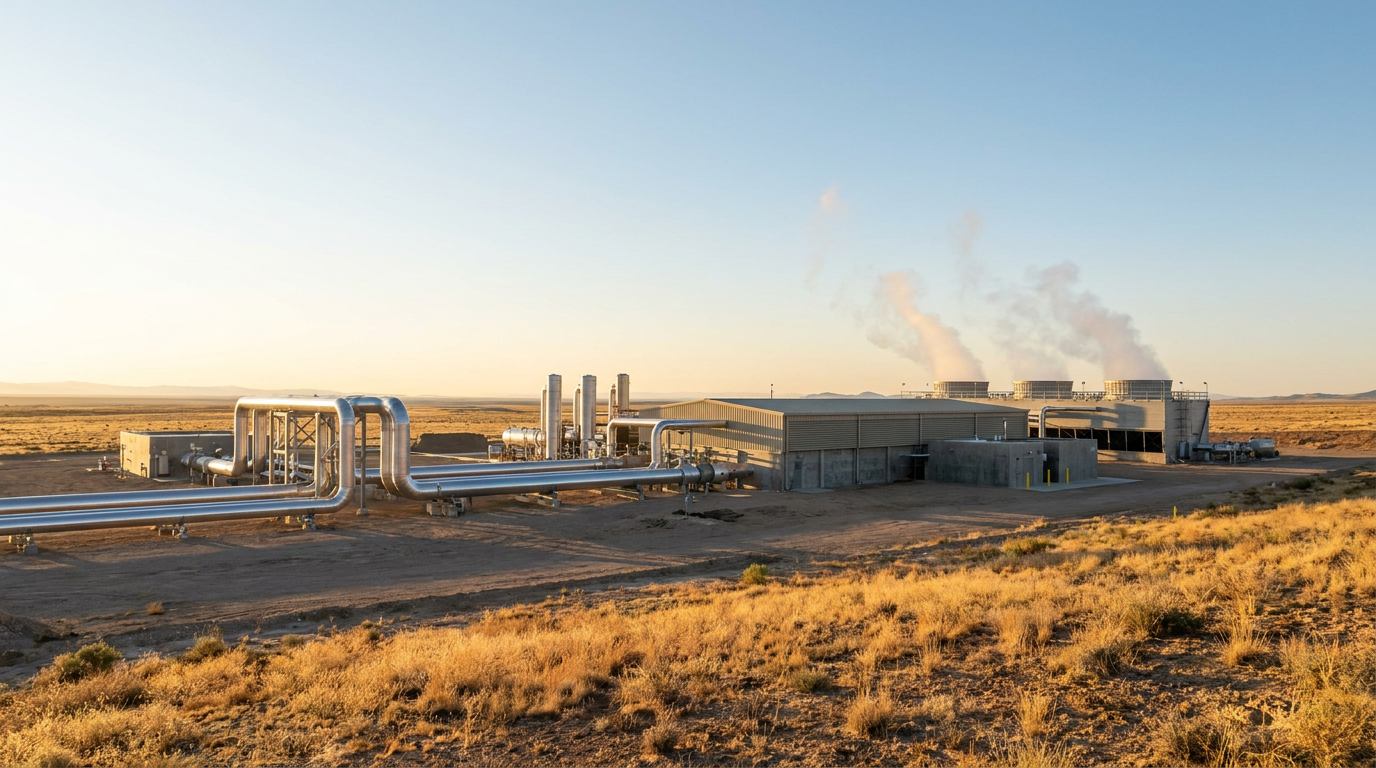
At the surface, the thermal energy is transferred to a working fluid that flashes into vapor, spinning a turbine to generate electricity. Because the system operates in a closed loop, the cooled water is immediately reinjected back into the earth to be heated again. The result is a continuous, reliable stream of electricity with virtually zero greenhouse gas emissions and a remarkably small physical footprint compared to sprawling solar farms.[1][5]
At the surface, the thermal energy is transferred to a working fluid that flashes into vapor, spinning a turbine to generate electricity.
The transition of EGS from a theoretical concept to a commercial reality has been remarkably swift, spearheaded by companies like Fervo Energy. At its Cape Station project in Beaver County, Utah, Fervo has successfully demonstrated the viability of EGS at scale. The company expects the facility to begin delivering 100 megawatts of continuous power by 2026, with plans to scale up to 500 megawatts—enough to power hundreds of thousands of homes.[3][4][6]
The economics of EGS have historically been the technology's biggest hurdle, as drilling deep into hard, hot rock is extraordinarily expensive. However, the industry is currently experiencing a dramatic learning curve. By applying horizontal drilling techniques perfected during the shale boom, developers have slashed drilling times by 70 percent in just two years. Because drilling accounts for more than half of a geothermal project's capital costs, these efficiency gains are fundamentally transforming the financial viability of next-generation geothermal.[4][6]

The potential scale of this resource is staggering. The U.S. Department of Energy estimates that advanced geothermal systems could produce over 90 gigawatts of electricity nationwide by 2050. A recent analysis by Princeton University researchers went even further, suggesting that if cost reductions continue on their current trajectory, EGS could supply up to 20 percent of all electricity in the United States by mid-century, emerging as the third most significant clean energy technology behind wind and solar.[1][2]
Beyond providing baseload power, EGS reservoirs offer a unique secondary benefit: long-duration energy storage. Because the artificial reservoirs are created in previously impermeable rock, they can effectively trap fluid and pressure. Operators can modulate the flow of water out of the production well, allowing pressure and heat to build up underground when solar and wind are abundant on the grid. When renewable generation drops off, the EGS plant can release the stored energy, acting as a massive, naturally insulated underground battery.[5][7]
Operating in these extreme subsurface environments requires equally extreme monitoring technology. At the Cape Station site, geophysicists from the Lawrence Berkeley National Laboratory recently achieved a major breakthrough by continuously monitoring the reservoir for seven months using custom seismometers deployed nearly 7,000 feet underground. Surviving temperatures of 338°F, these sensors provide real-time data on how the rock fractures form and behave, allowing engineers to optimize the reservoir's performance.[3]

This continuous monitoring is also critical for managing the primary environmental risk associated with EGS: induced seismicity. The process of fracturing deep rock inherently creates micro-earthquakes. While these seismic events are typically of very low magnitude and rarely felt at the surface, careful management is required to ensure they do not trigger larger, hazardous tremors. The Department of Energy has established strict protocols for seismic monitoring, and the use of advanced fiber-optic sensing allows operators to adjust fluid pressures instantly if seismic activity approaches safety thresholds.[1][3]
As the technology continues to mature, next-generation geothermal stands poised to reshape the energy landscape. By unlocking the vast thermal energy stored beneath our feet, EGS offers a reliable, scalable, and clean power source that can complement intermittent renewables and accelerate the retirement of fossil fuel plants. What was once dismissed as a niche, geographically limited resource is rapidly becoming a foundational pillar of the future zero-carbon grid.[2][5][6]
How we got here
1904
The world's first conventional geothermal power plant is built in Larderello, Italy.
2023
Fervo Energy successfully operates 'Project Red' in Nevada, proving the commercial viability of EGS.
2025
Researchers at Princeton publish data suggesting EGS could supply 20% of US electricity by 2050.
2026
Cape Station in Utah prepares to deliver its first 100 megawatts of continuous next-generation geothermal power.
Viewpoints in depth
Clean Energy Advocates
Focus on EGS as the missing piece for a fully decarbonized grid.
Advocates argue that the transition away from fossil fuels cannot rely on intermittent renewables alone. Because solar panels and wind turbines only generate power when the weather cooperates, grids currently require natural gas or coal plants to maintain baseload stability. EGS offers a zero-carbon alternative that runs 24/7. Furthermore, because EGS can be deployed across a much wider geographic footprint than traditional geothermal, advocates see it as a universally applicable solution that could singlehandedly replace retiring coal plants.
Energy Economists
Emphasize the rapid decline in drilling costs and the technology's market viability.
For economists, the most exciting aspect of EGS is its learning curve. By adapting horizontal drilling techniques perfected by the shale oil industry, geothermal developers have slashed drilling times by 70% in just two years. Economists project that as the industry scales, the cost per megawatt-hour will drop below $70 by 2030, making it directly competitive with solar-plus-battery installations. They argue that market forces, rather than just climate policy, will drive the rapid adoption of next-generation geothermal.
Geoscientists & Engineers
Focus on the technical hurdles of extreme subsurface environments and seismic monitoring.
Engineers and geologists view EGS as a monumental technical challenge that is finally being solved. Operating equipment at depths of 7,000 feet and temperatures exceeding 330°F destroys conventional electronics and drilling tools. Geoscientists are particularly focused on managing 'induced seismicity'—the micro-earthquakes caused by fracturing rock. By deploying advanced fiber-optic sensors and continuous seismic monitoring, they are mapping subsurface fracture networks in real-time to ensure reservoirs are created safely and efficiently without triggering hazardous tremors.
What we don't know
- Whether the rapid cost reductions seen in pilot projects will scale linearly to multi-gigawatt deployments.
- How the long-term thermal degradation of artificial reservoirs will affect power output over decades.
- The extent to which extreme-depth drilling tools can be mass-produced affordably.
Key terms
- Enhanced Geothermal Systems (EGS)
- A man-made geothermal reservoir created by injecting fluid into hot, dry, impermeable rock to fracture it and extract heat.
- Baseload Power
- The minimum amount of electric power needed to be supplied to the electrical grid at any given time, operating 24/7.
- Hydraulic Stimulation
- The process of injecting high-pressure fluid deep underground to create or widen fractures in solid rock, increasing its permeability.
- Closed-Loop System
- A power generation design where the geothermal fluid is kept contained within pipes and reinjected into the earth, producing zero emissions.
- Induced Seismicity
- Minor, typically imperceptible earthquakes caused by human activity, such as injecting fluids into the earth's crust.
Frequently asked
Can EGS be built anywhere?
Unlike traditional geothermal, which requires natural hot springs, EGS can theoretically be deployed anywhere the underlying rock is hot enough, vastly expanding its geographic potential.
Is this the same as oil and gas fracking?
EGS uses similar horizontal drilling and hydraulic fracturing techniques, but it pumps water rather than extracting fossil fuels, and operates in a closed loop with zero carbon emissions.
Does enhanced geothermal cause earthquakes?
The fracturing process does create micro-seismic events, which are usually too small to be felt at the surface. Sites are heavily monitored using advanced sensors to manage and mitigate any seismic risk.
Why is geothermal better than solar or wind?
It isn't necessarily better, but it is complementary. While solar and wind are intermittent (dependent on weather and time of day), geothermal provides constant, 24/7 baseload power.
Sources
Source coverage
7 outlets
3 viewpoints surfaced







[1]U.S. Department of EnergyGeoscientists & Engineers
Enhanced Geothermal Systems
Read on U.S. Department of Energy →[2]Princeton UniversityClean Energy Advocates
Enhanced geothermal systems could supply 20% of US electricity by 2050
Read on Princeton University →[3]Lawrence Berkeley National LaboratoryGeoscientists & Engineers
Scientists Develop New Technology to Continuously Monitor Geothermal Energy Operations
Read on Lawrence Berkeley National Laboratory →[4]Information Technology and Innovation FoundationEnergy Economists
Accelerating Next-Generation Geothermal Energy
Read on Information Technology and Innovation Foundation →[5]World Resources InstituteClean Energy Advocates
Next-Generation Geothermal Energy, Explained
Read on World Resources Institute →[6]Proceedings of the National Academy of SciencesEnergy Economists
The geothermal renaissance
Read on Proceedings of the National Academy of Sciences →[7]Factlen Editorial Team
Synthesis by Factlen editorial team
Read on Factlen Editorial Team →
Every angle. Every day.
Get guides stories with full source coverage and perspective breakdowns delivered to your inbox.