
How Neuroaesthetics is Turning Interior Design into Preventive Mental Healthcare
Architects and neuroscientists are teaming up to prove that interior design is more than just visual. By measuring brain activity, they are creating spaces that actively lower stress, boost focus, and accelerate healing.
By Factlen Editorial Team
- Neuroscientists & Researchers
- Focuses on empirical data, fMRI scans, and measurable biological markers to understand aesthetic responses.
- Architects & Designers
- Focuses on applying scientific principles to create functional, beautiful, and psychologically supportive spaces.
- Healthcare Planners
- Focuses on the clinical outcomes of neuroaesthetics, such as patient recovery times and reducing institutional stress.
What's not represented
- · Neurodivergent advocates
- · Low-income housing developers
Why this matters
Understanding how your environment affects your nervous system empowers you to design spaces that actively support your mental health. Simple changes to lighting, texture, and layout can measurably reduce daily stress and improve cognitive focus.
Key points
- Neuroaesthetics measures how the brain and body physically respond to interior design and architecture.
- Aesthetically pleasing spaces activate the brain's reward centers and lower stress hormones like cortisol.
- Biophilic design, which integrates natural elements, has been shown to increase productivity and reduce fatigue.
- Hospitals and schools are increasingly using these scientific principles to accelerate healing and improve focus.
For decades, interior design was treated as a purely visual and functional discipline—a matter of matching fabrics, selecting paint swatches, and arranging furniture for optimal flow. The success of a space was largely judged by its aesthetic appeal and practical utility. But a quiet, science-backed revolution is currently reshaping how architects, designers, and homeowners approach the spaces we inhabit. The focus is no longer just on how a room looks to the eye, but on how it fundamentally alters the human nervous system. By bridging the gap between biology and architecture, this new paradigm is transforming our understanding of the built environment.[6]
The shift is driven by neuroaesthetics, an emerging scientific field that measures how our brains and bodies physically respond to beauty, art, and spatial design. Instead of relying solely on a designer's intuition, the industry now has access to empirical evidence showing that our environments actively alter our biology. Advanced brain scanning technologies, which first became widely applicable to aesthetic research in the late 1990s, allow scientists to observe these reactions in real time. They can track which neural pathways light up when we enter a sunlit atrium, or measure the exact drop in stress hormones when we sit in a room filled with natural wood textures.[6]
“Neuroaesthetics examines how the environments we live in affect us on a physical and emotional level,” explains Suchi Reddy, founder of the neuroaesthetics-focused New York architecture practice Reddymade. When a person walks into a room and feels an immediate sense of calm, security, or inspiration, that is not merely a subjective preference or a fleeting mood—it is a measurable neurological event. The proportions of a space, the tactile quality of the materials, and the temperature of the lighting all send continuous, subconscious signals to the brain, shaping our cognitive state from the moment we cross the threshold.[1]
The mechanism behind this response lies deep within the brain's architecture. When we encounter aesthetically pleasing or highly functional spaces, functional magnetic resonance imaging (fMRI) studies show increased activity in the medial orbitofrontal cortex. This region of the brain is heavily linked to emotional regulation, decision-making, and the processing of rewards. Essentially, a well-designed room triggers the same neural reward pathways as listening to a favorite piece of music or experiencing a meaningful social connection, flooding the brain with positive reinforcement. Conversely, spaces that are cluttered, poorly lit, or visually jarring can stimulate the amygdala, triggering low-grade, chronic stress responses that exhaust our cognitive reserves over time.[3][5]

As the brain reacts, the body's physiological markers shift in tandem. Heart rates can slow, blood pressure can drop, and the production of stress hormones like cortisol noticeably decreases. In their place, the brain increases the release of serotonin and dopamine, neurotransmitters associated with mood stabilization and pleasure. This mind-body connection proves that interior design is not a passive backdrop to our lives; it is an active environmental input that our biological systems are constantly processing and reacting to, whether we are consciously aware of it or not.[4][6]
The Penn Center for Neuroaesthetics at the University of Pennsylvania has been at the forefront of mapping these hidden sensitivities to architectural interiors. Through rigorous experimental neuroarchitecture, researchers there have identified three primary dimensions of psychological experience that dictate how we perceive indoor spaces: coherence, fascination, and hominess. Each of these dimensions carries its own distinct neural imprint, providing a scientific vocabulary for feelings that designers have historically struggled to quantify. By isolating these variables, scientists can begin to understand exactly why a minimalist living room might feel soothing to one person but uncomfortably sterile to another.[5]
Coherence refers to how easily the brain can organize and make sense of a space. When a room is coherent, the brain doesn't have to expend excess energy decoding its layout, which naturally lowers cognitive load. Fascination involves the subtle complexity that holds our attention without overwhelming it—think of the intricate, repeating patterns found in a marble countertop or the dappled light filtering through window blinds. Finally, hominess relates to a profound sense of personal comfort, security, and belonging, often triggered by soft textures, warm lighting, and familiar proportions.[5]
Coherence refers to how easily the brain can organize and make sense of a space.
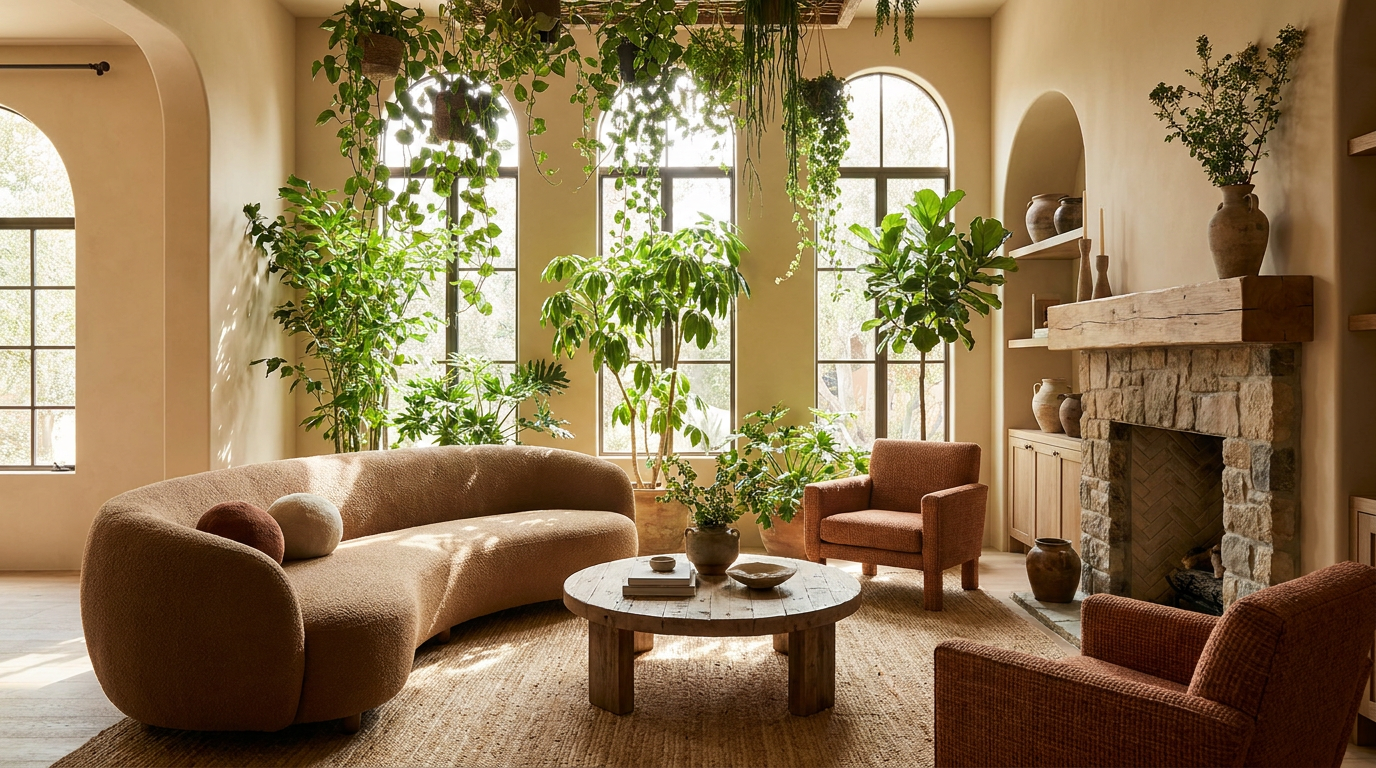
One of the most heavily researched and universally effective applications of neuroaesthetics is biophilic design—the intentional integration of natural elements into the built environment. Because the human brain evolved outdoors over millions of years, it remains hardwired to seek out nature. Modern humans, however, spend the vast majority of their lives inside buildings. Biophilic design attempts to bridge this evolutionary gap by bringing the outdoors in, co-opting our spatial memory and depth perception to generate a tangible experience of affiliation with living systems.[2][6]

The benefits of biophilia are highly quantifiable. Visual access to greenery, dynamic natural daylight that shifts with the circadian rhythm, and the use of natural materials like wood and stone have been shown to lower anxiety and improve working memory. In corporate environments, studies have linked biophilic design principles to a 15 percent increase in employee productivity and a significant reduction in daily fatigue. People inherently feel more comfortable and welcomed around woven fabrics and timber, as these textures stimulate the somatosensory cortex and produce feelings of groundedness.[2]
Geometry and spatial form also play a crucial role in how a room makes us feel. fMRI and electroencephalogram (EEG) scans reveal that curvilinear spaces and rounded furniture activate the brain's pleasure centers far more effectively than sharp angles and rectilinear contours. While sharp edges can subconsciously signal danger or require heightened spatial awareness, curved lines mimic the organic shapes found in nature, prompting the nervous system to relax and lowering our defensive barriers. This is why a circular dining table or an arched doorway often feels inherently more inviting than a rigid, boxy alternative.[2][3]
This science is moving rapidly from residential living rooms into high-stakes institutional environments, where the psychological impact of a space carries profound consequences. Healthcare architects are increasingly abandoning the sterile, fluorescent-lit corridors of traditional hospitals in favor of neuroaesthetic principles. The goal is to place recovery at the center of the design, using the building itself as an active participant in patient care rather than just a container for medical equipment. By reducing environmental stressors, hospitals can lower patient blood pressure, reduce the need for pain medication, and ultimately accelerate the healing process.[3][6]

At the Strawberry Hill Campus, an inpatient mental health facility at the University of Kansas, designers from CannonDesign utilized these exact strategies to promote psychological healing. They transformed a dreary government building into a therapeutic sanctuary featuring vertical green walls, landscaped courtyards, and interior spaces bathed in natural light. By layering in considerations related to patient well-being and staff fatigue, the facility demonstrates how architecture can actively support people's psychological and social needs during their most vulnerable moments. It proves that institutional design does not have to be institutional in its feel.[3]
The International Arts + Mind Lab at Johns Hopkins University is working to accelerate this transition across all sectors of society. Through their multidisciplinary research initiatives, brain scientists are collaborating directly with practitioners in architecture and design. Their goal is to ensure that evidence-based aesthetic design becomes a standard, recognized component of mainstream medicine and public health, moving neuroaesthetics from a niche academic pursuit into a foundational element of how we build our cities and homes. They argue that intentional spaces represent a highly cost-effective opportunity to improve human resilience and innovation at scale.[4]
Despite the wealth of new data, researchers acknowledge significant areas of uncertainty within the field. Aesthetic responses are not entirely universal; they are heavily filtered through an individual's personal history, cultural background, and unique neurobiology. What feels like a soothing, minimalist sanctuary to one person might feel cold, under-stimulating, and isolating to another. Neurodivergent individuals, for example, may have entirely different sensory thresholds for lighting, acoustics, and spatial complexity. Because of this inherent subjectivity, creating a single, universal blueprint for the "perfect" neuroaesthetic room remains an impossible—and likely undesirable—task.[1][6]

As the field matures, the challenge will be designing adaptable spaces that allow individuals to control their sensory inputs. The future of neuroarchitecture lies in flexibility—giving occupants the agency to adjust lighting temperatures, acoustic dampening, and spatial flow to meet their specific neurological needs at any given moment. A successful space will be one that can transition seamlessly from a high-focus work environment in the morning to a restorative, calming retreat in the evening. This requires moving away from static design choices and embracing dynamic environments that respond to human rhythms.[3][6]
Ultimately, neuroaesthetics invites a profound reframing of how we build our world. It suggests that interior design is not a luxury or a superficial pursuit, but a fundamental form of preventive mental healthcare. By decorating from the inside out—starting with how a space should make us feel rather than how it will look in a photograph—we can craft homes, schools, and hospitals that actively care for the people within them. When we align aesthetics with empathy and science, our buildings become powerful allies in human flourishing, proving that true beauty is measured by its impact on the mind.[1][6]
How we got here
Late 1990s
Advancements in brain scanning technology allow scientists to measure aesthetic responses in real-time.
2003
Early foundational studies link the built environment directly to measurable mental health outcomes.
2018
The Academy of Neuroscience for Architecture highlights the shift toward empathy-driven, evidence-based design.
2022
Major healthcare facilities begin opening with neuroaesthetics as their core design principle to aid patient recovery.
2026
Neuroarchitecture emerges as a formal, interdisciplinary sector bridging brain science and interior design.
Viewpoints in depth
Neuroscientists' view
Aesthetic responses are measurable biological events, not just subjective opinions.
Researchers in this camp prioritize empirical evidence over design intuition. By utilizing fMRI and EEG technology, they map exactly how the brain processes spatial dimensions, lighting, and texture. Their goal is to isolate the specific variables that trigger stress or relaxation, providing a rigorous scientific foundation for what has historically been a purely artistic discipline.
Architects' view
Science should guide, not replace, creative expression in design.
For design professionals, neuroaesthetics is a tool to validate their work and enhance human well-being. They argue that understanding the brain's preference for curves or natural light doesn't eliminate artistic freedom; rather, it provides a framework for 'decorating from the inside out.' This camp focuses on translating clinical data into tangible, beautiful environments that actively support the occupants' emotional needs.
Healthcare Planners' view
Buildings are active participants in the medical healing process.
Institutional planners view neuroaesthetics through the lens of clinical outcomes and return on investment. They argue that traditional, sterile hospital designs actively harm patients by elevating cortisol levels. By integrating biophilic design and neuroarchitecture, they aim to lower patient blood pressure, reduce the need for pain medication, and decrease staff burnout, proving that thoughtful design is a cost-effective medical intervention.
What we don't know
- How neurodivergent individuals process neuroaesthetic design principles, as most baseline studies focus on neurotypical brains.
- The long-term, multi-year psychological effects of living in a fully optimized neuroaesthetic environment.
- How to perfectly balance conflicting sensory needs when designing shared public spaces for diverse populations.
Key terms
- Neuroaesthetics
- The intersection of neuroscience and design, studying how aesthetic experiences physically affect the brain and body.
- Biophilic Design
- An architectural approach that connects building occupants more closely to nature through natural lighting, ventilation, landscape features, and organic materials.
- Medial Orbitofrontal Cortex
- A region of the brain involved in emotional regulation and decision-making that activates when we experience something beautiful.
- Somatosensory Cortex
- The part of the brain that processes tactile information, such as the comforting texture of woven fabrics or natural wood.
- Neuroarchitecture
- The discipline of designing buildings and spaces based on neuroscientific research to optimize human health and well-being.
Frequently asked
What is neuroaesthetics?
Neuroaesthetics is the scientific study of how the brain processes and responds to beauty, art, and spatial design, measuring physiological changes like heart rate and hormone levels.
How does biophilic design affect the brain?
Integrating natural elements like wood, plants, and sunlight lowers cognitive load, reduces anxiety, and improves working memory by tapping into our evolutionary preference for nature.
Can interior design really lower stress?
Yes. Studies show that well-designed spaces can lower blood pressure, decrease cortisol production, and increase the release of mood-stabilizing neurotransmitters like serotonin.
Do sharp angles cause stress?
While not inherently harmful, sharp angles and rectilinear contours can subconsciously signal danger to the brain, whereas curvilinear shapes activate neural pleasure centers.
Sources
Source coverage
6 outlets
3 viewpoints surfaced






[1]LivingetcArchitects & Designers
Neuroaesthetics: The interior design trend that focuses on the mind
Read on Livingetc →[2]ArchDailyArchitects & Designers
Neuroaesthetics and Neuroarchitecture: Designing for the Mind
Read on ArchDaily →[3]proto.lifeHealthcare Planners
Neuroaesthetics: Mental Health Facilities of the Future
Read on proto.life →[4]Johns Hopkins UniversityNeuroscientists & Researchers
International Arts + Mind Lab Center for Applied Neuroaesthetics
Read on Johns Hopkins University →[5]University of PennsylvaniaNeuroscientists & Researchers
The Neuroaesthetics of Architecture
Read on University of Pennsylvania →[6]Factlen Editorial TeamArchitects & Designers
Synthesis by Factlen editorial team
Read on Factlen Editorial Team →

Every angle. Every day.
Get home stories with full source coverage and perspective breakdowns delivered to your inbox.