
The Science of Koji: How an Ancient Mold is Rewriting the Rules of Home Cooking
Home cooks are increasingly turning to Aspergillus oryzae, the fungus behind miso and soy sauce, to tenderize meat and unlock massive umami through enzymatic fermentation.
By Factlen Editorial Team
- Culinary Scientists
- Focuses on the biochemical reactions—how specific enzymes break down macronutrients to manipulate flavor and texture at a molecular level.
- Traditional Fermenters
- Values the ancient Japanese heritage of Aspergillus oryzae and its foundational role in creating staple ingredients like miso and soy sauce.
- Modern Home Cooks
- Prioritizes practical kitchen applications, using koji as a versatile, single-ingredient shortcut to achieve complex umami and perfect browning.
What's not represented
- · Commercial Food Manufacturers
- · Individuals with severe mold or fungal allergies
Why this matters
Understanding the enzymatic power of koji allows home cooks to manipulate flavor and texture at a molecular level, turning cheap cuts of meat tender and adding deep, savory complexity to simple vegetable dishes without relying on ultra-processed additives.
Key points
- Koji (Aspergillus oryzae) is an ancient mold that produces over 100 powerful enzymes during its growth phase.
- Protease enzymes break down proteins into amino acids, naturally tenderizing meat and generating massive amounts of umami-rich glutamate.
- Amylase enzymes convert starches into simple sugars, which accelerates the Maillard browning reaction when the food is cooked.
- Home cooks can easily harness this science by mixing dried koji rice with salt and water to create shio koji, a versatile, shelf-stable marinade.
The culinary secret currently sweeping ambitious home kitchens isn't a high-tech gadget or a rare, expensive spice. It is a fuzzy, white mold. For centuries, Aspergillus oryzae has been the invisible architect behind some of the world's most complex flavors, quietly driving the fermentation of staple ingredients across Asia. Today, this ancient microorganism is stepping out of commercial brewing vats and into everyday kitchens, offering home cooks an unprecedented ability to manipulate flavor and texture at a molecular level.[1][2]
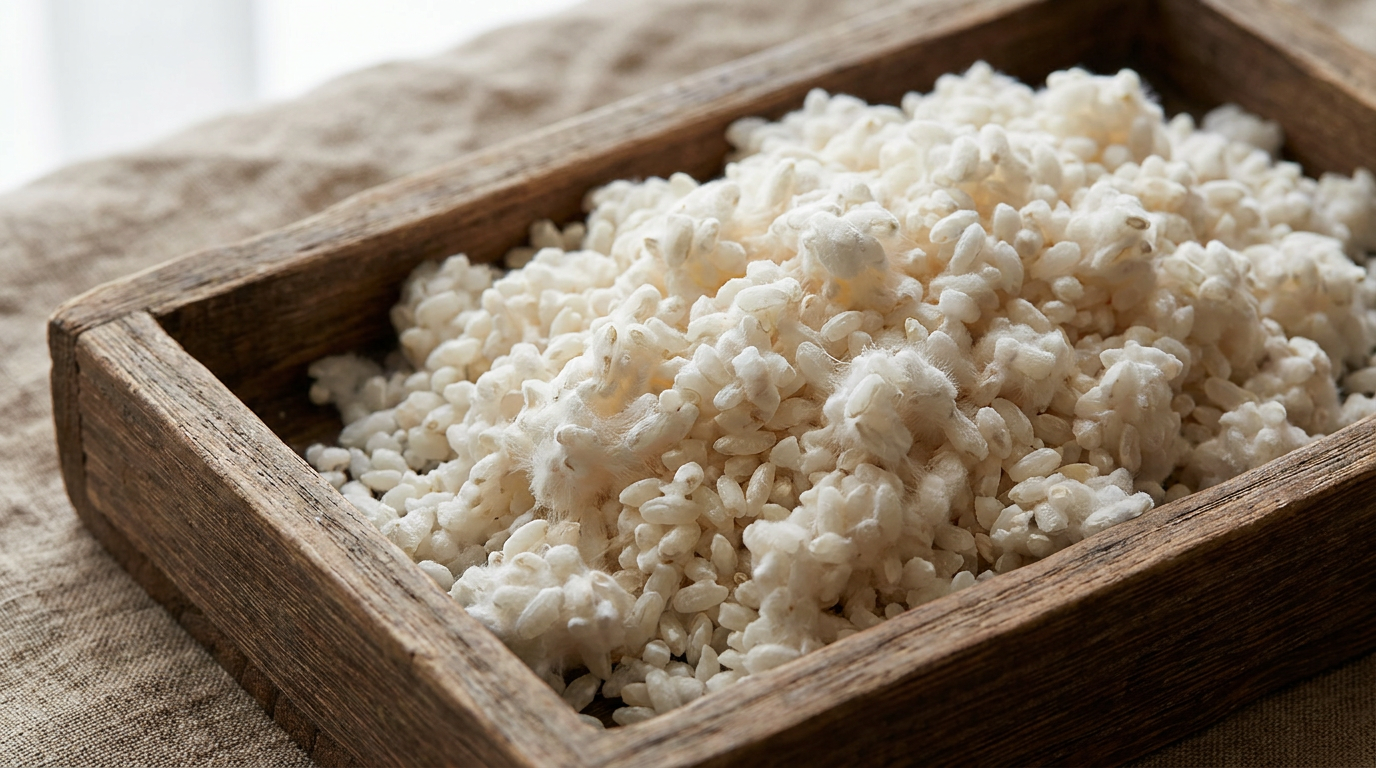
Known as the "national fungus of Japan," Aspergillus oryzae—commonly referred to as koji—is a non-pathogenic mold that thrives on cooked grains like rice, barley, or soybeans. Historically, it has served as the biological starter for soy sauce, miso, sake, and mirin. Without the transformative properties of this specific mold, a mixture of soybeans, salt, and water would simply rot; with it, the mixture becomes a highly nutritious, shelf-stable, and umami-packed paste that has sustained civilizations for over a millennium.[1][2][6]
While making traditional miso or soy sauce requires months or even years of careful aging, modern home cooks are harnessing the power of koji through a much faster, more accessible medium: shio koji. Translated literally as "salt koji," this simple mixture of dried koji-inoculated rice, water, and salt ferments at room temperature in just over a week. The resulting paste has become a viral sensation in culinary circles, prized not as a standalone dish, but as a universal flavor enhancer and tenderizer.[1][4]
The true magic of koji does not actually lie in the mold itself, but rather in the chemical byproducts it leaves behind. As the Aspergillus oryzae fungus grows and colonizes its host grain, it secretes a vast array of powerful biological catalysts. Scientists have identified over 100 different enzymes produced during the koji incubation process. When the mold is mixed with salt water to create shio koji, the high salinity inhibits the growth of spoilage bacteria, but it allows these resilient enzymes to remain highly active.[2][5][6]
Among this vast enzymatic arsenal, culinary scientists focus primarily on the "Big Three": amylase, protease, and lipase. These enzymes act as microscopic scissors, systematically deconstructing the complex macronutrients in our food into their most basic, flavorful building blocks. Understanding how these three enzymes operate is the key to unlocking koji's full potential in the kitchen, transforming it from a mysterious fermented paste into a predictable, highly effective culinary tool.[4][5][7]

The most celebrated of these enzymes is protease. Its primary function is to break down large, complex protein molecules into smaller peptide chains and individual free amino acids. Proteins, in their raw state, generally do not have much inherent taste. It is only when they are broken apart—either through the application of intense heat, long aging, or enzymatic action—that our taste receptors can register their savory qualities.[3][5]
When protease dismantles proteins, it releases a specific amino acid called glutamic acid. Glutamic acid is the chemical foundation of umami, the highly sought-after "fifth taste" characterized by a deep, savory, and mouth-filling richness. By applying shio koji to a piece of meat, fish, or even a block of tofu, cooks are essentially unleashing a localized flood of protease that continuously generates free glutamate directly on the surface of the food.[2][3][5]
This localized glutamate deposition translates directly into a measurable increase in umami perception when the food is finally cooked and eaten. Unlike commercial monosodium glutamate (MSG) powders, which add a single, isolated compound to a dish, the enzymatic breakdown triggered by koji produces a complex spectrum of various amino acids. This creates a rounded, multi-dimensional savory profile that enhances the ingredient's natural character rather than overpowering it with a uniform saltiness.[3][4]
This localized glutamate deposition translates directly into a measurable increase in umami perception when the food is finally cooked and eaten.
Beyond flavor enhancement, protease serves a critical structural function: it is one of the most effective natural meat tenderizers available to cooks. As the enzymes penetrate the surface of a cut of meat during marination, they begin cleaving the peptide bonds within the myofibrillar proteins—specifically actin and myosin—which are responsible for the toughness and rigidity of muscle tissue.[3][4]
This enzymatic tenderization is fundamentally different from traditional acid-based marinades utilizing lemon juice or vinegar. Acids tenderize by aggressively denaturing proteins, which can quickly turn the exterior of a piece of fish or chicken unpleasantly mushy if left for too long. Koji's proteases, by contrast, loosen the muscle fibers gently and systematically. The result is a piece of meat that remains structurally intact but yields beautifully when chewed, retaining a pleasant, refined mouthfeel.[3][5][6]

While protease handles the proteins, the enzyme amylase goes to work on the carbohydrates. Amylase attacks complex starches, breaking their long molecular chains down into simple sugars, primarily glucose and maltose. In traditional Japanese fermentation, this is the exact mechanism that converts the starches in rice into the fermentable sugars needed to brew sake, or provides the gentle, natural sweetness found in amazake, a traditional sweet rice drink.[4][6]
In the context of everyday cooking, this enzymatic sugar production serves two distinct purposes. First, it balances the savory and salty notes of a dish with a subtle, underlying sweetness, creating a harmonious flavor profile without the need for added refined sugars. Second, and perhaps more importantly for the visual and aromatic appeal of a meal, these newly freed simple sugars become the perfect fuel for the Maillard reaction.[2][5]
The Maillard reaction is the complex chemical process that occurs when amino acids and reducing sugars are subjected to heat, resulting in the deep browning and rich, roasted aromas associated with seared steaks, baked bread, and roasted coffee. Because a shio koji marinade actively coats the food in a dense concentration of both free amino acids (thanks to protease) and simple sugars (thanks to amylase), it essentially primes the ingredient for explosive browning.[3][5]
When a koji-marinated ingredient hits a hot pan, the Maillard reaction accelerates dramatically, occurring at lower temperatures (between 140 and 165 degrees Celsius) and at a much faster rate than it would on untreated food. Cooks must actually monitor their pans carefully, as a koji-marinated steak or vegetable will develop a thick, dark, caramelized crust in a fraction of the usual time, offering the complex roasted flavors of a high-heat sear without overcooking the interior.[3][5][7]
The final member of the enzymatic trio, lipase, plays a supporting but vital role. Lipase breaks down fats and lipids into free fatty acids and aromatic esters. While less pronounced than the dramatic tenderization of protease or the browning acceleration of amylase, this lipid breakdown adds crucial aromatic complexity and a perception of richness to the final dish, rounding out the sensory experience.[4][6]
The barrier to entry for utilizing this science is remarkably low. To create a working enzyme factory at home, cooks simply combine dried koji rice—now widely available online and in Asian grocers—with water and salt. The standard ratio targets a salt concentration of roughly 10 to 13 percent. This specific salinity is the critical control factor; it is high enough to prevent the growth of harmful pathogens, but low enough to allow the Aspergillus oryzae enzymes to operate freely.[4][5]

The mixture is left at room temperature, ideally between 25 and 30 degrees Celsius, and stirred daily. Over the course of seven to ten days, the rice grains soften and break down as the enzymes digest their own host starch, transforming the mixture into a sweet, salty, and profoundly savory paste. Once transferred to the refrigerator, the enzymatic activity slows to a crawl, providing the cook with a shelf-stable umami paste that lasts for months.[2][4][5]
The implications of cooking with koji extend beyond pure gastronomy into the realm of functional nutrition. The same enzymes that pre-digest proteins and starches for flavor also make those nutrients more bioavailable and easier for the human body to absorb. Furthermore, the breakdown of complex carbohydrates produces oligosaccharides—specialized sugars that act as prebiotics, feeding beneficial gut bacteria and supporting overall digestive health, proving that the oldest culinary traditions often hold the most advanced scientific wisdom.[6][7]
How we got here
8th Century
Early records indicate koji being meticulously cultured in Japan for brewing and fermentation.
2006
The Brewing Society of Japan officially designates Aspergillus oryzae as the 'National Fungus of Japan'.
Early 2010s
Shio koji experiences a massive boom in popularity within Japan as a versatile home-cooking ingredient.
2020s
Koji fermentation techniques spread rapidly through Western fine dining and into everyday home kitchens globally.
Viewpoints in depth
The Biochemical View
Focuses on the exact molecular mechanisms that drive flavor transformation.
Food scientists view koji not as an ingredient, but as a biological delivery system for enzymes. By isolating the effects of protease, amylase, and lipase, researchers can map exactly how glutamic acid is deposited onto proteins and calculate the precise temperature ranges (140–165°C) where the Maillard reaction is artificially accelerated by the newly freed simple sugars.
The Heritage View
Emphasizes the cultural and historical significance of Aspergillus oryzae in Japanese civilization.
Traditional fermenters and historians point out that the modern fascination with shio koji is just the latest chapter in a thousand-year history. For them, the true value of koji lies in its foundational role in creating miso, soy sauce, and sake—staples that allowed early agrarian societies to preserve nutrients, survive harsh winters, and develop one of the world's most distinct culinary identities.
The Practical Kitchen View
Values koji primarily as a functional shortcut for better home cooking.
For the everyday cook, the complex biochemistry is secondary to the practical results. Culinary instructors and recipe developers champion shio koji because it allows amateurs to achieve professional-level depth of flavor and perfect meat tenderization with a single, natural ingredient, replacing the need for complex, multi-step marinades or artificial MSG powders.
What we don't know
- While the primary enzymes (amylase, protease, lipase) are well understood, the exact culinary impact of the dozens of minor enzymes produced by Aspergillus oryzae remains an active area of food science research.
- The long-term viability of scaling traditional, slow-fermented koji processes for mass commercial production without compromising the delicate enzymatic balance is still a challenge for the food industry.
Key terms
- Aspergillus oryzae
- A non-pathogenic filamentous fungus, designated as the 'National Fungus of Japan,' used to ferment foods.
- Shio Koji
- A traditional Japanese seasoning made by fermenting koji rice, salt, and water, used as an umami-rich marinade.
- Protease
- An enzyme that breaks down proteins into smaller peptides and amino acids, such as glutamic acid.
- Glutamic Acid
- An amino acid responsible for the savory 'umami' taste in foods.
- Maillard Reaction
- A chemical reaction between amino acids and reducing sugars that gives browned food its distinctive flavor.
- Amylase
- An enzyme that breaks down complex starches into simple, sweet-tasting sugars.
Frequently asked
Is it safe to cook with mold?
Yes. Aspergillus oryzae is a non-pathogenic, domesticated fungus that has been safely used in food production for over a thousand years.
Can I use shio koji instead of salt?
Yes. Shio koji can replace salt in many recipes, adding not just saltiness but also natural sweetness and deep umami flavor.
Does shio koji make food taste like miso or soy sauce?
No. While it shares the same foundational mold, shio koji has a milder, slightly sweet, and savory flavor that enhances the food's natural taste without overpowering it.
Why does meat marinated in shio koji brown so quickly?
The enzymes in koji break down starches and proteins into simple sugars and amino acids, which are the exact building blocks needed to accelerate the Maillard browning reaction when heated.
Sources
Source coverage
7 outlets
3 viewpoints surfaced







[1]Food52Modern Home Cooks
The Magic of Shio Koji
Read on Food52 →[2]The House of UmamiTraditional Fermenters
Japanese fermentation: What is Koji?
Read on The House of Umami →[3]Umami ScienceCulinary Scientists
The biochemistry behind Shio Koji
Read on Umami Science →[4]Chef SquireModern Home Cooks
Why I Do Not Use Store-Bought Shio Koji
Read on Chef Squire →[5]Cosmos SocietyCulinary Scientists
The Science Behind Shio Koji
Read on Cosmos Society →[6]MarukomeTraditional Fermenters
Enzyme of Koji and its function
Read on Marukome →[7]Factlen Editorial TeamModern Home Cooks
Synthesis by Factlen editorial team
Read on Factlen Editorial Team →
Every angle. Every day.
Get food drink stories with full source coverage and perspective breakdowns delivered to your inbox.