
The Science and Surge of Induction Cooktops
Induction cooking is rapidly replacing gas ranges by using electromagnetism to heat food faster, safer, and with zero indoor emissions.
By Factlen Editorial Team
- Public Health Advocates
- Focus on the elimination of indoor air pollution and respiratory risks.
- Energy Efficiency Proponents
- Highlight the 90% energy transfer rate and the role of electrification in decarbonization.
- Culinary & Lifestyle Consumers
- Value the precision, rapid boiling speeds, and cooler kitchen environment.
- Appliance Industry Analysts
- Track the rapid market growth and the shift from luxury niche to mainstream standard.
What's not represented
- · Natural Gas Industry Representatives
- · Renters unable to upgrade appliances
Why this matters
Switching to an induction cooktop can drastically reduce harmful indoor air pollution while cutting energy waste, fundamentally changing both the health and efficiency of your home.
Key points
- Induction cooktops use electromagnetic fields to heat the pan directly, rather than heating the stove's surface.
- The technology is roughly 90% energy efficient, compared to 74% for traditional electric and 40% for gas stoves.
- A Columbia University study found that switching to induction reduced indoor nitrogen dioxide (NO2) levels by 56%.
- Cookware must contain ferromagnetic materials, like cast iron or stainless steel, to function on an induction surface.
- U.S. household adoption has quadrupled in four years, reaching 4.3 million homes in 2024.
For decades, the blue flame of a gas stove was the undisputed symbol of a serious kitchen. But a quiet, flameless revolution is sweeping through homes. According to the Consumer Technology Association, the number of U.S. households using induction cooktops quadrupled over a four-year period, reaching 4.3 million by 2024. This surge isn't just a fleeting design trend; it represents a fundamental shift in how we apply physics to our daily meals.[4]
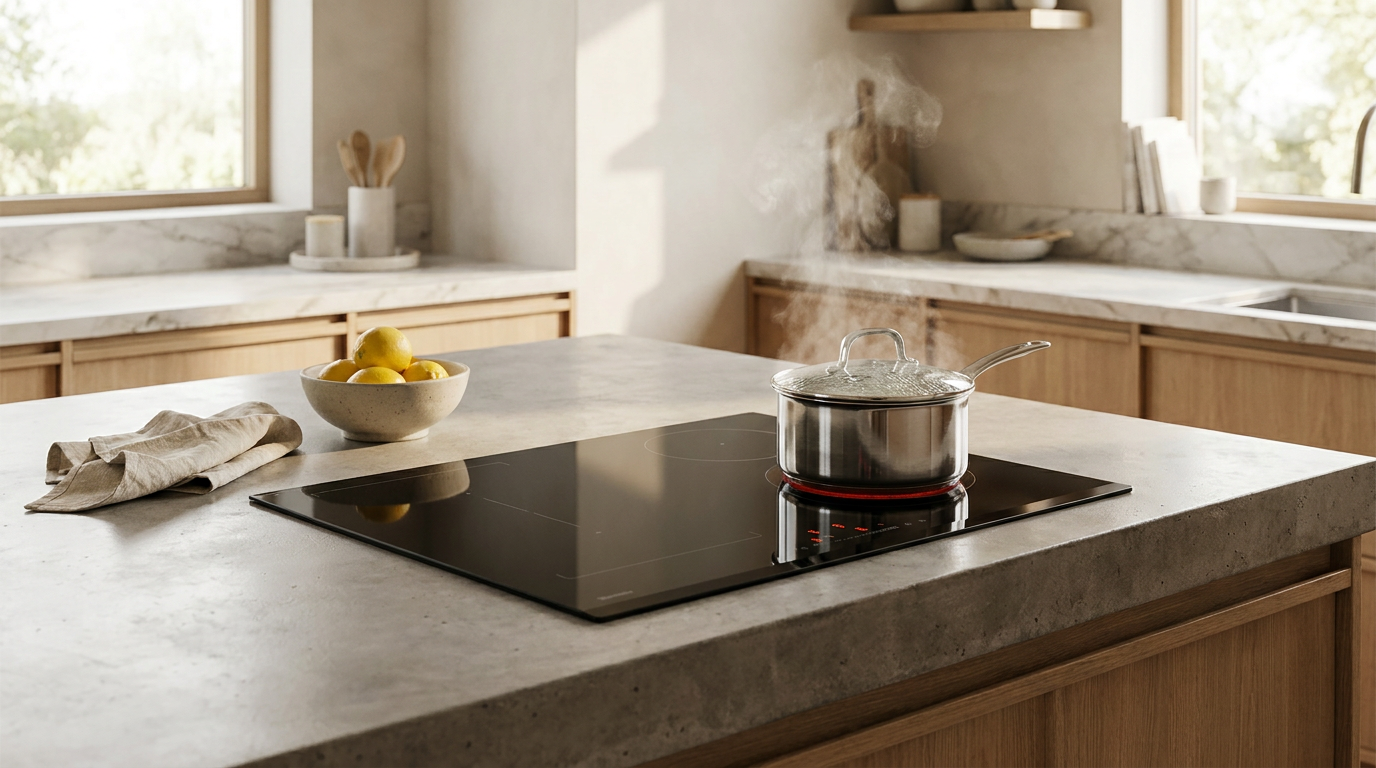
To understand why induction is replacing traditional ranges, you have to look under the glass. Conventional electric stoves rely on thermal conduction: electricity heats a resistive coil, which heats the glass, which eventually heats the pot. Induction bypasses this entirely. Beneath the surface lies a tightly wound coil of copper wire. When powered, it generates a rapidly alternating magnetic field rather than ambient heat.[3][5]

This magnetic field penetrates the bottom of the cookware, inducing swirling electrical currents—known as eddy currents—directly inside the metal of the pan. Because the metal resists this electrical flow, it generates intense heat. In short, the cooktop itself does not get hot; the pan becomes the heater. The glass surface only warms up slightly from the residual heat of the pan resting upon it.[3][5]
This direct energy transfer unlocks unprecedented efficiency. Energy agencies calculate that induction cooking is roughly 90% efficient, meaning almost all the energy consumed goes directly into the food. By contrast, traditional electric resistance stoves hover around 74% efficiency, while gas stoves capture a mere 40%, losing the vast majority of their energy to the surrounding air and unnecessarily heating up the kitchen.[3][5]

For home cooks, this efficiency translates to raw speed. Induction can boil a pot of water 20% to 40% faster than gas or standard electric models. Furthermore, because the energy transfer is instantaneous, temperature control is incredibly precise. Dropping the heat from a rolling boil to a gentle simmer happens the moment you tap the dial, rivaling the responsiveness that chefs have long loved about gas burners.[2][5]
But the most profound catalyst for the induction boom isn't culinary—it's medical. Combusting natural gas indoors releases a cocktail of pollutants, most notably nitrogen dioxide (NO2), which is strongly linked to respiratory issues and childhood asthma. As awareness of indoor air quality grows, public health advocates are increasingly pointing to residential electrification as a necessary medical intervention.[1][7]
But the most profound catalyst for the induction boom isn't culinary—it's medical.
A landmark pilot study led by Columbia University’s Mailman School of Public Health quantified this benefit. Researchers replaced gas stoves with induction models in 20 low-income public housing units in the Bronx. The results were striking: households with induction stoves saw a 56% reduction in average daily NO2 concentrations compared to the control group. Participants reported not only better air quality but reduced anxiety about gas leaks and accidental fires.[1][7]
Safety is another inherent advantage of the technology. Because the glass surface only absorbs residual heat from the pan, it remains significantly cooler than a traditional burner. If a child touches an induction element that is turned on but has no pot on it, nothing happens—the magnetic field requires a compatible metal to generate heat, and most units automatically shut off when the pan is removed.[2][5]
There is, however, a catch: cookware compatibility. Because the system relies entirely on electromagnetism, pots and pans must contain ferromagnetic materials. Cast iron, enameled cast iron, and most stainless steel work perfectly. However, aluminum, copper, and glass will not heat up at all unless they are explicitly manufactured with a specialized magnetic base plate.[2][3]

The easiest way to check your current kitchen arsenal is the "magnet test." If a standard refrigerator magnet sticks firmly to the bottom of a pan, it is ready for induction. If it slides off or barely clings, the pan will remain stone cold on the new stove, meaning an appliance upgrade might also require a cookware upgrade.[2][3]
The primary barrier to universal adoption remains cost. While prices are falling rapidly, induction ranges still carry a premium over basic electric or gas models. Additionally, homes switching from gas may require an electrician to install a dedicated 240-volt circuit to the kitchen, which can add hundreds of dollars to the installation cost.[2]
To bridge this gap, manufacturers are expanding their mid-tier offerings, and portable single-burner induction cooktops—often priced under $100—have become a popular gateway for curious consumers. Meanwhile, federal incentives like the Inflation Reduction Act offer substantial rebates to help offset the upfront costs of home electrification, making the switch more accessible to middle- and low-income households.[4][6]

The market trajectory is clear. The U.S. induction cooktop market is projected to nearly double, reaching $6.7 billion by 2033. With major brands like LG, Samsung, and Whirlpool scaling up production and integrating smart-home features, the technology is rapidly moving from a luxury niche to a mainstream standard in new builds and renovations.[4]
Ultimately, the transition to induction represents a rare technological leap where performance, environmental sustainability, and human health all align perfectly. While the learning curve and initial investment require some adjustment, the reward is a faster, cooler, and significantly cleaner kitchen environment for the long term.[6]
How we got here
Early 1900s
The first patents for induction heating are filed, though the technology remains too expensive for home use.
1970s
Westinghouse introduces the first modern induction cooktop for consumers, but it fails to gain widespread market traction.
2000s
Induction becomes highly popular in Europe and Asia due to high energy costs and smaller kitchen spaces.
2022
The U.S. passes the Inflation Reduction Act, including rebates for household electrification and induction stoves.
2024
U.S. household adoption hits 4.3 million, quadrupling over a four-year period as prices fall and health awareness rises.
Viewpoints in depth
Public Health Advocates
Focus on the elimination of indoor air pollution and respiratory risks.
Medical professionals and environmental justice groups emphasize that combusting natural gas indoors creates harmful levels of nitrogen dioxide (NO2) and particulate matter. They view the transition to induction not merely as a culinary upgrade, but as a critical public health intervention to reduce childhood asthma rates and improve indoor air quality, particularly in poorly ventilated apartments.
Culinary Professionals
Value the precision, speed, and cooler working environment.
While many chefs were historically loyal to the visual feedback of a gas flame, a growing segment of the culinary world is embracing induction. They highlight the technology's ability to boil water in a fraction of the time and its instantaneous temperature adjustments. Furthermore, because induction doesn't heat the surrounding air, it creates a significantly cooler and more comfortable environment in hot, fast-paced commercial kitchens.
Budget-Conscious Consumers
Highlight the financial barriers of upfront costs and electrical upgrades.
Despite the long-term energy savings, many homeowners point to the steep initial price tag as a major hurdle. Beyond the cost of the appliance itself, switching from gas to induction often requires hiring an electrician to run a dedicated 240-volt circuit to the kitchen, which can add hundreds or thousands of dollars to the project. The additional need to replace non-magnetic cookware further inflates the transition cost for many families.
What we don't know
- How quickly the rental housing market will adopt induction technology, given the split incentives between landlords and tenants.
- The long-term lifespan and repair costs of the complex electronic circuit boards in induction ranges compared to simpler gas valves.
- The exact impact widespread induction adoption will have on local electrical grid peak loads during evening cooking hours.
Key terms
- Electromagnetic Induction
- The process of generating an electric current with a magnetic field, used to heat cookware directly.
- Eddy Currents
- Swirling loops of electrical current induced within the metal of a pan, creating the resistance that generates heat.
- Ferromagnetic
- Materials like iron or certain steel alloys that are strongly attracted to magnets, required for induction cooking.
- Nitrogen Dioxide (NO2)
- A harmful indoor air pollutant produced by combusting natural gas, linked to respiratory issues like asthma.
Frequently asked
Do I need to buy all new pots and pans?
Not necessarily. If a magnet sticks firmly to the bottom of your current cookware, it will work on an induction stove. Cast iron and most stainless steel are fully compatible.
Does the glass surface get hot?
The cooktop itself does not generate heat, but it will absorb some residual heat from the hot pan resting on it. It cools down much faster than a traditional electric burner.
Will an induction stove increase my electric bill?
While it uses electricity, its 90% efficiency means it wastes far less energy than traditional stoves. Depending on local utility rates, it often lowers overall cooking energy costs.
Can induction cooktops interfere with pacemakers?
Because they generate electromagnetic fields, manufacturers generally advise individuals with pacemakers to consult their doctor and maintain a safe distance, though modern shielding makes the risks very low.
Sources
Source coverage
7 outlets
4 viewpoints surfaced







[1]Columbia University Mailman School of Public HealthPublic Health Advocates
Switching from Gas to Electric Stoves Cuts Indoor Air Pollution
Read on Columbia University Mailman School of Public Health →[2]Consumer ReportsCulinary & Lifestyle Consumers
Best Induction Ranges Recommended by Consumer Reports
Read on Consumer Reports →[3]Rewiring AmericaEnergy Efficiency Proponents
How induction stoves work
Read on Rewiring America →[4]Astute AnalyticaAppliance Industry Analysts
United States Induction Cooktop Market Set to Reach Valuation of US$ 6,735.67 Million by 2033
Read on Astute Analytica →[5]EECAEnergy Efficiency Proponents
Induction cooktops — energy efficient cooking
Read on EECA →[6]Factlen Editorial TeamAppliance Industry Analysts
Synthesis by Factlen editorial team
Read on Factlen Editorial Team →[7]Energy Research & Social SciencePublic Health Advocates
Out of Gas, In with Justice: Evaluating the benefits of transitioning from gas to induction stoves
Read on Energy Research & Social Science →



Every angle. Every day.
Get shopping stories with full source coverage and perspective breakdowns delivered to your inbox.