
The Rise of Solarpunk: How Literature is Trading Dystopia for Climate Optimism
A growing literary and artistic movement is rejecting apocalyptic doom, instead imagining sustainable, community-driven futures where humanity successfully tackles the climate crisis.
By Factlen Editorial Team
- Solarpunk Authors & Advocates
- View the movement as a necessary psychological tool to combat climate anxiety and inspire real-world sustainable community building.
- Literary Critics
- Analyze the genre as a direct evolutionary response to the fatigue of cyberpunk and dystopian tropes in speculative fiction.
- Cognitive Psychologists
- Emphasize how reading optimistic, character-driven fiction physically alters the brain to increase empathy and social cooperation.
- Climate Realists
- Warn that aesthetic movements must translate into tangible policy and infrastructure, rather than just corporate greenwashing.
What's not represented
- · Fossil Fuel Industry Workers
- · Urban Planners
Why this matters
As climate anxiety rises globally, solarpunk offers a psychological and cultural roadmap for survival, proving that envisioning a better world is the first crucial step toward actually building one.
Key points
- Solarpunk is a literary and art movement imagining a sustainable, renewable-powered future.
- It serves as an optimistic counter-narrative to the dystopian despair of cyberpunk.
- The genre focuses on 'protopia'—societies that are flawed but actively improving.
- Reading optimistic fiction helps combat climate anxiety by providing blueprints for action.
- Neuroscience shows reading character-driven fiction physically increases empathy and social cognition.
- Critics warn the aesthetic must not be co-opted into corporate greenwashing.
For decades, science fiction has sold us the apocalypse. From flooded megacities to scorched wastelands, the dominant vision of the future in popular culture has been one of inevitable collapse. Audiences have been primed with the terrible intuition of how to survive in a Hobbesian, everyone-for-themselves scenario where neighbors slaughter each other for scarce fuel and food.[1][6]
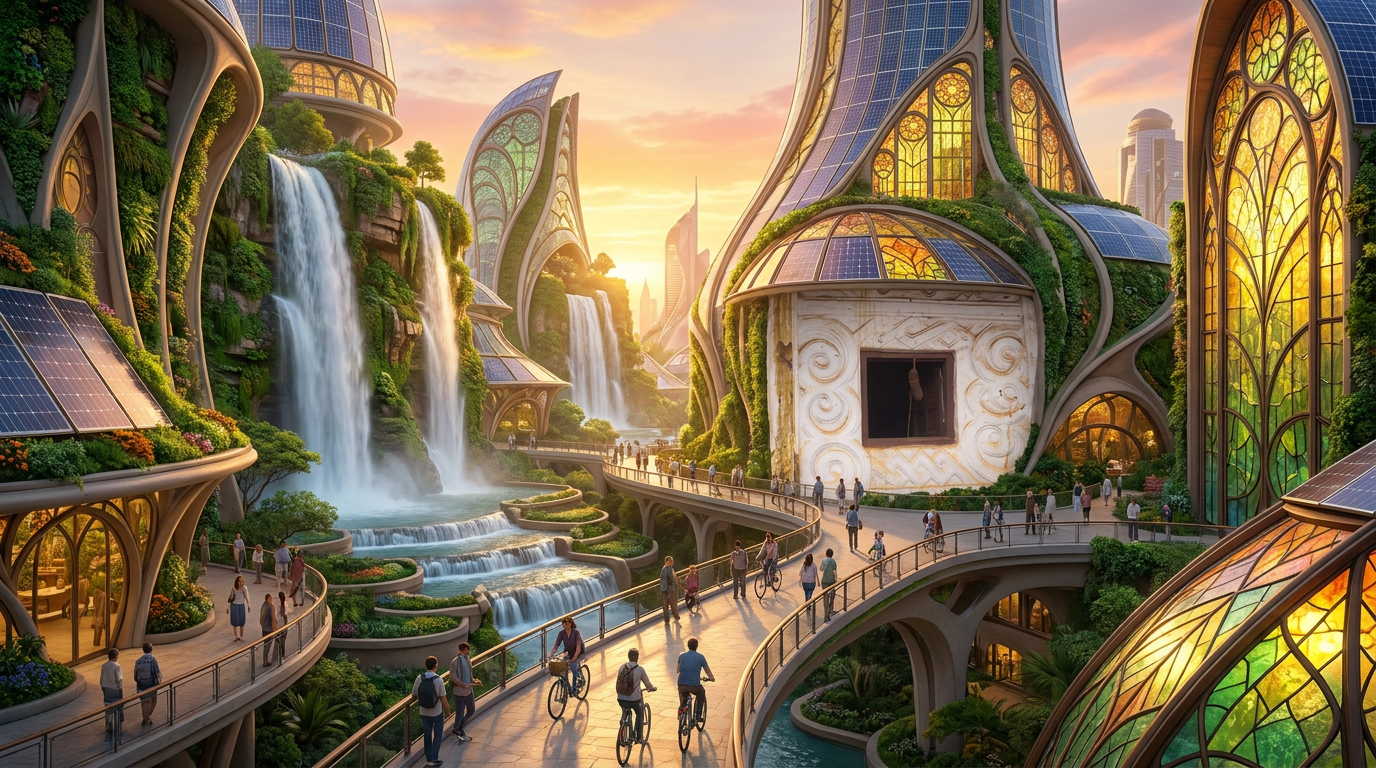
But a growing literary and artistic movement is actively rebelling against this pervasive climate doomerism. It is called "solarpunk," and it poses a radically different question: What if humanity actually gets it right? Instead of reveling in our downfall, this genre asks what a world that seriously tackled climate change would look like, and how we might live in it.[1][5]
Solarpunk is a subgenre of speculative fiction, art, and activism that envisions a sustainable civilization deeply interconnected with nature. The "solar" represents renewable energy and an optimistic vision of the future, while the "punk" signifies a countercultural rebellion against consumer capitalism, systemic inequality, and the paralyzing despair of modern environmental discourse.[2][5]
The origins of the movement trace back to a 2008 blog post inspired by a wind-assisted cargo ship, which made a case for using older technologies like wind and solar to power a modern world. It truly crystallized as a literary genre in Brazil in 2012 with the publication of a short story anthology, and has since blossomed into a global aesthetic popularized by digital artists and speculative fiction authors.[2][5]
Unlike its predecessor, cyberpunk—which features "high tech and low life" in neon-lit, corporate-controlled dystopias—solarpunk imagines "high tech and high nature." It replaces the lone hacker in a dark alley with the community organizer in a solar-powered cooperative. It depicts technology deployed not to conquer nature, but to complement it.[1][5]

However, authors in the space are quick to clarify that solarpunk is not a flawless, magical utopia. It operates on the concept of "protopia"—a society that is not perfect, but is actively working to be incrementally better today than it was yesterday. The characters are flawed, and as one author noted, society has not suddenly become worthy of a frictionless existence.[1][3]
In these stories, human flaws, political disagreements, and logistical challenges still exist. The drama simply shifts from fighting over the last drop of gasoline to negotiating how to equitably distribute resources from a communal desalination plant in Death Valley, or how to manage a cooperative housing unit in a flooded coastal city.[1][3]
In these stories, human flaws, political disagreements, and logistical challenges still exist.
Foundational texts of the genre include Ursula K. Le Guin's "The Dispossessed" and Kim Stanley Robinson's "New York 2140," which imagines a submerged Manhattan where residents form mutual-aid cooperatives. Contemporary authors like Becky Chambers and Sarena Ulibarri have further popularized the genre with cozy, character-driven narratives that focus on healing and adaptation rather than sheer survival.[1][3]

The appeal of these books goes beyond mere escapism; they serve as a psychological antidote to the pervasive sense of helplessness surrounding the climate crisis. Psychologists note that constantly consuming apocalyptic media can lead to paralysis and apathy, making the actual work of environmentalism feel futile.[3][6]
Conversely, reading optimistic fiction provides a cognitive blueprint for action. When readers can vividly imagine a sustainable future, the steps required to achieve it feel more tangible and less overwhelming. It moves the conversation past climate anxiety and into the realm of practical, community-level adaptation.[3][6]
Furthermore, the very act of reading character-driven fiction has been shown to physically alter the brain. Cognitive neuroscientists refer to this as "narrative transportation," where the brain's mirror neuron system activates as if the reader is experiencing the events themselves. The brain essentially rehearses social interactions in a safe environment.[4][6]
Studies demonstrate that individuals who regularly read literary fiction score higher on tests of empathy and social cognition. By simulating the experiences of characters working together to solve ecological problems, readers practice the cooperation, tolerance, and emotional intelligence needed to build resilient communities in the real world.[4][6]

Despite its growing popularity, the movement faces skepticism. Critics question whether an aesthetic heavily popularized by digital art on platforms like Tumblr can translate into meaningful policy changes, infrastructure development, or the dismantling of entrenched fossil-fuel economies.[5][6]
There is also a risk that solarpunk could be co-opted by corporate greenwashing—reduced to slapping solar panels and decorative ivy on luxury skyscrapers without addressing the underlying systemic inequities and consumption habits that the genre fundamentally critiques.[5][6]
Yet, proponents argue that politics is always downstream of culture. Before society can implement sweeping environmental reforms or pass radical climate legislation, the public must first believe that a better world is possible, and they need a shared vocabulary to describe it.[1][6]

By providing a visual language and a narrative framework for a sustainable future, solarpunk literature is doing the vital work of expanding our collective imagination. In a world starved for hope, choosing to envision survival, cooperation, and flourishing might be the most punk rock act of all.[1][5]
How we got here
2008
The term 'solarpunk' is first coined in a blog post inspired by a wind-assisted cargo ship.
2012
The first dedicated solarpunk short story anthology is published in Brazil.
2014
Project Hieroglyph publishes a foundational manifesto outlining the genre's aesthetic and political goals.
2018
The movement gains mainstream literary traction with the publication of English-language anthologies like 'Glass and Gardens'.
2024
Solarpunk officially enters The Encyclopedia of Science Fiction as a recognized subgenre.
Viewpoints in depth
Solarpunk Authors & Advocates
View the movement as a necessary psychological tool to combat climate anxiety.
For creators within the space, solarpunk is much more than an aesthetic; it is a survival mechanism. Authors argue that constantly bombarding the public with apocalyptic scenarios leads to apathy and paralysis. By writing stories where humanity successfully navigates the climate crisis through mutual aid, renewable energy, and community organizing, they provide readers with a tangible blueprint for action. They emphasize that these worlds are not frictionless utopias, but rather 'protopias' where the hard work of maintaining a sustainable society is the central drama.
Literary Critics
Analyze the genre as a direct evolutionary response to the fatigue of cyberpunk.
Literary analysts view solarpunk as a necessary rebellion against the decades-long dominance of cyberpunk and dystopian fiction. Where cyberpunk reflected the anxieties of the 1980s—corporate overreach, digital alienation, and urban decay—solarpunk reflects the anxieties of the 2020s: ecological collapse and social isolation. Critics note that solarpunk flips the script by making community and nature the ultimate rebellion against a hyper-capitalist status quo, though some question whether the genre has yet produced a singular, defining masterpiece on the level of cyberpunk's 'Neuromancer'.
Cognitive Psychologists
Emphasize how reading optimistic fiction physically alters the brain to increase empathy.
Researchers in neuroscience and psychology point to the tangible benefits of consuming character-driven, cooperative fiction. Through a process called 'narrative transportation,' the brain's mirror neuron system activates as if the reader is experiencing the story firsthand. Studies consistently show that readers of literary fiction score higher on empathy and social cognition tests. Psychologists argue that by mentally rehearsing the cooperation and tolerance required in solarpunk narratives, readers become better equipped to handle real-world social and ecological challenges.
Climate Realists
Warn that aesthetic movements must translate into tangible policy and infrastructure.
While acknowledging the psychological benefits of the genre, climate realists and policy experts caution against confusing aesthetic appreciation with actual environmental progress. They warn that solarpunk's popularity on highly visual platforms like Tumblr and Pinterest makes it vulnerable to corporate greenwashing. There is a danger that developers might simply append solar panels and decorative greenery to luxury high-rises, adopting the 'look' of solarpunk while ignoring the movement's core demands for anti-capitalist resource distribution and systemic equity.
What we don't know
- Whether the solarpunk aesthetic will successfully translate into widespread, real-world urban planning and policy changes.
- If the genre will produce a mainstream, breakout cultural phenomenon (like a blockbuster film) that cements it in the broader public consciousness.
- How the movement will protect its core anti-capitalist and community-driven ethos from being co-opted by corporate greenwashing.
Key terms
- Solarpunk
- A literary and artistic movement that envisions a sustainable future interconnected with nature, powered by renewable energy, and driven by community action.
- Protopia
- A state of society that is not a perfect utopia, but is actively and incrementally improving itself every day.
- Cyberpunk
- A science fiction subgenre characterized by a dystopian future with advanced technology but severe social decay and corporate dominance.
- Narrative Transportation
- A psychological phenomenon where a reader becomes so immersed in a story that their brain processes the fictional events and emotions as if they were real.
- Greenwashing
- The practice of making misleading or unsubstantiated claims about the environmental benefits of a product, service, or technology.
Frequently asked
What is the difference between cyberpunk and solarpunk?
Cyberpunk envisions a dystopian future of corporate control, pollution, and extreme inequality. Solarpunk envisions an optimistic future where humanity uses renewable energy and community cooperation to live in harmony with nature.
Is solarpunk just a utopian fantasy?
No. Authors describe it as 'protopia'—a society that isn't perfect and still faces conflicts, but is actively working to be incrementally better and more sustainable than it was yesterday.
How does reading fiction help with climate anxiety?
Psychologists note that constantly consuming apocalyptic media causes paralysis. Optimistic fiction provides a cognitive blueprint for action, making the steps to a sustainable future feel tangible and achievable.
What are some foundational solarpunk books?
Classic precursors include Ursula K. Le Guin's 'The Dispossessed', while modern examples include Kim Stanley Robinson's 'New York 2140' and Becky Chambers' 'A Psalm for the Wild-Built'.
Sources
Source coverage
6 outlets
4 viewpoints surfaced






[1]Mother JonesSolarpunk Authors & Advocates
Solarpunk poses a fascinating question: What would a world that had seriously tackled climate change look like?
Read on Mother Jones →[2]The Indian ExpressLiterary Critics
What is Solarpunk?
Read on The Indian Express →[3]Five BooksSolarpunk Authors & Advocates
The Best Solarpunk Books
Read on Five Books →[4]Discover MagazineCognitive Psychologists
How Reading Fiction Increases Empathy and Encourages Better Behavior
Read on Discover Magazine →[5]WikipediaLiterary Critics
Solarpunk
Read on Wikipedia →[6]Factlen Editorial TeamClimate Realists
Synthesis by Factlen editorial team
Read on Factlen Editorial Team →



Every angle. Every day.
Get culture stories with full source coverage and perspective breakdowns delivered to your inbox.