
The Rise of Local AI: How to Run Language Models on Your Own Device
As artificial intelligence becomes an everyday utility, a new wave of software and hardware is allowing users to run powerful language models directly on their laptops and phones, promising complete privacy and zero subscription fees.
By Factlen Editorial Team

- Privacy Advocates & Enterprise
- Prioritize data sovereignty and view local AI as the only secure way to use language models with sensitive information.
- Open-Source Developers
- Champion the democratization of AI, building tools that allow anyone to tinker with and customize offline models.
- Hardware Manufacturers
- Focus on the architectural shift toward NPUs and high-capacity RAM to drive a new cycle of hardware upgrades.
- Ecosystem Integrators
- Believe the best user experience comes from deeply integrating on-device AI with the operating system for seamless, agentic workflows.
What's not represented
- · Cloud Infrastructure Providers
- · Regulatory Bodies
Why this matters
Running AI locally gives you complete ownership over your data, eliminates monthly subscription costs, and allows you to use powerful digital assistants even when you are completely offline. It represents a shift from renting intelligence from tech giants to owning it on your own hardware.
Key points
- Local AI allows users to run language models directly on their own devices without an internet connection.
- This shift guarantees 100% data privacy, as prompts and files never leave the user's hardware.
- Tools like Ollama and LM Studio have made downloading and running local models as easy as installing an app.
- New Neural Processing Units (NPUs) allow laptops to run AI tasks continuously without draining the battery.
- System memory (RAM) is the primary bottleneck, with 16GB now considered the bare minimum for local AI.
For the past few years, the artificial intelligence revolution has lived almost entirely in the cloud. When a user typed a prompt into a popular chatbot, that text was beamed to massive, energy-hungry server farms hundreds of miles away, processed by supercomputers, and beamed back. But in 2026, a quiet computing shift is bringing that power directly to our desks and pockets. The rise of "Local AI" is transforming how we interact with language models, moving the intelligence from rented remote servers to the silicon inside our own devices.[7]
At its core, local AI refers to running Large Language Models (LLMs) entirely on personal hardware—laptops, desktops, and even smartphones—without requiring an internet connection. Instead of relying on a subscription service provided by a tech giant, users download the model files directly to their machines. This shift is democratizing access to frontier-level technology, allowing anyone with a moderately powerful computer to host their own personal AI assistant.[1][2]
The primary catalyst driving this migration is data privacy. When utilizing cloud-based AI, every prompt, uploaded document, and generated response is transmitted over the internet, often becoming part of a provider's training data or subject to their retention policies. For enterprises handling confidential client data, healthcare professionals managing patient records, or individuals protective of their personal lives, this is a non-starter. Local LLMs solve this by ensuring that sensitive information never leaves the physical device.[2][5]
Beyond privacy, local execution fundamentally changes the economics and reliability of artificial intelligence. Cloud services typically operate on subscription models or charge per token, costs that can compound rapidly for heavy users or automated workflows. Local models, once downloaded, are entirely free to run. Furthermore, because they operate offline, they are immune to server outages, internet dead zones, and the latency inherent in transmitting data back and forth across the web.[2][5]

Making this possible requires shrinking massive neural networks so they can fit onto consumer hardware. This is achieved through a mathematical compression technique known as quantization. By reducing the precision of the model's internal weights—often from 32-bit floating-point numbers down to 8-bit or even 4-bit integers—developers can drastically reduce the memory footprint of an LLM with only a negligible drop in its reasoning capabilities. Thanks to quantization, highly capable models can now run comfortably within 16GB of standard system RAM.[1][7]
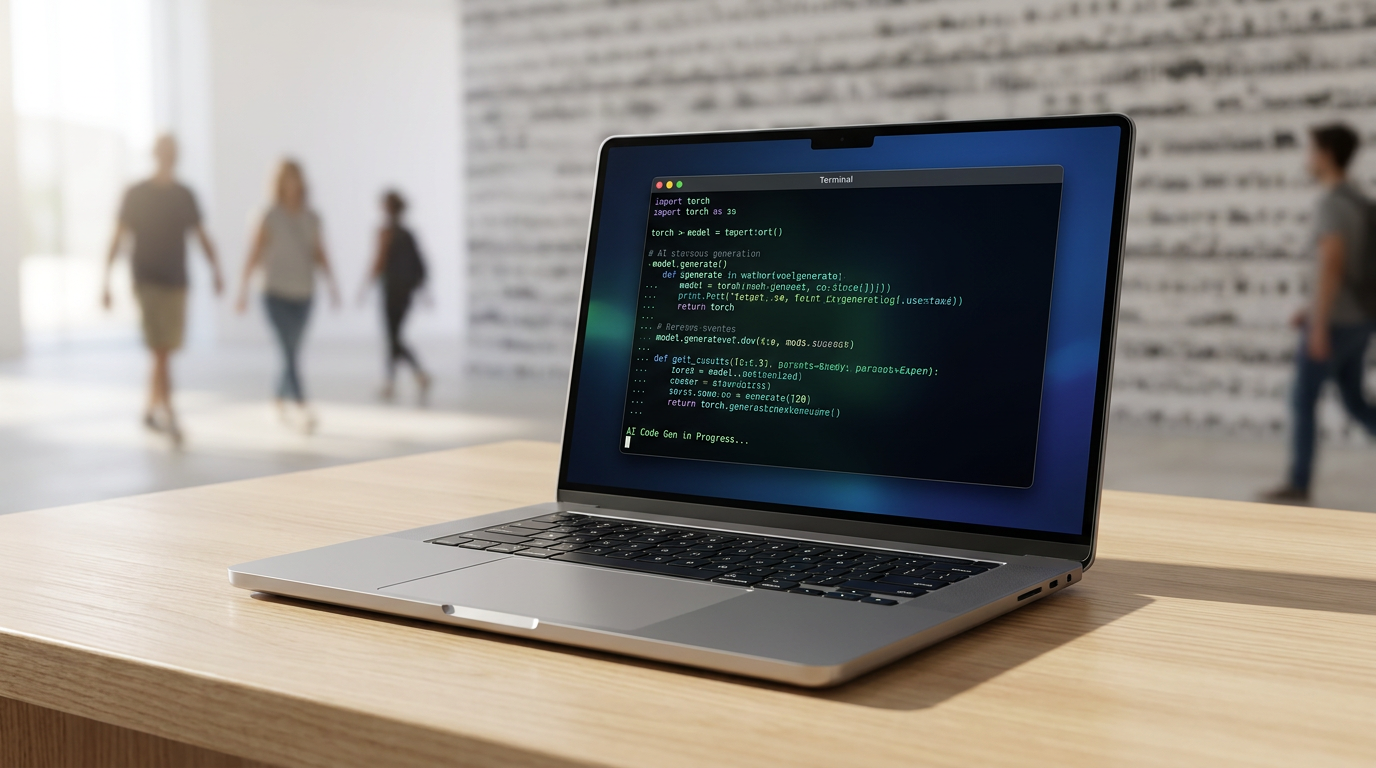
The software ecosystem enabling this local revolution has matured rapidly, transforming what was once a complex developer task into a consumer-friendly experience. Tools like Ollama have become the standard for developers and power users. Operating primarily through a command-line interface, Ollama allows users to download and run optimized models with a single line of code, while also providing a local API that other applications can plug into.[1][6]
For those who prefer a more visual approach, applications like LM Studio have built polished, intuitive graphical interfaces. Functioning much like an app store for AI, LM Studio allows users to browse a vast library of open-weight models, download them with a click, and interact with them in a familiar chat window. It abstracts away the technical friction, making local AI accessible to users who have no desire to open a terminal window.[1][6]

For those who prefer a more visual approach, applications like LM Studio have built polished, intuitive graphical interfaces.
These tools are powered by a new generation of highly efficient, open-weight models released by major research labs. Models like Google's Gemma 4, Meta's Llama 4, and Mistral Large 3 have been engineered specifically to punch above their weight class. A 12-billion parameter model in 2026, running locally on a laptop, can frequently match or exceed the performance of the massive, trillion-parameter cloud models that dominated the industry just two years ago.[1]
But software is only half the equation; the hardware landscape has undergone a radical redesign to support this shift. The traditional central processing unit (CPU) and graphics processing unit (GPU) are now being joined by the Neural Processing Unit (NPU). An NPU is a specialized accelerator designed specifically for the matrix math that underpins neural networks, trading general-purpose versatility for extreme efficiency.[4][5]
The true advantage of the NPU is its performance-per-watt. While a high-end GPU can process AI tasks incredibly fast, it consumes massive amounts of power and generates significant heat. An NPU, by contrast, can run continuous AI workloads—like real-time voice transcription, background noise cancellation, or contextual screen analysis—while sipping battery power. This efficiency is what allows modern laptops to remain intelligent all day without needing to be tethered to a wall outlet.[4][5]
This hardware evolution has sparked an arms race among chipmakers. To qualify for Microsoft's "Copilot+ PC" designation, a Windows laptop must feature an NPU capable of at least 40 Tera Operations Per Second (TOPS). In response, companies like Qualcomm, Intel, and AMD have rapidly iterated their silicon, with 2026 flagship processors routinely pushing past 50 to 80 TOPS, ensuring that local AI features operate seamlessly in the background of the operating system.[4][5]

Apple has taken this hardware-software integration a step further with its Apple Intelligence architecture. Built deeply into iOS and macOS, Apple's approach defaults to on-device processing using its proprietary Neural Engine. The system is designed to understand personal context—reading across messages, calendars, and photos—without exposing that data to the broader internet. When a request is too complex for the local hardware, it securely hands the task off to "Private Cloud Compute" servers, which cryptographically destroy the data immediately after processing.[3]
This deep integration is enabling a shift from "generative" AI to "agentic" AI. Instead of merely answering questions or writing text, local AI assistants are increasingly capable of taking action. A modern on-device assistant can see what is on the screen, understand the user's intent, and execute multi-step workflows across different applications—such as pulling data from an email, formatting it into a spreadsheet, and drafting a reply—all without a human needing to click between windows.[7]
Despite these advancements, local AI still faces physical constraints. The primary bottleneck in 2026 is no longer raw processing power, but memory bandwidth and capacity. Because LLMs must load massive amounts of data into memory to generate each word, systems with 16GB of RAM are now considered the bare minimum, with 32GB or more highly recommended for running larger, more capable models smoothly.[4]

Ultimately, the rise of local AI represents a fundamental shift in digital ownership. As language models become as essential to daily computing as the web browser or the word processor, users are reclaiming control over their data and their digital tools. By moving the intelligence from the cloud to the edge, the tech industry is ensuring that the most powerful software of our generation can be owned, customized, and operated entirely on our own terms.[2][7]
How we got here
Early 2023
Open-source models like LLaMA leak to the public, sparking the initial wave of local AI experimentation.
Late 2023
Tools like Ollama and LM Studio launch, drastically lowering the technical barrier to running models locally.
Mid 2024
Microsoft announces the Copilot+ PC standard, mandating NPUs with at least 40 TOPS for local Windows AI features.
June 2026
Apple unveils its next-generation Apple Intelligence architecture, cementing on-device processing as the industry standard.
Viewpoints in depth
Privacy Advocates & Enterprise
Prioritize data sovereignty and view local AI as the only secure way to use language models with sensitive information.
For organizations handling proprietary code, patient health records, or confidential financial data, the cloud is often a regulatory minefield. Privacy advocates argue that the only way to truly secure data is to ensure it never leaves the physical premises. Local LLMs provide a solution that allows enterprises to leverage the productivity gains of artificial intelligence without violating compliance standards or risking a third-party data breach.
Open-Source Developers
Champion the democratization of AI, building tools that allow anyone to tinker with and customize offline models.
The open-source community views local AI as a necessary counterweight to the centralized power of massive tech corporations. By building tools like Ollama and LM Studio, developers are ensuring that AI remains accessible and customizable. This camp believes that users should have the freedom to inspect, modify, and run models without being subject to the censorship, rate limits, or subscription fees imposed by cloud providers.
Hardware Manufacturers
Focus on the architectural shift toward NPUs and high-capacity RAM to drive a new cycle of hardware upgrades.
For chipmakers and PC manufacturers, the local AI boom is the catalyst for the biggest hardware upgrade cycle in a decade. They emphasize the necessity of Neural Processing Units (NPUs) to handle continuous AI workloads efficiently. This perspective often highlights the physical constraints of computing, pointing out that while software is advancing rapidly, users will ultimately need to invest in machines with 32GB of RAM and 50+ TOPS to unlock the full potential of local models.
Ecosystem Integrators
Believe the best user experience comes from deeply integrating on-device AI with the operating system for seamless, agentic workflows.
Companies like Apple argue that an AI model is only as useful as its context. Rather than treating AI as a standalone chatbot, ecosystem integrators weave intelligence directly into the operating system. By processing data on-device, the AI can safely read a user's screen, cross-reference their calendar, and take actions across multiple apps. When local hardware isn't enough, they advocate for secure, ephemeral cloud compute that cryptographically guarantees privacy.
What we don't know
- Whether local models will ever be able to match the complex, multi-step reasoning capabilities of massive, trillion-parameter cloud models.
- How quickly software developers will adopt and optimize their applications for the fragmented landscape of NPUs from different chipmakers.
Key terms
- Local LLM
- A large language model that runs entirely on a user's personal device rather than on a remote cloud server.
- NPU (Neural Processing Unit)
- A specialized hardware chip designed specifically to accelerate the math required for artificial intelligence tasks efficiently.
- Quantization
- A technique that compresses AI models by reducing the precision of their internal numbers, allowing them to run on consumer hardware with limited memory.
- TOPS (Tera Operations Per Second)
- A metric used to measure the raw computing performance of an NPU.
- Agentic AI
- Artificial intelligence systems designed not just to answer questions, but to take actions and execute multi-step workflows across different applications.
Frequently asked
Do I need an internet connection to use a local LLM?
No. Once the model files are downloaded to your device, the AI runs entirely offline, ensuring complete privacy and accessibility anywhere.
Can my current laptop run local AI?
It depends on your system memory. Most modern local LLMs require at least 16GB of RAM to run smoothly, and ideally a dedicated GPU or a modern NPU.
Is local AI as smart as cloud-based ChatGPT?
While massive cloud models still hold an edge in complex reasoning, optimized local models in 2026 can match the performance of flagship cloud models from just a year or two ago.
What is an NPU?
A Neural Processing Unit (NPU) is a specialized hardware chip designed specifically to accelerate the math required for AI tasks efficiently, saving battery life.
Sources
Source coverage
7 outlets
4 viewpoints surfaced







[1]PinggyOpen-Source Developers
Top 5 Local LLM Tools in 2026
Read on Pinggy →[2]DataNorthPrivacy Advocates & Enterprise
Local LLM: Privacy, Security, and Control
Read on DataNorth →[3]AppleEcosystem Integrators
Apple introduces the next generation of Apple Intelligence
Read on Apple →[4]Ordinary TechHardware Manufacturers
The battle between NPUs and GPUs for AI computing
Read on Ordinary Tech →[5]JacarHardware Manufacturers
The NPU Landscape in 2026: Apple, Qualcomm, Intel, and AMD
Read on Jacar →[6]CorsairOpen-Source Developers
Ollama vs LM Studio: Which Local AI Tool is Best?
Read on Corsair →[7]Factlen Editorial TeamPrivacy Advocates & Enterprise
Synthesis by Factlen editorial team
Read on Factlen Editorial Team →

More in ai
See all 133 stories →EU AI Act
Global Tech Faces Operational Reckoning as EU AI Act's August 2026 Deadline Looms
8 sources

Clinical AI
Healthcare's New AI Breakthrough Focuses on Fixing Fragmented Patient Records
6 sources

Embodied AI
How End-to-End Neural Networks Are Giving Humanoid Robots the Gift of General Intelligence
6 sources

On-Device AI
The Rise of Local AI: Running ChatGPT-Level Models on Your Own Machine
9 sources
Every angle. Every day.
Get ai stories with full source coverage and perspective breakdowns delivered to your inbox.