
The Rise of Local AI: How to Run Frontier Models on Your Own Hardware
As cloud AI subscriptions multiply and privacy concerns grow, a new ecosystem of hyper-optimized, open-source models is turning consumer laptops and smartphones into private AI servers.
By Factlen Editorial Team
- Privacy Advocates & Enterprise
- Prioritize local models to ensure sensitive data never leaves their control.
- Open-Source Developers
- Value the freedom to customize, tinker, and build without vendor lock-in.
- Hardware Realists
- Acknowledge the physical limitations and hidden costs of running AI locally.
What's not represented
- · Cloud AI Providers
- · Cybersecurity Threat Analysts
Why this matters
Running AI locally eliminates monthly subscription fees, allows you to work completely offline, and guarantees that your sensitive data—from proprietary code to personal journals—never touches a corporate server.
Key points
- Local AI models run entirely on your own device, requiring no internet connection after the initial download.
- Because prompts never leave the machine, local LLMs offer absolute data privacy for sensitive information.
- Tools like LM Studio and Ollama have made installing and running models as easy as downloading a standard app.
- Quantization compresses model weights, allowing 7-billion parameter models to run on laptops with just 8 GB of RAM.
- Flagship smartphones now feature dedicated neural processors to run smaller 1B-3B models efficiently on the edge.
For the past three years, the artificial intelligence boom has been fundamentally tethered to the cloud. Using a frontier model meant renting compute power from a tech giant, sending your prompts to a remote server, and paying either a monthly subscription or a per-token API fee. But in 2026, a quiet revolution is maturing: the rise of local, on-device AI. Driven by hyper-optimized open-source models and consumer hardware that increasingly features dedicated neural processing units, users are cutting the cord. They are downloading large language models (LLMs) directly to their laptops and smartphones, transforming everyday devices into private AI servers.[1][2]
The appeal of local AI rests on three pillars: absolute privacy, zero ongoing costs, and offline availability. When an LLM runs locally, the inference—the actual mathematical calculation that generates a response—happens entirely on the user's silicon. Prompts never leave the machine, meaning sensitive corporate data, proprietary code, or deeply personal questions are never logged by a third party. For enterprise users and privacy advocates, this is not just a feature; it is a strict requirement for adopting AI in regulated industries.[1][2][6]
Financially, the local approach flips the AI business model. Cloud APIs charge for every word read and written, creating a metering effect that discourages heavy, automated use. Local models require an upfront investment in capable hardware—specifically, machines with ample RAM and Video RAM (VRAM)—but once the hardware is acquired, the marginal cost of generating a million tokens drops to the price of the electricity required to run the processor. Developers can set up autonomous agents to process thousands of documents overnight without fear of hitting a rate limit or incurring a massive API bill.[2][4]

Making this possible requires a software layer that bridges the gap between complex neural network weights and the average computer user. Two dominant tools have emerged to solve this: Ollama and LM Studio. While they achieve the same goal, they represent different philosophies of software design. Ollama began as a streamlined, command-line tool beloved by developers. It runs as a background service, allowing builders to easily call local models from their own code via an API that mimics cloud providers. It is the engine of choice for those looking to integrate AI into automated workflows.[3]
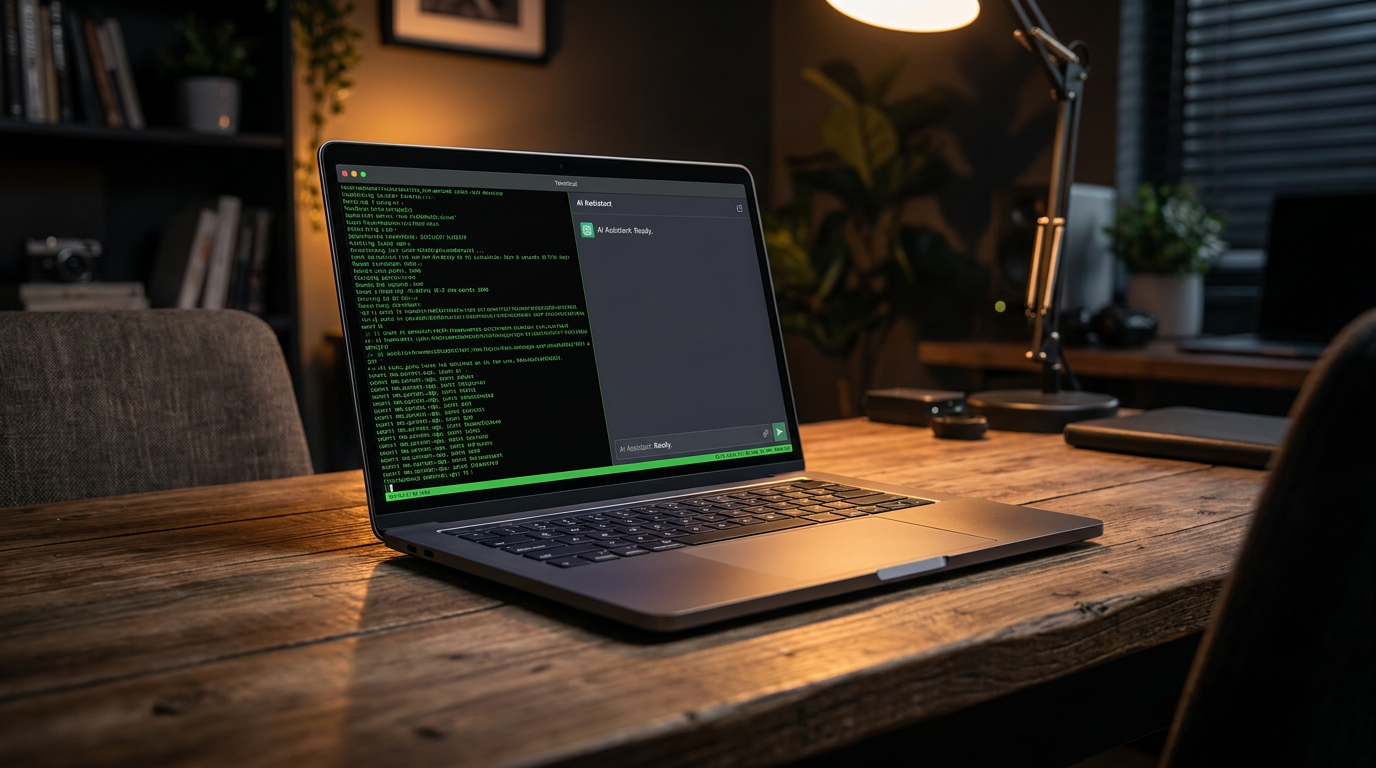
LM Studio, conversely, was built for discovery. It offers a polished graphical user interface where users can browse, download, and chat with models as easily as installing an app from a digital storefront. It abstracts away the technical friction, providing sliders for system parameters and a familiar chat window. As the ecosystem has matured in 2026, the two tools have begun to converge—Ollama now offers desktop interfaces, and LM Studio features a headless server mode—but together, they have permanently lowered the barrier to entry for local AI.[3]
It offers a polished graphical user interface where users can browse, download, and chat with models as easily as installing an app from a digital storefront.
The models themselves have undergone a radical diet to fit onto consumer hardware. A raw, uncompressed language model requires massive amounts of memory. To solve this, researchers rely on "quantization"—a compression technique that reduces the mathematical precision of the model's weights. By dropping from 16-bit to 4-bit precision, a model's memory footprint is slashed by more than half, with only a negligible drop in reasoning quality. Thanks to quantization, a highly capable 7-billion parameter model can now run comfortably on a machine with just 8 GB of RAM, utilizing roughly 4 to 5 GB of VRAM.[4]

The landscape of open-weight models in 2026 is fiercely competitive, providing users with a menu of specialized options. Meta's Llama ecosystem remains the baseline workhorse, with its smaller variants offering robust general-purpose chat. Mistral continues to dominate the European market, offering models that excel in enterprise data residency and agentic workflows. Meanwhile, Alibaba's Qwen family and Google's Gemma models provide exceptional coding and multilingual capabilities. Users with high-end rigs—such as 24 GB GPUs or Apple Silicon Macs with unified memory—can run massive models that rival the reasoning capabilities of GPT-4 class systems.[2][4][7]
This localization trend is not limited to desktop computers. The smartphone industry has aggressively pivoted toward "Edge AI." Modern flagship phones from Apple, Google, and Samsung now feature dedicated neural processing units (NPUs) designed specifically to accelerate machine learning tasks without draining the battery. For these devices, the sweet spot is models ranging from 1 billion to 3 billion parameters. A 3B model, quantized to 4-bit, takes up roughly 2 GB of storage and can run entirely in airplane mode, providing instant summarization, translation, and writing assistance on the go.[5]

Despite the rapid advancements, local AI is not without its physical constraints. Running complex inference on a laptop generates significant heat and drains battery life rapidly. The hardware requirements for the absolute largest open-source models—those exceeding 70 billion parameters—still demand multi-GPU setups that cost thousands of dollars, keeping the true cutting-edge of AI research firmly in the data center. Furthermore, local models shift the burden of security and content moderation entirely onto the user, bypassing the safety guardrails enforced by cloud providers.[1][4]
Yet, for a growing segment of the population, the trade-offs are overwhelmingly worth it. The democratization of AI means that intelligence is no longer a service you rent, but a tool you own. Whether it is a developer testing code on a cross-country flight, a small business processing sensitive client data without compliance fears, or an enthusiast simply wanting an uncensored brainstorming partner, local LLMs have proven that the future of computing will be distributed, private, and deeply personal.[1][6]
How we got here
Early 2023
The release of LLaMA weights sparks a grassroots movement to run large language models on consumer hardware.
Late 2023
Tools like Ollama and LM Studio launch, abstracting away the complex command-line setups required for local inference.
2024
Meta releases the Llama 3 family, including highly capable 8B models that set a new standard for laptop-grade AI.
2025
Smartphone manufacturers begin integrating dedicated Neural Processing Units (NPUs) to handle on-device AI tasks.
2026
Quantization techniques mature, allowing frontier-class models to run efficiently on standard 16GB consumer laptops.
Viewpoints in depth
Privacy Advocates & Enterprise
Prioritize local models to ensure sensitive data never leaves their control.
For corporate IT departments, healthcare providers, and privacy-conscious individuals, cloud AI presents a massive data liability. Sending proprietary code, patient records, or internal strategy documents to a third-party API violates strict compliance frameworks. This camp views local LLMs as the only viable path to enterprise AI adoption. By running open-source models on internal, air-gapped servers or employee laptops, they guarantee that their data cannot be used to train future commercial models or be intercepted in transit.
Open-Source Developers
Value the freedom to customize, tinker, and build without vendor lock-in.
The developer community champions local AI for its flexibility and lack of restrictions. Cloud APIs are subject to rate limits, sudden deprecations, and restrictive content filters that can break automated workflows. By using tools like Ollama and Llama.cpp, developers can fine-tune models on their own datasets, adjust system prompts at the granular level, and build autonomous agents that run 24/7 without incurring thousands of dollars in API fees. For them, local AI is about owning the infrastructure.
Hardware Realists
Acknowledge the physical limitations and hidden costs of running AI locally.
While enthusiastic about the technology, hardware analysts point out that 'free' AI comes with significant physical overhead. Running continuous inference on a laptop maxes out the GPU, generating intense heat and rapidly draining the battery. Furthermore, to run the truly elite 70B+ parameter models that rival GPT-4, users must invest in expensive multi-GPU desktop rigs or high-end Apple Silicon Macs. This camp argues that for the average consumer, the convenience and superior reasoning of cloud AI will often outweigh the benefits of local hosting.
What we don't know
- How quickly consumer hardware will evolve to run massive 100B+ parameter models natively without multi-GPU setups.
- Whether open-source models will continue to match the reasoning capabilities of heavily funded, closed-source cloud models.
- How mobile operating systems will balance the severe battery drain associated with continuous on-device AI processing.
Key terms
- Local LLM
- A large language model that is downloaded and executed entirely on your own computer or phone, rather than accessed via a cloud server.
- Quantization
- A mathematical compression technique that reduces the precision of an AI model's weights, allowing it to fit into consumer memory with minimal quality loss.
- VRAM (Video RAM)
- The dedicated memory on a graphics card, which is crucial for loading and running AI models quickly.
- Inference
- The computational process where an AI model analyzes a prompt and generates a response.
- Parameters
- The neural connections within an AI model; generally, a higher parameter count indicates better reasoning but requires more memory to run.
- Edge AI
- Artificial intelligence processing that occurs directly on a local device, like a smartphone or IoT sensor, rather than in a centralized data center.
Frequently asked
Do I need an internet connection to use a local AI?
No. You only need the internet to download the model and the software initially. Once installed, the AI runs entirely offline.
Is a local AI as smart as cloud-based models like ChatGPT?
It depends on your hardware. Massive local models (like Llama 4 70B) rival top cloud models, but smaller models designed for standard laptops are closer to GPT-3.5 in capability.
Can I run these models on a Mac?
Yes. Apple Silicon (M-series chips) is highly efficient for local AI because it uses unified memory, allowing the GPU to access large amounts of system RAM.
Are local AI models free to use?
Yes. The open-source models and software are free. Your only cost is the initial purchase of your computer hardware and the electricity required to run it.
Sources
Source coverage
7 outlets
3 viewpoints surfaced







[1]Factlen Editorial TeamPrivacy Advocates & Enterprise
Synthesis by Factlen editorial team
Read on Factlen Editorial Team →[2]OverchatHardware Realists
What Is a Local LLM? The Best Local Models in 2026
Read on Overchat →[3]MediumOpen-Source Developers
Ollama vs LM Studio: Running Large Language Models Locally
Read on Medium →[4]PromptQuorumOpen-Source Developers
Best Local LLMs May 2026: Ollama, LM Studio, Hardware & VRAM Guide
Read on PromptQuorum →[5]CoticsyHardware Realists
The Best AI Models for On-Device, Real-Time, and Offline Use on Phones
Read on Coticsy →[6]MetaPrivacy Advocates & Enterprise
How Llama is helping to spur economic growth in the US
Read on Meta →[7]MindStudioPrivacy Advocates & Enterprise
Mistral vs Llama: Enterprise AI Agents
Read on MindStudio →

More in ai
See all 7 stories →Edge AI
How On-Device AI and Quantization Are Moving LLMs Out of the Cloud
6 sources

Agentic AI
Agentic AI: How Large Action Models Are Automating Digital Chores
7 sources

Global AI Governance
EU Delays Key AI Act Enforcement as 'Brussels Effect' Fractures Under US Deregulation
8 sources

Drug Discovery
New AI Model Accelerates Molecular Simulations 10,000-Fold, Promising Faster Drug Discovery
6 sources

Every angle. Every day.
Get ai stories with full source coverage and perspective breakdowns delivered to your inbox.