
The Rise of Local AI: How Small Language Models Are Democratizing Artificial Intelligence
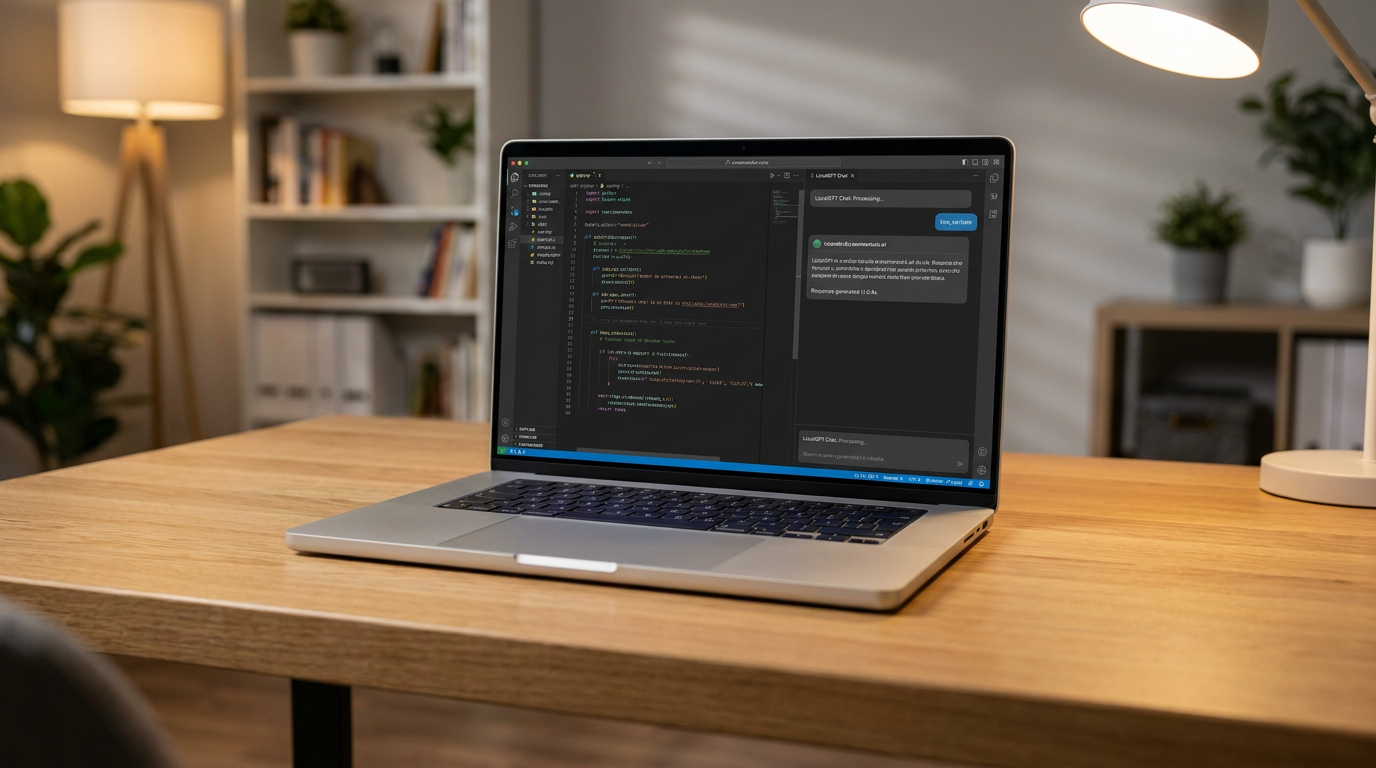
Advances in compact, highly efficient AI models are allowing users to run powerful artificial intelligence entirely offline on standard consumer laptops.
By Factlen Editorial Team
- Privacy & Open-Source Advocates
- Argue that AI must be decentralized and run on user-owned hardware to prevent corporate surveillance and data harvesting.
- Enterprise Efficiency Seekers
- Value SLMs primarily for their cost-saving potential, allowing companies to deploy AI at scale without paying exorbitant API fees.
- Frontier AI Labs
- View SLMs as highly useful edge components, but maintain that massive cloud models are still required for complex reasoning and general intelligence.
What's not represented
- · Hardware manufacturers benefiting from the push for AI-capable consumer devices
- · Cloud providers facing potential revenue loss from edge computing shifts
Why this matters
By running AI models directly on your own hardware, you gain access to powerful coding, writing, and reasoning assistants without paying monthly subscription fees or surrendering your private data to cloud providers.
Key points
- Small Language Models (SLMs) can now run entirely offline on standard consumer laptops with 8GB of RAM.
- Local execution guarantees 100% data privacy, as prompts and documents never leave the user's device.
- Running AI locally eliminates recurring API subscription costs and network latency.
- Tools like Ollama and LM Studio have made installing and running local AI as simple as downloading a web browser.
- While excellent at reasoning and coding, SLMs lack the deep encyclopedic knowledge of massive cloud models.
For the past three years, the artificial intelligence narrative has been dominated by massive, cloud-hosted behemoths. Models with hundreds of billions of parameters, locked behind corporate APIs and requiring warehouse-sized data centers to operate, have defined the bleeding edge of technology. But in 2026, a quiet counter-revolution has reached maturity. The focus has shifted from the sheer scale of the cloud to the localized efficiency of the edge, driven by a new class of algorithms known as Small Language Models (SLMs).[7]
Small Language Models typically range from 135 million to roughly 10 billion parameters—a fraction of the size of frontier models like GPT-4. Despite their compact footprint, these models are no longer mere toys or experimental novelties. Advances in training techniques, particularly the use of highly curated, textbook-quality synthetic data, have allowed SLMs to punch far above their weight class. They are now capable of executing complex reasoning, coding, and natural language tasks with a proficiency that rivals the massive cloud models of just a few years ago.[1][3][4]
The most profound consequence of this compression is where these models can live. Instead of relying on a continuous internet connection and a paid subscription to a cloud provider, users can now download an SLM for free and run it entirely on consumer hardware. A standard laptop with 8 gigabytes of unified memory or a dedicated graphics card is now a fully capable AI server. This shift democratizes access to generative AI, moving the locus of compute power from centralized server farms directly onto the user's desk.[4][6][7]

For many users and enterprises, the primary catalyst for adopting local AI is absolute privacy. When interacting with a cloud-based model, every prompt, document, and line of code is transmitted over the internet to a third-party server. Local SLMs operate in a completely offline environment. Because the model weights reside on the user's hard drive, the data never leaves the device. This air-gapped architecture provides a definitive solution for handling sensitive corporate data, proprietary codebases, and personal information without violating compliance frameworks like GDPR.[5][6]
Beyond privacy, local execution fundamentally alters the economics and physics of AI usage. Cloud APIs charge by the token, creating a recurring cost that scales with usage. Local models, once downloaded, are entirely free to run, eliminating the financial friction of continuous AI assistance. Furthermore, because the processing happens on the device's own silicon, users bypass network latency entirely. The result is instantaneous text generation, a critical requirement for real-time applications like coding assistants and smart home automation.[2][6]
The hardware capability alone would not have sparked this adoption without a parallel revolution in user-friendly software. In the early days of open-source AI, running a model locally required navigating complex Python environments, managing dependencies, and manually configuring hardware acceleration. Today, tools like Ollama and LM Studio have abstracted away that friction, making local AI as easy to install as a web browser.[5][7]
The hardware capability alone would not have sparked this adoption without a parallel revolution in user-friendly software.
Ollama has emerged as the developer standard for local inference. Operating much like Docker does for software containers, Ollama packages the model weights, configuration files, and system prompts into a single, easily manageable file. With a single command-line instruction, users can pull a model from a central registry and instantly spin up a local REST API. This allows developers to seamlessly swap out cloud APIs for local models in their existing applications without rewriting their code.[2][6]

For non-technical users, LM Studio provides a polished graphical interface that removes the command line entirely. Users can search for models, download them with a click, and interact through a familiar chat window. The software automatically detects the system's hardware, allocates the appropriate amount of memory, and optimizes the model for the specific CPU or GPU available, bridging the gap between complex machine learning architecture and everyday utility.[5][7]
The models powering this ecosystem are fiercely competitive. Microsoft's Phi-3 family has become a benchmark for efficiency. The Phi-3 Mini, with just 3.8 billion parameters, was trained on a meticulously filtered dataset designed to mimic the clarity of educational textbooks. As a result, it frequently outperforms models twice its size on logic and reasoning benchmarks, and can even run smoothly on smartphones and single-board computers like the Raspberry Pi.[1]
Meta's Llama 3 (8B) serves as the generalist powerhouse of the open-source community. Trained on a massive 15 trillion tokens, it offers a wider breadth of conversational fluency and multilingual support, acting as a versatile tool for everything from creative writing to complex coding. Meanwhile, Alibaba's Qwen series and Google's Gemma models have introduced lightweight multimodal capabilities, allowing small local models to process and understand images alongside text without overwhelming the host machine's memory.[3][4]

The technical magic that makes this possible is a process called quantization. In their raw state, AI models use high-precision numbers that consume massive amounts of memory. Quantization compresses these numbers—often down to 4-bit precision—drastically reducing the model's file size and memory footprint. While this compression discards some mathematical precision, the practical impact on the model's output quality is remarkably minimal, allowing a 16-gigabyte model to comfortably fit into 4 gigabytes of RAM.[4][5]
However, the shift to local SLMs is not without trade-offs. While small models excel at reasoning, formatting, and coding, they lack the vast, encyclopedic knowledge embedded in massive cloud models. If asked to recall an obscure historical fact or summarize a niche topic not heavily represented in their curated training data, SLMs are more prone to hallucination. They are best utilized as processing engines for data provided by the user—such as summarizing a local document—rather than as omniscient search engines.[1][3][7]
Recognizing these limitations, the industry is moving toward a hybrid architecture. In this paradigm, a local SLM acts as the first line of defense, handling 90% of routine tasks—drafting emails, formatting data, and answering basic queries—instantly and privately. Only when a prompt requires complex, multi-step reasoning or deep domain knowledge does the system route the request to a massive cloud model.[4][7]

The maturation of Small Language Models represents a fundamental democratization of artificial intelligence. By decoupling advanced reasoning capabilities from expensive cloud infrastructure, open-source developers have ensured that the future of AI is not solely controlled by a handful of massive tech conglomerates. Instead, it is becoming a decentralized, private, and ubiquitous tool, running quietly and efficiently on the devices we already own.[6][7]
Viewpoints in depth
Privacy & Open-Source Advocates
Argue that AI must be decentralized and run on user-owned hardware to prevent corporate surveillance.
For privacy advocates and open-source developers, the rise of local AI is a necessary defense against the centralization of power by massive tech conglomerates. They argue that sending personal journals, proprietary corporate code, or sensitive patient data to a cloud provider's API creates unacceptable security risks. By running models locally via tools like Ollama, users reclaim data sovereignty. This camp views open-source SLMs not just as a technological convenience, but as a fundamental requirement for ensuring AI remains a democratic tool rather than a mechanism for corporate surveillance and data harvesting.
Enterprise Efficiency Seekers
Value SLMs primarily for their cost-saving potential and ability to scale without API fees.
Enterprise IT leaders and startup founders view Small Language Models through the lens of unit economics. Relying entirely on frontier cloud models like GPT-4 for every automated task quickly becomes prohibitively expensive due to per-token pricing. This camp advocates for a hybrid or fully local approach, where highly capable 8B parameter models handle the vast majority of routine tasks—such as log analysis, basic customer service routing, and internal document summarization—for free. By deploying SLMs on edge devices or internal company servers, businesses can scale their AI operations infinitely without watching their cloud bills skyrocket.
Frontier AI Labs
Maintain that massive cloud models are still required for complex reasoning and general intelligence.
Researchers at major AI laboratories acknowledge the utility of SLMs for edge computing and simple tasks, but they caution against viewing them as a complete replacement for massive cloud infrastructure. This camp points out that while a 3.8B parameter model can format a JSON file or write a Python script flawlessly, it lacks the emergent reasoning capabilities, deep encyclopedic knowledge, and cross-domain synthesis found in models with hundreds of billions of parameters. They argue the future is a tiered ecosystem, where local models act as the interface, but the cloud remains the ultimate engine for solving humanity's most complex problems.
What we don't know
- Whether hardware manufacturers will standardize dedicated neural processing units (NPUs) to make local AI even faster on entry-level machines.
- How cloud providers will adjust their API pricing models to compete with the zero-marginal-cost reality of local open-source AI.
Key terms
- Small Language Model (SLM)
- A compact AI model, typically under 10 billion parameters, designed to run efficiently on consumer hardware rather than massive cloud servers.
- Quantization
- A compression technique that reduces the memory footprint of an AI model by lowering the mathematical precision of its weights, allowing it to run on standard laptops.
- VRAM (Video RAM)
- The memory on a graphics card (GPU) used to load and run AI models quickly.
- Inference
- The process of an AI model generating a response, prediction, or block of text based on a user's prompt.
Frequently asked
Can I run these models on my current laptop?
Yes, if your laptop has at least 8GB of unified memory or VRAM, you can run 3B to 8B parameter models smoothly using free tools like LM Studio or Ollama.
Are small models as smart as ChatGPT?
They excel at specific tasks like coding, summarizing, and basic reasoning, often matching older large models. However, they lack the broad encyclopedic knowledge of massive cloud models and may struggle with obscure facts.
Is my data safe when using local AI?
Yes. Because the model runs entirely on your own hardware, your prompts, documents, and code never leave your device, ensuring 100% privacy.
What is the difference between Ollama and LM Studio?
Ollama is a command-line tool favored by developers for integrating AI into applications, while LM Studio provides a graphical user interface that makes it easy for beginners to download and chat with models.
Sources
Source coverage
7 outlets
3 viewpoints surfaced







[1]MicrosoftFrontier AI Labs
Phi-3: Introducing Microsoft's Small Language Models
Read on Microsoft →[2]OllamaPrivacy & Open-Source Advocates
Ollama - Official Homepage
Read on Ollama →[3]BentoMLEnterprise Efficiency Seekers
The Best Open-Source Small Language Models (SLMs) in 2026
Read on BentoML →[4]Local AI MasterEnterprise Efficiency Seekers
Best Small Language Models 2026: 12 SLMs Ranked for 8GB RAM
Read on Local AI Master →[5]arXiv
Digital Forensics of Local LLMs: Artifact Analysis of Ollama and LM Studio
Read on arXiv →[6]CohortePrivacy & Open-Source Advocates
Run LLMs Locally with Ollama: Privacy-First AI for Developers in 2025
Read on Cohorte →[7]Factlen Editorial Team
Synthesis by Factlen editorial team
Read on Factlen Editorial Team →

More in ai
See all 5 stories →Frontier Models
The Great American AI Act of 2026: Evidence Pack on Congress's Frontier Model Play
7 sources

AI Reasoning
The End of Instant AI: How 'Test-Time Compute' is Teaching Models to Think Before They Speak
6 sources

Neuroprosthetics
How AI and Neural Interfaces Are Rewiring Human Mobility
8 sources

Every angle. Every day.
Get ai stories with full source coverage and perspective breakdowns delivered to your inbox.