
The Rise of Local AI: How Running LLMs on Your Own Device Became the Standard
Driven by privacy concerns, rising cloud costs, and powerful new hardware, running artificial intelligence entirely on personal devices has shifted from a developer niche to a mainstream consumer reality.
By Factlen Editorial Team
- Privacy & Open-Source Advocates
- Value data sovereignty, uncensored models, and the ability to run AI without corporate oversight.
- Enterprise IT & Security
- Focus on GDPR compliance, protecting proprietary code, and eliminating unpredictable cloud API costs.
- Hardware Enthusiasts
- Focus on optimizing VRAM, benchmarking NPUs, and pushing consumer silicon to its absolute limits.
What's not represented
- · Cloud AI Providers
- · Non-technical consumers without modern hardware
Why this matters
Running AI locally gives you absolute control over your data, eliminates monthly subscription fees, and allows you to use powerful tools offline. It represents a massive democratization of technology, putting enterprise-grade intelligence directly into the hands of everyday users.
Key points
- Local AI allows users to run powerful language models entirely on their own devices without an internet connection.
- Quantization techniques shrink massive models by up to 75%, making them viable for consumer laptops and desktops.
- Running AI locally ensures absolute data privacy, making it ideal for healthcare, legal, and proprietary coding work.
- User-friendly tools like LM Studio and Ollama have eliminated the need for complex command-line setups.
- VRAM is the most critical hardware component for local AI, with 16GB acting as the recommended baseline for desktop users.
- The integration of Neural Processing Units (NPUs) in 2026 has drastically improved the battery efficiency of running AI on laptops.
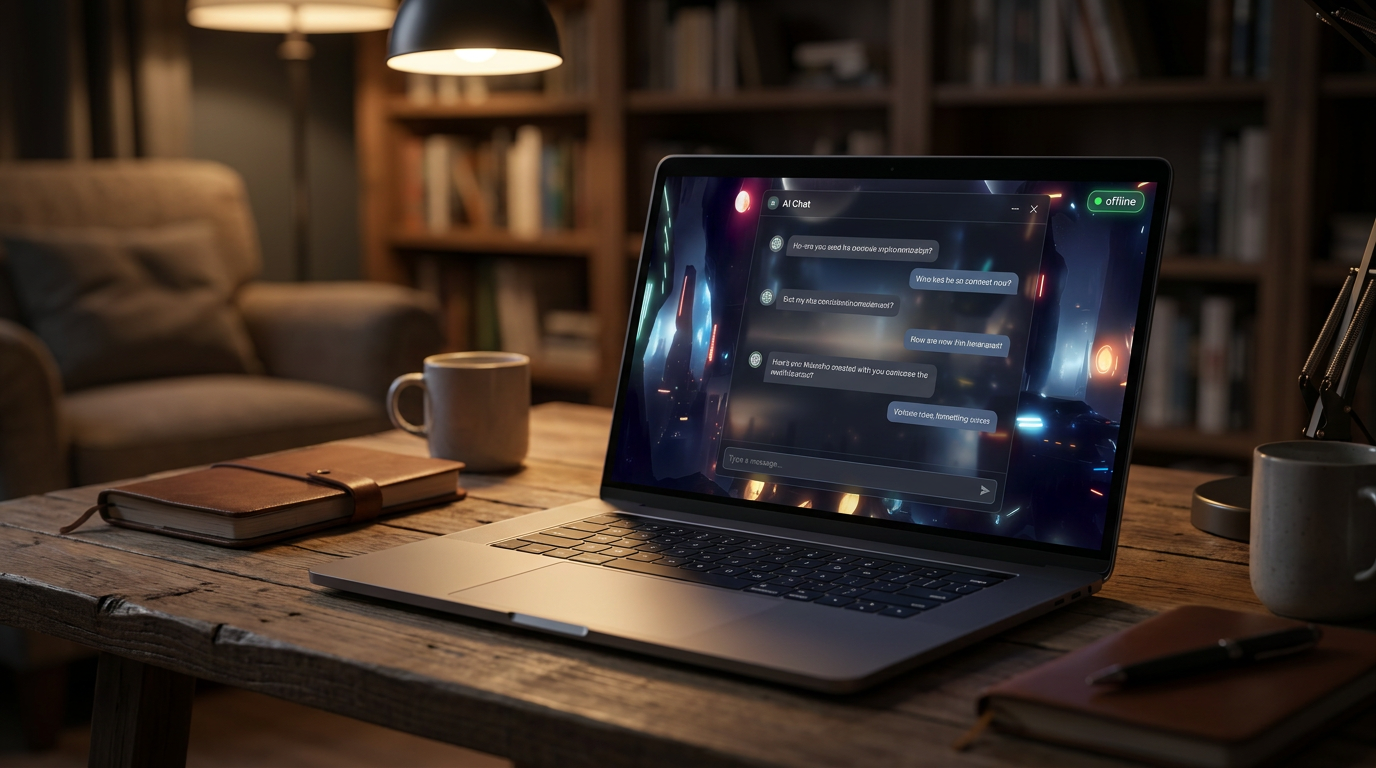
For the past three years, using artificial intelligence meant renting someone else's computer. Every prompt, question, and line of code was sent to a remote server, processed in the cloud, and beamed back. But in 2026, the paradigm is shifting. A growing movement of developers, businesses, and privacy-conscious users are cutting the cord, opting to run powerful Large Language Models (LLMs) directly on their own laptops, phones, and desktops.[2][3]
This transition to "local AI" or "on-device AI" marks a fundamental change in how we interact with machine learning. Instead of relying on subscription services that log user data, individuals are downloading models and running them offline. The appeal is straightforward: absolute data privacy, zero recurring API fees, and the ability to work seamlessly without an internet connection.[3][4]
To understand how this works, it helps to look at the mechanics of AI inference. Inference is the act of running a pre-trained model on new input data to produce a result. While training these massive models still requires server farms and millions of dollars, the actual inference—the part that generates text, code, or images—can now be handled entirely by consumer hardware.[1][2]
The breakthrough that made local AI possible is a mathematical technique called quantization. By reducing the precision of the model's weights—often from 16-bit down to 4-bit—developers can shrink a model's memory footprint by up to 75% with minimal impact on its actual intelligence. A model that once required a massive data center can now fit comfortably inside the memory of a standard laptop.[2][8]

Hardware alone didn't democratize local AI; software did. Just a couple of years ago, running a local model required navigating complex command-line interfaces and compiling code. Today, tools like LM Studio and Ollama have triggered the "Windows-ification" of local LLMs. They offer intuitive, drag-and-drop graphical interfaces where users can browse, download, and chat with AI models as easily as installing a smartphone app.[2][4]
Under the hood, these user-friendly applications rely on highly optimized frameworks like llama.cpp and Apple's MLX. These engines act as universal translators, allowing AI models to run efficiently across a wide variety of hardware architectures, from older Intel processors to the latest Apple Silicon. They dynamically allocate workloads, ensuring the model runs as smoothly as possible on whatever machine it finds itself on.[2]
For many users, the primary driver for adopting local AI is privacy. When an AI model runs locally, the data never leaves the device. For healthcare professionals handling patient records, lawyers reviewing sensitive contracts, or developers writing proprietary code, this is not just a preference—it is a legal and operational requirement. Local inference ensures compliance with strict data protection frameworks like GDPR and HIPAA.[4][5]
For many users, the primary driver for adopting local AI is privacy.
Beyond privacy, the economics of local AI are compelling. Cloud AI services charge per token or require monthly subscriptions, which can quickly add up for heavy users or small businesses. Running models locally requires an upfront hardware investment, but eliminates recurring costs entirely. Furthermore, local AI eliminates the 200 to 800 milliseconds of network latency inherent in cloud API calls, achieving near-instantaneous response times.[5]
However, local AI is entirely bound by the physical limits of the user's hardware. The golden rule of local inference in 2026 is simple: VRAM (Video RAM) is everything. An AI model must fit entirely within the system's memory to run at a usable speed. For desktop users, 16GB of VRAM has become the recommended baseline for serious work, while power users running larger, 32-billion parameter models often seek out GPUs with 24GB or more.[6][7]

Apple's M-series chips have proven uniquely suited for this era of local AI. Unlike traditional PCs that separate system RAM from GPU VRAM, Apple Silicon uses a unified memory architecture. This allows a Mac with 64GB or 128GB of unified memory to dedicate massive amounts of space to AI models, effectively rivaling the capacity of multi-thousand-dollar workstation graphics cards in a thin-and-light laptop form factor.[2]
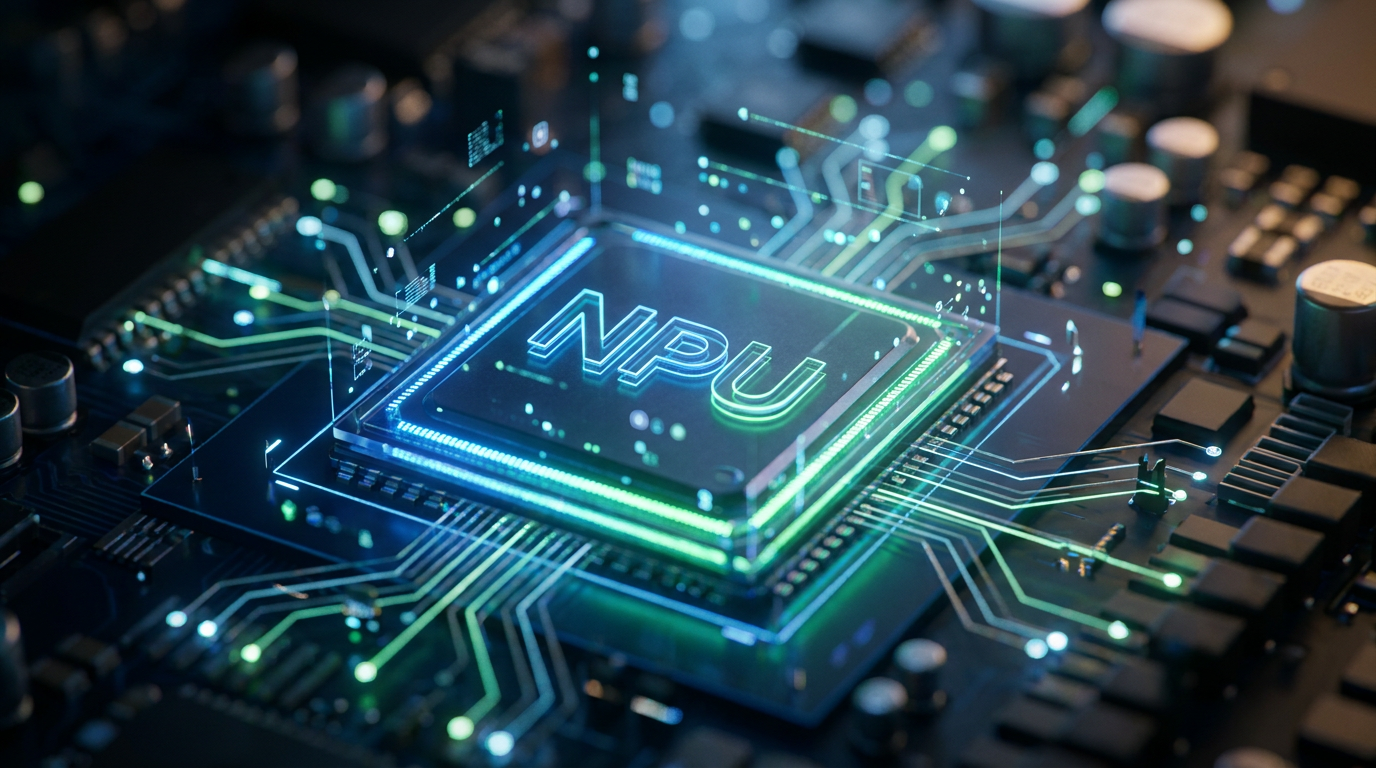
For the broader PC market, 2026 is the year of the "AI PC," defined by the inclusion of a Neural Processing Unit (NPU). NPUs are dedicated silicon accelerators designed specifically for the matrix math that AI requires. Chips like Qualcomm's Snapdragon X Elite, AMD's Ryzen AI 300, and Intel's Lunar Lake feature NPUs capable of 45 to 50+ TOPS (Trillions of Operations Per Second), allowing laptops to run background AI tasks with up to 60% faster inference while consuming roughly 40% less power than traditional GPUs.[1][8]

Because consumer devices cannot hold the trillion-parameter behemoths hosted in the cloud, the local AI movement has spurred the rise of Small Language Models (SLMs). Rather than trying to build a "jack of all trades" model, researchers are training highly focused, efficient models—like the Qwen 3.5 family or Llama 3 variants—that excel at specific tasks like coding or drafting emails while remaining small enough to run on a phone or tablet.[1]
Despite the rapid advancements, local AI is not without its trade-offs. Local models are generally less capable of complex, multi-step reasoning than frontier cloud models. They also demand diligent maintenance; users must manually update their models and software to benefit from the latest security patches and performance improvements.[4]
Running intensive AI workloads locally also has physical consequences for mobile devices. Continuous local inference can rapidly drain laptop batteries and generate significant heat, pushing cooling systems to their limits. While NPUs are mitigating this issue for background tasks, sustained heavy generation still requires serious thermal management.[8]
Ultimately, the future of AI in 2026 is not strictly local or strictly cloud, but hybrid. Developers are increasingly building "private routers"—systems that handle routine queries, sensitive data, and real-time tasks locally, while seamlessly escalating complex reasoning requests to larger cloud models when necessary.[4][5]

The democratization of AI hardware and software has returned a sense of ownership to computing. Much like the custom PC building culture of the past, users are once again taking control of their digital environments—choosing their models, managing their hardware, and running artificial intelligence on their own terms, completely independent of the cloud.[2][3]
How we got here
2023
Cloud AI dominates the landscape; running capable models locally requires expensive, enterprise-grade server hardware.
Early 2024
The release of optimized frameworks like llama.cpp and advanced quantization techniques make running models on consumer hardware possible.
2025
The 'AI PC' category launches, introducing dedicated Neural Processing Units (NPUs) from Apple, Qualcomm, and Intel to handle local inference efficiently.
2026
GUI tools like LM Studio and Ollama bring local AI to mainstream users, eliminating the need for command-line knowledge.
Viewpoints in depth
Privacy & Open-Source Advocates
Champions of local AI who prioritize data sovereignty and freedom from corporate oversight.
For this camp, local AI is fundamentally about control. They argue that relying on cloud providers creates a dangerous dependency where a single company can read your prompts, use your data for training, or arbitrarily change the model's behavior overnight. By running open-source models locally, users guarantee that their data remains entirely private and that their access to AI cannot be revoked, censored, or monetized by a third party.
Enterprise IT & Security
Corporate decision-makers focused on compliance, intellectual property protection, and cost management.
Enterprise IT departments view local AI as the solution to the massive security headache caused by employees pasting sensitive data into public chatbots. By deploying local models on company hardware, businesses can leverage AI for coding, document analysis, and drafting without violating GDPR, HIPAA, or internal IP policies. Additionally, this camp values the predictable cost structure of local AI—paying once for hardware rather than facing unpredictable, scaling API subscription fees.
Hardware Enthusiasts
Power users and PC builders focused on maximizing performance and pushing silicon to its limits.
This community treats local AI as the new frontier of custom PC building. Rather than optimizing for gaming frame rates, they benchmark systems based on VRAM capacity, memory bandwidth, and NPU TOPS (Trillions of Operations Per Second). They actively experiment with different quantization levels to squeeze the largest possible models onto consumer graphics cards, treating the setup and optimization of the AI environment as a rewarding technical challenge in itself.
What we don't know
- Whether open-source local models will eventually hit a capability ceiling compared to heavily funded, proprietary cloud models.
- How quickly software developers will fully optimize their applications to take advantage of the new NPUs in consumer laptops.
- If the hardware requirements for local AI will outpace the upgrade cycles of average consumers, creating a divide in access.
Key terms
- Inference
- The process of running a pre-trained AI model on new data to generate a response, such as answering a question or writing code.
- Quantization
- A mathematical compression technique that reduces the precision of an AI model's data, drastically shrinking its file size so it can run on consumer hardware.
- VRAM (Video RAM)
- The dedicated memory on a graphics card. For local AI, having enough VRAM is crucial because the entire model must be loaded into memory to run quickly.
- NPU (Neural Processing Unit)
- A specialized chip built into modern processors designed specifically to handle AI calculations efficiently, saving battery life compared to using a standard GPU.
- SLM (Small Language Model)
- A compact AI model designed to run efficiently on personal devices, focusing on specific tasks rather than trying to know everything like a massive cloud model.
Frequently asked
Do I need an internet connection to use a local LLM?
No. Once you download the model and the software (like Ollama or LM Studio), the AI runs entirely on your device's hardware and requires zero internet connectivity.
Can a local AI model match cloud models like ChatGPT?
Not entirely. Local models are smaller and generally less capable of highly complex, multi-step reasoning than massive cloud models, but they excel at focused tasks like drafting text, summarizing documents, and writing code.
Is my data safe with local AI?
Yes. Because the processing happens entirely on your own machine, your prompts and documents are never sent to an external server, making it highly secure and compliant with privacy laws.
What is the difference between Ollama and LM Studio?
Ollama is a lightweight, command-line-focused tool that runs quietly in the background, while LM Studio provides a full graphical user interface (GUI) that lets you browse, download, and chat with models easily.
Sources
Source coverage
8 outlets
3 viewpoints surfaced








[1]ArticsledgeHardware Enthusiasts
What Is On-Device AI? How It Works in 2026
Read on Articsledge →[2]Blueberry ConsultantsPrivacy & Open-Source Advocates
How Local LLMs Work: Running AI on Your Own Machine
Read on Blueberry Consultants →[3]DappnodePrivacy & Open-Source Advocates
Best Local LLMs You Can Run for Free in 2026
Read on Dappnode →[4]Sesame DiskEnterprise IT & Security
How to Run AI Models Locally in 2026: Hardware, Tools & Setup
Read on Sesame Disk →[5]Done Web AgencyEnterprise IT & Security
AI without cloud: a practical guide for SMBs in 2026
Read on Done Web Agency →[6]Popular AIHardware Enthusiasts
The 5 best prebuilt AI PCs for Ollama and local LLMs in 2026
Read on Popular AI →[7]NeweggHardware Enthusiasts
Best AI PC Builds for Running Local LLMs in 2026
Read on Newegg →[8]Tech WorkstationHardware Enthusiasts
On-Device AI in 2026: How NPUs Are Transforming AI PCs for Creators and Power Users
Read on Tech Workstation →
More in ai
See all 8 stories →Animal Cognition
AI Decodes Sperm Whale 'Phonetic Alphabet,' Revealing Complex Language Parallels
8 sources

Edge AI
How On-Device AI and Quantization Are Moving LLMs Out of the Cloud
6 sources

Agentic AI
Agentic AI: How Large Action Models Are Automating Digital Chores
7 sources
Global AI Governance
EU Delays Key AI Act Enforcement as 'Brussels Effect' Fractures Under US Deregulation
8 sources

Every angle. Every day.
Get ai stories with full source coverage and perspective breakdowns delivered to your inbox.