
The Rise of Green-Collar Trades: How the Clean Energy Transition is Reshaping Vocational Education
As the demand for electric vehicles and renewable energy surges, trade schools and apprenticeship programs are rapidly overhauling their curricula to train a new generation of high-tech, green-collar workers.
By Factlen Editorial Team
- Vocational Educators
- Trade schools and instructors focused on modernizing curricula.
- Government & Policymakers
- Officials leveraging workforce development to meet climate goals.
- Industry & Employers
- Renewable energy developers and automotive manufacturers.
- Economic Analysts
- Observers highlighting the broader labor market shift and wage premiums.
What's not represented
- · Traditional mechanics nearing retirement who may opt out of the workforce rather than upskill for high-voltage systems.
- · Students in rural or underfunded school districts who lack access to advanced, capital-intensive clean energy training labs.
Why this matters
The global shift away from fossil fuels relies entirely on a massive, specialized workforce. Understanding this boom in green-collar trades highlights lucrative, high-tech career pathways that bypass the debt of traditional four-year college degrees.
Key points
- The global transition to clean energy is driving unprecedented demand for skilled tradespeople, with Canada alone needing 264,000 new apprentices by 2034.
- Trade schools are pivoting from traditional internal combustion engine repair to specialized 6-to-12-month EV technician programs focused on high-voltage safety.
- Governments are heavily subsidizing this shift, tying infrastructure funding to registered apprenticeship programs to create stable, local jobs.
- The 'earn-while-you-learn' apprenticeship model is proving highly effective for teaching complex, high-stakes green technologies without saddling students with debt.
The global transition to clean energy is often visualized through sweeping landscapes of wind turbines, sprawling solar farms, and silent electric vehicles gliding down highways. Yet, beneath the surface of this technological shift lies a more fundamental transformation: a massive mobilization of human labor. The bottleneck for a decarbonized future is no longer just capital or political will, but the availability of skilled hands capable of building, installing, and maintaining this new infrastructure. This reality has sparked a renaissance in vocational education, giving rise to a booming sector of "green-collar" trades that are reshaping community colleges, union halls, and technical institutes worldwide.[6]
The scale of the workforce demand is staggering. As nations race to meet ambitious net-zero emissions targets by 2050, the pressure on the apprenticeship pipeline is growing exponentially. In Canada alone, economic models project a need for over 264,000 newly certified apprentices by 2034—a 49 percent increase over current training levels—just to keep pace with the green transition. This surge is not driven by the sudden invention of entirely new professions, but rather by the rapid evolution of existing trades. Electricians, HVAC technicians, welders, and industrial mechanics are finding their traditional roles supercharged by the demands of electrification, heat-pump installation, and renewable energy development.[3]
At the heart of this shift is the concept of the "green-collar" job—a term used to describe employment that directly contributes to preserving or restoring environmental quality. These roles bridge the gap between traditional blue-collar manual labor and white-collar environmental science, requiring a sophisticated blend of mechanical aptitude and high-tech diagnostic skills. For vocational schools, this means overhauling curricula that have remained largely static for decades. Instructors are now integrating climate literacy, advanced materials science, and digital systems management into foundational trade education, ensuring that the next generation of workers understands both the "how" and the "why" of their craft.[4][8]

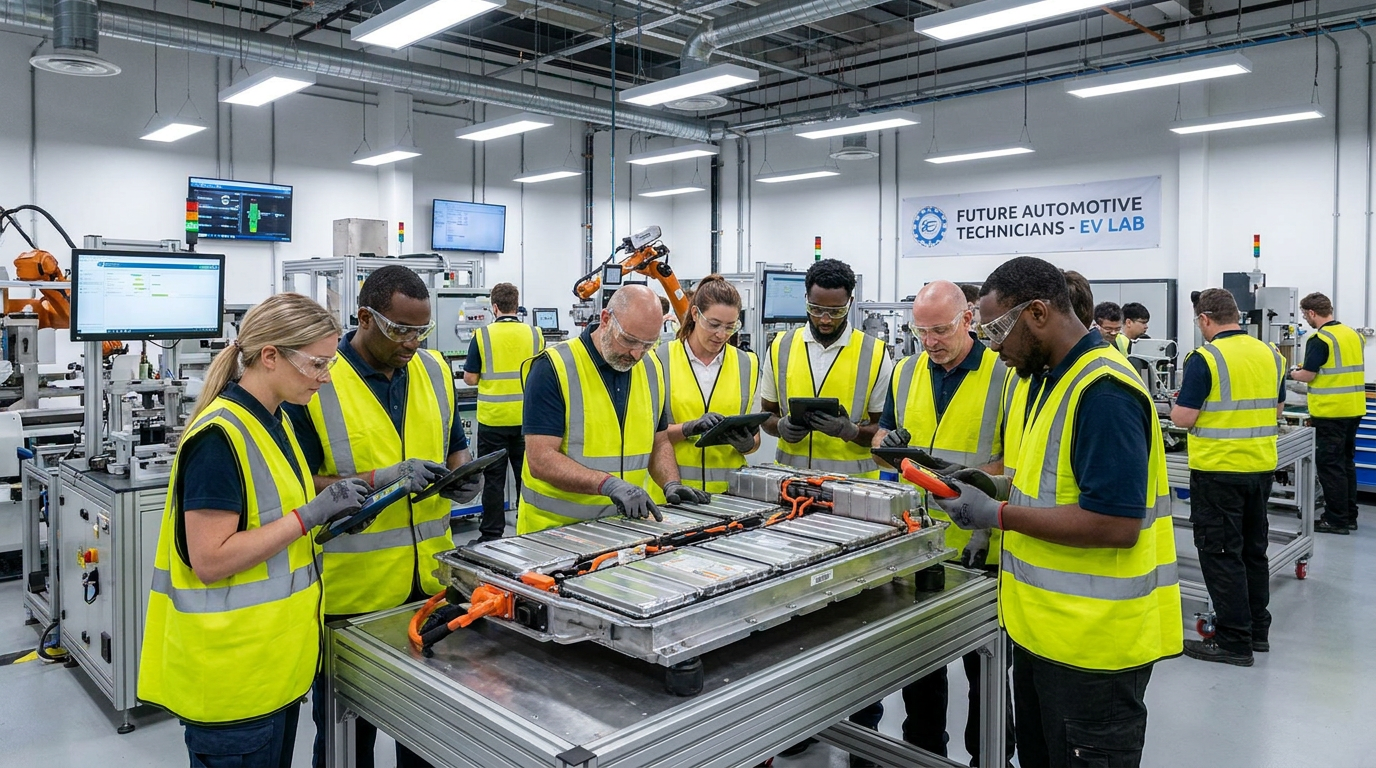
Nowhere is this educational pivot more visible than in the automotive repair industry. The internal combustion engine, with its thousands of moving parts, fluids, and exhaust systems, is steadily giving way to the electric vehicle (EV). EVs are fundamentally different machines, relying on massive lithium-ion battery packs, high-voltage electrical systems, and complex software networks. Consequently, the industry is facing a severe shortage of qualified EV technicians. Traditional mechanics, accustomed to turning wrenches and diagnosing fuel injection issues, are finding themselves ill-equipped to safely service vehicles that operate on lethal levels of electrical current.[1][7]
To bridge this gap, trade schools and community colleges are rapidly deploying specialized EV technician training programs. These intensive courses, typically lasting between six and twelve months, bypass conventional engine repair to focus entirely on battery diagnostics, thermal management systems, and high-voltage safety protocols. For existing mechanics looking to upskill, the pathway often involves targeted continuing education. In the United States, the Automotive Service Excellence (ASE) L3 certification—an advanced credential for hybrid and electric vehicle specialists—has emerged as the industry's gold standard, requiring rigorous testing on power electronics and drive system diagnostics.[1]
The urgency of this workforce transition has prompted significant intervention from government bodies, which increasingly view vocational training as a critical component of climate policy. In April 2026, the New York State Energy Research and Development Authority (NYSERDA) announced a $50 million expansion of its clean energy workforce commitment. This funding is specifically earmarked for career pathways training and technical upskilling, aiming to provide family-sustaining jobs while ensuring the state has the labor force necessary to support its growing portfolio of offshore wind and solar projects.[2]
At the federal level, the U.S. Department of Energy has adopted "high-road" sectoral strategies, tying infrastructure investments to the expansion of registered apprenticeships. By embedding workforce development requirements into clean energy manufacturing and supply chain grants, policymakers are attempting to guarantee that the economic benefits of the green transition flow directly to local workers. This approach not only scales skills attainment but also standardizes safety and wage protections across a rapidly expanding industry.[4]
Department of Energy has adopted "high-road" sectoral strategies, tying infrastructure investments to the expansion of registered apprenticeships.
Organized labor and academic institutions are also forming unprecedented partnerships to prepare workers for this new economy. Programs like Cornell University's Climate Jobs Institute are actively training pre-apprentices in climate dynamics, environmental justice, and the specific role that unionized construction workers will play in building resilient infrastructure. By combining hands-on technical training with a broader understanding of climate strategy, these initiatives aim to cultivate a workforce that is not just technically proficient, but deeply engaged in the mission of decarbonization.[8]

Meanwhile, industry groups are working to streamline the credentialing process to mobilize workers more efficiently. In Australia, the Clean Energy Council recently launched a "Clean energy, job ready" program, developed after months of consultation with renewable energy developers. A centerpiece of this initiative is a digital "skills passport," which allows tradespeople to securely upload and validate their qualifications. This standardized matrix makes it significantly easier for workers to transition seamlessly between large-scale wind, solar, and battery storage projects, reducing administrative friction for both employers and job seekers.[5]
The traditional "earn-while-you-learn" apprenticeship model is proving uniquely suited to the demands of the green economy. Unlike four-year university degrees, which often saddle students with debt while delaying their entry into the workforce, registered apprenticeships provide immediate income and hands-on experience. For complex, high-stakes tasks like installing commercial solar inverters or calibrating EV battery management systems, classroom theory must be immediately reinforced by supervised, real-world practice. This direct pipeline from training to employment is highly attractive to a new generation of workers seeking financial stability and purposeful careers.[6]
Despite the optimism surrounding green-collar jobs, the vocational education sector faces significant structural hurdles. The most pressing bottleneck is a severe shortage of qualified instructors. As the demand for skilled EV technicians and renewable energy experts surges, professionals who possess these advanced skills can command premium salaries in the private sector, making it difficult for community colleges and trade schools to recruit and retain them as teachers. Without enough trainers to teach the trainers, the capacity of educational institutions to scale their programs remains constrained.[7]
Furthermore, the sheer pace of technological change introduces a layer of persistent uncertainty into workforce planning. The clean energy sector is characterized by rapid innovation; the battery chemistries, solar cell efficiencies, and heat pump designs considered cutting-edge today may become obsolete within half a decade. For vocational schools, this means that curricula cannot be static. Training programs must be designed with built-in agility, emphasizing foundational principles of electrical engineering and digital diagnostics over rote memorization of specific, potentially fleeting, hardware configurations.[1]

This dynamic environment shifts the burden of education from a one-time credentialing event to a lifelong learning process. Green-collar workers will need to continuously upskill to remain relevant, requiring employers to invest heavily in ongoing professional development. Companies that fail to provide clear pathways for continuous learning risk losing their most capable technicians to competitors, exacerbating the very labor shortages they are trying to solve.[7]
For those who successfully navigate this evolving landscape, the financial rewards are substantial. Green-collar jobs frequently command a wage premium over traditional blue-collar roles, reflecting the specialized knowledge and higher safety risks associated with high-voltage and advanced mechanical systems. This earning potential, combined with the inherent job security of a rapidly expanding, globally mandated industry, is fundamentally rebranding vocational education. It is no longer viewed as a fallback option, but as a premier pathway to the middle class.[1]
The cultural perception of trade work is shifting in tandem with its technological evolution. The stereotype of the grease-stained mechanic or the dusty construction worker is being replaced by the image of a clean-room technician analyzing software telemetry or an electrician configuring a smart-grid interface. This rebranding is crucial for attracting a more diverse cohort of students—including women and tech-oriented youth—who might have previously overlooked vocational training in favor of traditional STEM degrees.[6]
Ultimately, the rise of green-collar vocational training represents a profound realignment of the global labor market. The transition away from fossil fuels is not merely an environmental imperative; it is the largest job-creation engine of the 21st century. By modernizing apprenticeships, standardizing credentials, and investing heavily in human capital, the education sector is ensuring that the workforce is ready to build the infrastructure of tomorrow. The clean energy revolution will not be won in boardrooms or laboratories alone, but in the classrooms and workshops where the next generation of tradespeople is currently learning to harness the power of the sun, the wind, and the electron.[6]

How we got here
2006
Early green building acts begin formalizing the need for sustainable construction trades.
2023
Major automakers announce accelerated shifts to EV production, exposing a critical shortage of high-voltage technicians.
June 2025
Australia's Clean Energy Council launches a digital skills passport to standardize renewable energy credentials.
April 2026
New York state commits an additional $50 million specifically for clean energy career pathways and technical upskilling.
Viewpoints in depth
Vocational Educators
Trade schools and instructors focused on modernizing curricula.
Educators argue that the transition to clean energy requires a fundamental overhaul of how trades are taught. They emphasize that traditional mechanical skills are no longer sufficient; students must now master high-voltage safety, digital diagnostics, and climate literacy. However, they also warn that their ability to scale these programs is severely limited by a lack of qualified instructors, as industry wage premiums draw top talent away from teaching.
Government & Policymakers
Officials leveraging workforce development to meet climate goals.
For policymakers, the green-collar boom is both an economic opportunity and a logistical necessity. They view massive investments in vocational training—such as NYSERDA's $50 million commitment—as essential to achieving net-zero emissions targets. By tying federal and state infrastructure grants to registered apprenticeship programs, they aim to ensure that the clean energy transition creates stable, family-sustaining jobs for local communities.
Industry & Employers
Renewable energy developers and automotive manufacturers.
Employers are primarily concerned with the immediate, acute shortage of skilled labor threatening to delay large-scale infrastructure projects. They advocate for highly standardized, rapidly deployable training programs and digital credentialing systems, like Australia's skills passport. Their goal is to reduce administrative friction and create a highly mobile workforce capable of moving seamlessly between wind, solar, and EV manufacturing sites.
What we don't know
- Whether vocational schools will be able to recruit enough qualified instructors to meet the surging enrollment demand, given the high private-sector salaries for EV and renewable experts.
- How quickly current battery and solar technologies will become obsolete, potentially requiring constant, rapid retraining for the existing green-collar workforce.
Key terms
- ASE L3 Certification
- An advanced credential awarded by the National Institute for Automotive Service Excellence to technicians who demonstrate mastery in diagnosing and repairing hybrid and electric vehicles.
- Green-Collar Job
- Employment in emerging environmental industries or conventional trades that has been adapted to support sustainable practices, energy efficiency, or renewable power.
- Skills Passport
- A digital platform used by tradespeople to securely store and verify their qualifications, making it easier to move between different clean energy projects.
- High-Road Sectoral Strategy
- A workforce development approach that ties government infrastructure funding to the creation of high-quality, well-paying jobs and registered apprenticeships.
Frequently asked
What exactly is a green-collar job?
A green-collar job is a role that directly contributes to preserving or restoring the environment, often blending traditional blue-collar manual trades with high-tech environmental and electrical skills.
Do traditional mechanics need to go back to school for EVs?
Yes. Because EVs rely on high-voltage electrical systems rather than internal combustion engines, traditional mechanics must upskill—often obtaining specialized credentials like the ASE L3 certification—to safely service them.
Are apprenticeships paid?
Yes. Registered apprenticeships follow an "earn-while-you-learn" model, allowing students to earn an income while receiving hands-on, supervised training in their chosen trade.
Why is there a shortage of EV technicians?
The rapid adoption of electric vehicles has outpaced the capacity of trade schools to train new technicians, a problem exacerbated by a shortage of qualified instructors capable of teaching advanced high-voltage diagnostics.
Sources
Source coverage
8 outlets
4 viewpoints surfaced








[1]Trade Schools DirectoryVocational Educators
EV Technician Salary, Training & Outlook (2026)
Read on Trade Schools Directory →[2]NYSERDAGovernment & Policymakers
Clean Energy Workforce Commitment Expanded With $50 Million In New Funding
Read on NYSERDA →[3]Future Skills CentreIndustry & Employers
The Demand for Green Skills and the Impact on Apprentices in the Economy
Read on Future Skills Centre →[4]U.S. Department of EnergyGovernment & Policymakers
Energy Workforce: Apprenticeships & Workforce Development
Read on U.S. Department of Energy →[5]Clean Energy CouncilIndustry & Employers
New Clean Energy, Job Ready program launches as demand for skilled workforce grows
Read on Clean Energy Council →[6]Factlen Editorial TeamEconomic Analysts
Synthesis by Factlen editorial team
Read on Factlen Editorial Team →[7]JBA Training DesignVocational Educators
EV Technician Shortage: What Is it and How to Solve it?
Read on JBA Training Design →[8]Cornell University ILR SchoolVocational Educators
Climate Jobs Institute: Preparing the Next Generation of Union Workers
Read on Cornell University ILR School →
Every angle. Every day.
Get education stories with full source coverage and perspective breakdowns delivered to your inbox.