
The Rise of Dark Sky Sanctuaries: Why Astrotourism is 2026's Biggest Travel Trend
As light pollution erases the stars for 99% of the Western world, travelers are increasingly seeking out certified 'Dark Sky Sanctuaries.' This booming astrotourism industry is driving remote economic growth while forcing a global reckoning over how we light our nights.
By Factlen Editorial Team
- Conservationists & Astronomers
- Advocating for the strict preservation of nocturnal environments as critical ecological and scientific resources.
- Tourism & Travel Forecasters
- Viewing astrotourism as a sustainable economic engine for remote and off-the-beaten-path communities.
- Editorial Analysts
- Balancing the demand for pristine darkness with the practical realities of guest safety and infrastructure.
What's not represented
- · Indigenous communities whose ancestral stargazing lands are being commercialized
- · Municipal lighting manufacturers facing new regulatory burdens
Why this matters
A truly dark night sky is no longer a given—it is a rapidly disappearing natural resource. The push to protect these areas not only offers awe-inspiring travel experiences but also preserves crucial nocturnal ecosystems and human circadian rhythms that artificial light disrupts.
Key points
- Astrotourism has emerged as a dominant 2026 travel trend, driven by the August solar eclipse and a desire for off-grid experiences.
- With 99% of the US and European populations living under light-polluted skies, true darkness is now a scarce natural resource.
- The International Dark Sky Places program certifies protected areas, with 'Sanctuaries' representing the most remote and pristine tier.
- Dark sky preservation provides significant off-season economic boosts to rural communities while protecting nocturnal wildlife.
- Destinations face the paradox of building hospitality infrastructure to host astrotourists without introducing new light pollution.
For most of human history, a star-strewn night sky was a universal backdrop to life on Earth. Today, it is a luxury commodity. As travelers finalize their 2026 itineraries, a new priority has eclipsed traditional beach resorts and bustling city breaks: the search for absolute darkness. Driven by a rare alignment of celestial events—including the August 2026 total solar eclipse across Europe and an intense solar maximum producing vivid auroras at unusually low latitudes—"astrotourism" has transitioned from a niche hobby to a dominant force in the global travel industry.[1][2][3]
The surge in stargazing travel is fundamentally a response to scarcity. Artificial light at night has quietly transformed the atmosphere, creating a persistent, glowing haze that blankets urban and suburban areas. According to environmental data, 99 percent of people living in the United States and Europe now reside under light-polluted skies. For roughly 80 percent of North Americans, the Milky Way is completely invisible from their homes. What was once an ordinary nightly occurrence is now an exotic spectacle that requires deliberate planning, a passport, and a plane ticket to witness.[3][4]
To understand the astrotourism boom, one must understand the pollutant it seeks to escape. Lighting experts categorize light pollution into four distinct types: glare (excessive brightness that causes visual discomfort), light clutter (bright, confusing, and excessive groupings of light sources), light trespass (light falling where it is not intended or needed), and skyglow (the brightening of the night sky over inhabited areas). Together, these factors erase the contrast necessary to see distant celestial bodies, replacing the cosmos with a flat, orange-gray ceiling.[6]
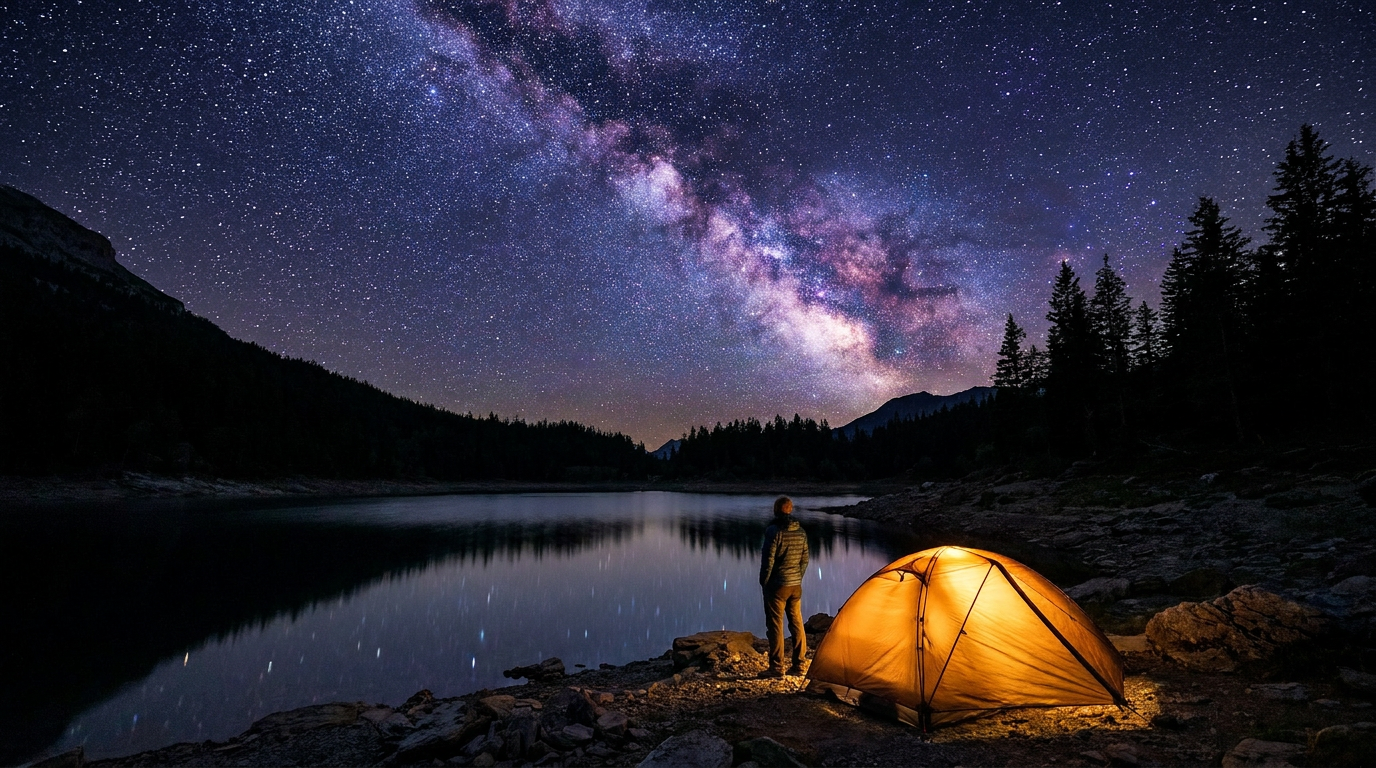
Astronomers and conservationists quantify this loss using the Bortle Scale, a nine-level numeric system that measures the night sky's brightness. A Class 9 sky represents an inner-city environment where only the moon and a few of the brightest planets are visible. Conversely, a Class 1 sky represents an exceptionally dark, pristine environment where the Milky Way casts distinct shadows on the ground, and thousands of stars are visible to the naked eye. Astrotourists are increasingly hunting for those elusive Class 1 and Class 2 destinations.[4][7]

The erasure of the night sky is not merely an aesthetic loss; it is an ecological crisis. The National Park Service and environmental researchers note that artificial light severely disrupts the circadian rhythms of nocturnal wildlife. Light pollution interferes with the navigation of migratory birds, alters the hunting patterns of nocturnal predators, and fatally disorients sea turtle hatchlings, which rely on the natural starlight reflecting off the ocean to find the water. Preserving dark skies is increasingly viewed as a critical component of broader biodiversity conservation.[5][6]
The biological impacts extend to humans as well. The proliferation of blue-rich artificial light suppresses the human body's production of melatonin, the hormone responsible for regulating sleep-wake cycles. Public health researchers have linked chronic exposure to artificial light at night with a range of sleep disorders and metabolic issues. In this context, astrotourism is marketed not just as an adventure, but as a wellness retreat—a chance to reset the body's internal clock under natural conditions.[6][7]
To help travelers find these vanishing vistas, a rigorous global certification system has emerged. Modeled after UNESCO World Heritage designations, the International Dark Sky Places program evaluates and protects nocturnal environments. Administered by DarkSky International, the program categorizes protected sites into five distinct tiers: Communities, Parks, Reserves, Urban Night Sky Places, and the most pristine of all—Dark Sky Sanctuaries.[4]
To help travelers find these vanishing vistas, a rigorous global certification system has emerged.
Achieving "Sanctuary" status is notoriously difficult and represents the gold standard of astrotourism. Unlike a Dark Sky Park, which might sit on the edge of a populated area and focus heavily on public outreach, a Sanctuary must be exceptionally remote with virtually zero threat of encroaching development. To qualify, the core area must routinely measure at least 21.2 magnitudes per square arcsecond on a sky quality meter—a metric that ensures the environment remains at the absolute threshold of natural darkness.[4]

The certification is not merely a geographic award; it requires active, ongoing management. Candidate sites undergo a multi-year audit of their lighting infrastructure. Every bulb, fixture, and streetlamp within the protected zone must be inventoried and, if necessary, retrofitted. Compliance means installing fully shielded fixtures that point light exclusively downward and utilizing warmer, amber-hued bulbs that minimize atmospheric scattering.[4][5]
Furthermore, the designation is not granted in perpetuity. Sites must submit annual reports proving they are maintaining their darkness through continuous sky quality monitoring. If a region permits new, non-compliant commercial development or fails to enforce its municipal lighting ordinances, the Sanctuary or Park status can be formally revoked. This creates a powerful incentive for local governments to strictly regulate their nighttime environment.[4]
For remote communities, the economic incentives to undergo this rigorous process are massive. Astrotourism brings a highly desirable demographic of travelers who tend to stay longer and spend more. Because the best stargazing often occurs during the colder, drier months when the atmosphere is crisp and nights are longer, dark sky tourism effectively extends the travel season. This brings vital overnight revenue to rural hotels, guides, and restaurants during traditional off-peak periods.[1][2]
The numbers reflect a rapid shift in consumer behavior. Travel agencies report that dedicated solar eclipse tours for 2026 sold out years in advance. Meanwhile, search demand for accommodations in remote, dark-sky-adjacent regions—such as Utah's dense cluster of certified parks, Iceland's volcanic plains, and rural Spain—has quadrupled year-over-year. The global astrotourism market is now valued in the billions, proving that darkness can be a highly lucrative natural resource if properly managed.[1][2][3]

However, the boom in astrotourism carries an inherent paradox. As remote destinations become popular stargazing hotspots, the influx of tourists brings the very infrastructure—hotels, rental cars, visitor centers, and glowing smartphone screens—that threatens the darkness. Academic studies on tourism-driven light pollution warn that without strict zoning laws, the economic success of a dark sky destination will inevitably erode the natural asset that attracted visitors in the first place.[6][7]
To combat this, certified destinations are implementing strict visitor protocols. Many Sanctuaries now require tourists to use specialized red-light flashlights, which do not disrupt night vision or scatter in the atmosphere the way white LEDs do. Lodges in these areas are designed with blackout curtains, low-lumen pathway lighting, and strict curfews for exterior illumination, ensuring that the hospitality infrastructure leaves no optical footprint.[4][7]

The rise of Dark Sky Sanctuaries represents a profound shift in how we value the natural world. It acknowledges that the night sky is not an empty void, but a fragile environment requiring active conservation. As 2026 shapes up to be the year of the astrotourist, the challenge for these remote destinations will be balancing the human desire to look up at the universe with the discipline required to keep the lights off on the ground.[7]
How we got here
2001
The International Dark-Sky Association (now DarkSky International) launches the Dark Sky Places certification program.
2007
Natural Bridges National Monument in Utah becomes the world's first certified International Dark Sky Park.
2015
The 'Dark Sky Sanctuary' tier is introduced to protect the most remote and fragile nocturnal environments on Earth.
April 2024
A total solar eclipse across North America triggers a massive spike in mainstream interest for celestial travel.
August 2026
A total solar eclipse will sweep across Europe, driving record-breaking astrotourism bookings for the year.
Viewpoints in depth
Conservationists & Astronomers
Advocating for the strict preservation of nocturnal environments as critical ecological and scientific resources.
For astronomers and ecologists, dark skies are a non-negotiable necessity. They argue that artificial light at night (ALAN) is a severe environmental pollutant that disrupts migratory patterns, predator-prey dynamics, and human circadian rhythms. This camp prioritizes strict municipal lighting ordinances and rigorous enforcement of the 21.2 magnitudes per square arcsecond standard, warning that even minor infrastructure development can permanently ruin a Class 1 sky.
Rural Tourism Boards
Viewing astrotourism as a sustainable economic engine for remote and off-the-beaten-path communities.
Local governments and tourism boards see dark skies as a highly lucrative, renewable resource. Because stargazing peaks in the colder, drier months, astrotourism provides a vital economic lifeline during traditional off-seasons. This camp focuses on marketing their region's natural darkness to high-value travelers, arguing that the economic benefits of overnight stays justify the upfront costs of retrofitting municipal lighting to meet DarkSky standards.
Hospitality Developers
Balancing the demand for pristine darkness with the practical realities of guest safety and comfort.
Hoteliers and resort developers face the practical challenge of the astrotourism paradox: hosting guests without ruining the sky. They must navigate strict zoning laws while ensuring pathways are safe to walk at night. This camp advocates for innovative architectural solutions—such as low-lumen amber ground lighting, blackout architecture, and red-light-only policies—to provide luxury accommodations that leave zero optical footprint on the surrounding sanctuary.
What we don't know
- How effectively remote municipalities can enforce strict lighting ordinances as commercial tourism development accelerates.
- Whether the surge in astrotourism will plateau after the 2026 solar eclipse or remain a permanent fixture of the travel industry.
- The long-term ecological impact of increased human foot traffic in previously undisturbed nocturnal habitats.
Key terms
- Astrotourism
- A form of nature-based travel focused on observing celestial events and the night sky in areas free from light pollution.
- Bortle Scale
- A nine-level numeric scale that measures the brightness of the night sky, ranging from Class 1 (darkest) to Class 9 (inner-city).
- Skyglow
- The brightening of the night sky over inhabited areas caused by artificial light scattering in the atmosphere.
- Magnitudes per square arcsecond
- An astronomical measurement used to quantify the darkness of the night sky; higher numbers indicate darker skies.
- Light Trespass
- Artificial light that falls beyond the property or area it is intended to illuminate, often disrupting neighboring environments.
Frequently asked
What is the difference between a Dark Sky Park and a Sanctuary?
A Dark Sky Park is typically an accessible public land with exceptional starry nights, while a Sanctuary is much more remote, harder to reach, and has virtually zero threat of future light pollution.
Why is astrotourism growing so fast in 2026?
The trend is driven by a desire for off-grid travel, the upcoming August 2026 total solar eclipse in Europe, and an intense solar maximum that is producing vivid auroras.
How does light pollution affect wildlife?
Artificial light disrupts the circadian rhythms of nocturnal animals, interferes with bird migrations, and disorients sea turtle hatchlings trying to find the ocean.
Can I use a regular flashlight in a Dark Sky Sanctuary?
Most sanctuaries require or strongly encourage the use of red-light flashlights, as white LED light ruins human night vision and scatters easily into the atmosphere.
Sources
Source coverage
7 outlets
3 viewpoints surfaced







[1]HomeToGoTourism & Travel Forecasters
The 2026 Astrotourism Report
Read on HomeToGo →[2]Explore WorldwideTourism & Travel Forecasters
Travel Trends 2026: Our Annual Report On Where People Go & Why
Read on Explore Worldwide →[3]InteleTravelTourism & Travel Forecasters
What Is Astrotourism? The Stargazing Travel Trend You Need to Know
Read on InteleTravel →[4]DarkSky InternationalConservationists & Astronomers
International Dark Sky Places Certification Program
Read on DarkSky International →[5]National Park ServiceConservationists & Astronomers
International Dark Sky Park FAQs
Read on National Park Service →[6]MDPIConservationists & Astronomers
Light Pollution Beyond the Visible: Insights from People's Perspectives
Read on MDPI →[7]Factlen Editorial TeamEditorial Analysts
Synthesis by Factlen editorial team
Read on Factlen Editorial Team →
Every angle. Every day.
Get travel stories with full source coverage and perspective breakdowns delivered to your inbox.