
The Rise of Community Land Trusts: How Splitting the House from the Land is Reshaping Affordable Housing
As housing prices outpace local incomes, communities are increasingly turning to a model that permanently removes land from the speculative market. Community Land Trusts offer a pathway to homeownership by capping resale profits, sparking a debate over the balance between affordable housing and generational wealth.
By Factlen Editorial Team
- Permanent Affordability Advocates
- Prioritize community stability, anti-displacement, and keeping housing permanently affordable over individual market speculation.
- Urban Planners & Policy Analysts
- Focus on the structural efficiency of CLTs, viewing them as a sustainable way to maximize the long-term impact of public housing subsidies.
- Homeowner Equity Advocates
- Express concern that shared-equity models cap the financial upside for low-income buyers, limiting their ability to build generational wealth.
What's not represented
- · Traditional real estate developers who compete with CLTs for land acquisition.
- · Commercial banks that underwrite traditional mortgages and may hesitate to finance ground-lease properties.
Why this matters
For decades, the standard American dream of homeownership has relied on buying property that appreciates in value, which inadvertently prices out the next generation of buyers. Community Land Trusts offer a structural alternative that guarantees permanent affordability, potentially redefining how cities solve their housing crises and how low-income families achieve stability.
Key points
- Community Land Trusts (CLTs) separate the ownership of a house from the land beneath it, drastically lowering the purchase price for low-income buyers.
- Homeowners lease the land on a 99-year renewable term and agree to a restricted resale formula that caps their profit.
- This shared-equity model ensures the home remains permanently affordable for future generations, insulating neighborhoods from gentrification.
- The number of CLTs in the U.S. has grown by 30% over the last decade, with over 314 organizations managing 44,000 housing units.
- Because CLTs intervene during financial hardships, homes within the trust have a foreclosure prevention rate exceeding 95%.
- Critics note that the model requires buyers to forfeit significant market appreciation, limiting their ability to build traditional generational wealth.
The traditional housing market operates on a paradox: the very mechanism that builds generational wealth for a homeowner—property appreciation—is exactly what makes that same home unaffordable for the next buyer. As communities across North America grapple with a historic affordability crisis, a quiet revolution in property ownership is gaining unprecedented traction. It is called the Community Land Trust (CLT).[8]
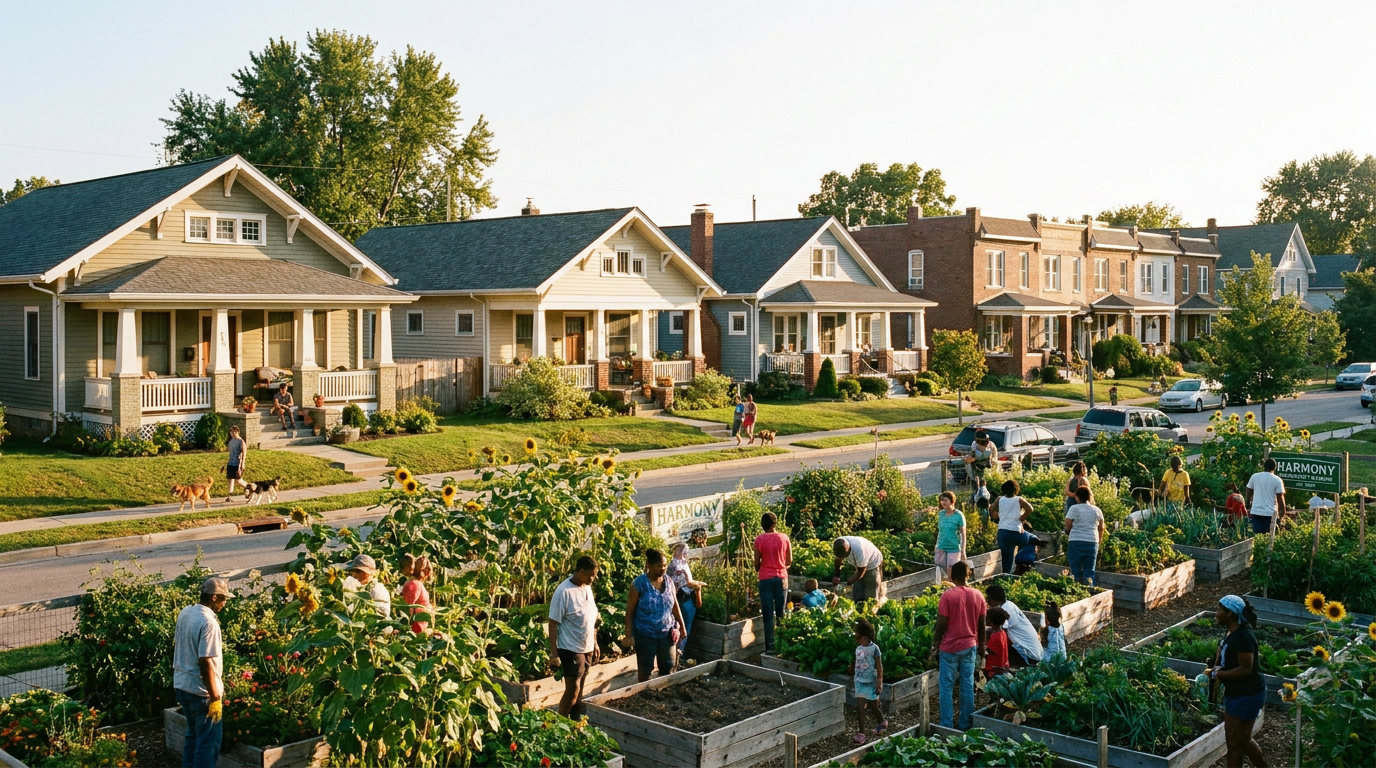
At its core, a CLT fundamentally changes what it means to buy a home by splitting the real estate into two separate entities: the house and the land beneath it. When a family purchases a home through a CLT, they buy only the physical structure. The land itself is retained by a nonprofit, community-governed organization, which leases the plot back to the homeowner on a long-term, renewable basis—typically 99 years.[3]
By removing the cost of the land from the purchase price, the upfront cost of the home drops dramatically, bringing homeownership within reach for low- to moderate-income families who are priced out of the speculative market. Homeowners pay a nominal monthly ground lease fee to the trust, which covers administrative costs and property taxes, while enjoying the stability, privacy, and tax benefits of traditional homeownership.[3]

The catch—and the genius—of the model lies in the resale formula. When a CLT homeowner decides to move, they cannot sell the house to the highest bidder at market rate. Instead, they agree to a restricted resale price that allows them to recoup their initial investment, plus a fixed, modest percentage of the home's appreciated value.[1]
This shared-equity model ensures that the home remains affordable for the next low-income buyer, in perpetuity. The seller walks away with forced savings from paying down their mortgage and a small profit, but they forfeit the windfall of a booming real estate market. In exchange for this capped upside, the community gains a permanent asset that will never slide back into the speculative market.[1][8]
What began as a niche concept rooted in the 1960s civil rights movement has surged into a mainstream housing strategy. A comprehensive census conducted by Grounded Solutions Network and the Lincoln Institute of Land Policy tracked a 30 percent increase in CLT and shared-equity organizations over a decade. Today, more than 314 such entities operate across 46 states, stewarding over 44,000 permanently affordable housing opportunities.[1][2]

What began as a niche concept rooted in the 1960s civil rights movement has surged into a mainstream housing strategy.
Beyond initial affordability, CLTs have demonstrated a remarkable ability to keep families housed during economic downturns. Because the trust retains ownership of the land, it has a vested interest in the homeowner's success. If a family falls behind on their mortgage, the CLT intervenes, offering financial counseling or negotiating with lenders. As a result, CLTs boast a foreclosure prevention rate exceeding 95 percent, vastly outperforming the traditional subprime market.[4]
Local success stories are driving the model's expansion. In Milwaukee, the local CLT has provided a lifeline to residents facing sudden displacement, offering a stable alternative to predatory landlords. Meanwhile, in New York, organizations like the East Harlem El Barrio CLT and the East New York CLT have successfully acquired neglected apartment buildings, renovating them and returning them to tenant control.[4][5]
The technical complexity of real estate development remains a hurdle for grassroots organizations. To address this, regional networks are launching capacity-building initiatives. The San Francisco Community Land Trust recently piloted a 'Capacity Catalyst' program, providing hundreds of hours of technical assistance to emerging Bay Area trusts, helping them navigate property acquisition, financial management, and construction.[6]
Similar efforts by Enterprise Community Partners in New York have equipped local trusts with the expertise needed to partner with developers and secure state funding. Financing a CLT home also requires specialized partnerships. Because the homeowner does not own the land, traditional banks are sometimes hesitant to underwrite the mortgages, fearing complications in the event of a default. To bridge this gap, CLTs work closely with local credit unions and specialized lenders who understand the ground-lease structure.[7]
Furthermore, the governance structure of a CLT is designed to keep the organization accountable to the neighborhood. Most trusts operate on a tripartite board model: one-third of the board is made up of CLT residents, one-third are community members who do not live on CLT land, and one-third are public representatives or technical experts. This ensures that the trust's actions reflect the genuine needs of the community rather than external corporate interests.[3]

To scale further, advocates are pushing for legislative support. A major policy frontier is the Community Opportunity to Purchase Act (COPA), which is gaining traction in cities like New York and San Francisco. COPA legislation grants CLTs and qualified nonprofits the right of first refusal when a landlord decides to sell a residential building, giving communities a fighting chance to purchase the property before it is absorbed by corporate investors.[5]
Despite its successes, the CLT model is not without its critics. Some housing advocates and economists argue that capping resale value inherently limits wealth accumulation for marginalized communities. In a country where home equity is the primary engine of middle-class wealth, asking low-income buyers to sacrifice market appreciation can be seen as creating a two-tiered system of homeownership.[8]
Proponents counter that the alternative is not market-rate homeownership, but perpetual renting and the constant threat of displacement. By prioritizing community stability over individual speculation, Community Land Trusts are redefining housing as a fundamental human need rather than a financial commodity. As cities look toward the future, the CLT model offers a proven, resilient blueprint for keeping neighborhoods in the hands of the people who live in them.[8]
How we got here
1969
New Communities Inc., the first Community Land Trust in the U.S., is founded in Georgia by civil rights leaders to secure land for Black farmers.
1980s
The CLT model expands into urban areas, with organizations forming to combat gentrification and displacement in cities like Cincinnati and Boston.
2022
A national census reveals a 30% growth in CLTs over the previous decade, with over 314 organizations operating across 46 states.
2025
Major capacity-building initiatives launch in New York and California to help emerging CLTs navigate complex real estate development.
2026
Advocates push for the Community Opportunity to Purchase Act (COPA) in major cities, aiming to give CLTs a structural advantage in acquiring properties.
Viewpoints in depth
Permanent Affordability Advocates
Focus on removing land from the speculative market to ensure long-term community stability.
Advocates for the CLT model argue that housing should be treated as a fundamental human need rather than a speculative financial asset. By permanently decoupling the value of the land from the physical home, they believe communities can insulate themselves against gentrification and the boom-and-bust cycles of the real estate market. This camp emphasizes that public subsidies used to build affordable housing are often lost after 15 or 30 years when traditional affordability covenants expire. In contrast, a CLT locks in that affordability for generations, ensuring that a neighborhood remains accessible to working-class families in perpetuity.
Homeowner Equity Proponents
Express concern that shared-equity models limit the primary engine of wealth creation for low-income families.
While acknowledging the immediate benefits of affordable entry prices, some economists and equity advocates point out a structural trade-off: CLTs cap the financial upside for buyers. In the United States, home equity is the primary vehicle for building generational wealth and entering the middle class. By requiring buyers to forfeit the majority of their home's market appreciation upon resale, critics argue that the model risks creating a two-tiered housing system. In this view, marginalized communities are offered stability, but are systematically excluded from the wealth-generating windfalls enjoyed by traditional, market-rate homeowners.
Urban Planners & Municipalities
View CLTs as a highly efficient, self-sustaining tool for maximizing the impact of public housing funds.
For city governments and urban planners, the appeal of Community Land Trusts lies in their financial efficiency. Traditional affordable housing programs require constant infusions of new capital to replace units that age out of their restricted-rent periods and revert to market rates. CLTs, however, require only a one-time upfront subsidy to acquire the land. Once established, the trust becomes a self-sustaining ecosystem, preserving the initial public investment forever. Planners increasingly view this as a vital tool in their policy arsenal, leading to legislative pushes like the Community Opportunity to Purchase Act (COPA) to give these trusts a competitive edge in acquiring properties.
What we don't know
- Whether local governments will pass widespread legislation like COPA to give CLTs a structural advantage in acquiring new properties.
- How the model will scale in hyper-expensive coastal markets where the initial capital required to purchase land is prohibitively high.
- If traditional commercial banks will eventually standardize mortgage products for ground-lease homes, which currently rely heavily on specialized lenders.
Key terms
- Community Land Trust (CLT)
- A nonprofit, community-based organization that acquires land and holds it in perpetuity to provide permanently affordable housing and other community assets.
- Ground Lease
- A long-term agreement (usually 99 years) where the homeowner leases the land beneath their house from the CLT, outlining the rules for use and resale.
- Shared Equity
- A housing model where the financial benefits of property ownership are divided between the individual homeowner and the community, balancing wealth creation with long-term affordability.
- Resale Formula
- A legally binding calculation written into the ground lease that dictates how much a CLT home can be sold for, ensuring it remains affordable for future low-income buyers.
- Community Opportunity to Purchase Act (COPA)
- Proposed legislation in several cities that gives CLTs and nonprofits the right of first refusal to buy residential buildings before they are sold on the open market.
Frequently asked
Do you actually own the home in a Community Land Trust?
Yes. You hold the deed to the physical house and pay a mortgage just like a traditional homeowner. You simply lease the land underneath it from the trust, typically on a 99-year renewable lease.
Can I pass a CLT home down to my children?
Yes. The 99-year ground lease is renewable and inheritable. Your children can inherit the home and continue living there under the same terms, provided they agree to the trust's guidelines.
What happens if I want to sell the house?
You can sell the house, but the resale price is determined by a pre-agreed formula. This allows you to get back your down payment, the equity you built by paying the mortgage, and a capped percentage of the home's appreciation, keeping it affordable for the next buyer.
Do I pay property taxes on a CLT home?
Yes. Homeowners are responsible for property taxes, though in many jurisdictions, the taxes are assessed at a lower rate because the resale value of the home is restricted.
Sources
Source coverage
8 outlets
3 viewpoints surfaced








[1]Grounded Solutions NetworkPermanent Affordability Advocates
The 2022 Census of Community Land Trusts and Nonprofits with Shared Equity Homeownership Programs
Read on Grounded Solutions Network →[2]Lincoln Institute of Land PolicyUrban Planners & Policy Analysts
The 2022 Census of Community Land Trusts and Shared Equity Entities in the United States
Read on Lincoln Institute of Land Policy →[3]Local Housing SolutionsUrban Planners & Policy Analysts
Community land trusts: Mechanisms for creating and maintaining affordable homeownership
Read on Local Housing Solutions →[4]WUWMPermanent Affordability Advocates
How Milwaukee Community Land Trust offers housing affordability for the price of reduced appreciation
Read on WUWM →[5]New Economy ProjectPermanent Affordability Advocates
Community Land Act Town Halls Build Momentum for COPA
Read on New Economy Project →[6]San Francisco Community Land TrustPermanent Affordability Advocates
San Francisco Community Land Trust – Impact Report 2025
Read on San Francisco Community Land Trust →[7]Enterprise Community PartnersUrban Planners & Policy Analysts
Equipping New York's Community Land Trusts for Long-Term Success
Read on Enterprise Community Partners →[8]Factlen Editorial TeamHomeowner Equity Advocates
Synthesis by Factlen editorial team
Read on Factlen Editorial Team →

More in community
See all 21 stories →Digital Divide
How Community-Owned Networks Are Bridging the Global Digital Divide
7 sources

Food Access
Neighborhoods Build Their Own Grocery Stores as Community Co-ops Surge
6 sources

Alternative Economies
The Global Rise of Timebanking: How Communities Are Trading Hours Instead of Dollars
7 sources

Community Solar
US Community Solar Surpasses 10-Gigawatt Milestone, Expanding Clean Energy Access
7 sources
Every angle. Every day.
Get community stories with full source coverage and perspective breakdowns delivered to your inbox.