
The Revival of 'Third Places' and the Hidden Power of Weak Ties
Urban planners and sociologists are combating the modern loneliness epidemic by reviving 'third places'—the cafes, parks, and libraries that foster crucial casual interactions.
By Factlen Editorial Team
- Urban Planners
- Focus on how physical infrastructure, zoning laws, and public space design dictate community interaction.
- Sociologists & Psychologists
- Emphasize the mental health benefits of casual interactions and the necessity of weak ties for personal well-being.
- Community Advocates
- Champion the creation of accessible, free-to-enter spaces like libraries and parks to ensure social connection isn't paywalled.
What's not represented
- · Rural residents who lack the population density to support commercial third places
- · Low-income communities facing the gentrification and pricing-out of local gathering spots
Why this matters
Understanding the psychological value of casual acquaintances can change how you navigate your neighborhood, turning mundane errands into opportunities to boost your mood and build a more resilient community.
Key points
- Third places are informal public spaces outside of home and work where communities naturally gather.
- Weak ties—casual acquaintances like baristas or neighbors—are scientifically proven to boost daily happiness and belonging.
- Decades of car-centric urban planning and the rise of digital commerce have eroded physical gathering spots.
- Cities are now actively reviving third places through tactical urbanism, reimagined libraries, and mixed-use zoning.
The modern paradox of connection is that society has never been more digitally linked, yet individuals are reporting record levels of isolation. As remote work normalizes and algorithms curate our social feeds, the physical spaces where communities once naturally intersected have quietly hollowed out. But the missing ingredient in the modern social diet isn't necessarily more close friends or family time. Instead, sociologists and urban planners are pointing to the loss of casual, low-stakes interactions that once defined daily life—and they are actively working to engineer their return.[1]
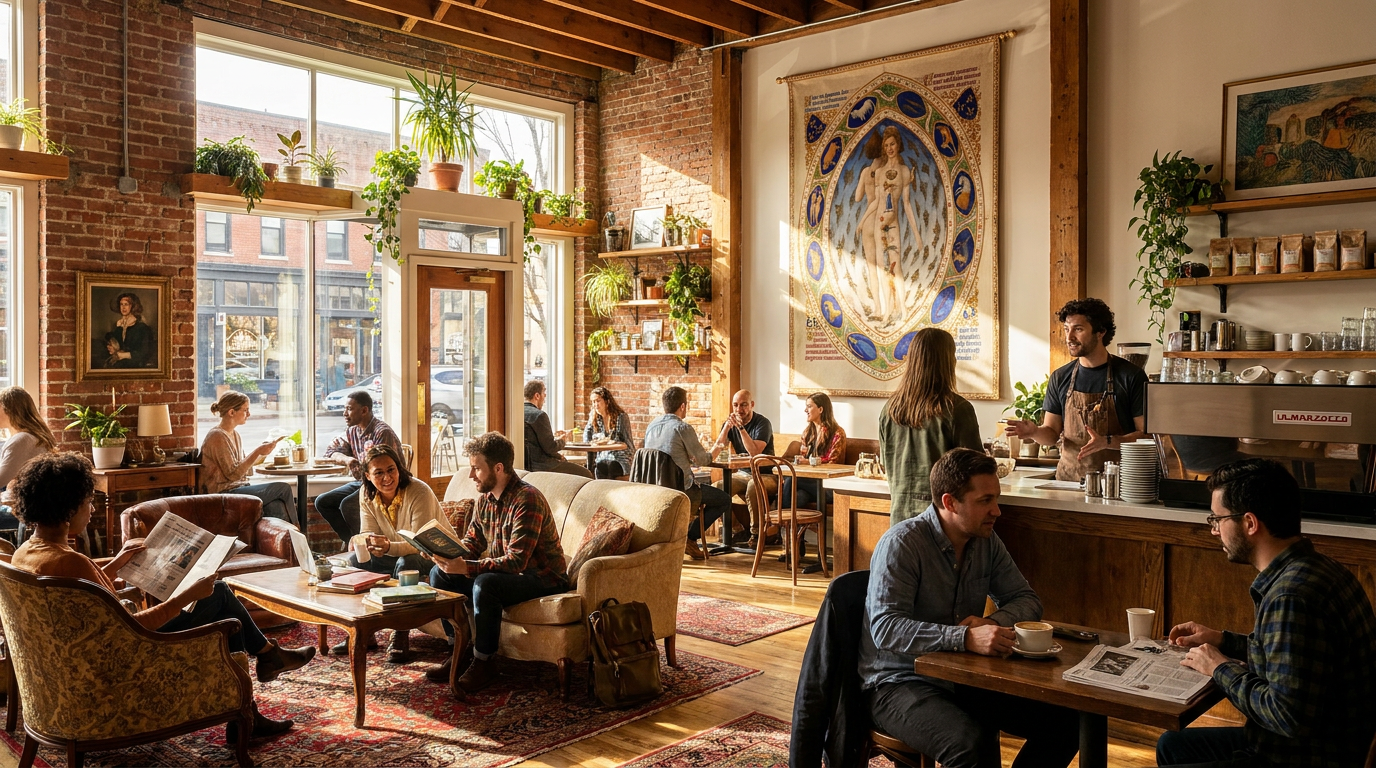
At the center of this revival is the concept of the "third place." Coined by American sociologist Ray Oldenburg in his 1989 book The Great Good Place, the term describes the informal public spaces that exist outside of the home (the "first place") and the workplace (the "second place"). These are the environments where people go simply to exist in the presence of others, free from the productivity demands of the office or the domestic responsibilities of the house.[2][3][5]
Third places serve as the anchors of community life. They encompass a wide variety of settings, from local cafes, public libraries, and barbershops to neighborhood parks and community recreation centers. In these spaces, titles and social statuses tend to fade into the background. A corporate executive and a college student can sit at adjacent tables or share a park bench, leveled by the neutral ground of the environment. In a true third place, conversation is the primary activity, and the atmosphere is inherently inviting.[2][8]

The magic of the third place relies heavily on a sociological phenomenon known as "weak ties." First identified by Stanford sociologist Mark Granovetter in a landmark 1973 paper, weak ties are the acquaintances and familiar strangers who exist on the periphery of our lives. They are the people we recognize but do not know deeply—the barista who remembers your coffee order, the fellow dog walker you nod to every morning, or the regular who always occupies the corner booth at the diner.[4][7]
While strong ties—our family members and closest friends—provide essential emotional support and intimacy, Granovetter discovered that weak ties serve a different, equally vital structural purpose. Because our close friends tend to know the same people and share the same information, our social circles can become echo chambers. Weak ties act as bridges to outside networks, exposing us to novel information, diverse perspectives, and even new professional opportunities that we would never encounter within our immediate bubble.[4]
Modern psychology has expanded on Granovetter's structural theories, revealing that these superficial interactions profoundly impact our daily mental health. Research led by psychologist Gillian Sandstrom demonstrates that individuals with a wider network of weak ties report significantly higher levels of overall happiness and a greater sense of community belonging.[4][7]

Sandstrom's studies found that on days when individuals engage in a higher number of casual interactions than usual, their mood measurably improves. These low-pressure exchanges require far less emotional investment and cognitive load than deep, intimate conversations. For someone feeling stressed, busy, or socially anxious, a brief, friendly exchange with a stranger can provide a vital micro-dose of human connection without the heavy demands of maintaining a close relationship.[7]
Sandstrom's studies found that on days when individuals engage in a higher number of casual interactions than usual, their mood measurably improves.
Despite their proven psychological and societal benefits, physical third places have faced a steep decline over the past few decades. Suburban sprawl and car-centric urban planning have systematically dismantled the walkable, mixed-use neighborhoods where informal gathering spots naturally thrive. Restrictive zoning laws in many municipalities have banned commercial establishments like corner stores or cafes from residential areas, forcing people into their cars and isolating them from their immediate neighbors.[6][8]
The rise of digital commerce and the COVID-19 pandemic dramatically accelerated this erosion. As brick-and-mortar venues faced temporary or permanent closures, socialization was pushed increasingly onto screens. The serendipity of bumping into an acquaintance at the local market was replaced by the frictionless, but ultimately sterile, efficiency of doorstep delivery and scheduled video calls.[6]
However, a deliberate post-pandemic revival is currently underway across the United States and beyond. Urban planners, public health officials, and local governments are increasingly recognizing that "social infrastructure" is just as critical to a city's survival as its roads and bridges. There is a growing consensus that combating the loneliness epidemic requires physical spaces designed specifically to foster human connection.[5][6]
Cities are experimenting with tactical urbanism to reclaim space for people. Municipalities are transforming street-side parking spaces into parklets, pedestrianizing commercial corridors, and redesigning public plazas to encourage lingering rather than just passing through. By adding movable seating, public art, and shade structures, planners are attempting to organically recreate the "living rooms" of society out in the open air.[8]

Public libraries are also undergoing a profound renaissance, evolving far beyond their traditional role as quiet book repositories. Today, libraries are positioning themselves as dynamic community hubs that offer everything from sewing classes and open chess play to tool-lending programs and co-working spaces. Crucially, they remain one of the few indoor third places where existence is entirely free, requiring no purchase to justify occupying a seat.[3]
The commercial sector is adapting to this cultural shift as well. Recognizing the deep consumer craving for connection, businesses are increasingly designing hybrid spaces. Independent bookstores, laundromats, and even climbing gyms are incorporating comfortable lounges and cafes to encourage patrons to stay, socialize, and build communities of interest around their hobbies.[6]
A lively debate remains over whether digital spaces—such as multiplayer video game lobbies, Discord servers, or specialized online forums—can truly function as modern third places. While these platforms undoubtedly offer community and connect like-minded individuals across vast distances, critics argue they often lack the physical serendipity and cross-demographic mixing that occurs when diverse neighborhood residents share a physical room.[6]
Ultimately, the data strongly supports the necessity of the physical revival. A 2022 survey by the Survey Center on American Life found that 58 percent of Americans feel close to their neighbors when they have physical third places—such as parks, coffee shops, and gyms—located nearby. The presence of these spaces directly correlates with higher civic trust and neighborhood resilience.[3]

Rebuilding the "great good places" of society requires intentionality from both city planners and individual citizens. As researchers like Richard Kyte point out, third places are not created by one group alone; they emerge when city leaders design accessible spaces, local businesses host welcoming environments, and residents take the initiative to show up regularly.[5]
By investing time and resources into our local third places, we do more than just buy a cup of coffee, borrow a book, or take a walk in the park. We actively participate in the architecture of connection, weaving the invisible social fabric of weak ties that makes our communities resilient, vibrant, and deeply human.[1]
How we got here
1973
Sociologist Mark Granovetter publishes his influential paper on the 'Strength of Weak Ties'.
1989
Ray Oldenburg coins the term 'Third Place' in his book The Great Good Place.
2020-2021
The COVID-19 pandemic forces the closure of physical gathering spaces, accelerating a shift to digital socialization.
2022
Surveys reveal that 58% of Americans feel closer to their neighbors when physical third places are accessible.
2025-2026
Urban planners and local governments launch initiatives to revive public spaces and combat the loneliness epidemic.
Viewpoints in depth
Urban Planners' View
Focusing on how the built environment dictates human connection.
Urban planners argue that the loneliness epidemic is largely a design problem. By prioritizing car-centric infrastructure, single-family zoning, and sprawling suburbs, cities have systematically engineered serendipity out of daily life. This camp advocates for mixed-use zoning, pedestrianized streets, and the aggressive expansion of public parks to force organic, face-to-face interactions back into the neighborhood ecosystem.
Sociologists' View
Emphasizing the psychological necessity of weak ties.
Sociologists and psychologists focus on the internal benefits of casual interactions. They argue that while society obsesses over deep friendships and romantic partnerships, it is the 'weak ties'—the barista, the mail carrier, the gym acquaintance—that provide a low-stakes sense of belonging. This perspective highlights that mental health interventions must include community-level socialization, not just individualized therapy.
Digital Community Advocates
Arguing that the third place has successfully migrated online.
Proponents of digital communities argue that the physical third place is an outdated metric for connection. They point to multiplayer gaming environments, Discord servers, and niche forums as the new frontier of the 'great good place.' In this view, digital spaces remove geographic and physical barriers, allowing individuals to find highly specific, supportive communities that a local neighborhood cafe could never provide.
What we don't know
- Whether digital 'third places' can provide the same long-term psychological benefits as physical, face-to-face interactions.
- How to ensure commercial third places remain accessible to lower-income residents amidst rising urban real estate costs.
- The long-term impact of remote work on the viability of downtown commercial third places.
Key terms
- Third Place
- A social environment outside of the home and workplace where people gather informally and build community.
- Weak Ties
- Acquaintances or familiar strangers on the periphery of our social networks, such as a local barista or a neighbor.
- Tactical Urbanism
- Low-cost, temporary changes to the built environment, like pop-up parks, intended to improve local neighborhoods and gathering spaces.
- Social Infrastructure
- The physical spaces and organizations that shape the way people interact, including libraries, parks, and community centers.
Frequently asked
What is the difference between a strong tie and a weak tie?
Strong ties are close relationships with family and deep friends, while weak ties are casual acquaintances like neighbors, baristas, or local shop workers.
Why are physical third places disappearing?
Suburban sprawl, car-centric zoning laws, and the rise of digital commerce have systematically reduced the number of physical gathering spaces in many neighborhoods.
Can an online community be a third place?
While online spaces offer connection and shared interests, sociologists debate whether they can fully replicate the serendipity and cross-demographic mixing of physical third places.
Do I have to spend money to access a third place?
Not necessarily. While cafes and gyms are commercial third places, public libraries, community centers, and parks serve as vital free-to-enter alternatives.
Sources
Source coverage
8 outlets
3 viewpoints surfaced








[1]Factlen Editorial TeamCommunity Advocates
Synthesis by Factlen editorial team
Read on Factlen Editorial Team →[2]The Shanker InstituteSociologists & Psychologists
Third Places and Their Role in Child Development
Read on The Shanker Institute →[3]Smithsonian MagazineCommunity Advocates
The History of 'Third Places' and Why We Need Them Now More Than Ever
Read on Smithsonian Magazine →[4]Ed Batista Executive CoachingSociologists & Psychologists
The Value of Weak Ties
Read on Ed Batista Executive Coaching →[5]University of Missouri ExtensionCommunity Advocates
Creating Third Places for Connection and Belonging
Read on University of Missouri Extension →[6]ArchDailyUrban Planners
Third Places in the United States: Commercialized or Community-Centered?
Read on ArchDaily →[7]Marmalade TrustSociologists & Psychologists
The Power of Weak Ties
Read on Marmalade Trust →[8]BrookingsUrban Planners
Third places as community builders
Read on Brookings →
Every angle. Every day.
Get lifestyle stories with full source coverage and perspective breakdowns delivered to your inbox.