
The Mechanics of the Synchronized Alert: How Heightened US-Iran Tensions Reshape Middle East Air Travel and Security
Following a synchronized security alert across eleven US embassies, global airlines and aviation regulators have executed a massive logistical pivot to safely reroute Europe-Asia air traffic around the Middle East.

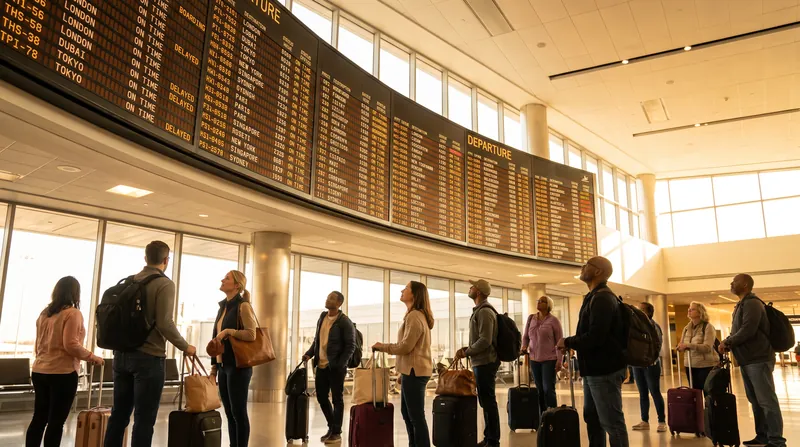
- Global Aviation Regulators
- Prioritizing absolute risk avoidance through strict airspace closures and synchronized alerts.
- International Network Carriers
- Focusing on operational predictability by suspending routes rather than navigating congested corridors.
- Gulf Hub Operators
- Leveraging regional expertise and dynamic routing to safely maintain global connectivity.
Why this matters
For travelers with late-summer international itineraries, this synchronized safety pivot means longer flight times and potential schedule adjustments. Understanding how airlines and regulators seamlessly reroute global traffic provides peace of mind that passenger safety remains the industry's absolute priority, even amid geopolitical friction.
Key points
- On August 1, US Embassies across eleven Middle East countries issued synchronized security alerts, prompting immediate aviation responses.
- Global regulators like the FAA and EASA have mandated strict avoidance of Iranian airspace due to heightened military activity.
- Europe-Asia flights are being safely funneled into narrow north-south corridors over the Caucasus and the Red Sea.
- Several international carriers, including British Airways and Singapore Airlines, have suspended regional flights to avoid operational strain.
- Gulf hub operators like Emirates continue to maintain global connectivity through dynamic scheduling and advanced routing.
On August 1, across eleven Middle East capitals, smartphones buzzed in unison with the exact same urgent directive from the US State Department. The synchronized security alert—issued simultaneously from embassies in Amman, Cairo, Dubai, and beyond—was not just a localized warning for travelers to remain vigilant. It served as the starting gun for one of the most complex logistical pivots in modern commercial aviation, setting off a chain reaction in airline dispatch centers from London to Singapore.[1][3]
The catalyst for this unprecedented coordination is a sharp escalation in US-Iran military tensions, particularly around the strategic Strait of Hormuz. With the breakdown of a recent ceasefire and renewed naval and aerial activity, the airspace above the region has become a volatile patchwork. For passengers settling into their seats with a movie queued up for a long-haul flight between Europe and Asia, the geopolitical friction below translates into a highly choreographed ballet of rerouting, ensuring that their journey remains entirely insulated from the conflict.[2][6]
At the heart of this safety net are the global aviation regulators, who act as the ultimate arbiters of where commercial jets can safely fly. The US Federal Aviation Administration (FAA) and the European Union Aviation Safety Agency (EASA) have both issued strict notices—known as NOTAMs and Conflict Zone Information Bulletins—effectively closing the Tehran Flight Information Region to their respective carriers. These directives are not mere suggestions; they are hard boundaries that redraw the map of global travel overnight.[2]
The mechanics of avoiding Iranian and Syrian airspace require funneling thousands of daily flights into narrow, heavily trafficked corridors. Dispatchers are now routing Europe-bound traffic far to the north, threading the needle through the Caucasus and Central Asia. Alternatively, flights are pushed south, tracing the Red Sea over Egypt and Saudi Arabia. For the traveler looking out the window, the shift might only be noticeable as a different coastline passing below, but in the cockpit, it represents a fundamental recalculation of fuel, weight, and time.[2][3]
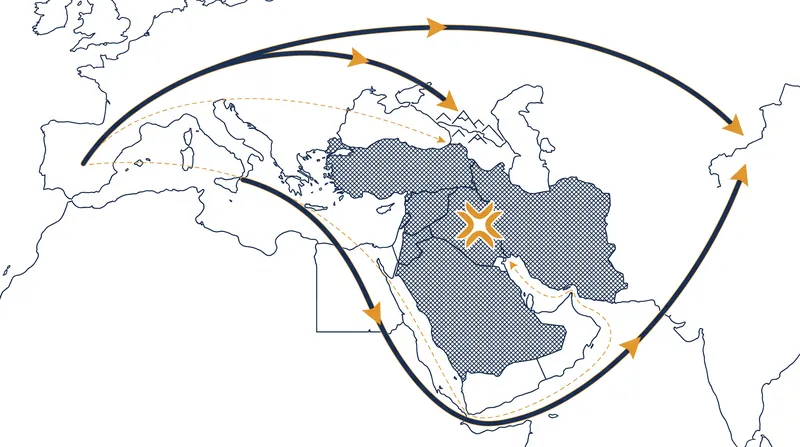
This southern and northern funneling adds considerable time to standard itineraries. A flight from London to Singapore, for instance, now requires extra fuel to accommodate the wider arc, which in turn tightens crew rotation schedules and increases the likelihood of missed connections at major hubs. Airlines are forced to balance the absolute necessity of passenger safety against the cascading operational delays that these longer routes inevitably cause.[3][6]
This southern and northern funneling adds considerable time to standard itineraries.
International network carriers have largely opted for caution, choosing to suspend services to key Middle Eastern destinations rather than risk the operational strain. British Airways has permanently suspended its flights to Jeddah, while extending pauses on routes to Bahrain and Amman. Similarly, Singapore Airlines has pushed its suspension of Dubai flights deep into October, offering affected passengers full refunds or alternative routings rather than attempting to navigate the congested southern corridors.[4][5]
European legacy carriers are following a similar playbook to protect their passengers and crews. KLM has halted its services to Dubai, Riyadh, and Dammam through early September, and Lufthansa has canceled thousands of flights across its broader network to manage the twin pressures of airspace restrictions and soaring jet fuel costs. For travelers holding tickets on these airlines, the synchronized alert means their late-summer plans require immediate rebooking, often onto partner airlines or entirely different transit hubs.[1][5]
Yet, amidst the suspensions, the Gulf's major hub operators are demonstrating remarkable operational resilience. Emirates and flydubai have largely maintained their schedules, utilizing their deep familiarity with regional air traffic control to navigate the safe corridors smoothly. While passengers might experience slight delays or schedule adjustments, the massive transit hubs in the UAE remain fully operational, keeping the vital link between East and West intact and welcoming travelers with their usual efficiency.[4][6]

Qatar Airways has also adapted its network dynamically to the evolving situation. While the Doha-based carrier extended temporary suspensions to specific regional destinations like Bahrain, Kuwait, and Erbil through the first week of August, it continues to operate the vast majority of its long-haul network. By shifting aircraft deployment and relying on newly established directional routes, these regional giants are proving that the aviation industry can adapt to even the most severe airspace constraints without stranding passengers.[4]
Ultimately, the synchronized alerts and the resulting airspace closures highlight a triumph of modern aviation safety. The system is designed to bend rather than break. Through real-time data sharing, conservative regulatory oversight, and the agility of airline dispatchers, the industry ensures that geopolitical conflicts remain firmly on the ground. For the millions of passengers taking to the skies this August, the rerouted corridors are a testament to an invisible, highly effective safety apparatus that prioritizes their well-being above all else.[3][6]
Viewpoints in depth
Global Aviation Regulators
Prioritizing absolute risk avoidance through strict airspace closures.
Agencies like the FAA and EASA operate on a mandate of zero tolerance for conflict-zone risk. By issuing NOTAMs and Conflict Zone Information Bulletins, these regulators remove the guesswork for airlines, mandating that the Tehran and Baghdad Flight Information Regions be avoided entirely. Their approach relies on the principle that adding hours to a flight is always preferable to exposing civilian aircraft to the unpredictable nature of military air defense systems.
International Network Carriers
Focusing on operational predictability and crew safety by suspending routes.
For legacy carriers based in Europe and Asia, the logistical strain of flying the longer, congested corridors often outweighs the commercial benefit of maintaining the route. Airlines like British Airways and Singapore Airlines argue that extending flight times disrupts delicate crew rotation limits and cascades delays across their entire global networks. By suspending flights to key Middle Eastern hubs, they prioritize the stability of their broader operations and the well-being of their staff.
Gulf Hub Operators
Leveraging regional expertise to maintain global connectivity safely.
Carriers headquartered in the UAE and Qatar view the airspace restrictions as a complex but manageable logistical puzzle. Operating from the center of the affected region, airlines like Emirates and Qatar Airways utilize their deep familiarity with local air traffic control to thread their flights through the remaining safe corridors. They argue that with dynamic scheduling and advanced dispatch technology, they can safely maintain the vital transit links between East and West without compromising passenger security.
Sources
Source coverage
6 outlets
3 viewpoints surfaced





[1]TravelValueFinderGlobal Aviation Regulators
August 2026 Travel Alerts: US Embassy Warnings Across 16 Countries, Middle East Flight Crisis
Read on TravelValueFinder →[2]SafeAirspaceGlobal Aviation Regulators
Risk Level: One - Do Not Fly (Iran / Syria)
Read on SafeAirspace →[3]The TravelerGlobal Aviation Regulators
US Issues New Middle East Travel Alert Amid Iran Conflict
Read on The Traveler →[4]Arabian BusinessGulf Hub Operators
UAE flights: Emirates, flydubai, Qatar Airways, Etihad update schedules amid regional tensions
Read on Arabian Business →[5]The NationalInternational Network Carriers
Middle East flights: Which airlines have suspended or cancelled services amid US-Iran conflict?
Read on The National →[6]Gulf NewsGulf Hub Operators
US-Iran conflict: What it means for UAE residents and flights
Read on Gulf News →
Comments

Every angle. Every day.
Get travel stories with full source coverage and perspective breakdowns delivered to your inbox.