
How Europe is Re-Engineering Its Supply Chain for a Shallow-Water Rhine
As the Rhine River hits historic lows, European industries are moving beyond crisis management. From shallow-draft barges to predictive data systems, here is how the continent is adapting to a permanently altered economic artery.

- Industrial Adapters
- Focuses on engineering solutions, buffer stocks, and technological adaptations to maintain production.
- Logistics & Freight Operators
- Highlights the immediate pricing dynamics, capacity constraints, and the mathematical challenge of shallow-water shipping.
- Macroeconomists
- Analyzes the broader GDP impact and the structural risks to Europe's export-driven economy.
Perspectives this story doesn't cover
- Local River Communities
- Rail Network Operators
When the Rhine River's water levels drop to historic lows, the immediate assumption is that European industry will simply grind to a halt. The reality is far more complex—and far more resilient. As the critical Kaub gauge plummeted below 24 centimeters in August 2026, breaking records that date back to 1880, headlines warned of an unprecedented economic crisis. But framing this as a sudden catastrophe misses the structural shift already underway. Europe is not just waiting for rain; it is actively re-engineering its supply chains for a shallow-water future.[1]
The argument that the Rhine is a dying artery ignores the massive capital being deployed to keep it alive. Yes, the immediate numbers are stark. The port of Duisburg, nestled in Germany's steel-producing Ruhr region, reported that vessel loading capacities dropped to about one-third of their usual levels by early August. Freight rates for petroleum products shipped between Rotterdam and Karlsruhe surged to €200 per tonne, shattering the previous record of €130 set during the 2022 drought.[2]
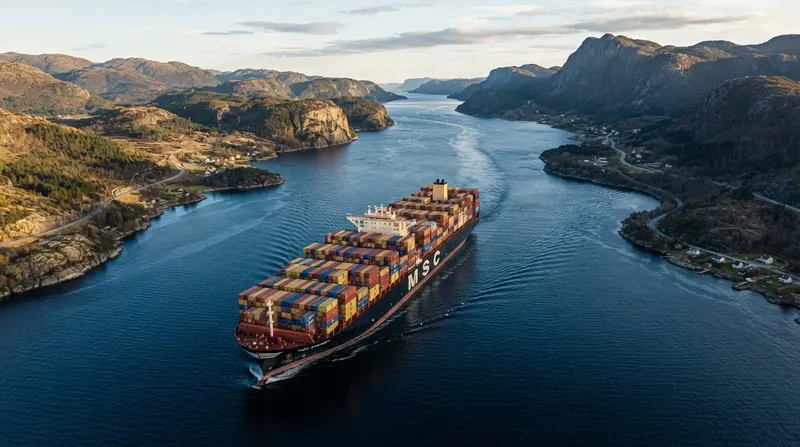
To understand why these costs spike, one must look at the mechanics of river logistics, specifically the Kaub gauge. Located at the shallowest part of the Middle Rhine, Kaub acts as the ultimate chokepoint for vessels heading to southern Germany and Switzerland. The gauge does not measure the absolute depth of the river, but rather serves as a reference point for the navigable channel.
The physics of barge transport are unforgiving. A standard 135-meter container vessel can carry its full capacity when the Kaub gauge reads 250 centimeters. When the gauge drops to 75 centimeters, that same vessel can only safely load 25% of its cargo. Below 40 centimeters, traditional freight navigation becomes practically impossible.
This mathematical reality means that when the water drops, the number of ships required multiplies. If a barge can only carry one-quarter of its normal load, logistics operators need four vessels to move the same volume of goods. This sudden demand for hull space is what drives up shipping rates and triggers "low water surcharges," with major carriers like CMA CGM halting standard barge transport entirely when the gauge dips below 24 centimeters.
This mathematical reality means that when the water drops, the number of ships required multiplies.
The macroeconomic drag of this bottleneck is undeniable. The Kiel Institute for the World Economy estimates that the logistics disruptions caused by the August 2026 low-water event could reduce Germany's gross domestic product by 0.1% to 0.2% in the third quarter. For an economy heavily reliant on the export of manufactured goods and the import of raw materials, that translates to billions of euros in lost value.[3]
However, the strongest counter-argument to the "doom" narrative is the rapid pace of industrial adaptation. Major players are no longer treating these droughts as "once-in-a-century" anomalies. Chemical giant BASF and steelmaker Thyssenkrupp have fundamentally altered their fleet compositions, deploying newly designed shallow-draft vessels that can navigate the river even when water levels hit historic lows.[2][4]
These specialized ships feature wider, flatter hulls that distribute weight more evenly, allowing them to carry substantial payloads with significantly less draft. While they require significant upfront investment, they ensure that critical raw materials—from iron ore to petrochemicals—continue to flow to blast furnaces and production complexes regardless of the weather.[2][5]
Beyond hardware, the government is stepping in with predictive data infrastructure. In July 2026, the German government launched the Low Water Information System (NIWIS). Consolidating daily data on river levels, groundwater, and soil moisture, NIWIS replaces a fragmented patchwork of regional systems, giving logistics planners the centralized foresight needed to reroute cargo before bottlenecks form.
As Environment Minister Carsten Schneider noted during the launch, water availability is now a primary factor in business decisions, warning that inaction could cost the economy €625 billion by 2050. By providing actionable daily intelligence, NIWIS allows companies to dynamically shift their reliance between river, rail, and road transport based on predictive models rather than reactive panic.
The uncertainty in this adaptation strategy lies in the limits of alternative transport. When the river fails, companies naturally look to trains and trucks. But the sheer volume of goods moved on the Rhine—some 285 million tonnes annually—cannot be easily absorbed by Germany's overstretched rail network or a trucking sector facing chronic driver shortages.[2][5]
This is why the ultimate solution is not abandonment of the river, but a hybrid model of resilience. Companies are increasing their buffer stocks, storing more coal and chemicals on-site during high-water months to ride out the dry seasons. The Rhine will remain Europe's most vital economic artery, but the era of taking its depth for granted is over. The continent is proving that with the right mix of engineering, data, and foresight, a shallower river does not have to mean a shallower economy.[4]
Key points
- The Rhine River's Kaub gauge fell below 24 centimeters in August 2026, breaking low-water records that date back to 1880.
- Rather than halting production, major industrial players are deploying newly designed shallow-draft vessels to navigate the depleted waterway.
- Germany has launched a centralized predictive data platform, NIWIS, to help logistics operators reroute cargo before bottlenecks form.
- Shifting river freight to rail and road remains difficult due to the sheer volume of goods and existing infrastructure constraints.
- Economists estimate the logistics friction could reduce Germany's third-quarter GDP by up to 0.2%, underscoring the need for permanent adaptation.
Key terms
- Kaub Gauge
- A decisive water-level measurement station on the Rhine River that dictates the maximum allowable draft for cargo vessels heading to southern Germany.
- Low Water Surcharge
- An additional fee imposed by shipping companies to compensate for the lost revenue when vessels are forced to carry less cargo due to shallow waters.
- NIWIS
- Germany's Low Water Information System, a centralized platform launched in 2026 to monitor and predict water scarcity across the country.
- Draft
- The vertical distance between the waterline and the bottom of a ship's hull, which determines the minimum depth of water a ship needs to safely navigate.
Sources
Source coverage
5 outlets
3 viewpoints surfaced




- [1]Insurance JournalMacroeconomists
Rhine Falls to Lowest Since 1880, Threatening European Trade
Read on Insurance Journal → - [2]EuractivLogistics & Freight Operators
Low water on Germany's Rhine river threatens new blow to economy
Read on Euractiv → - [3]Anadolu AgencyMacroeconomists
Germany's economy facing serious shipping difficulties on Rhine River
Read on Anadolu Agency → - [4]INGIndustrial Adapters
Extreme low water on the Rhine River disrupts supply chains
Read on ING → - [5]The Straits TimesLogistics & Freight Operators
Low water on Germany's Rhine river threatens new blow to economy
Read on The Straits Times →
Comments
More in Opinion
See all →Seismology
The Gutenberg-Richter Law: Why Small Earthquakes Are Exponentially More Common Than Large Ones
7 sources
Stellar Physics
The Eddington Limit: Why Radiation Pressure, Not Fuel, Sets the Maximum Mass of a Star
8 sources

Tribology
The Archard Equation: Why Wear Volume Is Proportional to Load, Not Contact Area
3 sources

Wind Energy Physics
The 400 TW Geophysical Limit: Why Atmospheric Drag, Not the Betz Formula, Sets the Ceiling for Global Wind Energy
7 sources
Every angle. Every day.
Get Opinion stories with full source coverage and perspective breakdowns delivered to your inbox.