
The Local AI Revolution: How Open-Source Models Moved from the Cloud to Your Laptop
Advances in hardware and quantization have made it possible to run frontier-level AI models entirely offline. Here is how local inference works, and why it is reshaping the AI landscape in 2026.
By Factlen Editorial Team
- Privacy and Security Advocates
- Values the ability to run AI entirely offline, ensuring that sensitive data, proprietary code, and personal documents never leave the user's device.
- Hardware Ecosystem Builders
- Focuses on the architectural race between Apple, Microsoft, and chipmakers to optimize consumer hardware for native AI inference.
- Open-Source Developers
- Prioritizes the democratization of AI capabilities, emphasizing the importance of permissive licensing and community-driven fine-tuning.
What's not represented
- · Cloud API Providers
- · Enterprise IT Administrators
Why this matters
Running AI locally means your data never leaves your device, eliminating privacy risks and recurring API subscription fees. As consumer hardware becomes capable of running frontier models, everyday users gain access to powerful, uncensored digital assistants that work entirely offline.
Key points
- Local AI inference allows users to run powerful language models entirely offline, ensuring data privacy.
- Quantization techniques compress massive models to fit within the memory limits of standard consumer laptops.
- Apple's Unified Memory and Windows NPUs have drastically accelerated the speed of local AI processing.
- Models like Llama 4, Gemma 4, and Phi-4 offer frontier-level performance without requiring cloud APIs.
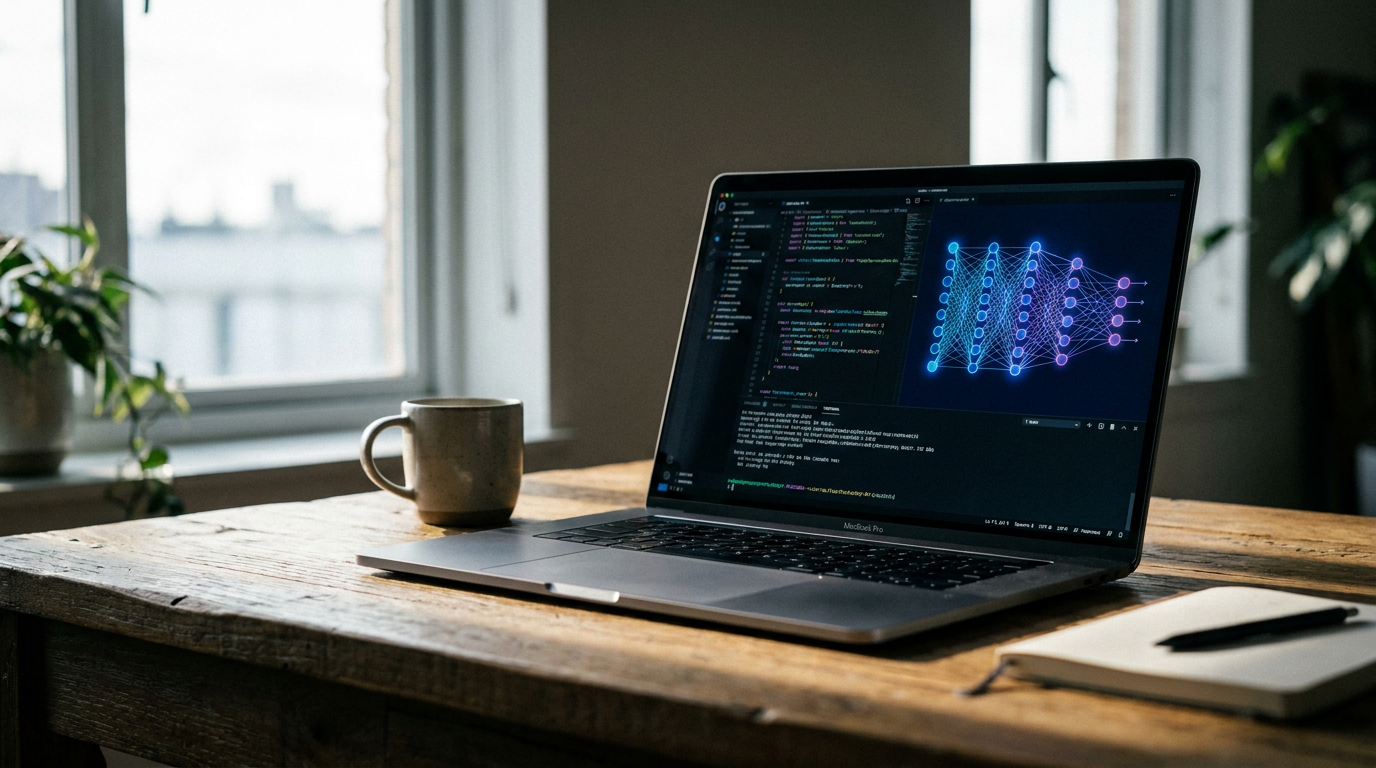
The era of cloud-only artificial intelligence is quietly ending. While massive data centers still train the world's most powerful models, the center of gravity for daily AI use is shifting to the devices sitting on our desks. In 2026, running a frontier-level large language model (LLM) locally is no longer a bleeding-edge hobby reserved for researchers. It has become a practical, everyday reality for developers, writers, and businesses.[1][4]
The appeal of local AI is rooted in three fundamental advantages: privacy, cost, and control. When an AI model runs directly on a laptop or workstation, the user's prompts, proprietary code, and sensitive documents never leave the device. There are no API calls to third-party servers, no monthly subscription fees, and no sudden changes to the model's behavior due to corporate updates.[1][2]
This shift from cloud dependency to local sovereignty was not achieved by simply shrinking the models. It required a synchronized breakthrough across three distinct layers of technology: hardware architecture, inference software, and model design. Together, these innovations have compressed what used to require a server rack into a software package that can run on a standard consumer laptop.[4][7]
The first major catalyst was the maturation of inference engines, most notably the open-source project llama.cpp. Originally created as a lightweight way to run Meta's early models, it introduced the masses to a technique called quantization. Quantization mathematically compresses a model's weights—the billions of parameters that dictate its behavior—from high-precision 16-bit or 32-bit floating-point numbers down to 4-bit integers.[2][4]

In practice, quantization means a model that would normally require 30 gigabytes of video memory can be squeezed into just 8 gigabytes, with only a negligible drop in output quality. This compression technique single-handedly unlocked the ability to run capable AI on standard consumer hardware, bypassing the need for expensive, specialized graphics cards.[2]
Hardware manufacturers quickly recognized the shift and began optimizing their silicon for local inference. Apple's M-series chips provided an early, massive advantage through their Unified Memory architecture. In a traditional PC, the central processing unit (CPU) and the graphics processing unit (GPU) have separate memory pools, creating a bottleneck when massive AI models need to shuttle data back and forth.[3][6]
Apple's architecture allows the CPU and GPU to share the exact same pool of memory. To capitalize on this, Apple released the MLX framework, an open-source machine learning library designed specifically for Apple Silicon. By eliminating data transfer overhead, MLX enables Macs to run local LLMs 20 to 50 percent faster than generic frameworks, turning standard MacBooks into highly capable AI workstations.[3][6]
Apple's architecture allows the CPU and GPU to share the exact same pool of memory.
The Windows ecosystem responded with its own architectural leap: the Neural Processing Unit (NPU). Found in the latest generation of processors from Qualcomm, Intel, and AMD, the NPU is a dedicated slice of silicon designed exclusively for AI math. Unlike a power-hungry GPU, an NPU can run background AI tasks with minimal battery drain.[5]
To harness these NPUs, Microsoft introduced Foundry Local and DirectML 2.0 in 2026. This software layer provides a unified abstraction, allowing developers to write an AI application once and have it run seamlessly across NVIDIA GPUs, Intel CPUs, or Snapdragon NPUs. This means local AI models can now operate as background services in Windows, quietly summarizing documents or organizing files without interrupting the user's primary workflow.[5]
Of course, powerful hardware and efficient software require capable models to run. The landscape of available models has exploded, led by Meta's Llama 4 family. Released with a Mixture-of-Experts (MoE) architecture, Llama 4 Scout activates only a fraction of its 109 billion total parameters for any given word, allowing it to process a staggering 10-million-token context window while remaining efficient enough for high-end local setups.[4]

Google has also entered the local arena aggressively with its Gemma 4 series. The 12-billion and 26-billion parameter versions of Gemma 4 are specifically engineered to run on consumer hardware, offering native multimodal capabilities—meaning they can process both text and images—while fitting comfortably within 16 gigabytes of RAM.[1][4]
Meanwhile, Microsoft's Phi-4 and Alibaba's Qwen3 families have proven that massive parameter counts are not strictly necessary for high performance. Phi-4, a 14-billion parameter model trained heavily on synthetic, textbook-quality data, routinely outperforms much larger models on reasoning and coding benchmarks, making it ideal for memory-constrained devices.[1][4]
As the ecosystem matures, a critical distinction has emerged between open-source and open-weight models. True open-source models release their training data, code, and weights under permissive licenses like Apache 2.0 or MIT. However, many of the most popular models, including Llama 4, are technically open-weight.[4]

Open-weight models allow users to download and run the final, trained neural network, but the underlying data used to train it remains a closely guarded corporate secret. While this distinction matters deeply for licensing and commercial product development, for the everyday user running a local coding assistant or document summarizer, the practical benefit is the same: free, private, offline AI.[1][4]
Looking ahead, the trajectory of local AI mirrors the evolution of personal computing in the 1980s. Just as massive mainframes were eventually supplemented by personal computers that empowered individuals, cloud-based AI monoliths are now being complemented by personal, localized models. By moving intelligence to the edge, the technology is becoming less of a centralized service and more of a fundamental, ubiquitous utility.[1][7]
How we got here
February 2023
Meta releases the original Llama model, sparking the open-source and local AI movement.
December 2023
Apple introduces the MLX framework to optimize machine learning natively on Apple Silicon.
April 2025
Meta releases Llama 4 with a highly efficient Mixture-of-Experts architecture.
June 2026
Microsoft announces general availability of Foundry Local for on-device AI inference via Windows NPUs.
Viewpoints in depth
Privacy and Security Advocates
Focuses on the necessity of data sovereignty in the AI era.
For privacy advocates, the shift to local AI is an essential defense against corporate surveillance and data harvesting. When an AI model runs locally, the surface of attack is dramatically reduced. Legal documents, proprietary source code, and personal health queries can be processed without ever being transmitted to a third-party server. This camp argues that relying on cloud APIs creates an unacceptable vulnerability, as users are entirely dependent on the security practices and terms of service of the provider.
Hardware Ecosystem Builders
Views local AI as the next major battleground for consumer hardware dominance.
Hardware manufacturers and operating system developers see local inference as the key to driving the next supercycle of device upgrades. Apple's integration of the MLX framework with its Unified Memory architecture gave it an early lead, turning Macs into default AI developer machines. In response, Microsoft and chipmakers like Qualcomm and AMD are heavily pushing Neural Processing Units (NPUs) to make Windows PCs equally capable. For this camp, the goal is to make AI a seamless, battery-efficient background service integrated directly into the operating system.
Open-Source Developers
Emphasizes the democratization of AI technology and the importance of permissive licensing.
The open-source community views local inference as the ultimate equalizer, allowing individual developers to build applications that rival those of massive tech corporations. However, this camp is increasingly focused on the distinction between true open-source models and 'open-weight' models. While they celebrate the availability of powerful tools like Llama 4, they advocate strongly for models released under permissive licenses like Apache 2.0 or MIT, which allow for unrestricted commercial use and community-driven fine-tuning without corporate oversight.
What we don't know
- Whether future frontier models will grow too large for consumer hardware to keep pace, even with advanced quantization.
- How impending AI regulations might impact the distribution of open-weight models to the general public.
- Whether hardware manufacturers will eventually lock down local AI capabilities behind proprietary software ecosystems.
Key terms
- Quantization
- A mathematical technique that compresses an AI model by reducing the precision of its weights, allowing it to run on devices with less memory.
- Unified Memory
- An architecture used by Apple Silicon where the CPU and GPU share the same pool of memory, eliminating the bottleneck of transferring data between them.
- NPU (Neural Processing Unit)
- A specialized hardware chip designed specifically to accelerate artificial intelligence tasks efficiently without draining battery life.
- Open-Weight Model
- An AI model where the final, trained neural network is available to download, but the underlying training data and code remain proprietary.
- Mixture-of-Experts (MoE)
- An AI architecture that divides a model into specialized sub-networks, activating only the necessary 'experts' for a given prompt to save computing power.
Frequently asked
Do I need an internet connection to run a local LLM?
No. Once the model weights are downloaded to your device, the AI runs entirely offline, ensuring complete privacy and zero latency from network round-trips.
What kind of computer do I need?
Most modern models can run on a standard laptop with 8GB to 16GB of RAM, though Apple Silicon Macs or PCs with dedicated GPUs or NPUs offer significantly faster performance.
Are these models as smart as ChatGPT?
While massive cloud models still hold an edge in complex reasoning, modern local models like Llama 4 and Qwen3 are highly competitive for everyday tasks like coding, writing, and summarization.
Is it free to use?
Yes. Running an open-weight model locally incurs zero API costs or subscription fees, though you do bear the electricity cost of running your own hardware.
Sources
Source coverage
7 outlets
3 viewpoints surfaced






[1]Hugging FacePrivacy and Security Advocates
The Best Open Source LLM Models to Run Locally in 2026
Read on Hugging Face →[2]Red HatPrivacy and Security Advocates
llama.cpp vs. vLLM: Choosing the right engine for your AI journey
Read on Red Hat →[3]The New StackHardware Ecosystem Builders
Ollama Updates Bring Apple MLX and NVIDIA NVFP4 Support
Read on The New Stack →[4]CodeToCloudOpen-Source Developers
Open-Source LLMs for Developers: The Complete Guide
Read on CodeToCloud →[5]BuildFastWithAIHardware Ecosystem Builders
Foundry Local GA: Full AI Inference On-Device
Read on BuildFastWithAI →[6]LLMCheckHardware Ecosystem Builders
Apple MLX vs. NVIDIA: How local AI inference works on the Mac
Read on LLMCheck →[7]Factlen Editorial TeamOpen-Source Developers
Synthesis by Factlen editorial team
Read on Factlen Editorial Team →

More in ai
See all 7 stories →Edge AI
How On-Device AI and Quantization Are Moving LLMs Out of the Cloud
6 sources

Agentic AI
Agentic AI: How Large Action Models Are Automating Digital Chores
7 sources

Global AI Governance
EU Delays Key AI Act Enforcement as 'Brussels Effect' Fractures Under US Deregulation
8 sources

Drug Discovery
New AI Model Accelerates Molecular Simulations 10,000-Fold, Promising Faster Drug Discovery
6 sources

Every angle. Every day.
Get ai stories with full source coverage and perspective breakdowns delivered to your inbox.