
The "Green Collar" Boom: How Vocational Schools are Powering the Renewable Energy Transition
As the demand for wind turbine technicians, solar installers, and EV mechanics skyrockets, community colleges and trade schools are offering lucrative, fast-track career paths that bypass the four-year degree.
By Factlen Editorial Team
- Vocational Educators
- Advocates for community colleges and trade schools as the primary engine for the green workforce.
- Labor Economists
- Analysts tracking the supply, demand, and wage dynamics of the clean energy transition.
- Clean Energy Employers
- Companies building the infrastructure and servicing the new technology.
What's not represented
- · Traditional Auto Mechanics
- · Fossil Fuel Workers
Why this matters
The transition to renewable energy is creating a massive, highly-paid job market that doesn't require a four-year college degree. For workers seeking financial stability and upward mobility, 'green-collar' vocational training offers a future-proof career path with immediate hiring demand.
Key points
- Wind turbine technicians and solar installers are projected to see 50% and 42% job growth respectively by 2034.
- Electric vehicle technicians command a 30% wage premium over traditional auto mechanics due to specialized high-voltage skills.
- Only 1.4% of ASE-certified automotive technicians currently hold EV-specific certifications, creating a massive labor bottleneck.
- Community colleges and trade schools are rapidly expanding 14-week to 1-year certificate programs to train 'middle-skill' workers.
- Clean energy companies are increasingly funding apprenticeships and guaranteeing job placement to secure human capital.
The transition to a clean energy economy is often framed as a story of technological breakthroughs and sweeping government policies. But on the ground, the shift is fundamentally a labor story. The United States is currently undergoing a massive rewiring of its infrastructure, requiring millions of solar panels, thousands of wind turbines, and a nationwide network of electric vehicle charging stations. This physical transformation has sparked a surge in demand for a new class of worker: the "green-collar" technician.[6]
Green-collar jobs are career-track roles that directly contribute to environmental sustainability, blending the hands-on work of traditional blue-collar trades with the specialized technical knowledge required for modern energy systems. Unlike many sectors of the modern economy that demand a four-year university degree, the clean energy boom is largely fueled by "middle-skill" labor. These positions require post-secondary training—such as a vocational certificate or an apprenticeship—but bypass the traditional, and often debt-heavy, bachelor's degree pathway.[6][7]
The sheer scale of the labor demand is staggering, consistently outpacing the broader job market. According to the Bureau of Labor Statistics, employment for wind turbine service technicians is projected to grow by 50 percent between 2024 and 2034. This makes it one of the fastest-growing occupations in the country, far exceeding the 4 percent average growth rate for all jobs.[1]
Solar photovoltaic (PV) installers are seeing a similarly explosive trajectory. The Bureau of Labor Statistics projects a 42 percent growth rate for solar installers over the same decade. These workers are responsible for assembling, installing, and maintaining the mechanical and electrical components of solar arrays on residential roofs and commercial solar farms. Because there is no single mandated apprenticeship for solar installation, many workers enter the field through related trades, such as roofing or electrical work, before completing specialized PV training modules.[1][5]

The U.S. Department of Energy has explicitly identified a "wind energy workforce gap," noting that while the technology and capital are ready to deploy, the industry is struggling to find qualified applicants to build and maintain the infrastructure. This bottleneck has forced employers, academics, and government agencies to collaborate on rapid workforce development programs. The goal is to establish standardized safety and training guidance that can quickly move workers from the classroom to the field.[2]
Nowhere is this labor mismatch more acute than in the automotive sector. In 2024, electric vehicles accounted for a record 8.1 percent of all new car sales in the United States, totaling roughly 1.3 million vehicles. However, the workforce required to service these vehicles has not kept pace. Of the more than 229,000 automotive technicians certified by the National Institute for Automotive Service Excellence (ASE), only about 1.4 percent currently hold EV-specific certifications.[3]
Nowhere is this labor mismatch more acute than in the automotive sector.
This severe shortage of qualified personnel has created a highly lucrative market for those who do possess the right skills. Traditional auto mechanics primarily deal with internal combustion engines, but EV technicians must be proficient in diagnosing complex software systems and safely handling high-voltage battery packs. Because these skills are rare and highly specialized, EV technicians command a significant wage premium over their peers.[3][4]
Industry data from 2026 shows that the median base pay for an EV technician in the United States is approximately $70,000. This figure sits roughly 30 percent higher than the $49,670 median salary for all automotive service technicians reported by the Bureau of Labor Statistics. In states with the highest rates of EV adoption, such as California and Massachusetts, experienced technicians with high-voltage diagnostic skills and direct-current fast charging field experience can earn upwards of $85,000 to $95,000 annually.[3][4]

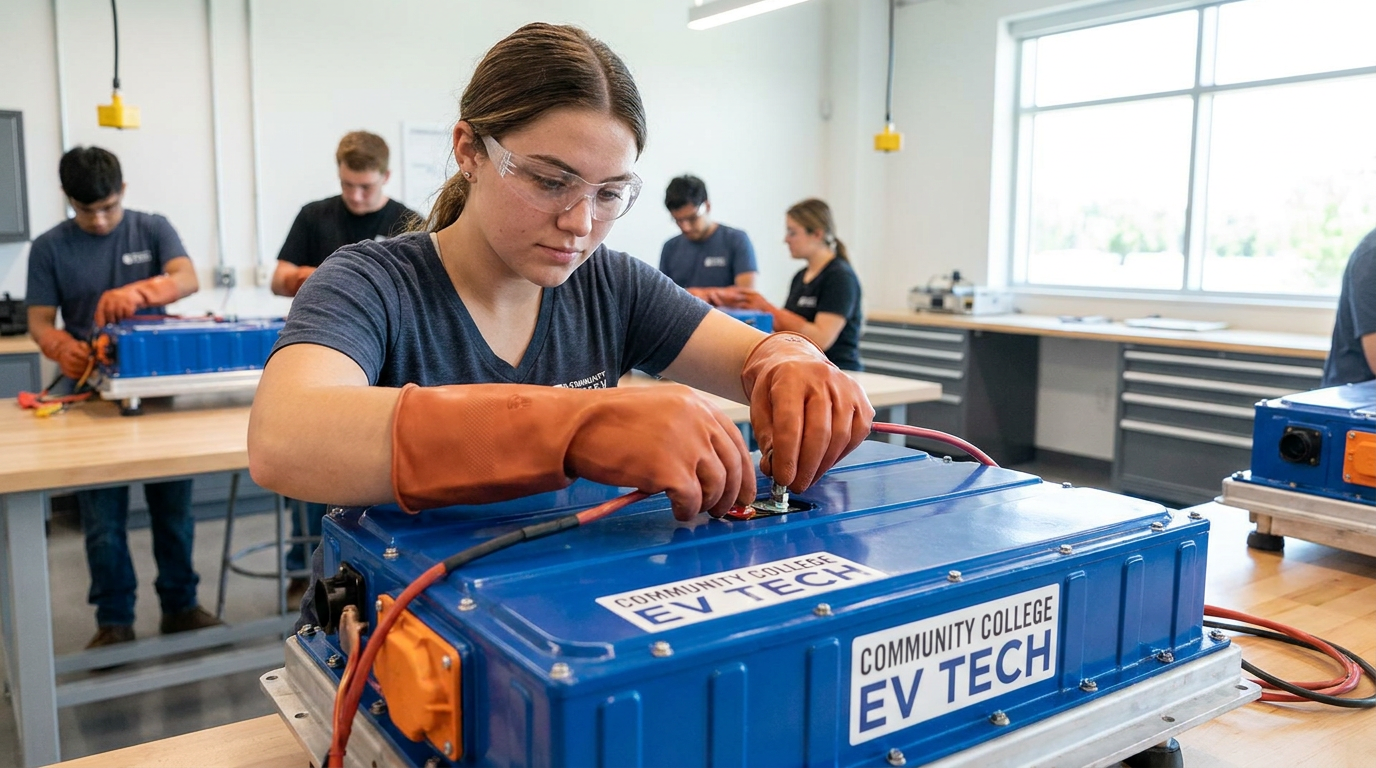
To bridge this gap, community colleges and vocational trade schools are rapidly overhauling their curricula. Rather than starting from scratch, many institutions are adapting their existing automotive, electrical, and manufacturing programs to include green technology modules. For example, a student pursuing a traditional automotive degree can now add a 14-week certificate in high-voltage systems and electric drivetrains, instantly making them a highly sought-after candidate in the local job market.[3][7]
These accelerated training models are highly appealing to students looking to enter the workforce quickly. Many community college programs are designed to be completed in under a year, heavily emphasizing hands-on laboratory experience with state-of-the-art simulation software and real-world equipment. Furthermore, because the demand is so high, many clean energy companies are partnering directly with these schools, offering tuition assistance, paid apprenticeships, and guaranteed job placement upon graduation.[5][6]
However, the green-collar boom is not without its challenges and uncertainties. The work itself can be physically grueling and mentally taxing. Wind turbine technicians, for instance, must be comfortable working outdoors in harsh weather conditions and climbing towers that frequently exceed 200 feet in height. They must possess the physical stamina to haul heavy tools up vertical ladders while maintaining the mental acuity to troubleshoot complex mechanical and electrical failures hundreds of feet in the air.[1]

There is also a geographic disparity in where these jobs are located. While solar installation and EV maintenance are becoming increasingly ubiquitous nationwide, large-scale wind energy jobs are heavily concentrated in specific regions, such as the Great Plains, Texas, and coastal areas developing offshore wind farms. Workers seeking the highest-paying roles in utility-scale renewables may need to relocate to where the infrastructure is being built.[2]
Furthermore, the rapid evolution of the technology means that training is never truly complete. An EV technician who masters today's lithium-ion battery architecture will likely need to return to the classroom in a few years to learn about solid-state batteries or advanced hydrogen fuel cell systems. The green-collar workforce must be highly adaptable, committing to lifelong learning as the underlying science of renewable energy continues to advance.[3][6]
Despite these hurdles, the consensus among labor economists and educators is that middle-skill green jobs represent one of the most secure and upwardly mobile career paths available today. As the global economy continues its irreversible pivot away from fossil fuels, the technicians who build, install, and repair the new energy grid will find themselves holding the keys to the future. For a generation of workers seeking financial stability without the burden of a four-year university degree, the green-collar economy offers a powerful and uplifting alternative.[6][7]
How we got here
2009
Federal stimulus packages begin earmarking significant funds for green jobs education and training at community colleges.
2024
Electric vehicles hit a record 8.1 percent of all new U.S. car sales, exposing a massive shortage of qualified EV technicians.
2025
The U.S. Department of Energy formally highlights the 'wind energy workforce gap' as a primary barrier to infrastructure deployment.
2026
The wage premium for specialized EV technicians reaches 30 percent above traditional automotive mechanics as employers scramble for talent.
Viewpoints in depth
Vocational Educators
Advocates for community colleges and trade schools as the primary engine for the green workforce.
Educators argue that the traditional four-year university model is too slow and expensive to meet the urgent demands of the energy transition. By pivoting to 14-week certificate programs and one-year apprenticeships, community colleges can rapidly equip workers with the exact 'middle-skills' local employers need, allowing students to enter high-paying careers without crippling student debt.
Labor Economists
Analysts tracking the supply, demand, and wage dynamics of the clean energy transition.
Economists view the current green-collar landscape as a classic supply-and-demand mismatch. The rapid influx of federal infrastructure funding and private capital has created a labor bottleneck. Because the educational pipeline has not kept pace with the deployment of solar panels and EVs, employers are forced to offer significant wage premiums—such as the 30 percent bump for EV technicians—to attract scarce talent.
Clean Energy Employers
Companies building the infrastructure and servicing the new technology.
For employers in the renewable sector, the biggest barrier to growth is no longer the cost of technology, but human capital. Facing a severe shortage of qualified applicants, many companies are taking training into their own hands. They are increasingly partnering with local trade schools to design custom curricula and are offering paid, on-the-job apprenticeships to build their workforce from the ground up.
What we don't know
- How quickly traditional auto mechanics will be able to upskill to meet the surging demand for EV diagnostics.
- Whether the geographic concentration of wind and solar farms will force a mass relocation of the skilled trades workforce.
- How future breakthroughs in solid-state batteries or hydrogen fuel cells will alter the training requirements for technicians.
Key terms
- Green-collar job
- A career-track role that directly contributes to environmental sustainability, blending traditional blue-collar trades with specialized technical knowledge.
- Middle-skill job
- An occupation that requires education and training beyond a high school diploma, such as a certificate or apprenticeship, but less than a four-year bachelor's degree.
- High-voltage certification
- Specialized safety and technical training required to diagnose, service, and repair the powerful battery packs and electrical systems found in electric vehicles.
- ASE Certification
- A professional credential issued by the National Institute for Automotive Service Excellence that validates an automotive technician's competence and expertise.
- Photovoltaic (PV) system
- A technology that converts sunlight directly into electricity, most commonly recognized as solar panels.
Frequently asked
Do I need a four-year college degree to get a green-collar job?
No. Most green-collar roles, including wind turbine technicians and solar installers, are 'middle-skill' jobs. They typically require a high school diploma followed by a vocational certificate or an on-the-job apprenticeship.
How much more do EV technicians make than traditional mechanics?
EV technicians earn a significant premium due to the specialized high-voltage skills required. In 2026, the median base pay for an EV technician is around $70,000, which is roughly 30% higher than the median for traditional auto mechanics.
Are green-collar jobs physically demanding?
Many are. Wind turbine technicians, for example, must be comfortable climbing towers over 200 feet tall and working outdoors in various weather conditions while hauling heavy equipment.
Where can I get training for these careers?
Many community colleges and vocational trade schools now offer accelerated 14-week to 1-year certificate programs in renewable energy and electric vehicle diagnostics. Apprenticeship programs are also widely available through employers and trade unions.
Sources
Source coverage
7 outlets
3 viewpoints surfaced







[1]Bureau of Labor StatisticsLabor Economists
Occupational Outlook Handbook: Wind Turbine Technicians
Read on Bureau of Labor Statistics →[2]U.S. Department of EnergyLabor Economists
Workforce Growth and Support in Wind Energy
Read on U.S. Department of Energy →[3]Trade CollegesClean Energy Employers
EV Technician Salary, Training & Outlook (2026)
Read on Trade Colleges →[4]EV.CareersClean Energy Employers
EV Technician Salary Guide 2026
Read on EV.Careers →[5]Apprenticeship.govVocational Educators
Solar Photovoltaic Installers Apprenticeship Programs
Read on Apprenticeship.gov →[6]Factlen Editorial Team
Synthesis by Factlen editorial team
Read on Factlen Editorial Team →[7]National Wildlife FederationVocational Educators
Community Colleges and the Green Workforce
Read on National Wildlife Federation →
Every angle. Every day.
Get education stories with full source coverage and perspective breakdowns delivered to your inbox.