
The Global Expansion of Front-of-Package Food Warning Labels and Their Impact on Nutrition
Pioneered by Chile in 2016, mandatory black octagonal warning labels on unhealthy foods are spreading globally. Evidence shows they successfully drive both consumer behavior changes and massive industry product reformulations, though their ultimate impact on obesity rates remains debated.
By Factlen Editorial Team
- Public Health Advocates
- Argue that mandatory warning labels are the most effective tool to empower consumers and force industry reformulation.
- Behavioral Researchers
- Focus on the data, noting that while purchases shift, population-level obesity is stubbornly resistant to single interventions.
- Food & Beverage Industry
- Argue that warning labels are overly punitive and fail to address the complex root causes of obesity.
What's not represented
- · Low-income consumers navigating food costs
- · Small-scale food manufacturers facing reformulation costs
Why this matters
By shifting the burden of nutritional transparency from the consumer to the manufacturer, these labels empower shoppers to make instantly healthier choices and force food companies to quietly improve their recipes.
Key points
- Chile pioneered mandatory black octagonal warning labels for unhealthy foods in 2016.
- The policy has spread across Latin America, with Mexico adding warnings for artificial sweeteners.
- Data shows the labels significantly reduce consumer purchases of calories and added sugars.
- Up to 90% of the nutritional improvement comes from food companies quietly reformulating their recipes.
The modern supermarket is a minefield of ultra-processed foods, often disguised behind bright packaging and misleading health claims. For decades, consumers have been expected to flip products over and decipher complex nutritional tables to understand exactly what they are eating.[1]
This reliance on consumer math has largely failed to stem the global rise in diet-related chronic diseases. In response, public health officials are increasingly shifting the burden of transparency from the shopper to the manufacturer.[1]
The mechanism driving this shift is Front-of-Package Nutrition Labeling (FOPNL). Instead of hiding data on the back of the box, FOPNL places clear, interpretive information on the front, allowing shoppers to assess a product's healthfulness at a glance.[2][6]
The most aggressive and widely studied version of this policy was pioneered by Chile in 2016. Facing one of the highest obesity rates in the world, the Chilean government implemented the landmark Law of Food Labeling and Advertising.[7]
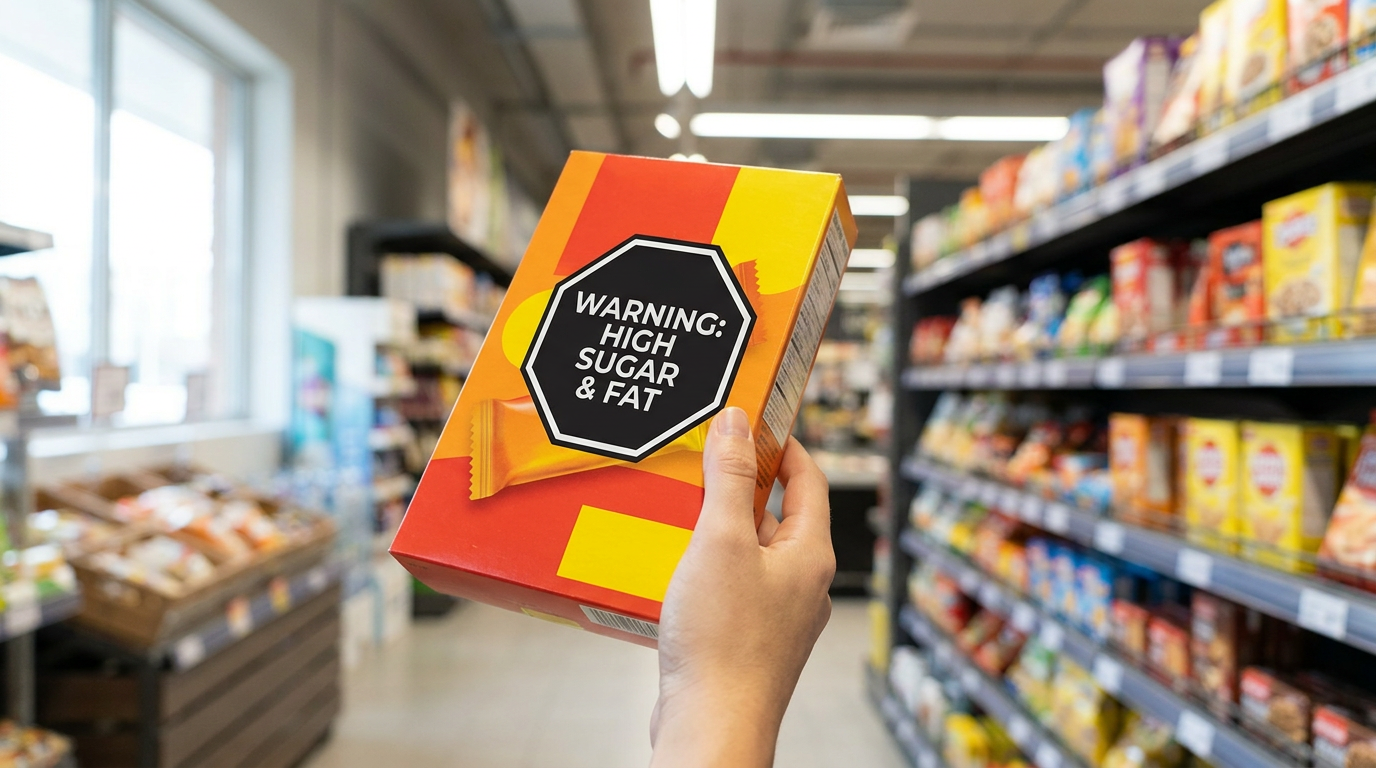
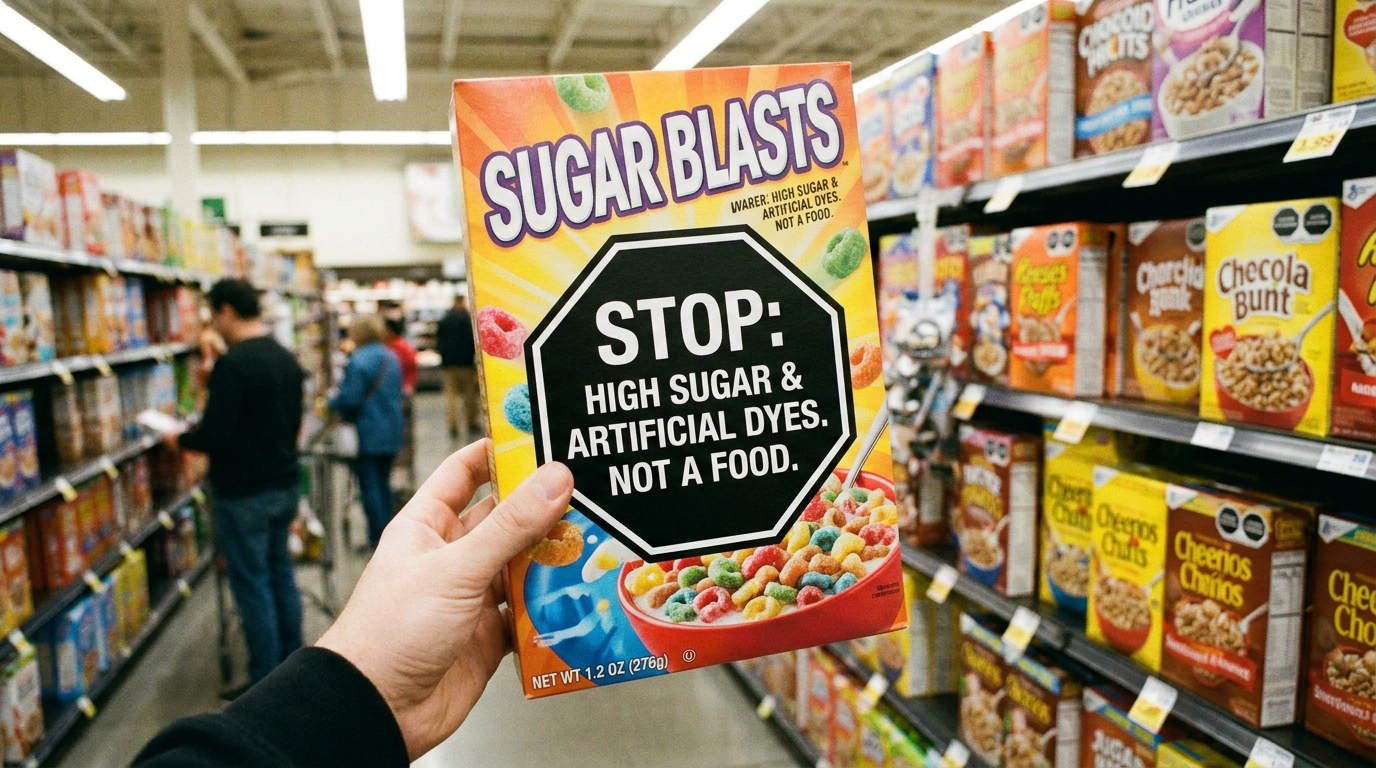
The law mandated that any packaged food or beverage exceeding strict thresholds for sugar, sodium, saturated fat, or calories must carry a stark, black octagonal warning label resembling a stop sign.[2][7]

Crucially, the Chilean model tied these labels to broader marketing restrictions. Products carrying a "High In" black octagon are legally barred from being advertised to children under 14 and cannot be sold or distributed in schools.[7]
The visual shock of the black stop signs proved highly effective at breaking the "health halo" effect. Products that previously marketed themselves as "all-natural" or "fortified with vitamins" were suddenly forced to display prominent warnings about their excessive sugar content, instantly changing consumer perception.[6]
Following Chile's success, the model rapidly spread across Latin America. Mexico, Argentina, Peru, Uruguay, and Colombia have all adopted variations of the mandatory warning label system.[2]
Mexico expanded on the Chilean framework in 2020. In addition to the standard nutrient warnings, Mexican law requires rectangular warning labels on products containing caffeine or non-nutritive artificial sweeteners, explicitly stating they are "not recommended for children."[2][3]

As these policies mature, a robust body of evidence is emerging regarding their efficacy. The primary claim—that warning labels change consumer behavior—is strongly supported by national sales data.[3]
As these policies mature, a robust body of evidence is emerging regarding their efficacy.
A comprehensive evaluation of Mexico's policy found significant shifts in the national diet. Following the implementation of the labels, total calories purchased from packaged foods dropped by 15%, while purchases of added sugars plummeted by 25%.[3]
However, researchers have discovered that the true power of mandatory warning labels lies not just in changing consumer minds, but in forcing corporate hands.[1][3]
To avoid the stigma of the black octagons, the food and beverage industry has engaged in massive product reformulation. Manufacturers are quietly altering recipes, reducing sugar and salt just enough to fall below the legal thresholds that trigger a warning.[3][6]
This hidden mechanism is profoundly impactful. In the Mexican study, researchers estimated that a staggering 90% of the observed calorie reduction was driven by industry reformulation rather than consumers actively choosing different products.[3]

In Chile, the food industry reformulated more than 1,500 products to escape the labels. Global conglomerates have reportedly reformulated thousands of items worldwide in response to the growing regulatory trend.[1]
Public health organizations, including the World Health Organization and UNICEF, now view interpretive warning labels as superior to older labeling schemes. Studies consistently show that black octagons outperform the UK's "Traffic Light" system and the US's "Guideline Daily Amounts," which rely on complex percentages that many consumers struggle to interpret.[2][4][6]
Despite these victories, the policy is not a panacea, and critics point to stubborn macroeconomic health data. A study highlighted by the Consumer Brands Association noted that despite Chile's aggressive labeling and marketing bans, the country's adult overweight and obesity rate has continued to climb, reaching nearly 79% in 2022.[5]

Furthermore, some controlled experiments, such as a recent Spanish virtual supermarket study, found minimal differences in the nutritional quality of shopping baskets when comparing the Chilean warning labels to the European Nutri-Score system.[8]
These limitations underscore the complexity of the obesity epidemic. While warning labels successfully clean up the packaged food supply, they cannot single-handedly solve systemic issues like poverty, food deserts, and sedentary lifestyles.[1][5]
Ultimately, the global expansion of the black stop sign represents a fundamental shift in food policy. By prioritizing clear, unavoidable warnings over confusing data tables, governments are prioritizing public well-being over corporate marketing, ensuring that the easiest choice in the grocery aisle is also an informed one.[1][7]
How we got here
2016
Chile implements the world's first mandatory black octagonal warning label system.
2020
Mexico adopts the warning label system, adding specific alerts for caffeine and sweeteners.
2021
Argentina introduces its own front-of-pack warning labels for ultra-processed foods.
2026
New data confirms Mexico's labels drove a 15% reduction in purchased calories, largely through industry reformulation.
Viewpoints in depth
Public Health Advocates
Argue that mandatory warning labels are the most effective tool to empower consumers and force industry reformulation.
Organizations like the WHO and UNICEF view interpretive warning labels as a massive upgrade over traditional nutritional tables. They argue that by breaking the 'health halo' of misleading marketing, black octagons force transparency. Their primary focus is on the undeniable data showing that these labels compel food manufacturers to quietly reduce the sugar and sodium in their products to avoid the stigma of the warning.
Food & Beverage Industry
Argue that warning labels are overly punitive and fail to address the complex root causes of obesity.
Industry groups often point to macroeconomic health data to argue that warning labels are an ineffective silver bullet. They highlight that despite years of aggressive labeling in countries like Chile, national obesity rates have continued to climb. These groups generally advocate for voluntary, percentage-based labeling systems—like Guideline Daily Amounts—that they argue provide more nuance without demonizing specific products.
Behavioral Researchers
Focus on the data, noting that while purchases shift, population-level obesity is stubbornly resistant to single interventions.
Academic researchers emphasize the nuance in the data. They acknowledge the clear success of warning labels in driving product reformulation and reducing the purchase of targeted nutrients. However, they caution that dietary environments are complex. Simulated studies sometimes show minimal differences between labeling systems, suggesting that while labels are a crucial tool, they must be paired with broader systemic changes to food access and affordability to truly reverse obesity trends.
What we don't know
- Whether warning labels will eventually lead to a measurable decline in national obesity rates.
- How consumers will react to warning labels over a multi-decade timeline as the novelty wears off.
- Whether major markets like the United States or the European Union will ever adopt the stark black octagon model.
Key terms
- Front-of-Package Nutrition Labeling (FOPNL)
- Nutrition information displayed on the front of food packaging to help consumers quickly assess the healthfulness of a product.
- Ultra-Processed Foods (UPFs)
- Industrial formulations made mostly from substances extracted from foods, often containing cosmetic additives and high levels of sugar, fat, and sodium.
- Nutrient Profile Model (NPM)
- A scientific method for classifying foods based on their nutritional composition, used to determine which products receive warning labels.
- Health Halo Effect
- A cognitive bias where a single positive claim causes consumers to perceive a product as entirely healthy, masking high levels of unhealthy ingredients.
- Reformulation
- The process by which food manufacturers alter a product's recipe to improve its nutritional profile, often to avoid mandatory warning labels.
Frequently asked
What do the black stop sign food labels mean?
They are mandatory warnings indicating that a packaged food or beverage exceeds healthy limits for sugar, sodium, saturated fat, or calories.
Which country invented the black octagonal warning label?
Chile pioneered the mandatory black octagonal warning label system with its 2016 Law of Food Labeling and Advertising.
Do warning labels actually make people healthier?
Evidence shows they successfully reduce the purchase of unhealthy nutrients and force companies to make recipes healthier, though national obesity rates remain difficult to reverse.
Why don't all countries use warning labels?
The food industry often lobbies against mandatory warning labels, advocating instead for voluntary or less explicit systems like Guideline Daily Amounts.
Sources
Source coverage
8 outlets
3 viewpoints surfaced







[1]Factlen Editorial Team
Synthesis by Factlen editorial team
Read on Factlen Editorial Team →[2]Obesity Evidence HubPublic Health Advocates
Adoption of nutritional warning labels around the world
Read on Obesity Evidence Hub →[3]Global Food Research ProgramBehavioral Researchers
Mexico's front-of-package warning labels are improving nutrition of food supply and purchases
Read on Global Food Research Program →[4]Center for Science in the Public InterestPublic Health Advocates
What the evidence says about which front-of-package labeling scheme is best
Read on Center for Science in the Public Interest →[5]ForbesFood & Beverage Industry
As FDA Mulls Food Warning Labels, Study Shows They Haven't Halted Obesity
Read on Forbes →[6]UNICEFPublic Health Advocates
Front-of-Pack Nutrition Labelling of Foods and Beverages
Read on UNICEF →[7]Health Policy WatchPublic Health Advocates
Chile's progressive food policy offers new insight
Read on Health Policy Watch →[8]National Institutes of HealthBehavioral Researchers
Effectiveness of a front-of-pack nutritional warning label system versus a simple nutritional traffic light
Read on National Institutes of Health →

More in health
See all 84 stories →Nutrition Policy
The Black Stop Sign: How Chile's Warning Labels Are Rewriting the Rules of Global Nutrition
7 sources
Autoimmune Disease
Revolutionary 'Immune Reset' Therapy Puts Severe Lupus Into Drug-Free Remission
6 sources

Autoimmune Breakthrough
How a Cancer Breakthrough is Delivering an 'Immune Reset' for Severe Lupus
7 sources

Longevity Science
The Senolytics Breakthrough: How Clearing 'Zombie Cells' Could Redefine Human Aging
5 sources

Every angle. Every day.
Get health stories with full source coverage and perspective breakdowns delivered to your inbox.