
The FBI Built a 22,000-Square-Foot Replica Town to Simulate Live Cyberattacks
The "Kinetic Cyber Range" in Huntsville, Alabama, allows investigators to practice responding to ransomware and digital breaches in a fully functional, air-gapped community.
By Factlen Editorial Team
- Law Enforcement & Cybersecurity Officials
- Argue that hands-on, high-stress simulation is the only way to prepare for cascading infrastructure attacks.
- Privacy & Civil Liberties Advocates
- Express concern over digital forensics training that relies on undisclosed zero-day vulnerabilities to bypass consumer encryption.
- Enterprise IT & Infrastructure Defenders
- Value the realistic replication of corporate environments to better coordinate incident response between federal agents and private sector admins.
What's not represented
- · Local emergency responders who handle the physical fallout of infrastructure hacks
- · Consumer device manufacturers whose encryption is bypassed during forensics training
Why this matters
As cybercrime losses hit a record $20.9 billion in 2025, training agents to handle cascading infrastructure failures—like a power grid hack shutting down a hospital—is critical to preventing catastrophic real-world disruptions.
Key points
- The FBI built a 22,000-square-foot replica town in Alabama to simulate live cyberattacks.
- The facility features a mock hospital, power company, and data center on an isolated network.
- Agents practice responding to cascading infrastructure failures, such as a grid hack affecting medical care.
- The training responds to a record $20.9 billion in U.S. cybercrime losses in 2025.
- Over 1,400 federal and local law enforcement personnel have trained there since February 2025.
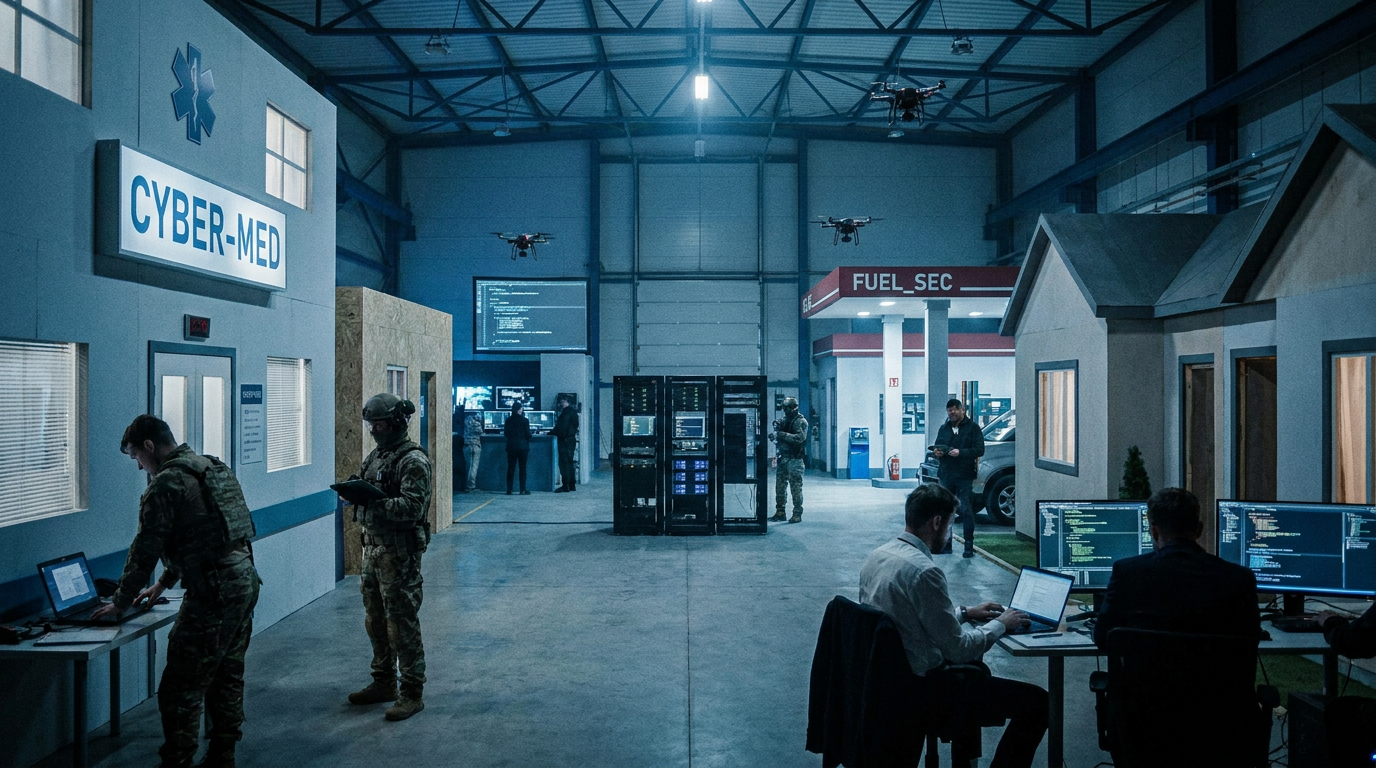
Tucked inside the Federal Bureau of Investigation's campus in Huntsville, Alabama, sits a town that appears entirely ordinary at first glance. It features a hotel, a gas station, a grocery store, a courthouse, and a hospital, all connected by roads and functioning traffic lights. But nothing in this 22,000-square-foot community is real. Known as the Kinetic Cyber Range, the facility is a massive, fully operational replica town built specifically to train law enforcement agents in responding to live digital breaches. By moving cybersecurity training out of the classroom and into a physical environment, the bureau aims to prepare investigators for the visceral reality of modern cyber warfare.[1][2][3]
The concept of a mock town for federal training is not without precedent. In 1987, the FBI opened "Hogan's Alley" at its Quantico academy—a physical replica of a crime-ridden town used to teach agents firearms skills, defensive tactics, and physical raid execution. The Kinetic Cyber Range serves as the modern, digital equivalent of Hogan's Alley. Instead of practicing shootouts with bank robbers, today's agents are learning how to negotiate with ransomware syndicates and restore critical infrastructure before simulated patients lose their lives.[2][6]
Every structure within the Kinetic Cyber Range is wired with functioning consumer and enterprise devices that behave exactly as they would in a real American community. The entire mock town operates on a closed-loop, air-gapped network, completely isolated from the public internet. This architectural sandbox allows instructors to launch aggressive, live malware attacks—including destructive ransomware—without any risk of the digital contagion spilling out of the facility and infecting actual civilian infrastructure.[4][5]

The urgency behind this immersive training environment is grounded in stark economic reality. According to the FBI's 2025 Internet Crime Report, which compiled data from over one million public complaints, United States cybercrime losses reached a staggering $20.9 billion last year. This represents a 26 percent increase from the prior year, with ransomware explicitly ranked as the top ongoing threat to the nation's critical infrastructure. The evidence suggests that classroom theory is no longer sufficient to combat syndicates capable of paralyzing entire municipalities.[1][6]
The primary pedagogical advantage of the Kinetic Cyber Range is its ability to simulate the "cascading effects" of a digital breach. In a traditional server-room simulation, an attack is isolated to a single network. In the Huntsville facility, agents learn that hacking the mock power company immediately causes the hospital down the street to go dark. Trainees are forced to navigate both the technical crisis of rebooting the grid and the human crisis of managing a hospital where life-saving medical equipment is suddenly running on limited backup generators.[3][4]

The primary pedagogical advantage of the Kinetic Cyber Range is its ability to simulate the "cascading effects" of a digital breach.
To heighten the realism, the facility employs role-players and physical environmental stressors. When a simulated ransomware attack locks down the hospital's network, physical alarms sound throughout the building. Actors portraying medical staff respond as if patient care is actively failing, forcing the investigating agents to make high-pressure triage decisions while simultaneously attempting to trace the digital intrusion. This corporeal approach ensures that agents understand that a cyberattack is not just lines of code on a screen, but a physical emergency.[3]
Beyond the residential and commercial facades, the Kinetic Cyber Range houses a massive data center designed to replicate the grueling conditions of enterprise incident response. The room contains more than 200 physical servers running a mix of Windows and Linux operating systems, mirroring the complex, heterogeneous environments that agents encounter when executing search warrants at major corporations.[1][4][5]
Program managers deliberately engineered this server room to be as unpleasant as possible. Dave Beachboard, the manager of the Kinetic Cyber Range, noted that the data center is intentionally kept cold, cramped, noisy, and dark. By forcing trainees to extract digital evidence while shivering in a deafening server aisle, the facility prepares them for the miserable, exhausting reality of corporate breach investigations, ensuring they do not make critical forensic errors when fatigued.[1][4]

A significant portion of the curriculum is dedicated to digital forensics—the highly technical process of cracking the cybersecurity defenses of modern encrypted devices to extract evidence. Agents practice seizing connected devices from the mock homes and businesses, learning which hardware contains volatile memory that must be preserved and which systems can be safely powered down. This hands-on experience is critical for building airtight criminal cases that can withstand scrutiny in federal court.[1][3]
However, the digital forensics training has sparked debate among privacy and civil liberties advocates. Industry reporting indicates that some of the forensic tools utilized at the range work by exploiting undisclosed "zero-day" vulnerabilities in consumer devices manufactured by companies like Apple and Google. By leveraging these secret flaws to defeat built-in user protections, law enforcement can extract necessary evidence, but critics argue that hoarding these vulnerabilities leaves the broader public at risk of exploitation by malicious hackers.[1][4]
Despite the friction over forensic methods, the facility's impact on federal readiness is already substantial. Since opening its doors in February 2025, the Kinetic Cyber Range has trained more than 1,400 students. This cohort includes not only FBI personnel but also partners from other federal agencies and local law enforcement departments, creating a standardized, cross-agency approach to incident response.[1][4][5]
As digital attacks increasingly target physical systems—from municipal water supplies to regional power grids—the line between cybercrime and kinetic warfare continues to blur. The Huntsville facility represents a massive investment in ensuring that when the next major infrastructure breach occurs, the agents responding have already faced the exact scenario in a controlled, high-stakes environment.[3][5]
How we got here
1987
The FBI opens 'Hogan's Alley' in Quantico, a physical mock town for tactical and firearms training.
February 2025
The FBI officially opens the Kinetic Cyber Range in Huntsville, Alabama, to modernize training for digital threats.
Early 2026
The FBI reports that US cybercrime losses hit a record $20.9 billion in 2025, underscoring the need for advanced incident response.
June 2026
The FBI publicly details the inner workings of the 22,000-square-foot facility, revealing that over 1,400 students have completed the training.
Viewpoints in depth
Law Enforcement & Cybersecurity Officials
Emphasize that physical, high-stress simulations are necessary to grasp the real-world consequences of cyber warfare.
Federal program managers argue that classroom theory fails to capture the chaos of a live infrastructure breach. By forcing agents to extract data in a freezing, deafening server room while alarms blare from a simulated hospital failure, the FBI ensures investigators learn to manage both the technical intrusion and the human panic. Officials maintain that this corporeal approach is the only way to prepare for modern syndicates that target physical utilities.
Privacy & Civil Liberties Advocates
Raise concerns over the digital forensics tools used at the facility, which reportedly exploit undisclosed device vulnerabilities.
While acknowledging the need for robust cyber defense, privacy advocates are troubled by the digital forensics curriculum. Reports indicate that agents train using tools that bypass the encryption of consumer devices by exploiting 'zero-day' flaws unknown to manufacturers like Apple and Google. Critics argue that when law enforcement hoards these vulnerabilities instead of reporting them to be patched, it leaves the broader public exposed to exploitation by malicious state actors and criminal hackers.
Enterprise IT & Infrastructure Defenders
Appreciate the facility's accurate replication of corporate environments, which bridges the gap between federal agents and private sector admins.
Private sector cybersecurity professionals often express frustration when law enforcement agents arrive at a breach without understanding the complexities of enterprise architecture. IT defenders view the Kinetic Cyber Range's 200-server, multi-OS data center as a crucial bridge. By training agents in environments that mirror actual corporate server rooms, the FBI ensures that when a real breach occurs, federal investigators can seamlessly integrate with a company's internal IT team without disrupting ongoing recovery efforts.
What we don't know
- It is unclear exactly which undisclosed zero-day vulnerabilities the FBI is utilizing in its digital forensics training.
- The specific operational budget for maintaining and upgrading the 22,000-square-foot facility has not been publicly detailed.
Key terms
- Kinetic Cyber Range
- A physical, simulated environment where cybersecurity professionals can practice defending against and responding to live digital attacks.
- Ransomware
- Malicious software that encrypts a victim's files or locks their systems, demanding payment to restore access.
- Digital Forensics
- The process of uncovering and interpreting electronic data on encrypted devices for use in a criminal investigation.
- Zero-Day Vulnerability
- A software flaw unknown to the vendor, which hackers or investigators can exploit before a security patch is created.
- Air-Gapped Network
- A computer network that is physically isolated from unsecured networks, such as the public internet, to prevent data leaks or malware spread.
Frequently asked
What is the Kinetic Cyber Range?
It is a 22,000-square-foot replica town in Huntsville, Alabama, built by the FBI to train law enforcement agents in responding to real-world cyberattacks.
Why did the FBI build a physical town for digital training?
To simulate the cascading real-world effects of cyberattacks, such as a power grid failure shutting down a hospital, which cannot be accurately replicated in a traditional classroom.
How much did cybercrime cost the US recently?
According to the FBI's 2025 Internet Crime Report, U.S. cybercrime losses reached a record $20.9 billion last year.
Is the facility connected to the real internet?
No, the entire mock town operates on a closed-loop, air-gapped network to ensure that simulated malware and ransomware cannot escape into the public internet.
Sources
Source coverage
6 outlets
3 viewpoints surfaced






[1]TechCrunchPrivacy & Civil Liberties Advocates
FBI Opens 22K Sq Ft Cyber Range to Train on Real-World Attacks
Read on TechCrunch →[2]The VergeLaw Enforcement & Cybersecurity Officials
The FBI built a small town to simulate cyberattacks
Read on The Verge →[3]CyberNewsLaw Enforcement & Cybersecurity Officials
FBI shows every inch of 22,000 sq ft “cyber range” used to train agents on cyberattacks
Read on CyberNews →[4]The Next WebPrivacy & Civil Liberties Advocates
The FBI built a 22,000 sq ft replica town to train agents on live cyberattacks
Read on The Next Web →[5]NDTVEnterprise IT & Infrastructure Defenders
FBI Builds Fake Town To Train Agents For Cyber Warfare
Read on NDTV →[6]Federal Bureau of InvestigationLaw Enforcement & Cybersecurity Officials
Hogan's Alley and the 2025 Internet Crime Report
Read on Federal Bureau of Investigation →

More in technology
See all 5 stories →
Every angle. Every day.
Get technology stories with full source coverage and perspective breakdowns delivered to your inbox.