
The Evidence Pack: Analyzing the Houthi Red Sea Tanker Attacks and Global Energy Supply Risks
Houthi militants have claimed strikes on two Saudi oil tankers in the Red Sea, triggering a spike in global crude prices and forcing maritime reroutes. This evidence pack examines the verified damage, the mechanics of the Bab el-Mandeb chokepoint, and the cascading impact on global energy markets.

- Maritime Risk Analysts
- Focus on verifiable tracking data and the structural shift in shipping risk.
- Energy Market Traders
- View the strikes as a systemic threat to global supply chains, pricing in the risk of bottlenecks.
- Houthi Leadership
- Argue the strikes are a legitimate enforcement of a naval blockade in response to Saudi military actions.
- Allied Military Commands
- Emphasize the violation of international maritime law and the need to protect commercial shipping.
Perspectives this story doesn't cover
- Vessel Crew Members
- Asian Energy Importers
- Marine Insurance Underwriters
The competing cases
Maritime Intelligence Analysts
Security firms focus on verifiable tracking data and the structural shift in shipping risk.
Firms like Lloyd's List and Vanguard Tech approach the crisis through the lens of empirical data, relying on Automatic Identification System (AIS) pings, satellite imagery, and VHF radio distress calls. They emphasize that the Red Sea has moved away from any 'gradual normalization' and is now in a state of acute uncertainty. For these analysts, the primary concern is not the political rhetoric, but the quantifiable reduction in vessel transits and the 'new normal' of elevated war-risk premiums that shipping operators must now absorb.
Houthi Leadership
The militant group frames the attacks as a legitimate enforcement of a naval blockade.
Through their official channels and the SABA news agency, Houthi spokespersons argue that the strikes on the Encelia and Layla are justified military operations. They claim the vessels violated a newly declared maritime blockade against Saudi Arabia, which the Houthis frame as a direct and proportionate retaliation for the kingdom's ongoing military actions and blockade of northwestern Yemen. From this perspective, the disruption of global energy markets is a necessary leverage point to force a cessation of hostilities in their domestic conflict.
Global Energy Markets
Traders and economists view the strikes as a systemic threat to global supply chains.
Energy market participants are pricing in the 'double whammy' effect of simultaneous disruptions in both the Red Sea and the Strait of Hormuz. Traders are less concerned with the localized damage to a single hull and more focused on the macro-level bottleneck. If Saudi Arabia cannot safely export crude from its western port of Yanbu, and the eastern routes remain contested by Iran, the market anticipates a structural reduction in the effective global oil supply, justifying the rapid spike in Brent crude prices above $100 a barrel.
What’s at stake
The Red Sea serves as a vital artery for global trade, and the introduction of kinetic strikes against commercial tankers threatens to choke off millions of barrels of daily oil exports. For consumers worldwide, this translates directly into sustained inflationary pressure on fuel prices and broader economic instability as shipping costs soar.
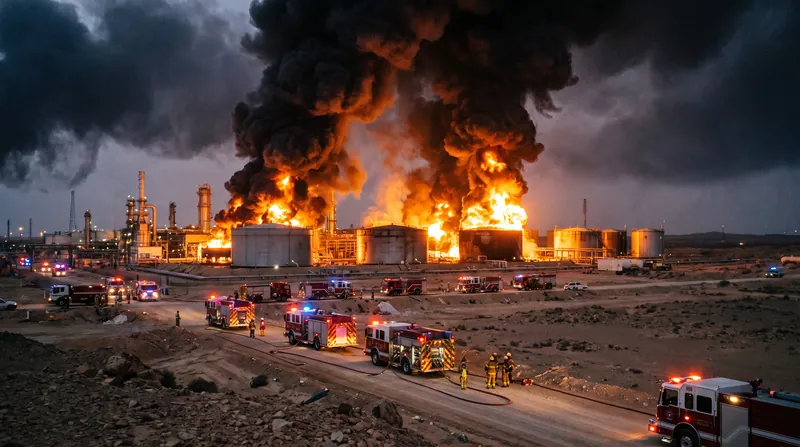
On July 23, 2026, the flow of global energy trade faced a severe disruption when Yemen's Houthi militants claimed responsibility for striking two Saudi-linked oil tankers in the Red Sea. The attacks on the product tanker Encelia and the crude tanker Layla mark a significant escalation in regional maritime hostilities, effectively threatening to create a second major chokepoint for international shipping. The strikes occurred just days after the Houthis announced a naval blockade against Saudi Arabia, a move the group described as retaliation for the kingdom's military actions in Yemen. As the international community scrambles to assess the damage, the incident has immediately rippled through global energy markets, pushing benchmark crude prices to their highest levels in months and forcing major shipping operators to rapidly recalculate their logistical routes.[1][2][3]
The primary evidence for the strikes centers on the Saudi-flagged product tanker Encelia. The United Kingdom Maritime Trade Operations (UKMTO), a Royal Navy capability that monitors regional security, issued an alert confirming that a vessel had been struck by an "unknown projectile" approximately 130 kilometers southwest of Al Shuqaiq, Saudi Arabia. Shortly after, the Saudi Press Agency corroborated the incident, stating that an attack had caused a fire on the bow of the Encelia, though all crew members were reported safe and the vessel remained afloat. Maritime security firm Vanguard Tech further detailed that the ship was hit on its starboard side following its departure from the Saudi port of Yanbu. This convergence of military monitoring, state media confirmation, and independent security analysis provides a high degree of certainty regarding the physical strike on the Encelia.[2][4][7]
Conversely, the status of the second vessel, the crude tanker Layla, remains shrouded in transparent uncertainty. While Houthi spokespersons explicitly named the Layla in their broadcasted claims of successful missile and drone strikes, independent verification has proven elusive. Maritime intelligence analysts at Lloyd's List reported that the Layla had turned off its Automatic Identification System (AIS) transponder in mid-July, effectively "going dark" on public tracking networks. Without AIS data or visual confirmation from allied naval patrols, security firms have been unable to corroborate the Houthi claims regarding the Layla. This discrepancy highlights a common fog-of-war dynamic in maritime conflicts, where militant groups may exaggerate their operational success to project power, while shipping companies deliberately obscure vessel movements to mitigate targeting risks.[1][5]
The strategic mechanism behind these attacks relies on the geographic vulnerability of the Bab el-Mandeb Strait. Often referred to as the "Gate of Tears," this narrow waterway connects the Red Sea to the Gulf of Aden and the broader Indian Ocean. During peacetime, millions of barrels of crude oil and refined products transit this corridor daily, moving between European and Asian markets via the Suez Canal. By demonstrating the capability to strike commercial vessels near this chokepoint, the Houthis are attempting to enforce their declared blockade by making the insurance and operational costs of transiting the Red Sea prohibitively expensive for Saudi-linked shipping. The group has explicitly warned shipping companies that loading or discharging cargo at Saudi Arabian ports will render their vessels legitimate military targets.[3][6]
The timing of the Red Sea attacks has amplified their impact, creating what maritime data firm Lloyd's List Intelligence describes as a "double whammy" for global energy supplies. The international shipping industry is already grappling with severe disruptions in the Strait of Hormuz, the primary artery for Middle Eastern oil, due to the escalating military conflict between the United States and Iran. With the Strait of Hormuz facing near-closure conditions and heavy military contestation, the Red Sea and the Bab el-Mandeb Strait had served as a critical alternative route for regional energy exports. The sudden introduction of kinetic strikes in the Red Sea effectively threatens both ends of the Arabian Peninsula, drastically reducing the safe avenues for Middle Eastern crude to reach the global market.[4][5]
The immediate consequence of this dual-chokepoint threat materialized rapidly in global financial markets. Following the confirmation of the Encelia strike, the price of Brent crude, the international benchmark, surged by more than 7 percent to settle at $100.69 a barrel—its highest level since May. Similarly, the West Texas Intermediate (WTI) contract climbed to over $92 a barrel. Energy analysts note that the market is not merely reacting to the temporary loss of a single tanker's cargo, but rather pricing in the systemic risk of a prolonged supply squeeze. If the Bab el-Mandeb Strait becomes functionally impassable for a significant portion of the global tanker fleet, the resulting logistical bottlenecks could reduce the effective global oil supply by millions of barrels per day, sustaining inflationary pressure on fuel prices worldwide.[1][3][6]
The immediate consequence of this dual-chokepoint threat materialized rapidly in global financial markets.
In response to the heightened risk profile, the physical movement of energy commodities is already shifting. S&P Global Commodities at Sea data indicates that crude and refined product flows completing Bab el-Mandeb transits had already dropped from 5.5 million barrels per day in June to an average of 2.6 million in the first weeks of July. Following the attacks, tracking services like Vortexa observed at least five tankers departing the Saudi port of Yanbu altering their courses, making U-turns to avoid the southern Red Sea entirely. These vessels are now forced to navigate north through the Suez Canal, potentially embarking on much longer and more expensive voyages around the African continent to reach their destinations in Asia, thereby tying up shipping capacity and delaying delivery schedules.[1][5]
To circumvent the maritime risks, Saudi Arabia has historically relied on its East-West pipeline, which transports crude from the oil-rich eastern provinces to the Red Sea port of Yanbu, bypassing the Strait of Hormuz entirely. However, the Houthi strikes in the Red Sea directly undermine the utility of this overland alternative. If tankers cannot safely load at Yanbu and transit south through the Bab el-Mandeb, the pipeline's strategic value as a failsafe is severely compromised. While some crude can be redirected north to European markets, the bulk of Saudi Arabia's demand growth lies in Asia. The inability to safely export from the western coast to eastern clients forces the kingdom into a difficult logistical corner, highlighting the fragility of regional energy infrastructure against asymmetric drone and missile warfare.[1][4]
The maritime intelligence community is now advising clients to prepare for a sustained period of acute uncertainty. Analysts at Lloyd's List have warned that the Red Sea has transitioned away from any semblance of gradual normalization, suggesting that the security environment has fundamentally changed. While some commercial vessels, particularly those with no links to Saudi Arabia, the United States, or Israel, continue to transit the region, they do so under a cloud of elevated war-risk premiums. To avoid being mistakenly targeted, many ships are now broadcasting their crew affiliations and neutral nationalities via their public tracking systems. Yet, as the conflict persists, the industry is being forced to accept severe operational risks as the new normal, adjusting their supply chains to account for a permanently volatile Middle Eastern maritime corridor.[5][7]
The international response to the Red Sea strikes has been swift, though the path to restoring maritime security remains fraught. The United States Central Command (CENTCOM) and allied naval forces continue to operate in the region, attempting to degrade the militant capabilities threatening commercial shipping. However, the sheer volume of maritime traffic and the vast expanse of the Red Sea make it nearly impossible to provide a defensive umbrella for every commercial vessel. As diplomatic efforts remain stalled amid the broader regional conflict, the burden of navigating this crisis falls heavily on the shipping operators and energy markets, who must continuously weigh the economic imperatives of global trade against the very real kinetic threats lurking in the world's most critical waterways.[2][6]
Background
July 20, 2026
The Encelia departs the Saudi Arabian port of Yanbu, heading south through the Red Sea.
July 21, 2026
Houthi militants announce a naval blockade on Saudi-linked shipping in the Red Sea.
July 23, 2026
UKMTO reports a vessel struck by a projectile 130 km southwest of Al Shuqaiq; Houthis claim strikes on the Encelia and Layla.
July 23, 2026
Brent crude prices surge past $100 a barrel in response to the confirmed attacks.
July 24, 2026
Maritime tracking data reveals multiple tankers making U-turns to avoid the Bab el-Mandeb Strait.
Sources
Source coverage
8 outlets
4 viewpoints surfaced








- [1]S&P GlobalMaritime Risk Analysts
Encelia fire confirmed, crew safe, says SPA. Iran tells Houthis to prepare route closure.
Read on S&P Global → - [2]The GuardianAllied Military Commands
Yemen's Houthi militia attacked two Saudi Arabian oil tankers
Read on The Guardian → - [3]The Washington PostEnergy Market Traders
Oil prices leap to $100 a barrel after attacks in Red Sea
Read on The Washington Post → - [4]PBSAllied Military Commands
Yemen's Houthis attack Saudi tankers in the Red Sea, threatening to widen Iran war
Read on PBS → - [5]gCaptainMaritime Risk Analysts
Houthi militants claim responsibility for attacks on Saudi-linked tankers
Read on gCaptain → - [6]Los Angeles TimesEnergy Market Traders
Iran-backed Houthi forces struck two Saudi oil tankers in the Red Sea
Read on Los Angeles Times → - [7]Seatrade Maritime NewsMaritime Risk Analysts
Saudi-flagged product tanker Encelia on fire after Red Sea attack
Read on Seatrade Maritime News → - [8]The HinduHouthi Leadership
Houthis strike tankers in Red Sea; first since Saudi-linked shipping blockade
Read on The Hindu →
Comments

More in Defense & Security
See all →Intelligence Tradecraft
Overcoming Confirmation Bias: How the Analysis of Competing Hypotheses Structures Intelligence Evaluation
6 sources

Yemen Conflict
Houthi Attacks Ignite Fires at Saudi Oil Facilities, Shattering Four-Year Truce
3 sources
Nuclear Strategy
The Five Phases of OPLAN 8010: How the U.S. Nuclear War Plan Defines Target Categories and Execution Options
5 sources

Domestic Deployment
The Statutory Boundary Between Military and Civilian Law Enforcement: How the Posse Comitatus Act and the Insurrection Act Interact
9 sources

Every angle. Every day.
Get Defense & Security stories with full source coverage and perspective breakdowns delivered to your inbox.