
The Evidence on Passkeys: Are They Truly Phishing-Proof?
As major platforms mandate the shift away from passwords, cybersecurity researchers and early adoption data reveal the real-world efficacy of passkeys against credential theft.
By Factlen Editorial Team
- Identity Standards Bodies
- Advocate for deprecating passwords in favor of cryptographic, phishing-resistant authentication.
- Enterprise Security Teams
- Focus on the operational ROI of passkeys while managing the friction of legacy system migration.
- Usability Researchers
- Highlight the UI inconsistencies and account recovery anxieties that still hinder mainstream adoption.
What's not represented
- · Elderly or low-tech consumers struggling with biometric device requirements
- · Small business IT administrators lacking budget for identity infrastructure overhauls
Why this matters
Passwords are the leading cause of data breaches and identity theft, costing billions annually and causing immense consumer frustration. The global shift to passkeys fundamentally eliminates this vulnerability, offering a faster, phishing-proof way to secure your digital life.
Key points
- Over 5 billion passkeys are now in active use globally, signaling mainstream adoption.
- Passkeys reduce average login times from 31.2 seconds to just 8.5 seconds.
- NIST's updated guidelines officially prioritize passkeys and eliminate mandatory password expirations.
- Phishing-resistant authentication blocks over 99% of identity-based attacks.
- Usability researchers warn that inconsistent UI and recovery flows still create consumer friction.
For decades, the cybersecurity industry has treated the password as a necessary evil, attempting to patch its vulnerabilities with arbitrary complexity rules, mandatory expirations, and secondary text-message codes. Yet the fundamental flaw remains: a password is a shared secret that can be tricked out of a human being. In 2025, stolen credentials initiated 22% of all corporate data breaches, making it the leading vector for initial network access. The financial toll is equally stark, with the average cost of a phishing-driven breach reaching $4.88 million. The industry's reliance on a memorized string of characters has created a structural vulnerability that training alone cannot fix.[4][7]
The definitive solution to this vulnerability—the passkey—has now crossed the threshold from early-adopter technology to global standard. As of May 2026, the FIDO Alliance reports that 5 billion passkeys are in active use worldwide. This milestone marks a structural shift in how digital identity is verified, moving away from shared secrets toward public-key cryptography. The transition is not merely a theoretical upgrade; it is actively reshaping the daily login habits of billions of consumers and thousands of enterprise workforces.[1][8]
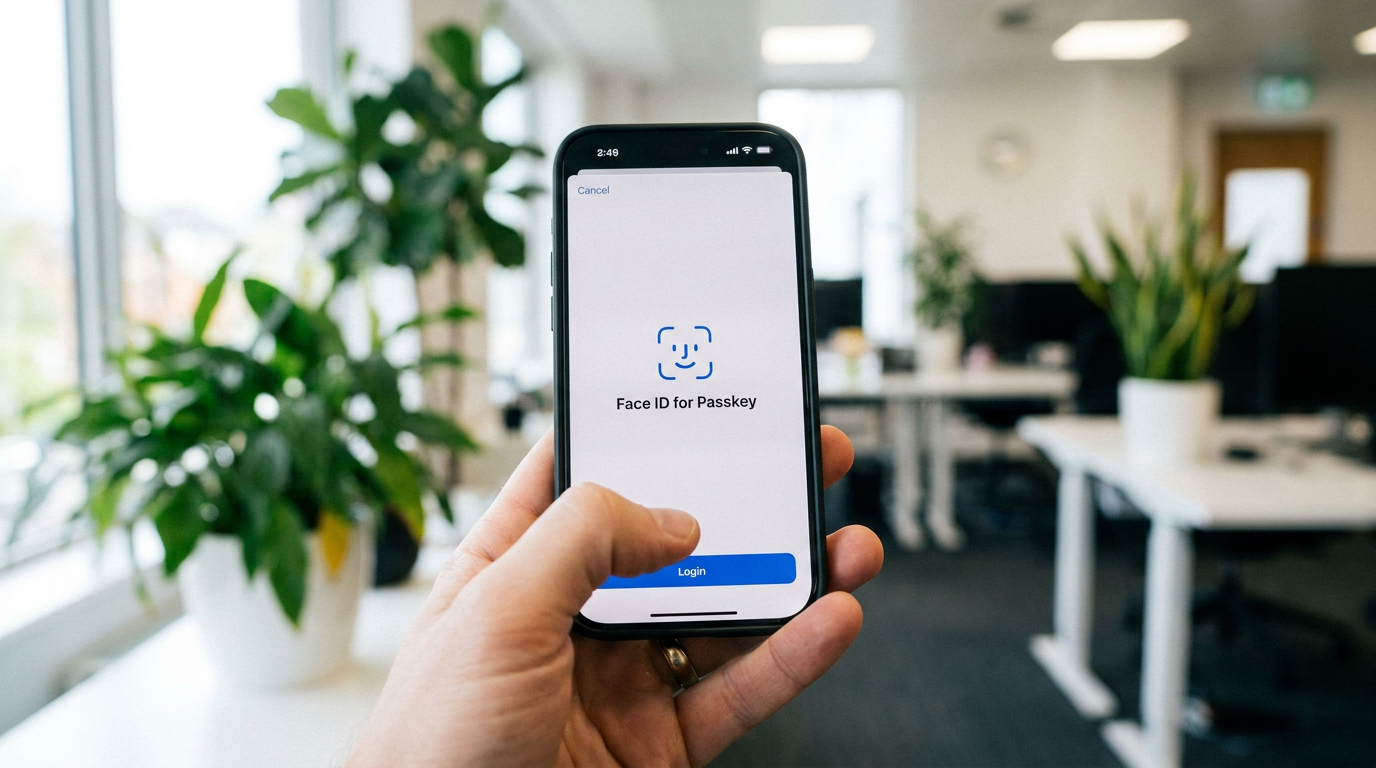
At a technical level, a passkey replaces the typed password with a cryptographic key pair generated directly on the user's device. The private key remains securely locked within the device's hardware enclave, while only the public key is shared with the website or application. When a user attempts to log in, the server issues a cryptographic challenge that can only be solved by the private key, which the user unlocks locally using a biometric scan—like a fingerprint or facial recognition—or a device PIN.[1][8]
This architecture renders passkeys inherently resistant to phishing. Because the credential is cryptographically bound to the specific domain where it was created, a passkey simply will not function on a deceptive lookalike site that attempts to intercept the login. Furthermore, because the server only holds public keys, a database breach yields no usable credentials for attackers to steal, crack, or leak onto the dark web. The shared secret is eliminated entirely, neutralizing the primary weapon of modern cybercriminals.[1][8]

The evidence supporting the usability of passkeys is equally compelling for both consumers and enterprise users. Telemetry data from major identity providers shows that the average passkey authentication takes just 8.5 seconds from start to finish, compared to a tedious 31.2 seconds for a traditional password-plus-code routine. This drastic reduction in friction translates directly to reliability: passkey logins boast a 93% success rate, dramatically outperforming the 63% success rate of legacy passwords, which are frequently forgotten, mistyped, or locked out after too many failed attempts.[1]
Consumer adoption has accelerated rapidly in response to these tangible benefits. By mid-2026, 90% of global consumers report awareness of passkeys, and 75% have actively enabled the technology on at least one of their personal accounts. More importantly, the data indicates that this initial awareness is converting into habitual, everyday use, with nearly half of all consumers stating they use passkeys regularly whenever a service offers the option, signaling a permanent shift in user behavior. The days of consumer resistance to biometric authentication appear to be largely over.[1]

The enterprise sector is mirroring this consumer momentum, driven by the dual mandates of security and efficiency. Currently, 68% of organizations are either deploying, piloting, or actively rolling out passkeys for their employee authentication systems. For IT departments, the business case extends far beyond security to tangible operational savings. Organizations that have deployed passkeys report a 35% reduction in helpdesk tickets related to password resets, alongside a 45% improvement in overall employee login speeds, freeing up valuable time for both staff and support teams.[1]
The enterprise sector is mirroring this consumer momentum, driven by the dual mandates of security and efficiency.
This industry-wide shift received vital institutional validation in August 2025, when the U.S. National Institute of Standards and Technology (NIST) finalized Special Publication 800-63-4. This comprehensive document represents the first major update to federal digital identity guidelines since 2017 and serves as the definitive gold standard for authentication practices globally. The publication of these guidelines provided the regulatory cover that many risk-averse enterprises needed to finally begin deprecating their legacy password systems. By officially endorsing passkeys, NIST signaled that passwordless technology is now mature enough for critical infrastructure.[2]
The updated NIST guidelines officially embrace passkeys and fundamentally rewrite the traditional rules of password management. Based on extensive behavioral research, NIST eliminated outdated recommendations like mandatory periodic password resets and arbitrary character complexity requirements, noting that such rules often push users to create predictable patterns or reuse credentials across multiple sites. Instead, the framework explicitly prioritizes phishing-resistant, passwordless authentication methods, acknowledging that human memory is no longer a viable foundation for digital security. This marks a profound philosophical shift from blaming users for weak passwords to designing systems that do not rely on them.[2]
The security efficacy of this modern approach is backed by massive, real-world datasets. Microsoft's telemetry indicates that phishing-resistant multi-factor authentication blocks more than 99% of identity-based attacks, even in scenarios where the attacker has successfully acquired the user's username and password. The company's infrastructure currently blocks roughly 7,000 password-based attacks per second, underscoring the relentless automated pressure on legacy credentials and the urgent need for cryptographic alternatives. Without passkeys, organizations are left playing an unwinnable game of whack-a-mole against automated credential stuffing bots.[5]
Corroborating this trend, identity provider Okta reported a 63% year-over-year growth in the enterprise adoption of phishing-resistant authenticators between 2024 and 2025. This rapid uptake suggests that organizations are increasingly treating hardware-backed and biometric authentication not as an optional security upgrade, but as an absolute baseline requirement for network access. As cyber insurance premiums rise for companies lacking robust identity controls, the financial incentive to adopt passkeys has never been stronger. The transition is rapidly moving from the realm of early adopters into mainstream corporate governance.[6]
However, a transparent review of the evidence reveals that the passkey ecosystem is not without its flaws. While the underlying cryptography is robust, usability researchers have identified significant inconsistencies in how different websites implement the technology. A 2025 study presented at the USENIX Symposium on Usable Privacy and Security analyzed 111 websites and found that the user experience of finding, setting up, and managing passkeys varies wildly, often deviating from the FIDO Alliance's own design guidelines. These UI inconsistencies can confuse everyday users, slowing down the broader cultural transition away from passwords.[3]

The USENIX study highlighted a particularly concerning security gap in current implementations: 70% of the analyzed websites allowed users to add a new passkey to their account without first verifying their identity. This oversight creates a severe vulnerability where a malicious actor with temporary physical access to an unlocked device could quietly provision their own passkey, establishing persistent, undetectable backdoor access to the victim's account. Researchers stress that identity verification must be a prerequisite for passkey enrollment. Until these implementation flaws are standardized, the security guarantees of passkeys remain partially dependent on the competence of individual web developers.[3]
Account recovery also remains a persistent source of friction and consumer anxiety. While 89% of enterprise organizations report confidence in their ability to restore access when an employee loses their passkey, everyday consumers are often confused about how to regain access to their personal accounts if their primary smartphone is lost, stolen, or destroyed. The industry is still working to standardize clear, secure recovery flows that do not inadvertently reintroduce phishable vulnerabilities through email or SMS fallbacks. If the recovery method is weak, the entire cryptographic strength of the passkey is effectively bypassed.[1][8]
Furthermore, a technical debate continues regarding 'synced' versus 'device-bound' passkeys. Consumer passkeys are typically synced across a user's devices via cloud ecosystems like Apple iCloud or Google Password Manager, prioritizing convenience and ease of recovery. However, NIST guidelines note that these exportable, synced keys do not meet the highest enterprise security tier (Authenticator Assurance Level 3), which strictly requires non-exportable hardware keys for highly privileged administrative access. This creates a bifurcated landscape where consumer and enterprise security models diverge.[1][2]
Despite the rapid growth of passkeys, the legacy tail of passwords will take years to fully sever. Even among organizations that have begun deploying passkeys, 57% still rely on phishable authentication methods for their employees' primary, day-to-day sign-ins. Legacy system compatibility, budget constraints, and the sheer inertia of decades-old IT infrastructure continue to slow the final eradication of the password. Many older applications simply lack the modern architecture required to support WebAuthn protocols. As a result, hybrid environments will remain the reality for the foreseeable future.[1]
Nevertheless, the aggregate evidence from 2026 confirms that the password's era of absolute dominance has ended. The combination of cryptographic certainty, drastically reduced login times, and institutional backing from bodies like NIST has cemented passkeys as the new foundation of digital identity. As UI implementations standardize and recovery mechanisms mature, the internet is steadily closing its most exploited vulnerability, offering a safer, more seamless experience for billions of users worldwide. The transition may be gradual, but the trajectory is irreversible: the future of authentication is undeniably passwordless.[8]
How we got here
2012
The FIDO Alliance is established to develop open standards for passwordless authentication.
2022
Apple, Google, and Microsoft announce expanded support for the FIDO standard, introducing the consumer-friendly term 'passkeys'.
August 2025
NIST finalizes SP 800-63-4, officially integrating passkeys into federal digital identity guidelines and dropping mandatory password expirations.
May 2026
The FIDO Alliance reports that 5 billion passkeys are now in active use globally, marking mainstream adoption.
Viewpoints in depth
Identity Standards Bodies
Organizations like FIDO and NIST argue that the password is fundamentally broken.
Standards bodies maintain that human behavior cannot be patched through training or complex password rules. They argue that the only way to secure digital identity is to remove the shared secret entirely. By shifting to public-key cryptography via FIDO2 and WebAuthn, these organizations believe the industry can structurally eliminate phishing and credential stuffing, rendering stolen password databases useless to attackers.
Enterprise Security Teams
IT leaders focus on the operational benefits and deployment friction of passwordless systems.
For corporate security teams, passkeys represent a rare convergence of improved security and reduced operational overhead. They point to the drastic reduction in helpdesk tickets for password resets as a primary ROI driver. However, these teams also highlight the practical challenges of migration, noting that legacy applications, budget constraints, and the need for hardware-bound keys for highly privileged users complicate the path to a fully passwordless environment.
Usability Researchers
Academic researchers caution that inconsistent UI implementations still create friction for everyday users.
While acknowledging the cryptographic superiority of passkeys, usability experts warn that the human element remains a vulnerability. Researchers point out that many websites fail to follow standardized design guidelines, leading to confusing enrollment processes. Furthermore, they highlight security oversights—such as allowing passkeys to be added without re-verifying the user's identity—and emphasize that consumer anxiety around account recovery must be solved before passwords can be entirely deprecated.
What we don't know
- How quickly legacy enterprise systems and older web applications will be able to migrate away from password-based architecture.
- Whether consumers will fully trust cloud-synced account recovery processes if they lose their primary devices.
- How the industry will standardize the user interface for passkey enrollment across different operating systems and browsers.
Key terms
- Passkey
- A digital credential that uses public-key cryptography to authenticate a user without requiring a typed password.
- Phishing-resistant
- An authentication method that cannot be intercepted, tricked, or replayed by a fake website.
- FIDO2
- The overarching open standard created by the FIDO Alliance and W3C that enables passkeys and passwordless authentication.
- Public-key cryptography
- A security system that uses a pair of keys: a public key shared with the server, and a private key kept secretly on the user's device.
- Authenticator Assurance Level 3 (AAL3)
- The highest security level defined by NIST, which requires hardware-bound cryptographic keys that cannot be exported or synced.
Frequently asked
What exactly is a passkey?
A passkey is a digital credential tied to your device that uses cryptography instead of a typed password. You unlock it locally using your face, fingerprint, or a device PIN.
What happens if I lose my phone?
Most consumer passkeys are synced to your cloud account, such as Apple iCloud or Google Password Manager. When you sign into your cloud account on a new device, your passkeys are automatically restored.
Are passkeys completely unhackable?
While they are highly resistant to remote phishing and server breaches, they can still be compromised if a malicious actor gains physical access to your unlocked device and knows your local PIN.
Do I still need a password manager?
Yes, for now. While passkey adoption is growing rapidly, many websites still require traditional passwords, making a password manager essential for the transition period.
Sources
Source coverage
8 outlets
3 viewpoints surfaced








[1]FIDO AllianceIdentity Standards Bodies
The State of Passkeys 2026: Global Consumer and Workforce Report
Read on FIDO Alliance →[2]NISTIdentity Standards Bodies
NIST Special Publication 800-63-4: Digital Identity Guidelines
Read on NIST →[3]USENIXUsability Researchers
A Systematic Analysis of the Passkey User Experience
Read on USENIX →[4]IBM SecurityEnterprise Security Teams
Cost of a Data Breach Report 2025
Read on IBM Security →[5]Microsoft SecurityEnterprise Security Teams
Microsoft Digital Defense Report 2025
Read on Microsoft Security →[6]OktaEnterprise Security Teams
Secure Sign-in Trends Report 2025
Read on Okta →[7]VerizonEnterprise Security Teams
2025 Data Breach Investigations Report
Read on Verizon →[8]Factlen Editorial TeamIdentity Standards Bodies
Synthesis by Factlen editorial team
Read on Factlen Editorial Team →
More in technology
See all 5 stories →Identity Security
The Evidence That Passkeys Have Finally Killed the Password
7 sources
AI Architecture
Why Hypernetworks Are Replacing RAG and Fine-Tuning for Enterprise AI Agents
7 sources

Memory Safety
The Evidence on Memory-Safe Languages: How Rust is Actually Performing in Core Infrastructure
7 sources

Every angle. Every day.
Get technology stories with full source coverage and perspective breakdowns delivered to your inbox.