
The Evidence Is In: Building More Housing, Even Luxury Units, Lowers Rents for Everyone
A mountain of new empirical data from economists and urban planners confirms that restrictive zoning is the primary driver of the housing crisis. By legalizing 'missing middle' housing and building abundantly, cities like Austin and Auckland are successfully reversing rent growth.
By Factlen Editorial Team
- Housing Economists & Researchers
- Focus on empirical data showing that aggregate supply increases relieve price pressure across all income tiers.
- Policy Reformers
- Argue that restrictive zoning is the primary driver of the housing crisis and advocate for legalizing missing middle housing.
- State Development Advocates
- Emphasize that zoning reform not only enables private developers but also allows state institutions to build public housing efficiently.
- Editorial Synthesis
- Synthesizes the empirical consensus that abundant housing supply is a prerequisite for affordability.
What's not represented
- · Neighborhood preservationists opposing density
- · Tenants' rights groups advocating strictly for rent control
Why this matters
Housing is the single largest expense for most families. Understanding that building more homes—rather than just subsidizing existing ones—is the key to affordability empowers voters to support local zoning reforms that can actually lower their cost of living.
Key points
- The US faces a 15-million-unit housing deficit caused primarily by decades of restrictive local zoning laws.
- A 2025 Pew study found that a 10% increase in regional housing stock reduces rent growth by 5%.
- Building market-rate housing triggers a 'filtering' effect, directly lowering rents for older, lower-income apartments.
- Austin, Texas added 120,000 homes over nine years, resulting in a 4% overall rent decline despite population growth.
- Zoning reform must be paired with streamlined permitting and lower development fees to successfully spur construction.
The United States housing market has reached a breaking point, fundamentally altering the financial trajectory of millions of families. Between October 2017 and October 2024, rents across American metropolitan areas surged by an astonishing 49%, vastly outpacing wage growth. This relentless inflation has pushed half of all US renters into "cost-burdened" status, meaning they spend more than 30% of their income just to keep a roof over their heads, while a record 27% now spend more than half their earnings on rent. For years, the political debate over how to solve this crisis was paralyzed by ideological battles over rent control, public subsidies, and the fear of gentrification. But as the data from the last decade rolls in, a stark, empirical consensus has emerged among housing economists and urban planners: the root cause of the affordability crisis is a catastrophic, decades-long failure to build enough homes.[1][9]
A landmark 2025 study from the National Bureau of Economic Research quantified the sheer scale of this shortfall. Leading housing economists Edward Glaeser and Joseph Gyourko found that if the US had simply maintained the construction pace it set between 1980 and 2000, the country would have 15 million more housing units today. The primary bottleneck driving this deficit is not a lack of available land, a shortage of capital, or a decline in construction technology, but rather a web of restrictive local regulations. In many major American cities, exclusionary zoning laws mandate that over 70% of residential land be reserved exclusively for single-family detached homes. By effectively making it illegal to build denser, more affordable housing types on the vast majority of urban and suburban land, local governments have artificially capped the housing supply, driving up the cost of the limited inventory that remains.[2][9]

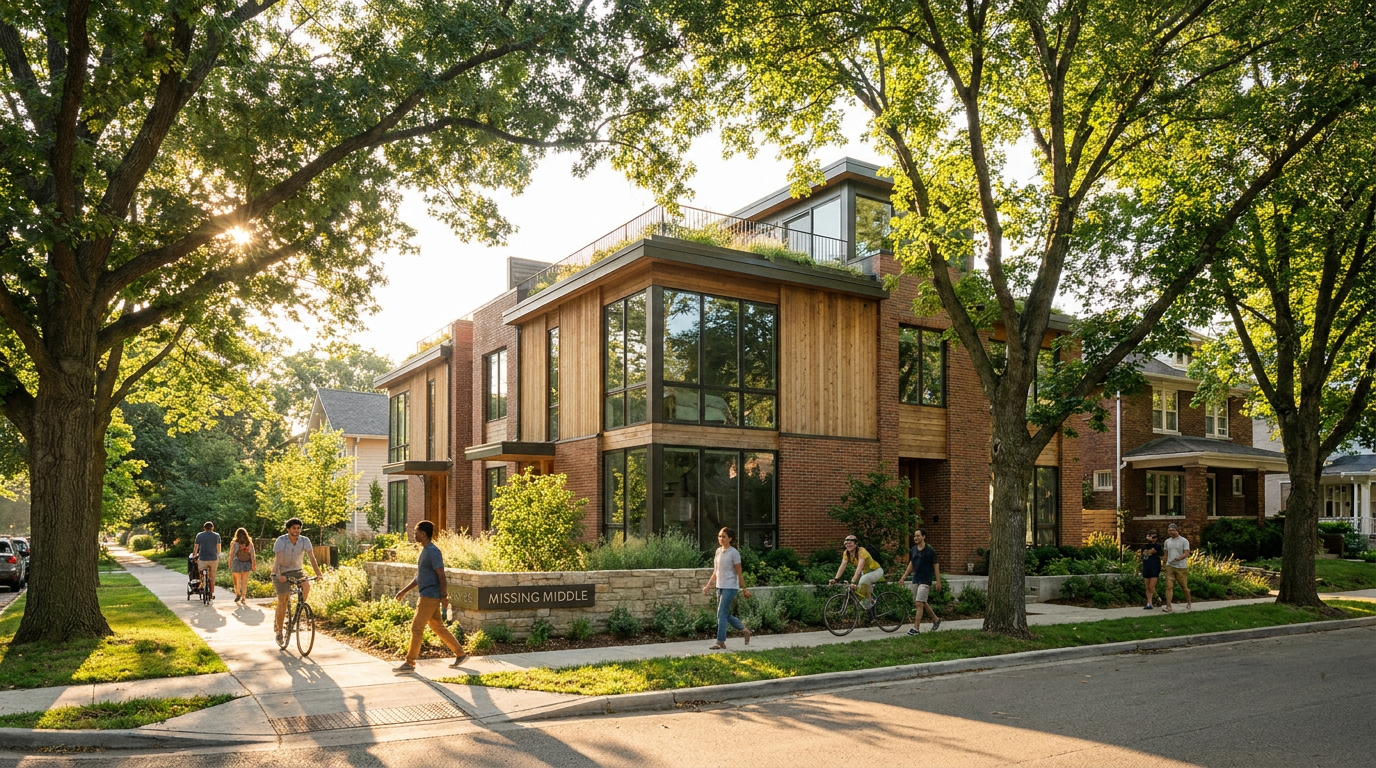
To combat this artificial scarcity, a growing coalition of policymakers, environmentalists, and economists has championed the legalization of "Missing Middle" housing. This concept refers to a return to the duplexes, triplexes, townhomes, and courtyard apartments that were common before modern zoning codes outlawed them. These structures provide gentle density that blends seamlessly into existing neighborhoods without the visual disruption or infrastructure demands of high-rise towers. But as cities began debating these reforms, a central, highly contested question remained: Does allowing private developers to build market-rate or "luxury" housing actually help lower-income renters? Skeptics and neighborhood preservationists have long argued that new, expensive buildings only induce demand, raise neighborhood property values, and accelerate the displacement of working-class residents, demanding instead that new construction be strictly limited to subsidized affordable housing.[3][6]
A comprehensive 2025 analysis by The Pew Charitable Trusts provides a definitive, data-driven answer to that debate. Analyzing 1,654 ZIP codes across the United States, researchers found that building more housing—even expensive, market-rate units—significantly slows rent growth across the board. The Pew data revealed a direct mathematical relationship: for every 10% increase in a metropolitan area's housing stock between 2017 and 2023, rent growth was reduced by 5%. Crucially, the benefits of this new construction disproportionately helped the most vulnerable renters through an economic process known as "filtering." When high-income earners moved into newly constructed luxury buildings, they vacated older units, reducing competition for existing housing. In the 11 metro areas that built the most housing, older "Class C" apartments—which typically cater to lower-income renters—saw the steepest rent declines, proving that new luxury supply directly relieves price pressure at the bottom of the market.[1][6]

A comprehensive 2025 analysis by The Pew Charitable Trusts provides a definitive, data-driven answer to that debate.
The real-world application of these economic theories is already yielding undeniable results, with Austin, Texas, serving as a prime example of supply-side success. Starting in 2015, the city overhauled its restrictive zoning laws, streamlined its notoriously sluggish permitting processes, and allowed for dense apartment construction, particularly near transit corridors and job centers. The market response in Austin, alongside similar efforts in Minneapolis and New Rochelle, was massive and immediate. Austin added 120,000 new housing units over nine years—a staggering 30% increase in its total housing stock, growing at more than three times the national average. This massive influx of supply broke the back of Austin's rent inflation. By early 2026, while national rents were still climbing, Austin's median rent had fallen by 4%. More importantly, in the city's older, lower-cost buildings, rents plummeted by 11%, demonstrating that aggregate supply is the most effective tool for stabilizing living costs.[7][8]

International data strongly corroborates the American experience, showing that broad upzoning benefits both private markets and public housing initiatives. In Auckland, New Zealand, a sweeping zoning reform legalized three-story, three-unit buildings by right across much of the city, effectively ending exclusive single-family zoning. The policy not only spurred a massive boom in private development but also revolutionized the state's ability to provide affordable housing. Researchers found that the reform enabled state-backed developers to triple their output of public housing. Because public agencies operate on strict budgets, restrictive zoning previously forced them to buy large, expensive parcels of land to house very few people. Upzoning allowed the state to build triplexes and mid-rises on smaller footprints, multiplying the impact of their affordable housing subsidies and proving that zoning reform is a prerequisite for effective public housing.[4][9]
Interestingly, the evidence suggests that upzoning does not harm the wealth of existing homeowners, addressing a primary fear of neighborhood preservationists. Economic modeling by Arlington Analytics evaluating the impact of missing middle housing found that legalizing duplexes and townhomes actually increases the value of existing single-family lots by roughly 0.5% to 1.0%. This occurs because developers are willing to pay a premium for land that carries expanded development rights. While the land value increases, the overall cost of housing decreases because that land cost is split across multiple households. However, researchers caution that simply changing a zoning map is not a silver bullet. The Urban Institute found that some cities that legalized duplexes saw only a 1% increase in housing supply because the zoning reforms were undermined by exorbitant development charges, lengthy approval delays, and strict parking minimums that made small-scale projects financially unviable.[3][5]

To actually get shovels in the ground and reverse the affordability crisis, municipalities must treat zoning reform as just the first step in a broader deregulation effort. True affordability requires a comprehensive dismantling of the administrative barriers, impact fees, and design mandates that suppress construction. The empirical evidence gathered over the last five years is now overwhelming and unambiguous. While targeted financial subsidies will always be necessary to house the lowest-income populations and the unhoused, the broader housing crisis is fundamentally a problem of artificial scarcity. As the data from Austin, Auckland, and thousands of ZIP codes proves, the filtering effect is real, and the only sustainable, long-term way out of a housing shortage is to legalize construction and build abundantly.[9]
How we got here
1980–2000
The US builds housing at a robust pace, keeping national rent growth relatively stable.
2000–2020
Housing construction plummets due to restrictive zoning, creating an estimated 15-million-unit deficit.
2015
Austin, Texas begins implementing aggressive zoning reforms to allow large apartment buildings and dense development.
2021
Cities like Portland and regions like Auckland, New Zealand pass landmark reforms effectively ending exclusive single-family zoning.
2024–2025
Major empirical studies from Pew and the NBER confirm that the new supply successfully halted or reversed rent growth in reformed markets.
Viewpoints in depth
Housing Economists' View
The empirical consensus that housing operates on supply and demand, and restricting supply harms the poorest renters most.
Economists point to a mountain of ZIP-code-level data demonstrating the 'filtering' effect. When cities block new market-rate construction, high-income earners don't disappear; they simply bid up the prices of older, existing housing stock, displacing lower-income residents. By allowing developers to build new units, even luxury ones, cities absorb that high-end demand, which demonstrably slows rent growth for older 'Class C' apartments.
Policy Reformers' View
The argument that exclusionary zoning is an artificial, government-imposed barrier to affordability.
Advocates for the 'Missing Middle' argue that the housing crisis is a policy choice. By mandating that 70% or more of residential land be reserved exclusively for detached single-family homes, local governments have made it illegal to build the starter homes, duplexes, and townhomes that historically housed the middle class. They argue that legalizing these structures is a free-market solution that restores property rights and naturally creates diverse, walkable communities.
State Development View
The perspective that zoning reform is necessary to empower public housing initiatives.
While upzoning is often framed as a handout to private developers, researchers analyzing international markets like New Zealand note that it is equally crucial for public housing. State-backed developers operate under strict budgets. When zoning laws restrict density, public agencies are forced to buy more land to house fewer people. Upzoning allows the state to build triplexes and mid-rises on smaller footprints, multiplying the impact of affordable housing subsidies.
What we don't know
- Whether the political momentum for zoning reform can overcome entrenched local opposition in the most expensive coastal cities.
- The exact timeline for when 'filtering' effects reach the lowest-income brackets in newly upzoned neighborhoods.
- How much construction costs and interest rates might offset the financial benefits of upzoning in the near term.
Key terms
- Upzoning
- Changing local zoning codes to allow for higher-density development, such as legalizing duplexes on lots previously restricted to single-family homes.
- Filtering
- The economic process where the construction of new, often expensive housing frees up older housing stock, making it available and more affordable for lower-income residents.
- Missing Middle Housing
- House-scale buildings with multiple units—like townhomes and triplexes—that provide density in walkable neighborhoods without the scale of high-rise towers.
- Cost-Burdened
- A household that spends more than 30% of its gross income on housing costs, including rent and utilities.
- Class C Apartments
- Older, less expensive apartment buildings with fewer amenities, typically serving lower- and middle-income renters.
Frequently asked
Does building luxury apartments actually help lower-income renters?
Yes. Studies show a 'filtering' effect: when high-income earners move into new luxury units, they vacate older apartments, reducing competition and lowering rents for middle- and lower-income brackets.
What is 'missing middle' housing?
It refers to multi-unit housing that falls between single-family homes and large apartment complexes, such as duplexes, triplexes, and townhomes, which fit seamlessly into residential neighborhoods.
Will upzoning lower the value of my single-family home?
Evidence suggests the opposite. Upzoning often increases the value of existing single-family lots because developers are willing to pay a premium for land that can legally hold multiple units.
Is changing zoning laws enough to solve the housing crisis?
No. While upzoning is necessary, researchers note it must be paired with streamlined permitting, lower development fees, and reduced parking requirements to actually spur construction.
Sources
Source coverage
9 outlets
4 viewpoints surfaced








[1]The Pew Charitable TrustsHousing Economists & Researchers
New Housing Slows Rent Growth Most for Older, More Affordable Units
Read on The Pew Charitable Trusts →[2]National Bureau of Economic ResearchHousing Economists & Researchers
The Decline of America's New Housing Supply
Read on National Bureau of Economic Research →[3]Regional Plan AssociationPolicy Reformers
How Six Cities are Creating Missing Middle Housing
Read on Regional Plan Association →[4]Taylor & FrancisState Development Advocates
Zoning reform and state-developed housing in Auckland
Read on Taylor & Francis →[5]Arlington AnalyticsHousing Economists & Researchers
Housing Prices and the Missing Middle
Read on Arlington Analytics →[6]Davis VanguardPolicy Reformers
Pew Report: Increasing Housing Supply Could Reduce Rent Burden for Low-Income Renters
Read on Davis Vanguard →Austin's Surge of New Housing Construction Drove Down Rents
Read on Pew Housing Policy Initiative →[8]CSG WestPolicy Reformers
Housing Policy Developments & Outcomes
Read on CSG West →[9]Factlen Editorial TeamEditorial Synthesis
Synthesis by Factlen editorial team
Read on Factlen Editorial Team →
Every angle. Every day.
Get real estate stories with full source coverage and perspective breakdowns delivered to your inbox.