
The Evidence-Based Guide to Over-the-Counter CGMs for Non-Diabetics
Over-the-counter continuous glucose monitors are booming in 2026, promising personalized metabolic insights for the general public. But while the hardware is highly accurate, clinical evidence on whether they actually improve long-term health for non-diabetics remains fiercely debated.
By Factlen Editorial Team
- Metabolic Optimization Advocates
- Believe real-time glucose data is essential for personalized nutrition and preventing long-term metabolic dysfunction.
- Clinical Skeptics
- Warn that tracking normal glucose fluctuations causes unnecessary anxiety and lacks evidence for long-term health benefits in non-diabetics.
- Consumer Tech Reviewers
- Focus on the usability, app experience, and cost-effectiveness of the devices as lifestyle wearables.
What's not represented
- · Individuals with a history of eating disorders who have been negatively impacted by health-tracking wearables.
- · Primary care physicians who must manage the influx of data and anxiety from healthy patients using OTC sensors.
Why this matters
With over-the-counter continuous glucose monitors now widely available for under $100 a month, millions of healthy adults are tracking their blood sugar to optimize energy and diet. Understanding where the clinical evidence supports these devices—and where it falls short—is essential before investing time and money into metabolic tracking.
Key points
- Over-the-counter CGMs like Dexcom Stelo and Abbott Lingo are now widely available for under $100 a month.
- The devices measure interstitial fluid, not blood, and boast high accuracy rates with MARD scores around 8%.
- Evidence strongly supports their use for discovering highly individualized responses to specific foods.
- Clinical trials have not yet proven that CGMs lead to significant long-term weight loss in metabolically healthy adults.
- Experts warn that over-tracking normal glucose spikes can lead to unnecessary anxiety and restrictive eating habits.
For decades, continuous glucose monitors (CGMs) were strictly medical devices, prescribed exclusively to help people with diabetes manage their insulin. In 2026, that paradigm has entirely shifted. Following landmark FDA clearances, CGMs have entered the mainstream wellness market as over-the-counter wearables, transforming how the general public interacts with their own metabolic data.
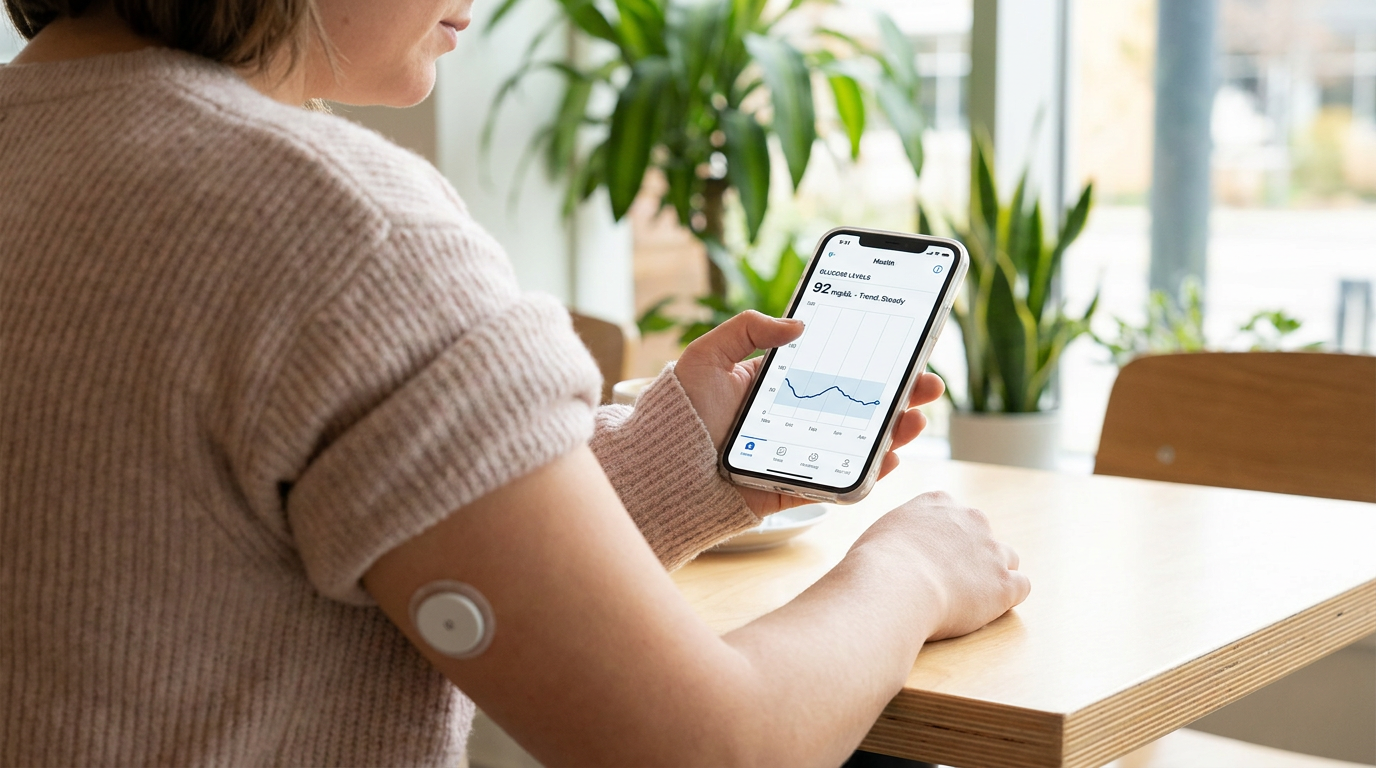
Devices like the Dexcom Stelo and Abbott Lingo are now available online and in pharmacies for roughly $90 a month. They require no prescription, no doctor's visit, and no painful finger-pricks. Instead, users apply a small, water-resistant sensor—roughly the size of two stacked pennies—to the back of their arm, where it streams real-time metabolic data directly to a smartphone.[3][5]
The marketing pitch is compelling: by watching how your blood sugar reacts to specific foods, workouts, and stressors, you can effectively "hack" your metabolism. Proponents claim this real-time biofeedback can cure afternoon energy crashes, optimize athletic performance, and prevent long-term metabolic dysfunction. But as the hardware becomes ubiquitous, the medical community is fiercely debating the actual clinical evidence for non-diabetics.
To understand the evidence, it is first necessary to understand the technology. CGMs do not actually measure blood. Instead, a tiny filament sits just beneath the skin, measuring glucose levels in the interstitial fluid—the liquid surrounding your cells. Because glucose takes time to move from the bloodstream into this fluid, CGM readings typically lag behind actual blood sugar by 5 to 15 minutes.

Despite this lag, modern sensors are highly accurate. The industry standard for accuracy is the Mean Absolute Relative Difference (MARD), and top-tier 2026 devices boast MARD scores between 7.6% and 8.3%, meaning their readings are remarkably close to laboratory blood tests.[4][6]
The strongest evidence supporting CGM use in healthy adults centers on the concept of personalized nutrition. Traditional dietary advice relies on generalized metrics like the Glycemic Index, which assigns a fixed score to foods based on how they affect average blood sugar across a broad population.
However, landmark clinical studies have proven that individual glycemic responses vary wildly. A bowl of oatmeal that causes a massive glucose spike in one person might barely register for another, while a banana could have the exact opposite effect. This variability is driven by genetics, microbiome composition, and sleep quality.[6]
However, landmark clinical studies have proven that individual glycemic responses vary wildly.
For discovering these personal triggers, the evidence shows that CGMs are unparalleled. A 2026 systematic review published by the National Institutes of Health found that CGM use in non-diabetic populations significantly improved dietary adherence. When people can literally see a graph of their glucose spiking after eating a specific food, they are highly motivated to modify their behavior.[1]

Athletes are also leveraging this data with proven success. By tracking their glucose curves, endurance runners and cyclists can identify exactly which carbohydrate sources provide sustained energy versus those that cause a sharp spike followed by a performance-killing crash. This allows for highly precise pre-workout fueling and post-workout recovery strategies.
But the evidence becomes much weaker when looking at long-term health outcomes for the general public. While ongoing trials aim to quantify the benefits of pairing CGMs with targeted coaching, current clinical data has struggled to prove that they lead to sustained weight loss or cardiovascular risk reduction in metabolically healthy adults.[8]
The same 2026 NIH systematic review noted that while CGMs improved mean blood glucose levels, they did not result in statistically significant changes to Body Mass Index (BMI). For people whose fasting glucose and A1C are already in a healthy range, optimizing an already-functioning system may not yield measurable medical benefits.[1]
Furthermore, clinical skeptics warn that tracking normal physiological functions can have unintended negative consequences. A narrative review from University College London highlighted the psychological risks of giving healthy people real-time access to their glucose data.[2]
A healthy body is designed to experience glucose spikes after meals—it is a normal, necessary physiological response. But because CGMs have an accuracy margin of up to 20% in certain conditions, a sensor might display a reading that looks alarmingly high, even when the actual blood glucose is perfectly normal.

Researchers warn this discrepancy can lead to unnecessary anxiety and, in severe cases, orthorexia—an unhealthy obsession with eating only "pure" or perfectly healthy foods. Users may begin aggressively restricting carbohydrates to keep their glucose line perfectly flat, inadvertently depriving themselves of essential nutrients and fiber.
For this reason, OTC models like the Stelo and Lingo intentionally omit the hypoglycemia and hyperglycemia alarms found on prescription models. They are designed to show trends rather than trigger medical alerts, reducing the panic associated with normal post-meal fluctuations.[5]
Ultimately, the consensus among metabolic researchers in 2026 is that OTC CGMs are powerful educational tools, but they are not permanent lifestyle requirements for healthy people. They are best utilized in short, targeted bursts—wearing a sensor for two to four weeks to map out personal food responses, and then taking it off.

By treating the CGM as a temporary diagnostic tool rather than a permanent appendage, users can extract the valuable biofeedback needed to build a personalized diet, without falling into the trap of micromanaging every bite they eat. The data is empowering, provided it is used to inform healthy habits rather than dictate them.
How we got here
2023
Prescription CGMs like the Dexcom G7 and FreeStyle Libre 3 launch with significantly smaller profiles and higher accuracy.
March 2024
The FDA clears the Dexcom Stelo as the first over-the-counter CGM for adults not using insulin.
June 2024
Abbott receives FDA clearance for its Lingo and Libre Rio over-the-counter systems.
2025–2026
OTC CGMs become mainstream wellness wearables, integrating directly with fitness platforms like Oura and Apple Health.
Viewpoints in depth
Metabolic Optimization Advocates
Believe real-time glucose data is essential for personalized nutrition and preventing long-term metabolic dysfunction.
This camp argues that generalized dietary advice has failed the public, and that real-time biofeedback is the only way to truly understand individual metabolism. They point to studies showing massive variability in how different bodies process the exact same carbohydrates. By using CGMs to identify and eliminate personal 'spike triggers,' they believe individuals can maintain steady energy, improve athletic recovery, and proactively prevent the insulin resistance that leads to chronic disease.
Clinical Skeptics
Warn that tracking normal glucose fluctuations causes unnecessary anxiety and lacks evidence for long-term health benefits in non-diabetics.
Medical traditionalists and eating disorder specialists argue that the human body is perfectly designed to handle post-meal glucose spikes. They emphasize that a temporary rise in blood sugar is a normal physiological response, not a medical emergency. This camp warns that giving healthy people access to continuous, highly granular data often leads to the medicalization of normal eating, triggering anxiety, orthorexia, and the unnecessary restriction of healthy, fiber-rich foods like fruits and whole grains.
Consumer Tech Reviewers
Focus on the usability, app experience, and cost-effectiveness of the devices as lifestyle wearables.
Viewing CGMs through the lens of consumer electronics, this group evaluates the devices based on sensor adhesion, Bluetooth connectivity, and app interface. They praise the 2026 generation of OTC sensors for eliminating painful finger-pricks and offering seamless integration with platforms like Apple Health and Oura. However, they frequently critique the recurring subscription costs, noting that spending nearly $1,000 a year on sensors may not provide enough ongoing value once a user has already learned their baseline metabolic habits.
What we don't know
- Whether long-term use of CGMs in healthy populations actively prevents the onset of metabolic diseases like type 2 diabetes.
- How the psychological impact of continuous tracking affects eating disorder rates over a multi-year period.
- Whether the algorithms used by consumer wellness apps accurately interpret the nuances of interstitial fluid lag during high-intensity exercise.
Key terms
- Continuous Glucose Monitor (CGM)
- A wearable sensor that tracks glucose levels 24/7, typically applied to the back of the upper arm.
- Interstitial Fluid
- The fluid surrounding the body's cells, which CGMs measure instead of direct blood.
- MARD (Mean Absolute Relative Difference)
- The standard metric for CGM accuracy; a lower percentage indicates the sensor's readings are closer to actual laboratory blood values.
- Glycemic Variability
- The degree to which a person's blood sugar fluctuates between high and low levels throughout the day.
- Orthorexia
- An unhealthy obsession with eating only foods considered pure or perfectly healthy, which experts warn can be triggered by over-tracking.
Frequently asked
Do I need a prescription for a CGM in 2026?
No. Devices like the Dexcom Stelo and Abbott Lingo are FDA-cleared for over-the-counter purchase by adults who do not use insulin.
Do CGMs measure actual blood?
No. They measure interstitial fluid—the fluid surrounding your cells. This means there is a 5-15 minute lag compared to a traditional finger-prick blood test.
Will a CGM help me lose weight?
Evidence is mixed. While they improve dietary adherence and awareness, clinical trials have not shown significant long-term weight loss in healthy adults using CGMs alone.
Can I use an OTC CGM if I have diabetes?
OTC models are only cleared for people who do not use insulin. If you are insulin-dependent, you need a prescription model with hypoglycemia alarms, like the Dexcom G7.
Sources
Source coverage
8 outlets
3 viewpoints surfaced








[1]National Institutes of Health (Systematic Review)Clinical Skeptics
Effects of continuous glucose monitoring on non-diabetic populations
Read on National Institutes of Health (Systematic Review) →[2]University College LondonClinical Skeptics
Lack of evidence for CGM use in people not living with diabetes
Read on University College London →[3]CNETConsumer Tech Reviewers
Best continuous glucose monitor for pairing with phones or Apple Watch
Read on CNET →[4]Health Tech ReviewsConsumer Tech Reviewers
The 5 Best CGMs of 2026: Tested & Reviewed
Read on Health Tech Reviews →[5]Wearable Wellness GuideMetabolic Optimization Advocates
Over-the-Counter (OTC) CGMs — No Prescription Required
Read on Wearable Wellness Guide →[6]AskVoraMetabolic Optimization Advocates
The 2026 Consumer CGM Landscape
Read on AskVora →[7]Factlen Editorial TeamConsumer Tech Reviewers
Synthesis by Factlen editorial team
Read on Factlen Editorial Team →[8]ClinicalTrials.govMetabolic Optimization Advocates
Use of Continuous Glucose Monitoring in Non-Diabetic Population
Read on ClinicalTrials.gov →


Every angle. Every day.
Get shopping stories with full source coverage and perspective breakdowns delivered to your inbox.