
The EU's War on Waste: A Guide to the ESPR Ban on Destroying Unsold Products and the Digital Product Passport
Starting in 2026, the EU will ban the destruction of unsold apparel and mandate Digital Product Passports for physical goods. Here is how brands are restructuring their supply chains to comply.


- European Regulators & Circularity Advocates
- Argue the ban and DPP are long overdue corrections to an industry that externalizes its waste costs.
- Retail & Manufacturing Operators
- Argue the timeline is aggressive and the recycling infrastructure does not yet exist at scale.
- Supply Chain Data Technologists
- View the regulation primarily as a data standardization and software interoperability challenge.
The competing cases
Strategy 1: In-House Circularity & Resale
Building internal infrastructure to repair, refurbish, and resell unsold or returned inventory directly to consumers.
**The Case For:** Captures secondary revenue streams, protects brand equity by keeping products out of off-price discount channels, and maintains direct control over the Digital Product Passport data lifecycle. Brands retain the customer relationship and can market their circularity efforts directly. **The Case Against:** Requires massive upfront capital expenditure (CapEx) to build reverse logistics, grading facilities, and repair centers. The unit economics only work for high-margin, durable goods; repairing and restocking a low-cost item often costs more than its original production value. **The Evidence:** Pilot programs in the premium outdoor and luxury sectors show that branded resale can recover 40-60% of the original retail price, offsetting the compliance costs of the ESPR destruction ban. **Fits well when:** The brand sells high-margin, durable goods (luxury, premium outdoor, high-end electronics) where the secondary market value justifies the cost of refurbishment. **Does not fit when:** The product has a low retail value, fast trend cycle, or poor physical durability, making the cost of reverse logistics mathematically unviable.
Strategy 2: Third-Party Liquidation & Recycling
Outsourcing the compliance burden to specialized B2B partners who handle donation, fiber-to-fiber recycling, or compliant liquidation.
**The Case For:** Minimizes upfront capital investment and allows brands to focus on their core competency of front-end retail. Instantly scales to handle massive volumes of unsold stock, shifting the regulatory reporting and DPP end-of-life data updates to a specialized partner. **The Case Against:** Brands lose control over where their products end up, risking brand dilution if items flood secondary discount markets. True high-grade recycling capacity in Europe remains bottlenecked, meaning outsourcing fees will likely surge as the July 2026 ban forces the entire industry to seek compliant disposal simultaneously. **The Evidence:** European textile recycling capacity currently processes less than 5% of the continent's waste into new fibers. As demand for compliant recycling spikes under the ESPR, processing gate fees are projected to increase by up to 300% by 2028. **Fits well when:** The company operates on a high-volume, low-margin model (fast fashion, mass-market retail) where building internal repair infrastructure is financially impossible. **Does not fit when:** The brand relies on strict scarcity and prestige, or when the company lacks the software integration to securely pass DPP data rights to the third-party handler.
Strategy 3: Upstream Prevention & On-Demand Production
Eliminating the overproduction problem at the source by shifting to nearshoring, smaller batch sizes, and on-demand manufacturing.
**The Case For:** The most foolproof way to comply with a ban on destroying unsold inventory is to not have unsold inventory. Reduces warehousing costs, eliminates end-of-life compliance fees, and drastically simplifies the Digital Product Passport data collection by tightening the supply chain geographically. **The Case Against:** Sacrifices the massive economies of scale achieved through bulk overseas manufacturing. Nearshoring and on-demand production significantly increase the per-unit cost of goods sold (COGS) and require a complete overhaul of historical forecasting and procurement models. **The Evidence:** Brands shifting from 12-month Asian production cycles to 6-week European nearshore cycles report a 15-25% increase in base manufacturing costs, but offset this entirely by reducing unsold inventory markdowns from 30% to under 5%. **Fits well when:** The brand has agile design teams, access to localized manufacturing hubs, and a customer base willing to accept slightly higher retail prices or longer delivery times for specific items. **Does not fit when:** The business model relies on flooding physical retail floors with massive, cheap inventory assortments, or when the required raw materials are exclusively sourced from distant global regions.
What’s at stake
If your company manufactures, imports, or sells physical goods in the European Union, product traceability is no longer a marketing choice—it is a legal requirement for market access. Brands that fail to digitize their supply chains and eliminate inventory destruction face border blocks and severe financial penalties.
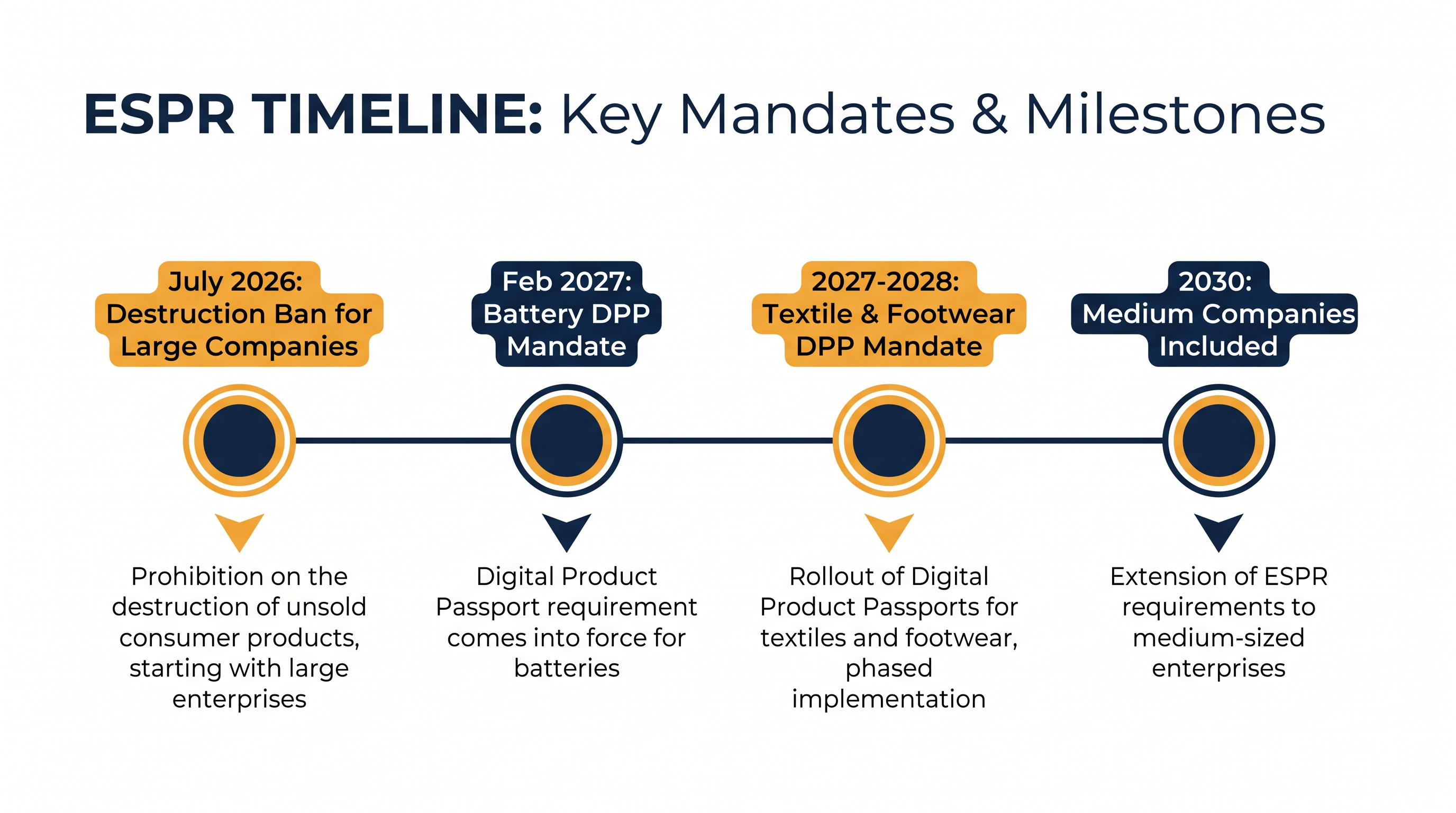
On July 19, 2026, the era of quietly writing off and shredding unsold inventory officially ends in Europe. The European Union’s Ecodesign for Sustainable Products Regulation (ESPR) enacts a strict ban prohibiting large companies from destroying unsold apparel, clothing accessories, and footwear. For decades, destroying excess stock—whether through direct incineration or shredding for low-grade fiber recovery—served as a cost-effective default for fashion and retail brands looking to clear warehouse space and protect brand equity from deep discounting. That operational safety valve is now closed. Under the new regulatory framework, every unsold or returned item must have a documented, sustainable second life, forcing brands to prioritize resale, donation, refurbishment, or high-grade recycling. Destruction is only permitted under narrow, heavily scrutinized exceptions—such as safety hazards, severe damage, or counterfeit goods—and relying on those exceptions requires rigorous, auditable proof.[1][5]
The destruction ban is merely the vanguard of a much broader regulatory overhaul. The ESPR also introduces the Digital Product Passport (DPP), a mandatory, machine-readable digital record that tracks a product’s entire lifecycle. Accessible via a data carrier like a QR code or NFC tag, the DPP will store granular data on a product’s material composition, origin, carbon footprint, repairability, and end-of-life processing instructions. The central DPP registry became operational in July 2026, setting the stage for strict enforcement. Passports become a hard legal requirement for batteries in February 2027, with delegated acts for textiles, footwear, and apparel expected to enforce compliance shortly after. This shifts traceability from a voluntary corporate social responsibility initiative to a non-negotiable gate for market access. If a product lacks a valid, registered passport, EU customs authorities possess the legal authority to block it at the border.[1][3][4]
The operational burden of the DPP mandate requires immediate action. The European Commission estimates that products placed on the EU market are responsible for over 80% of environmental impacts determined at the design stage, which is why the regulation demands data from the very beginning of the supply chain. Brands must now map their operations down to the fiber and chemical level, capturing data points that have historically been opaque or siloed across multiple tier-two and tier-three suppliers. This requires integrating legacy enterprise resource planning (ERP) systems, product lifecycle management (PLM) software, and supplier databases that were never designed to communicate with one another. Furthermore, the data must remain accessible and accurate throughout the product's lifespan, surviving ownership transfers and even the potential insolvency of the original manufacturer.[2][3][7]
Compliance with the ESPR is not a localized European issue; it is a global supply chain mandate. The regulation applies to any physical product placed on the EU market, regardless of where it was manufactured. An apparel brand based in the United States or a footwear manufacturer in Vietnam must meet the exact same DPP data requirements and destruction prohibitions as a company headquartered in Paris or Milan. Consequently, large multinational retailers are already rewriting their procurement contracts, requiring DPP-readiness and strict inventory controls from their global suppliers as a prerequisite for doing business. Brands that treat the ESPR as a mere reporting exercise risk severe market access disruptions, while those that proactively restructure their data governance are securing a distinct competitive advantage.[3][4][6]
Compliance with the ESPR is not a localized European issue; it is a global supply chain mandate.
Faced with the dual pressures of the destruction ban and the DPP mandate, companies are realizing that traditional reverse logistics are entirely inadequate. When destruction stops being an acceptable answer, the handoffs between returns processing, warehousing, and final disposition become a massive liability. Every item that cannot be sold at full price must be triaged, graded, and routed to a compliant outcome, generating a verifiable data trail at every step. This requires a fundamental restructuring of inventory management. Companies can no longer afford to overproduce by 20% and figure out the excess later; the cost of managing that excess compliantly now destroys the margin gained by bulk manufacturing.[1][5]
To navigate this new reality, enterprise brands are diverging into three distinct strategic models. The first approach is building in-house circularity, where brands develop their own direct-to-consumer resale platforms, repair centers, and refurbishment operations to capture secondary revenue from unsold or returned stock. The second approach is outsourcing compliance to third-party liquidators, specialized B2B recyclers, and donation networks, effectively paying a premium to offload the operational headache. The third, and perhaps most disruptive approach, is upstream prevention—shifting to on-demand manufacturing and nearshoring to eliminate the overproduction problem at the source, ensuring there is simply no unsold inventory to manage.[2][4][7]
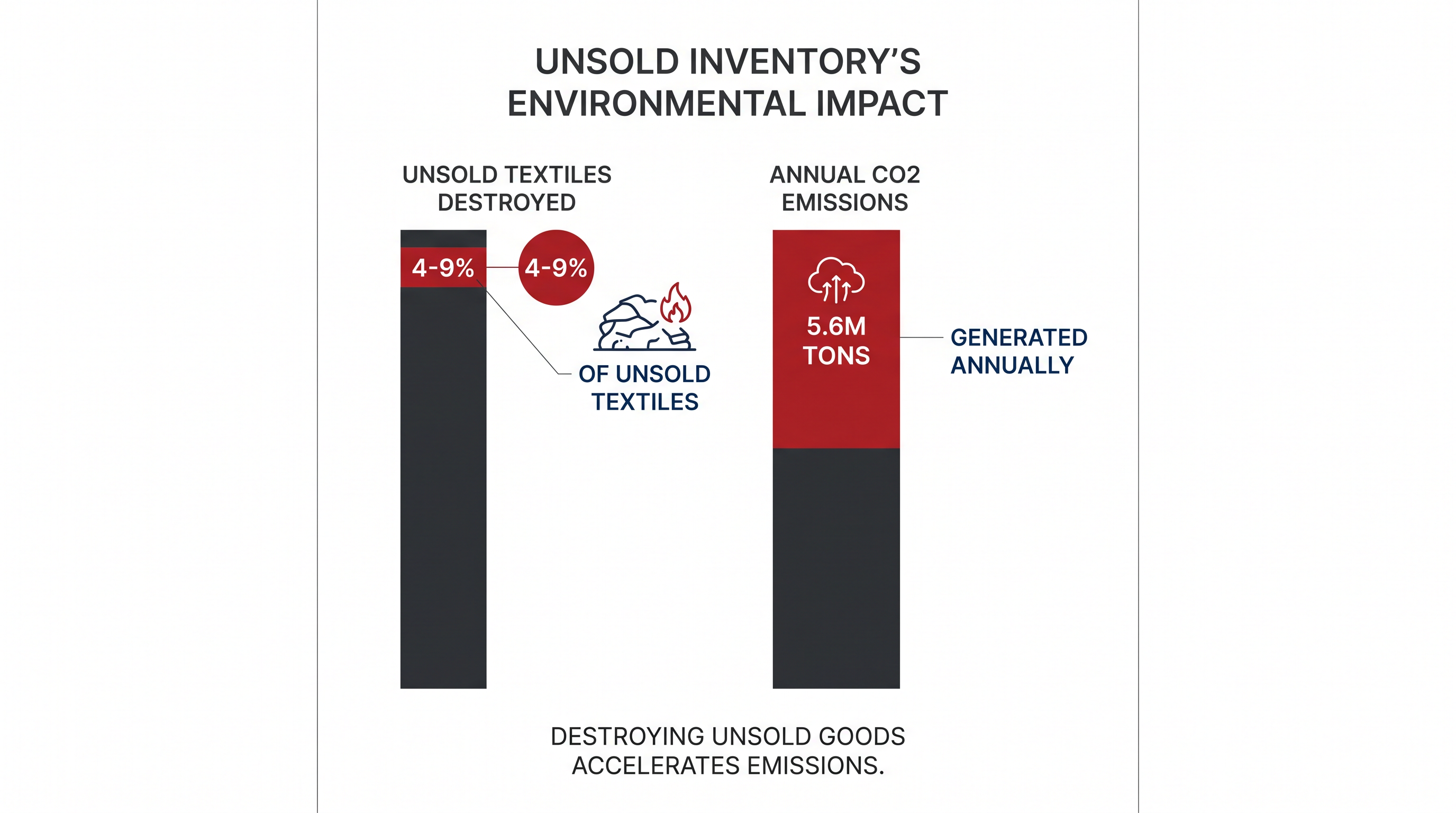
The financial implications of these strategies vary wildly depending on a brand's margin structure and product durability. High-luxury brands, which fiercely protect their intellectual property and brand positioning, are heavily incentivized to keep unsold inventory within their own controlled ecosystems, making in-house circularity a natural fit. Conversely, fast-fashion retailers operating on razor-thin margins and massive volumes often lack the unit economics to justify repairing a ten-dollar garment, pushing them toward industrial-scale recycling partnerships and third-party liquidation. Meanwhile, mid-market brands are caught in the middle, forced to run complex cost-benefit analyses to determine which compliance model will protect their bottom line without running afoul of the new transparency requirements.[6][7]
Ultimately, the ESPR and the Digital Product Passport represent the end of the linear 'take-make-dispose' economy in Europe. By forcing companies to internalize the cost of product waste and mandating unprecedented transparency, regulators are fundamentally altering the unit economics of physical goods. The transition period is closing rapidly. With the destruction ban taking effect for large companies in July 2026 and the DPP infrastructure already live, the window for theoretical planning has passed. Brands must now commit to a compliance architecture, knowing that the systems they build today will dictate their ability to operate in the world's largest single market for the next decade.[1][3][4]

The decision of how to comply is no longer a sustainability question; it is a core operational strategy. The European market will soon penalize inefficiency with hard regulatory blocks and public disclosure of waste. Companies must weigh the capital expenditure of building new infrastructure against the ongoing operational costs of outsourcing, all while ensuring their chosen path generates the exact data required by the DPP registry. The following analysis breaks down the three dominant strategies emerging across the retail and manufacturing sectors, quantifying the trade-offs of each approach and identifying the specific business models they best serve.[2][5][7]
Key takeaways
- The EU's Ecodesign for Sustainable Products Regulation (ESPR) bans large companies from destroying unsold apparel and footwear starting July 19, 2026.
- The regulation introduces the Digital Product Passport (DPP), a mandatory digital record tracking a product's lifecycle, materials, and carbon footprint.
- DPPs become a strict requirement for market access, starting with batteries in 2027 and expanding to textiles and other sectors.
- Brands must shift from traditional reverse logistics to compliant end-of-life strategies: in-house resale, third-party recycling, or upstream on-demand production.
- Failure to comply risks severe market access disruptions, as EU customs authorities will have the power to block products lacking a valid DPP.
Unsettled ground
- How strictly EU customs authorities will enforce the DPP mandate at the border during the initial 2027 rollout phase.
- Whether Europe's current high-grade textile recycling infrastructure can scale fast enough to handle the massive influx of unsold goods diverted by the 2026 ban.
- The exact technical specifications and interoperability standards for the DPP delegated acts covering textiles and footwear, which are still being finalized.
Sources
Source coverage
7 outlets
3 viewpoints surfaced







[1]European CommissionEuropean Regulators & Circularity Advocates
Ecodesign for Sustainable Products Regulation
Read on European Commission →[2]RenoonSupply Chain Data Technologists
Understanding the Regulation: What Does the Digital Product Passport (ESPR) Require?
Read on Renoon →[3]inriverSupply Chain Data Technologists
The EU Digital Product Passport: What it is and how to prepare
Read on inriver →[4]InspectorioSupply Chain Data Technologists
EU Digital Product Passport: What You Need to Know
Read on Inspectorio →[5]Beveridge & DiamondRetail & Manufacturing Operators
EU Adopts Ban on Destruction of Unsold Apparel
Read on Beveridge & Diamond →[6]CilooRetail & Manufacturing Operators
The EU ban on destroying unsold apparel: What it means for branded merchandise
Read on Ciloo →[7]Factlen Editorial TeamEuropean Regulators & Circularity Advocates
Synthesis by Factlen editorial team
Read on Factlen Editorial Team →
Comments

Every angle. Every day.
Get guides stories with full source coverage and perspective breakdowns delivered to your inbox.