
The $33 Billion AES Takeover: Comparing Private Equity vs. Public Markets for Grid Expansion
The record $33.4 billion take-private of AES Corp. by BlackRock and EQT highlights a growing dilemma: whether the massive capital needed for AI data centers is best raised through private equity or traditional public markets.
By Layla Zaher

- Infrastructure Investors
- Argues that private capital is the only viable way to fund the massive, decade-long grid expansions required by AI without penalizing public shareholders.
- Public Market Analysts
- Focuses on the financial mechanics of the deal, noting that public markets were actively punishing AES for its capital-intensive renewable transition.
- Consumer Advocates
- Warns that allowing global asset managers to control franchised utilities removes transparency and exposes captive ratepayers to unchecked financial engineering.
The short answer
- BlackRock's GIP and EQT are leading a $33.4 billion consortium to take AES Corp. private, marking a historic infrastructure buyout.
- AES required the buyout to fund its 11.8-gigawatt pipeline of corporate clean energy projects without cutting its dividend or diluting shareholders.
- Consumer advocates have petitioned FERC to block the deal, arguing that private equity control over franchised utilities threatens ratepayer protections.
- The transaction highlights a structural shift in energy markets, as private capital steps in to finance the massive grid expansion required by AI data centers.
The common assumption regarding private equity's sudden interest in public utilities is that financial giants are looking to strip assets, slash maintenance, and extract short-term profits from captive ratepayers. The reality, however, is fundamentally structural: the traditional public market model is failing to provide the massive, long-term capital required to build the power infrastructure demanded by the artificial intelligence boom. [8] This capital bottleneck was the primary forcing function behind the $33.4 billion take-private acquisition of AES Corp. by a consortium led by BlackRock's Global Infrastructure Partners (GIP) and Swedish private equity firm EQT. [1, 2] Announced earlier this year, the landmark deal represents one of the largest infrastructure take-private transactions in history and signals a paradigm shift in grid financing. [3, 4][1][2][3][4][8]
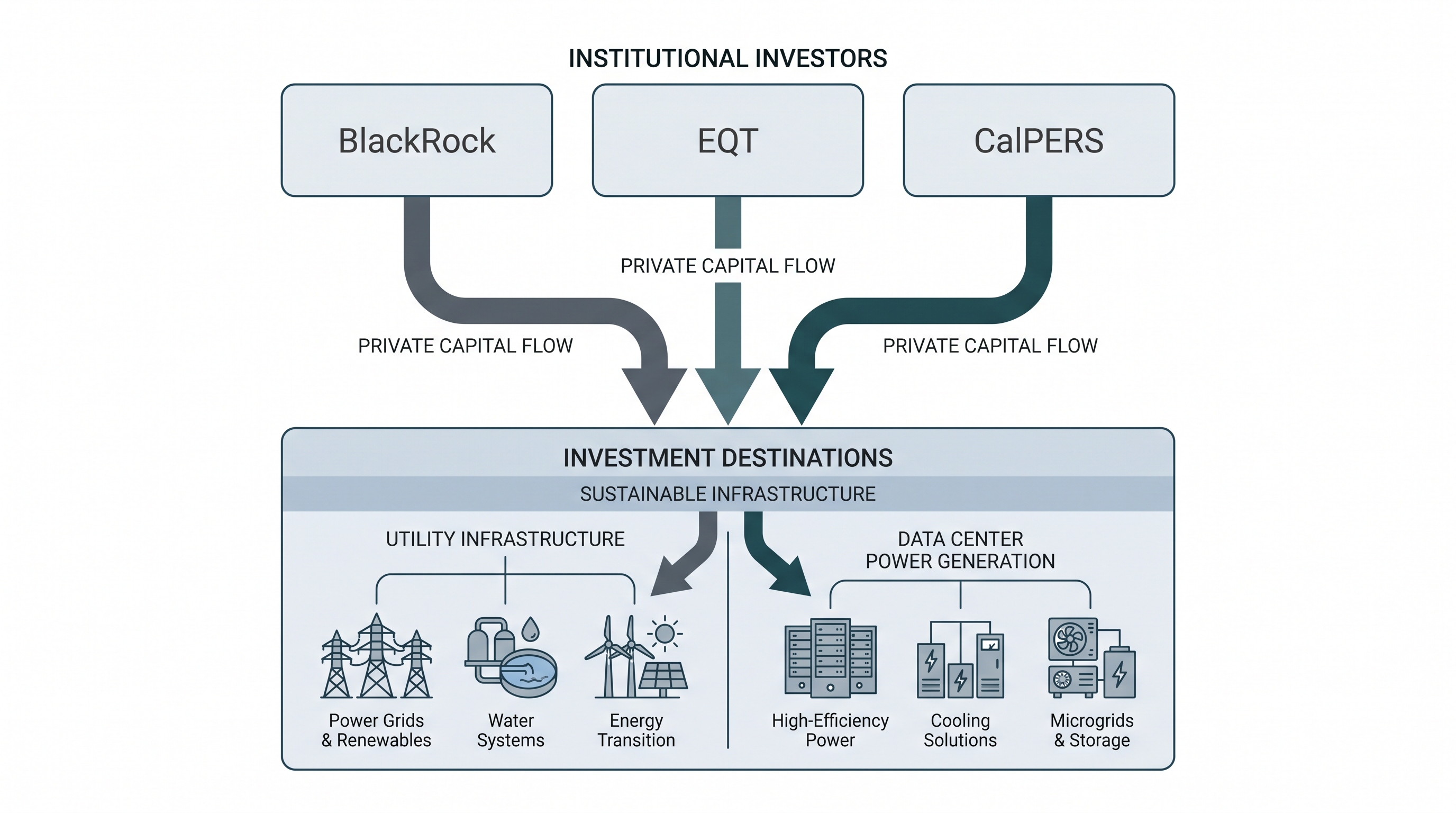
The consortium backing the AES buyout highlights the sheer scale of capital required to modernize the grid. Alongside BlackRock and EQT, the deal includes co-underwriters like the California Public Employees' Retirement System (CalPERS) and the Qatar Investment Authority (QIA). [1, 3] AES itself is not a distressed asset; it is a global Fortune 500 power company that operates regulated utilities in Indiana and Ohio, alongside a massive competitive renewables platform that spans multiple continents. [2, 6] Crucially, AES holds 11.8 gigawatts of signed corporate agreements to supply clean energy to major technology firms, placing it at the absolute center of the hyperscaler data center expansion. [1, 8][1][2][3][6][8]
However, building out that 11.8-gigawatt pipeline requires a scale of upfront investment that public equity markets are currently unwilling to support without severely penalizing the company's stock. [8] Prior to the buyout rumors surfacing, AES shares had declined 34% over a five-year period. [9] The company struggled to balance the immense capital costs of its renewable transition against Wall Street's relentless demand for steady quarterly dividends. [7, 9] In its communications to investors, AES leadership was remarkably blunt about the mathematical reality of its balance sheet, acknowledging that the public markets were no longer a viable vehicle for its long-term strategy. [4, 8][4][7][8][9]
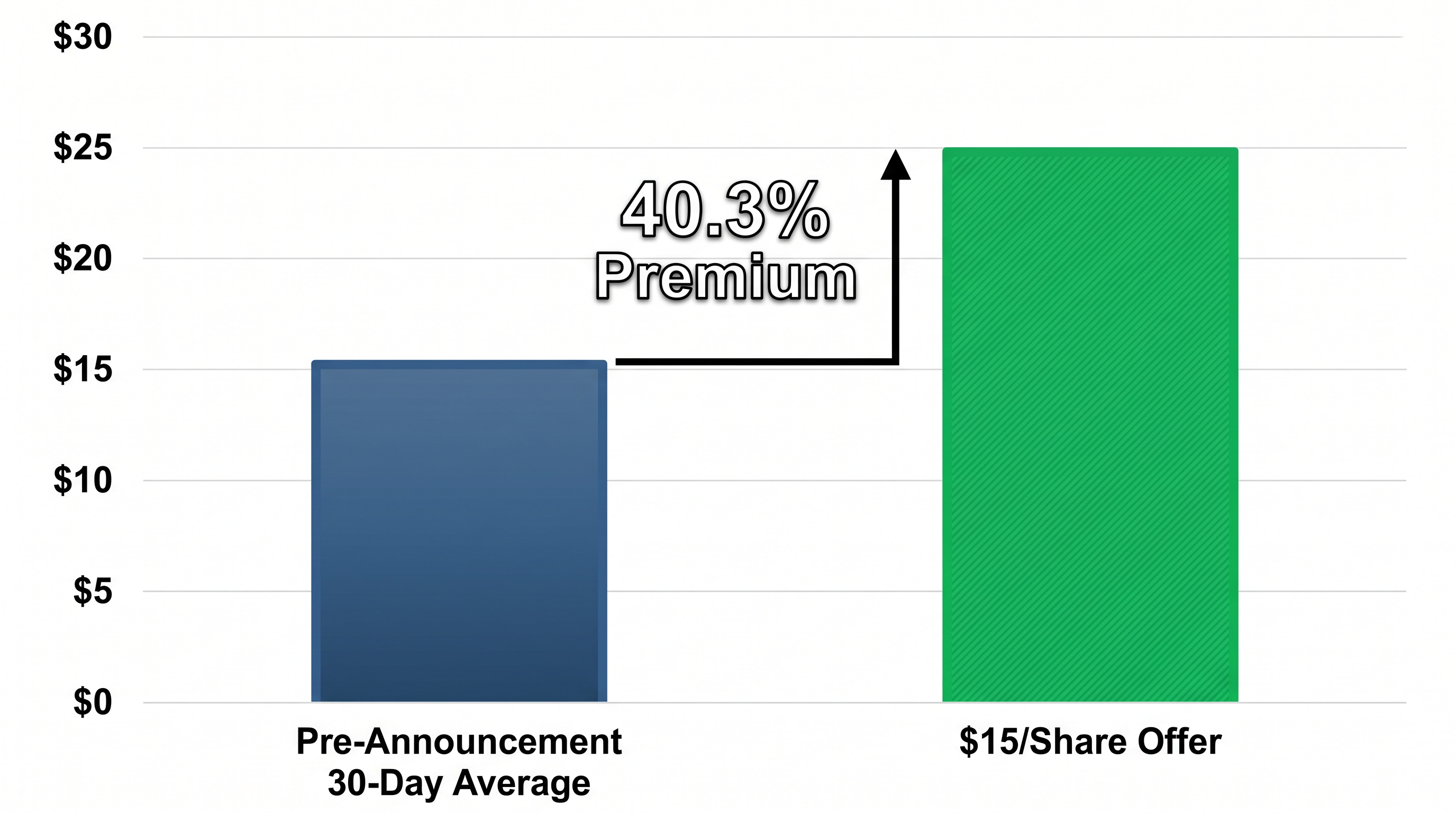
The AES board explicitly stated that absent a private buyout, funding the company's U.S. renewables and utilities growth beyond 2027 would likely require a reduction or total elimination of its dividend. [4, 8] Alternatively, the company would have faced substantial new equity issuances that would heavily dilute existing shareholders. [8] By offering $15 per share in cash—a 40.3% premium over the company's 30-day volume-weighted average price prior to the initial media leaks—the BlackRock and EQT consortium provided an immediate and lucrative exit for public shareholders who were unwilling to fund the next decade of infrastructure development. [1, 8][1][4][8]
The AES board explicitly stated that absent a private buyout, funding the company's U.S.
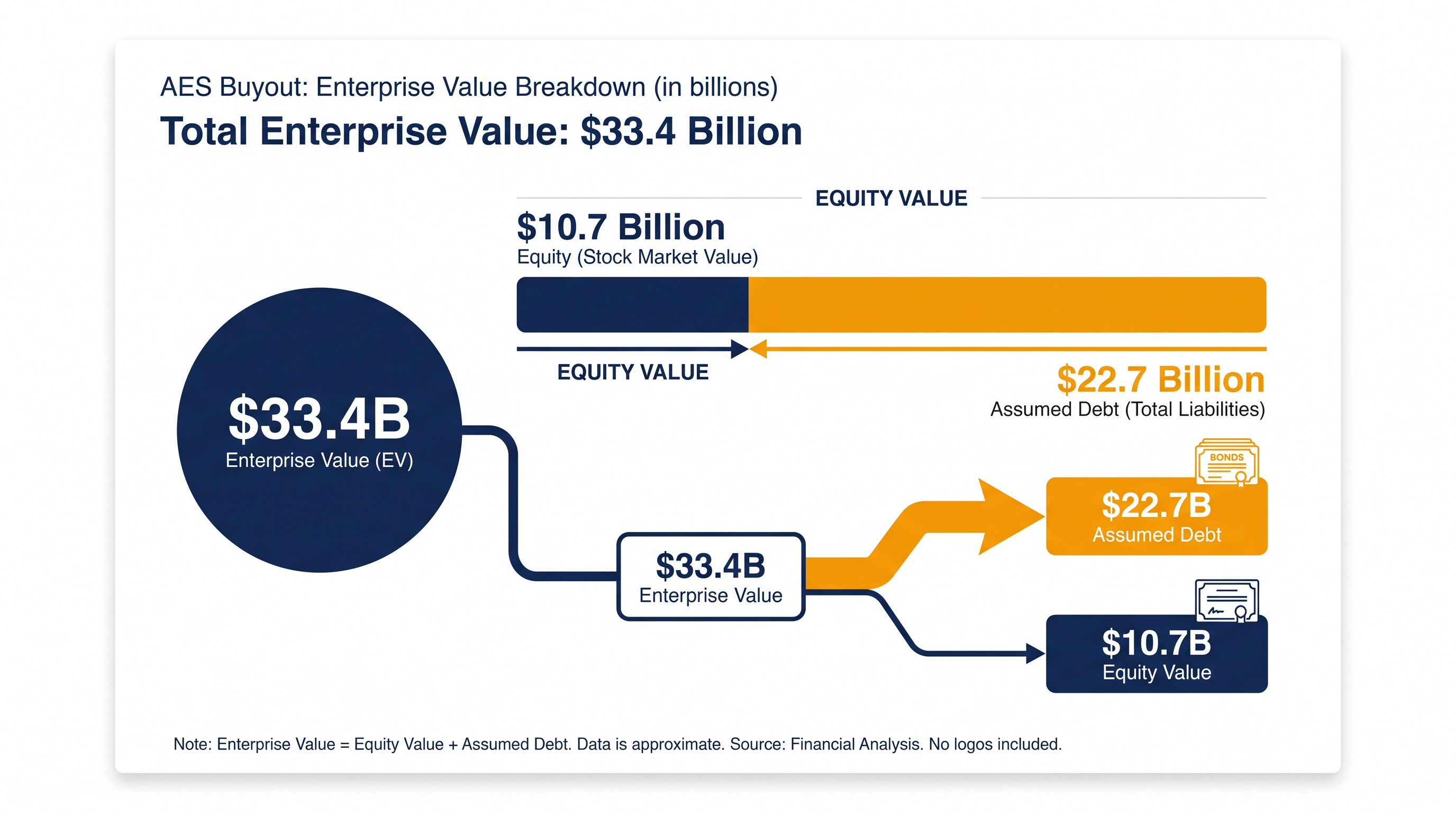
The transaction values AES's equity at $10.7 billion and assumes roughly $22.7 billion in net debt, effectively shifting the burden of financing the grid's expansion from retail investors to deep-pocketed institutional funds capable of absorbing decade-long investment horizons. [1, 4] Yet the privatization of a major utility holding company introduces significant regulatory and systemic risks that have alarmed consumer watchdogs. Advocacy groups, including Public Citizen and the Citizens Action Coalition of Indiana, quickly filed formal complaints with the Federal Energy Regulatory Commission (FERC) in an attempt to halt or modify the acquisition. [5][1][4][5]
These consumer advocates argue that allowing a financial behemoth like BlackRock to control a utility serving over a million franchised customers violates the public interest and exposes captive residential ratepayers to unchecked financial engineering. [5, 6] The advocates specifically highlighted the unprecedented concentration of control, noting that BlackRock affiliates would effectively manage 56.6% of AES post-transaction, while EQT would control 33.3%. [5] They contend that this level of consolidation by passive asset managers and private equity firms requires stringent mitigation to protect consumers from rate hikes driven by industrial data center load growth. [5][5][6]
Ultimately, the AES transaction is not an isolated event, but a bellwether for the broader energy sector's evolution. With Blackstone acquiring TXNM Energy for $11.5 billion and Constellation Energy purchasing Calpine, private capital is systematically absorbing the critical nodes of the U.S. power grid. [3, 7] As electricity consumption climbs to meet the demands of digitalization and electrification, the industry is being forced to choose between the transparency of public markets and the financial firepower of private equity. [7, 8] The shift from public to private ownership fundamentally alters how grid infrastructure is capitalized and regulated. [8][3][7][8]
Public utilities rely on rate cases approved by state commissions, balancing the cost of new transmission lines against the political reality of consumer utility bills. When a utility is publicly traded, any capital shortfall must be met by issuing bonds or selling new shares, both of which are heavily scrutinized by analysts focused on near-term yield. [8] Private infrastructure funds, by contrast, operate on an entirely different timeline. Vehicles like EQT's Infrastructure VI Fund and BlackRock's GIP are explicitly designed to deploy billions of dollars over decade-long horizons, matching the physical reality of permitting and building utility-scale generation. [2, 8][2][8]
By removing AES from the New York Stock Exchange, the consortium shields the company's capital-intensive transition from the volatility of quarterly earnings reports and the impatience of retail investors. [2] However, the core tension moving forward will be regulatory oversight. While private ownership solves the immediate funding gap for hyperscaler energy demands, state utility commissions in Indiana and Ohio will still have to approve the rate structures that ultimately pay for these investments. [2, 6] The AES buyout tests whether the U.S. regulatory framework can effectively manage a grid increasingly funded by sovereign wealth and global private equity. [5, 8][2][5][6][8]
Why it matters
The privatization of major utilities signals a fundamental shift in how the electrical grid is funded. As AI data centers demand unprecedented amounts of power, the infrastructure required is increasingly being financed by global private equity rather than public markets—a transition that could reshape consumer electricity rates and regulatory oversight for decades.
Competing readings
Option 1: The Private Capital Takeover Model
Delisting utilities to fund massive, long-term infrastructure buildouts away from quarterly earnings pressure.
**For:** Unlocks massive capital pools (like sovereign wealth and pension funds) without the penalty of public market dividend expectations. Allows for rapid deployment of capital into multi-year interconnection and generation projects required by hyperscalers. **Against:** Concentrates systemic grid control in the hands of passive asset managers and private funds, reducing transparency and potentially exposing captive ratepayers to the financial priorities of global investors. **Evidence:** AES explicitly stated that remaining public would require dividend cuts to fund its 11.8 GW data center pipeline, while the $33.4 billion private buyout provides immediate liquidity and a 40.3% premium for shareholders. **Fits well when:** A utility has massive, capital-intensive growth pipelines (like AI data centers) that exceed its current balance sheet capacity and require decade-long investment horizons. **Does not fit when:** The utility is purely a regulated residential provider where ratepayer protection, local control, and public transparency are the sole priorities.
Option 2: The Traditional Public Market Model
Utilities remaining publicly traded, relying on rate base growth, equity issuance, and dividends to attract investors.
**For:** High transparency, strict SEC reporting, and clear regulatory oversight. Retail investors benefit from steady dividend yields, and the public has direct visibility into the financial health and strategic direction of the utility. **Against:** Public markets punish capital-heavy growth that threatens near-term dividends. Stock prices suffer when companies issue new equity to fund long-term projects, creating a capital bottleneck for necessary grid expansion. **Evidence:** Prior to the buyout rumors, AES shares had declined 34% over a five-year period as public investors balked at the costs of its renewable transition, despite the company securing massive corporate clean energy contracts. **Fits well when:** The utility is operating in a stable, low-growth environment focused on maintaining existing infrastructure and paying steady, predictable dividends to retail investors. **Does not fit when:** The grid requires generational, multi-billion-dollar expansions to support sudden industrial or technological load growth, which public markets are unwilling to finance.
What’s still unclear
- Whether the Federal Energy Regulatory Commission (FERC) will require BlackRock to spin off its utility assets or impose strict mitigation measures before approving the deal.
- How state utility commissions in Indiana and Ohio will handle future rate cases if the private consortium attempts to pass data center infrastructure costs onto residential ratepayers.
- Whether the $33.4 billion valuation will set a new floor for future utility take-privates, accelerating the consolidation of the U.S. power grid.
Sources
Source coverage
9 outlets
3 viewpoints surfaced









[1]PE InsightsInfrastructure Investors
BlackRock's GIP and EQT agree $33.4bn take-private of AES in landmark infrastructure deal
Read on PE Insights →[2]EnergyTechInfrastructure Investors
BlackRock's GIP and EQT Buying Energy Utility AES for nearly $34B
Read on EnergyTech →[3]CIOInfrastructure Investors
Consortium Including CalPERS, EQT, BlackRock's GIP to Acquire Utility Company AES
Read on CIO →[4]ESG TodayInfrastructure Investors
BlackRock, EQT Lead $33 Billion Acquisition of AES
Read on ESG Today →[5]Citizens Action CoalitionConsumer Advocates
Public Citizen, Private Equity Stakeholder Project, and Citizens Action Coalition of Indiana argue that financial behemoth's attempt to acquire effort to buy utility AES violates Federal Power Act
Read on Citizens Action Coalition →[6]POLITICO ProConsumer Advocates
BlackRock-led investors eye $33B takeover of power company AES
Read on POLITICO Pro →[7]FinimizePublic Market Analysts
BlackRock And EQT Move To Buy AES In A $33 Billion Deal
Read on Finimize →[8]CTOL DigitalPublic Market Analysts
The $33 Billion Power Grab: Why AES's Take-Private Is the Sharpest Signal in Energy Markets
Read on CTOL Digital →[9]BarchartPublic Market Analysts
Utility AES Is Being Taken Private In $33 Billion Deal
Read on Barchart →
Comments

Every angle. Every day.
Get energy stories with full source coverage and perspective breakdowns delivered to your inbox.