
D.C. Circuit Limits Executive Privilege, Upholds Navarro Contempt Conviction
A federal appeals court has ruled that presidential advisers cannot unilaterally invoke executive privilege to defy congressional subpoenas, upholding the criminal contempt conviction of former Trump aide Peter Navarro.
By Anaya Sharma

For senior government officials and the lawmakers who oversee them, the legal shield surrounding the Oval Office has just been firmly contracted. The U.S. Court of Appeals for the District of Columbia Circuit has ruled that presidential advisers cannot unilaterally invoke executive privilege to defy a congressional subpoena, establishing a hard boundary on how the executive branch can resist legislative oversight.
The decision clarifies that the power to withhold information from Congress is not a blanket immunity that aides carry with them, but a specific presidential authority that must be explicitly exercised. This ruling fundamentally alters the calculus for future administrations, ensuring that executive branch staff cannot easily stonewall congressional investigations without direct and documented cover from the commander-in-chief.[2][4]
In a unanimous decision, a three-judge appellate panel upheld the criminal contempt of Congress convictions of Peter Navarro, a senior trade adviser during Donald Trump's first administration. The court found that Navarro failed to prove the former president had actually invoked executive privilege to block his testimony before the House select committee investigating the January 6 Capitol attack.
Navarro had been subpoenaed to provide documents and deposition testimony regarding his public claims of developing a strategy to delay the certification of the 2020 election results. When he categorically refused to comply, the House voted to hold him in contempt, leading to a grand jury indictment and his eventual conviction by a federal jury in Washington.[1]
The appellate opinion, authored by Judge Patricia Millett and joined by Judges Cornelia Pillard and J. Michelle Childs, systematically dismantled the defense's structural arguments. The panel ruled that executive privilege belongs exclusively to the president—whether current or former—or an official explicitly authorized by the president to claim it.
The court determined that the district court did not err in finding a complete lack of evidence that Trump had directed Navarro to defy the subpoena. The judges emphasized that the privilege is designed to protect the confidentiality of presidential communications and decision-making, not to serve as a personal shield for former aides seeking to avoid legislative scrutiny.[2][4]
Navarro, who recently completed a four-month federal prison sentence for the contempt charges, had argued that his good-faith belief that he was covered by executive privilege should have excused his noncompliance. The D.C. Circuit firmly rejected this defense, stating that a mistaken belief in the privilege's application does not negate the 'willfulness' required for a contempt of Congress conviction under federal law.
The court clarified that the statute requires only a deliberate and intentional default on the subpoena, not a correct legal understanding of its validity. This interpretation effectively removes the 'good faith' defense for future officials who choose to ignore congressional demands based on their own legal assumptions.[1][4]
The factual record highlighted by the court underscored the unilateral nature of Navarro's actions. The panel noted that Navarro asserted the privilege within three minutes of receiving an email notification about the committee's intent to subpoena him, before he had even reviewed the subpoena's specific demands.
He conceded during the legal proceedings that he did not communicate with Trump or anyone in the former president's inner circle during that brief window. The court pointed out that Navarro had previously been subjected to subpoenas where Trump or a designee had explicitly invoked the privilege, indicating he should have understood the proper procedural mechanics required to secure such protection.
Furthermore, the appellate panel emphasized that even a valid and documented invocation of executive privilege would not justify a blanket refusal to cooperate with a congressional committee. The court pointed out that the subpoena specifically sought information regarding Navarro's public statements, media interviews, and published writings about his election strategies.
Because Navarro had already discussed these matters publicly in his book and on television, the court reasoned that the information inherently fell outside the scope of confidential executive branch communications. A proper assertion of privilege, the judges noted, requires a witness to appear and assert the privilege on a question-by-question or document-by-document basis, rather than ignoring the subpoena entirely.[2][5]
Despite the appellate defeat, Navarro's legal team is not abandoning the fight and has signaled an intent to escalate the structural debate. His attorney, Abhishek Kambli, recently filed a petition for an en banc rehearing before the full D.C. Circuit, arguing that the three-judge panel relied on outdated precedent regarding the definition of 'willfully' in the federal contempt statute.
The defense contends that a 1961 D.C. Circuit decision adopted an overly broad standard that treats an intentional failure to appear as sufficient for conviction, a standard they argue is out of step with modern Supreme Court interpretations of criminal intent.[3]
The defense's broader argument centers on the assertion that the government should be required to prove a defendant acted with a 'bad motive' or knew their conduct was strictly unlawful. They argue this higher standard of proof is necessary to protect senior advisers of any political party who genuinely believe they are legally constrained from testifying due to separation-of-powers concerns.
Kambli has stated publicly that the case affects every presidential adviser who might find themselves caught between conflicting directives from the legislative and executive branches, framing the appeal as a necessary battle to correct decades of flawed jurisprudence.[3]
The ruling arrives at a moment of heightened structural tension between the branches of government regarding oversight and accountability. By requiring explicit presidential authorization for privilege claims and rejecting the good-faith defense, the D.C. Circuit has effectively lowered the barrier for Congress to compel testimony from recalcitrant officials.
The decision shifts the burden of proof squarely onto the executive branch, demanding documented evidence of a president's intent to shield information rather than allowing aides to operate on presumed authority. Legal analysts note that this precedent will make it significantly harder for future administrations to use executive privilege as a generalized delaying tactic.[2][4]
The trajectory of the case now depends on whether the full D.C. Circuit agrees to reconsider the panel's unanimous decision. If the appellate court declines the en banc petition, Navarro's only remaining recourse would be an appeal to the Supreme Court.
Such a move could prompt the high court to definitively settle the modern boundaries of executive privilege, the precise definition of willful contempt, and the balance of power between congressional oversight committees and the executive branch. Until then, the D.C. Circuit's ruling stands as a stark warning to political appointees about the personal legal risks of defying congressional subpoenas.[1][3]
Key points
- A D.C. Circuit panel unanimously upheld the criminal contempt of Congress convictions of former White House adviser Peter Navarro.
- The court ruled that executive privilege belongs exclusively to the president and cannot be unilaterally asserted by an aide.
- Judges determined Navarro failed to prove former President Trump had explicitly invoked the privilege to block his testimony.
- The panel clarified that a mistaken, good-faith belief in executive privilege is not a valid defense against contempt charges.
How we got here
Feb 2022
The House Jan. 6 committee subpoenas Peter Navarro for documents and testimony.
Sep 2023
A federal jury in Washington convicts Navarro on two counts of contempt of Congress.
Mar 2024
Navarro reports to federal prison in Miami to begin a four-month sentence.
Jul 2026
A three-judge panel of the D.C. Circuit Court of Appeals unanimously upholds his conviction.
Aug 2026
Navarro's legal team files a petition for an en banc rehearing before the full D.C. Circuit.
- Judicial Institutionalists
- Focus on the strict procedural requirements of executive privilege and the necessity of compliance with lawful subpoenas.
- Legislative Oversight Defenders
- Emphasize Congress's constitutional right to investigate the executive branch and demand accountability from officials.
- Executive Branch Advocates
- Argue for broad protections for presidential advisers to ensure candid internal deliberations without fear of prosecution.
Perspectives this story doesn't cover
- Future presidential administrations
- Constitutional law scholars specializing in separation of powers
Sources
Source coverage
6 outlets
3 viewpoints surfaced






- [1]AP NewsLegislative Oversight Defenders
Appeals court upholds White House adviser Peter Navarro's contempt of Congress convictions
Read on AP News → - [2]The Washington PostLegislative Oversight Defenders
Appeals court upholds Peter Navarro's contempt of Congress convictions
Read on The Washington Post → - [3]Washington ExaminerExecutive Branch Advocates
Appeals court upholds Peter Navarro contempt conviction over Jan. 6 subpoena
Read on Washington Examiner → - [4]Just SecurityJudicial Institutionalists
D.C. Circuit Reaffirms Limits on Executive Privilege in Navarro Contempt Case
Read on Just Security → - [5]NOTUSLegislative Oversight Defenders
D.C. Circuit Upholds Peter Navarro's Contempt Conviction
Read on NOTUS → - [6]JustiaJudicial Institutionalists
USA v. Navarro, No. 24-3006 (D.C. Cir. 2026)
Read on Justia →

More in Law & Justice
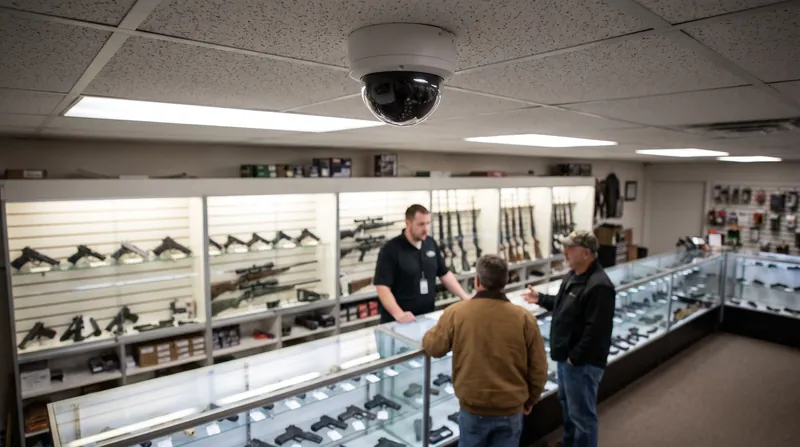
See all →Retail Surveillance
Ninth Circuit Upholds California Law Requiring 24/7 Audio and Video Surveillance at Gun Stores
5 sources
False Claims Act
Eleventh Circuit Rejects Appointments Clause Challenge to False Claims Act Whistleblower Provision
7 sources
Public Records
Appeals Court Rules Fourth Amendment Cannot Block Public Access to Police Investigation Records
3 sources
Drug Pricing
Fifth Circuit Upholds Medicare Drug Price Negotiation Program Against PhRMA Challenge
4 sources
Comments
Every angle. Every day.
Get Law & Justice stories with full source coverage and perspective breakdowns, free every day.